




Abstract
Previous studies have shown that oral whole honey reduces weight gain in rats on a normal diet (ND) or high-fat diet (HFD) and suppresses inflammation by modulating immunological cytokines in human neutrophils and macrophages. We hypothesize that the honey proteins (HP) are responsible for the reduced weight gain in rats on ND and HFD and that HP would alleviate obesity parameters. To test this, proteins were isolated from acacia honey through the salting-out method. Wistar rats (N = 24) were randomized to get ND or HFD for 4 weeks, then further randomized to four groups and treated with HP or saline for another 4 weeks. Energy intake (EI), body weight gain, EI per gram body weight gain, serum glucose, and lipids were measured. Expression of adipose tissue genes fatty acid binding protein (FABP), lipase C (LIPC), and apolipoprotein A-1 (APOA1) was evaluated through the quantitative polymerase chain reaction. HFD increased the body weight versus ND in weeks 1–4. HP for the next 4 weeks reduced weight gain in ND-HP and HFD-HP groups versus saline controls (P < .01). EI was not significantly different among groups. However, EI per gram body weight gain among groups was markedly different (P < .01), demonstrating reduced weight gain efficiency by HP (P < .01). HP reduced glucose in ND but not in HFD groups. Triglycerides were lower in both HP groups. The expressions of FABP, LIPC, and APOA1 genes were significantly increased (P < .05) in HP-treated HFD rats. Collectively, weight gain efficiency was remarkably reduced without altering EI in rats following the HP treatment, suggesting HP increased metabolic rate or substrate partitioning. Studies of HP are suggested in humans.
INTRODUCTION
There is a global epidemic of obesity. 1 The high worldwide incidence of overweight (body mass index [BMI] >25 kg/m2 and <30 kg/m2) and obesity (BMI >30 kg/m2) is accompanied by many severe comorbidities and complications, making it a complex metabolic syndrome. 2 The World Health Organization reported that about 1.9 billion adults aged 18 and above are overweight, and over 650 million are obese, which is 39% and 13%, respectively, of the world’s adult population. The global prevalence of obesity has tripled from 1975 to 2016. 3
Management of obesity in the past involved starting with low-risk treatments and progressing to more invasive treatments. 4 Low-risk treatments such as exercise, dietary changes, and lifestyle interventions have proven ineffective in the long term in the majority of patients. 5 In a study of the effectiveness of weight loss by primary care physicians, the most intensive lifestyle regimen showed that less than 35% of subjects lost more than 5% of initial body weight and much of this effect was gone after 24 months. 5 Recent advances in drug treatment of obesity are more promising and provide two- to threefold greater weight loss than diet and exercise. 6 Bariatric surgery is reserved for the severely obese and produces weight losses of 25 − 30%, although it is associated with significant side effects and a small risk of death. 7
Since treatment of established obesity is difficult, many clinicians believe that preventing weight gain would be very valuable and might reduce the prevalence of established obesity. Although there are many examples, two important groups for which prevention or reduction of weight gain would be particularly valuable are children and patients who have had bariatric surgery for obesity and are now starting to regain some of the lost weight. Obesity drugs have been poorly investigated in children and are used with great caution. Obesity drugs after bariatric surgery to reduce weight regain are used, but the high costs of the newer drugs are barriers for widespread use. Less expensive methods to prevent weight gain in these situations would significantly advance obesity medicine.
There has been very modest attention paid to the role of natural products in the treatment of obesity. We previously reported that intake of natural honey alters several gene products and increases locomotor activity, resulting in weight loss in rats. 8 Earlier, honey glycoproteins and glycopeptides were shown to possess immunomodulatory activities in vitro, and to suppress reactive oxygen species production in zymogen-activated macrophages, suggesting their tissue-protective role. 9,10 In this study, we investigated honey proteins (HP) as a potential treatment for obesity and its complications in rats. The effect of HP in reducing body weight gain and modulating different metabolic, inflammatory, and oxidative stress parameters in animal models (in vivo) has not been investigated.
The hypothesis for this article was that HP are the active ingredients in whole honey responsible for reducing weight gain in rats on a high-fat diet (HFD). Whole honey had been given orally in a prior study, 8 but because proteins might be destroyed in the gut, in this initial experiment, injections of HP were used to insure they entered the body. If weight gain was reduced by the proteins alone, it would be a proof of principle. This article describes the physiological effects of HP on weight gain in rats on a HFD.
METHODS
Isolation of proteins from natural honey
Acacia honey was purchased from a local market in Karachi, Pakistan, to isolate HP. The proteins were isolated according to the protocol described in previous studies by us and colleagues. 9,10 Briefly, 50 g honey was dissolved in 100 mL Tris buffer (20 mM Tris-HCl, 150 mM NaCl, and 0.05% sodium azide, pH 7.4). The particulates, particularly pollens, were removed by centrifugation of the solution at 8300 × g for 10 min at 4°C. The supernatant was collected and filtered with a 0.45 μm sterile filter (GE Healthcare Lifesciences, USA). Ammonium sulfate was added into the filtrate to 80% saturation at 4°C. The solution was kept on stirrer for 1–2 h until the ammonium sulfate dissolved completely, followed by an overnight incubation at 4°C so that the proteins could precipitate to a maximum extent. Then, the solution was centrifuged at 8300 ×g for 10 min at 4°C, and the pellet was dissolved in phosphate-buffered saline (pH 7.4) and filtered by using an Amicon ultrafiltration device (Merck Millipore, Germany) to remove excess salts and other molecules including peptides (up to 5 kDa) and stored at −20°C. The Bradford method was used to measure protein concentration.
Rat models of obesity and HP intervention
Twenty-four male albino Wistar rats (weight ∼120–140 g, age 5–6 weeks) were obtained from the institutional animal facility (Dr. Panjwani Center for Molecular Medicine and Drug Research, ICCBS,
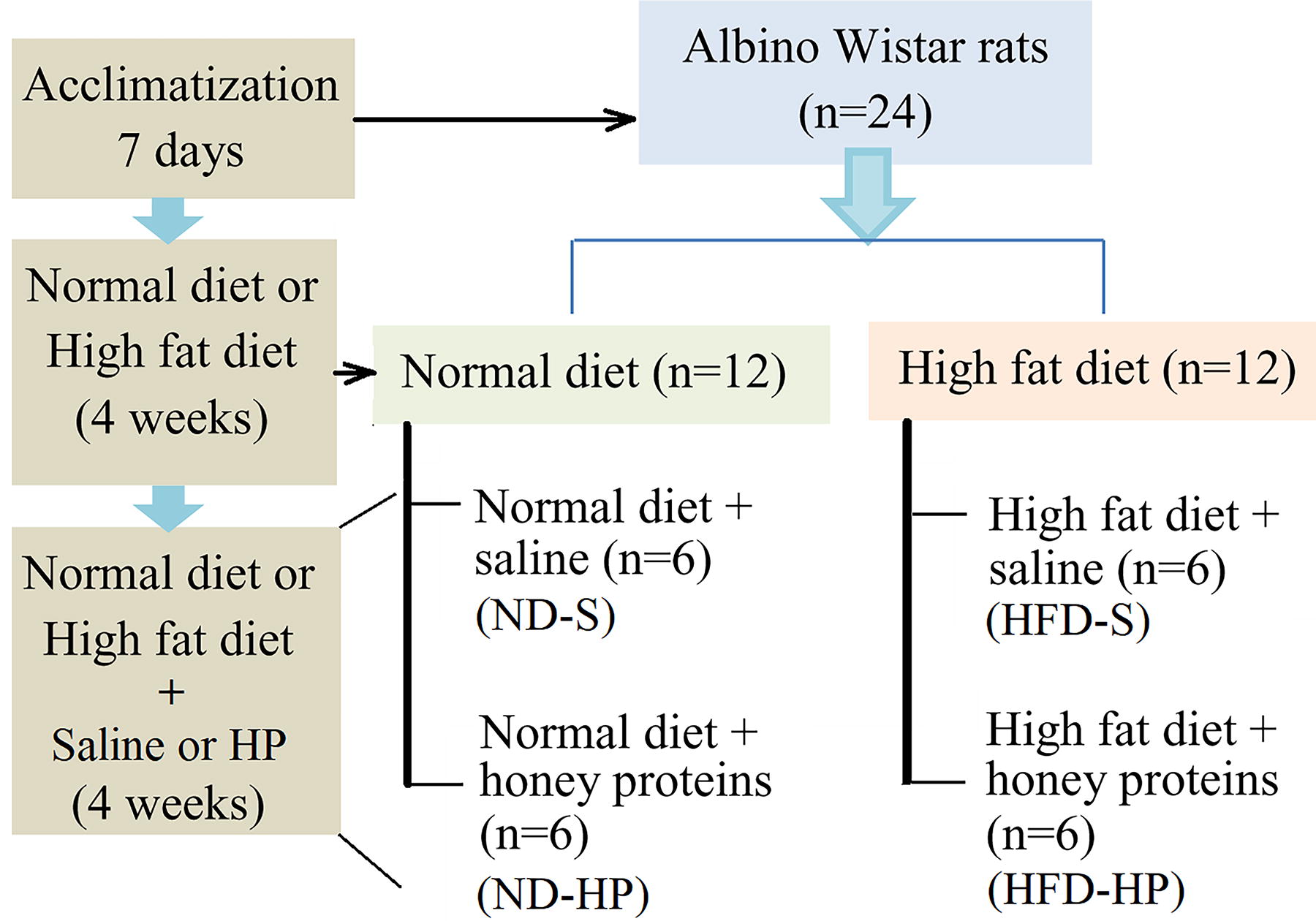
Design of the study. Twenty-four Wistar rats were acclimatized for seven days, then randomly divided into two groups (12 rats each). One group was on normal diet (ND) and the other group was on high-fat diet (HFD) for 4 weeks. Then, for the next 4 weeks, each of ND and HFD groups was further divided into two subgroups, each containing six animals. In the ND group, six animals were on ND and saline (ND-S), whereas the other six animals were on ND and the honey proteins (ND-HP). Likewise, in the HFD group, six animals were on HFD and saline (HFD-S), and the other six animals were on HFD and the honey proteins (HFD-HP).
Estimation of blood glucose and lipids
For biochemical analyses, blood samples were collected in plain tubes after sacrifice of the rats. The blood samples were allowed to coagulate at room temperature followed by centrifugation at 1640 × g for 15 min for separation of serum. The clear supernatant was separated and stored at −20°C until biochemical analyses, as described in our previous study. 8 The concentrations of glucose, total cholesterol, and triacylglycerol in the serum were determined by calorimetric method using commercially available kits (Spinreact, Girona, Spain). The methods for estimating these metabolites are detailed in Supplementary Data S1.
Gene expression analysis of adipose proteins
The expression of three genes of adipose tissue, fatty acid binding protein (FABP), lipase C (LIPC), and apolipoprotein A-1 (APOA1), along with a house-keeping gene glyceraldehyde-3-phosphate dehydrogenase (GAPDH), was determined with real-time quantitative polymerase chain reaction (qPCR). For this, the gene-specific primers were designed using the Primers3 online tool (Supplementary Table S2, Supplementary Data S1).
The total RNA from the visceral adipose tissue was isolated by following a method described previously by us. 8 Briefly, 0.1 g adipose tissue was homogenized in 1 mL of the TRIzol reagent (Thermo Fisher Scientific, USA) according to the manufacturer’s instructions. The total RNA was precipitated using isopropanol (Sigma-Aldrich, St. Louis, MO, USA) and washed with 70% ethanol (SERVA, Heidelberg, Germany). To assess the quality of the isolated RNA, 1% agarose gel electrophoresis was performed. A nanodrop (Thermo Fisher Scientific, USA) was used to determine the purity (A260/A280 ratio). For quantification of the total RNA, the Qubit High Sensitivity RNA kit (Thermo Fisher Scientific, USA) was used.
The complementary DNA (cDNA) was synthesized from 1 µg of the isolated total RNA with random hexamer primers using the RevertAid first strand cDNA synthesis kit (Thermo Fisher Scientific, USA) by following the manufacturer’s instructions. Expression of the genes was determined with real-time qPCR. The gene-specific primers (Supplementary Table S2) were used with Maxima SYBR Green/ROX qPCR Master Mix (Thermo Scientific, USA) on a QuantStudio 5 system (Thermo Fisher Scientific, USA), following the manufacturer’s protocol. Each reaction was performed in triplicate to achieve sufficient statistical power. The data were analyzed using the ΔΔCt method.
Statistical analyses
Food intakes were recorded daily, whereas body weights were recorded weekly. Energy intakes (EI) were calculated from the consumed diet and using the values of dietary calories provided by Research Diets Inc. The data were analyzed by two- or three-way analysis of variance, where applicable, followed by post-hoc Tukey’s significant difference test. The outliers (two values) were normalized using the winsorization method in which the outliers were replaced with the average values of the respective variables, as described previously. 12 Details of the statistical analyses are reported in Supplementary Data S1.
RESULTS
Isolation of proteins from the natural honey
A small fraction of proteins, in addition to the minerals and phenolic compounds, exist in natural honey. In the present study, the HP were isolated using the ammonium sulfate salting-out method. The Bradford method and sodium dodecyl sulfate-polyacrylamide gel electrophoresis (SDS-PAGE) were used to assess the quantity and quality of the isolated proteins. On the SDS-PAGE, prominent bands of the proteins were visible (Supplementary Fig. S1, Supplementary Data S1). After quantification of the proteins, the concentration of the proteins was adjusted to 0.5 mg/mL.
Effect of HFD and HP on body weight, caloric intake, and weight gain efficiency
The initial 4 weeks of feeding with ND versus HFD showed a significant difference in body weight (Fig. 2A) despite no difference in EI (Fig. 2C). On D1 of the experiment, the average body weight of the ND rats was 124.4 (±5.9) g and of the HFD rats was 127.4 (±6.5) g. After 4 weeks, average body weights had increased to 214.8 (±30.0) g in ND rats and to 259.5 (±22.5) g in HFD rats (P < .01). See the Supplementary Information for a detailed description of the statistical analyses in this section.
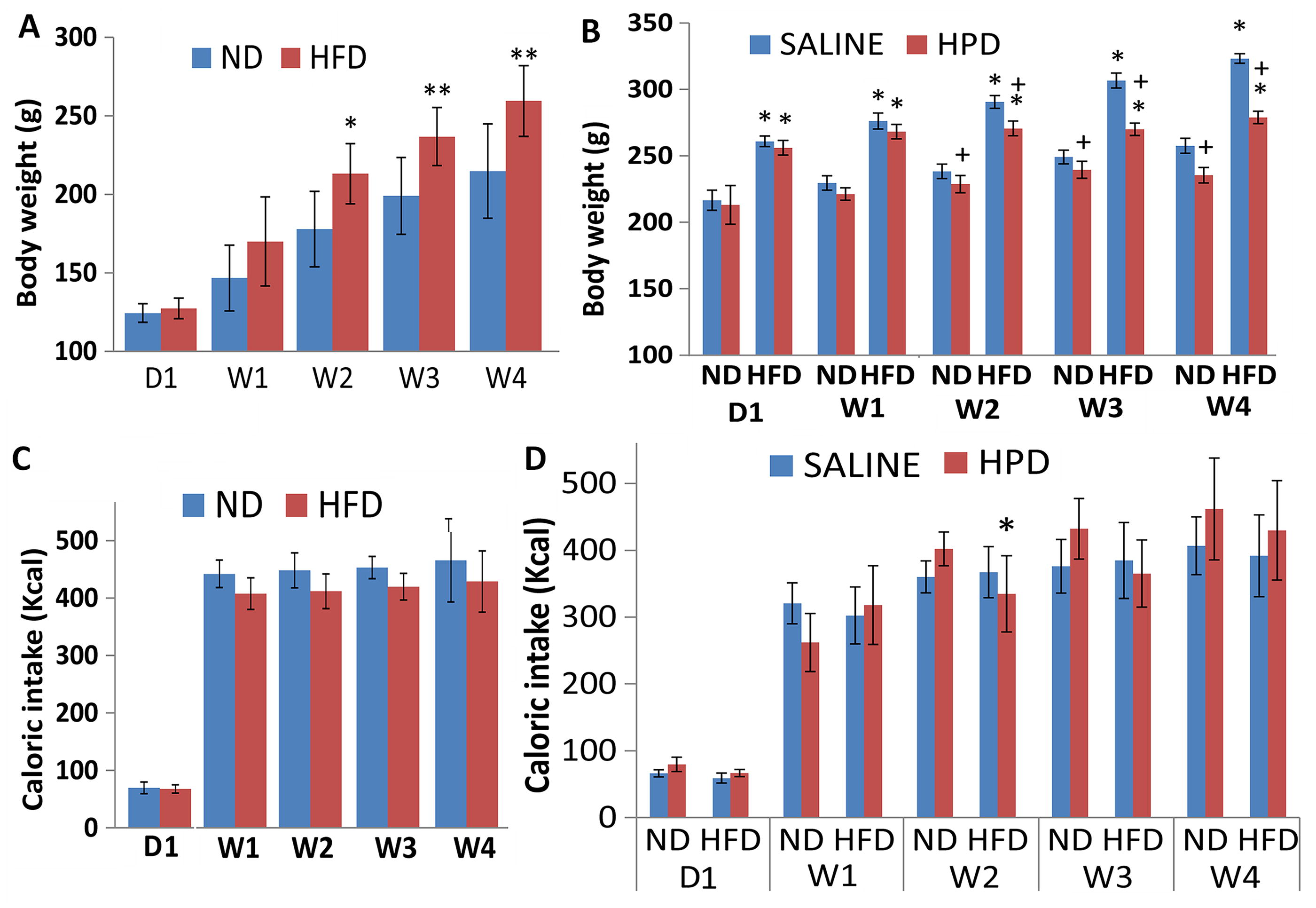
Effect of ND, HFD, and treatment with honey proteins and saline on caloric intake and body weight in the rats.
During the second 4 weeks of the trial, the rats received ND or HFD and daily injections of saline or HP (0.5 mg/kg body weight). All groups gained weight, but rats on HP gained significantly less weight than their saline control groups (Fig. 2B). The respective weight gains were: ND-S 41.0 ± 7.3 g, HFD-S 60.4 ± 5.8 g, ND-HP 26.9 ± 4.6 g, and HFD-HP 19.9 ± 4.9 g (Table 1). Rats on ND-S gained 52% more weight than ND-HP (P < .01) and rats on HFD-S gained over threefold more weight than HFD-HP (P < .01) (Table 1).
Final Body Weight, Body Weight Change, Cumulative Energy Intake, and Energy per Gram Body Weight Gain in Rats after 4 Weeks of Honey Protein Treatment
P < .01 from ND-HP with respect to ND-S and HFD-HP with respect to HFD-S.
P < .01 from ND-S with respect to HFD-S and HFD-HP with respect to ND-HP.
P < .01 from HFD-HP with respect to ND-s and ND-HP with respect to HFD-S.
BW, body weight; BWG, body weight gain; EI, energy intake; HFD, high-fat diet; HP, honey protein; ND, normal diet; S, saline.
EI showed that the HP groups ate slightly more than their respective saline groups (P = not significant). The 4-week mean cumulative EI of the saline groups were: ND-S group 1464 kcal and HFD-S group 1446 kcal, and that of the HP groups were: ND-HP group 1558 kcal and HFD-HP group 1481 kcal (Fig. 2D, Table 1).
Since cumulative EI of the HP groups were higher, yet the weight gains of the HP rats were sharply lower, increased energy expenditure had to account for the differences in weight gain. When the EI required for 1 g of weight gain is examined, the differences on HP are highly significantly different (Table 1). ND-S required 36.6 ± 6.0 kcal/g weight gain, HFD-S required 24.2 ± 3.7 kcal, ND-HP required 59.3 ± 10.1 kcal, and HFD-HP required 79.2 ± 22.6 kcal (P < .01). Rats on ND and HP required 62% more kcal per gram of weight gain and rats on HFD-HP required more than threefold more kcal per gram weight gain (both P < .01).
Effect of HFD and HP on serum glucose, cholesterol, and triglyceride
Serum glucose differed between HP and control in rats on ND (98.0 ± 8.2 vs. 121.1 ± 18.4 mg/dL, respectively, P < .05) but not in rats on the HFD (104.5 ± 12.8 vs. 113.9 ± 14.2 mg/dL, respectively, P = not significant) (Fig. 3, Table 2). Serum triglyceride was significantly different in HP versus control in rats on both diets: ND-S 129.3 ± 15.0 mg/dL versus ND-HP 103.7 ± 4.8 mg/dL, P < .05; and HFD-S 189.8 ± 16.1 mg/dL versus HFD-HP 98.3 ± 14.1 mg/dL, P < 0.05. Total cholesterol differed significantly between the rats on ND and HFD (146.0 ± 16.5 vs. 231.3 ± 28.6 mg/dL, respectively, P < .05), but HP had no beneficial effects on cholesterol (Table 2).
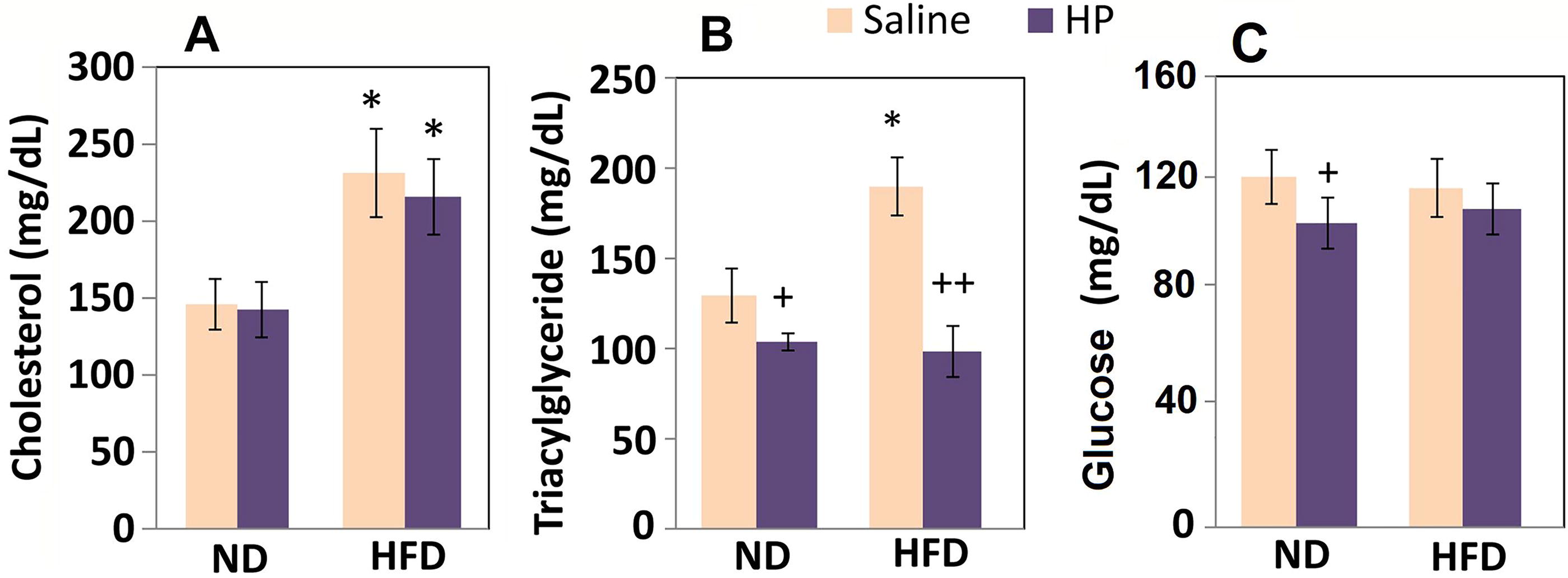
Effect of ND, HFD, and honey proteins on serum total cholesterol
Concentrations of Serum Glucose, Triglyceride, and Cholesterol in the Rats after 4 Weeks of Honey Protein Treatment
P < 0.01 from ND-S with respect to ND-HP and HFD-S with respect to HFD-HP.
P < 0.01 from ND-S with respect to HFD-S and HFD-HP with respect to ND-HP.
P < 0.01 from HFD-HP with respect to ND-S and ND-HP with respect to HFD-S.
Expression of the adipose genes
The expression of visceral adipose genes FABP, LIPC, and APOA1 in ND-S, ND-HP, HFD-S, and HFD-HP rats are shown in Figure 4. The relative expressions of these genes were determined after normalizing the expression values with that of the house-keeping gene, GAPDH. This analysis showed that the expression of FABP was significantly increased (P < .01) in the ND as well as HFD rats following the HP treatment (Fig. 4A). Likewise, the HP treatments led to significant overexpression (P < .01) of visceral adipose LIPC in the ND as well as the HFD-treated rats (Fig. 4B). Moreover, the HFD led to decreased expression of LIPC, but the expression was restored and significantly increased after the HP treatment. The changes in gene expression of APOA1 showed that there was a significant increase (P < .01) in its expression in both the ND and HFD rats after the administration of HP (Fig. 4C).
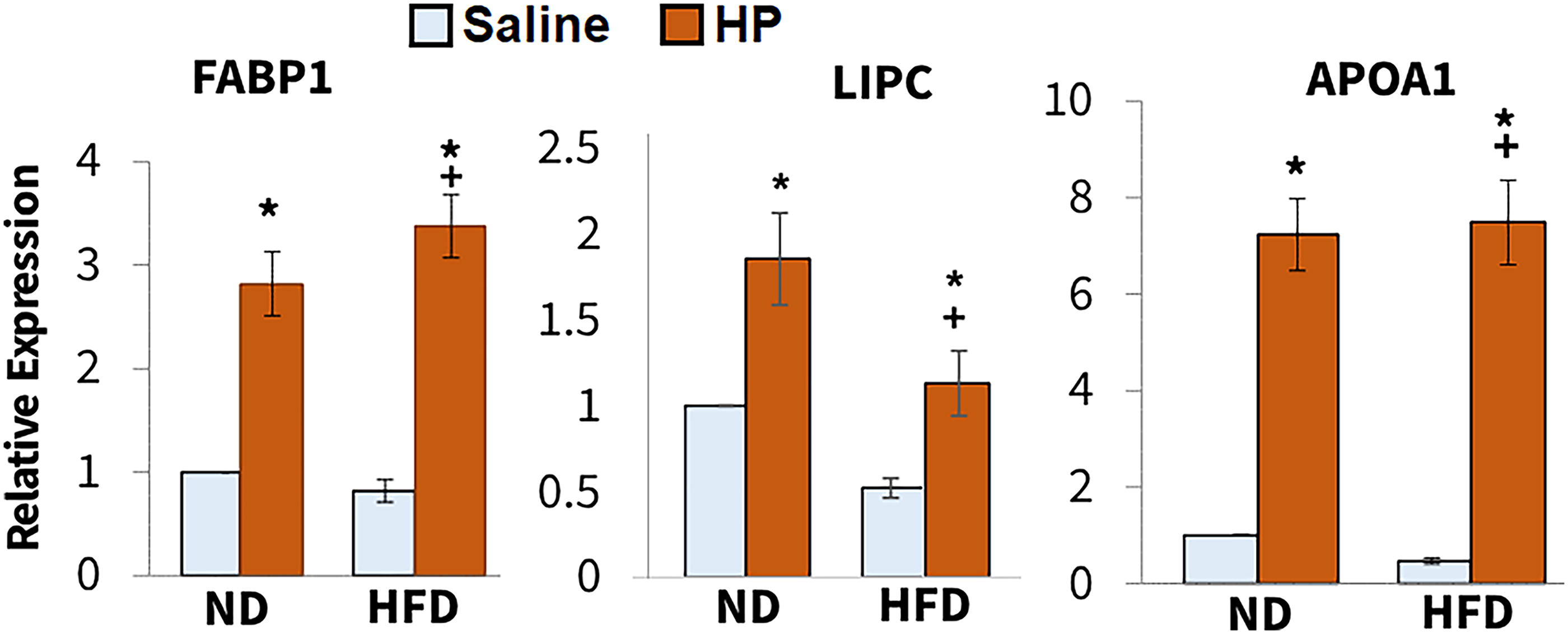
Relative expression of FABP1, LIPC, and APOA1 genes in the visceral adipose tissue of rats, normalized with glyceraldehyde-3-phosphate dehydrogenase (GAPDH). Significant differences by Tukey’s post-hoc test: *P < .05 indicates comparison of HFD rats with respective ND rats following two-way ANOVA; + P < .05 indicates comparison of HP-treated rats with saline-treated rats following two-way ANOVA. ND, normal diet; HFD, high-fat diet; HP, honey proteins; FABP1, fatty acid binding protein 1; LIPC, lipase C; APOA1, apolipoprotein A-1.
DISCUSSION
Previous studies investigating the impact of oral natural honey on body weight gain and lipid profiles in rats on HFDs showed decreased weight gain and improvements in blood lipids. 13,14 The current study was designed to identify the whole honey component(s) responsible for the effects. This is the first study to evaluate the effects of natural HP on changes in body weight, glucose, and circulating lipids (triglyceride and total cholesterol).
There are numerous intriguing findings in this study. First, rats given HP, whether on ND or HFD, had much lower weight gains. As expected in the initial 4 weeks of ND versus HFD, weight gain was much greater in the HFD group (59 g more). A similar trend continued in the second 4 weeks, rats on HFD-S gained 47% more weight than ND-S. In contrast, in the 4 weeks of HP treatment, weight gain was much less in both ND and HFD as compared with the saline controls. Rats on ND-S gained 52% more weight than rats on ND-HP. Rats on HFD-S gained >3 times as much weight as rats on HFD-HP.
Differences in food intake cannot explain the differences in weight in this study. The 4-week mean cumulative EI of the ND-S group was 1464 kcal and 1446 kcal for HFD-S, and that of the HP group was 1558 kcal for ND-HP and 1481 kcal for HFD-HP, so HP rats on both diets ate more. Thus, the lower weight gain on HP was not due to failure to eat, suggesting that the HP did not have adverse effects or make the rats sick. In the initial 4 weeks of the experiment, when rats were given either an ND or HFD, the EI of the HFD group was slightly less, but weight gain was more, suggesting the HFD produced a reduced metabolic rate. During the next 4 weeks of HP versus saline treatment, the weight gain was less in both the ND and HFD groups treated with HP, whereas the food intake was similar or slightly greater. This suggests that the HP may have altered metabolic rate toward higher energy expenditure. This is also supported by the increased expression of FABP, LIPC, and APOA1 genes in the adipose tissue following the HP intervention. The adipocyte FABP is involved in lipolysis and modulates adipogenesis. Previously, knockdown of adipocyte FABP using the RNA interference technique enhanced HFD-induced body weight gain in mice. 15 Likewise, the inactive LIPC due to genetic mutations leads to enhanced visceral adiposity. 16 The APOA1 has also been demonstrated to be strongly correlated with the prevalence and pathological development of obesity. Previously, it was shown that APOA1 significantly lowered the quantity of intracellular lipid droplets and inhibited adipogenesis progression of human adipose-derived mesenchymal stem cells. 17
We considered other reasons why rats on HP would gain less weight or have a higher metabolic rate. The metabolic rate could be higher if the rats were infected or had peritoneal inflammation from the injections. The peritoneum at sacrifice was not specifically examined, but we did remove visceral adipose tissue after sacrifice and no gross inflammation sufficient to increase metabolic rate was noted.
One possible explanation for the markedly different energy expenditure in the HP rats (62% in rats on saline-HP and by more than threefold in rats on HFD-HP) is increased locomotor activity. In our previous study, 7 oral feeding of whole honey produced an increased locomotor activity versus control, but increased locomotor activity could not have explained the entire difference in weight gain on HP in this study and whole body metabolic activity must have been increased.
In this pilot experiment, HP were injected to ensure constant and accurate doses were given to each rat based on body weight and to ensure that the HP was introduced into the body. However, our previous experiment showed that oral administration of whole honey reduced weight gain, presumably due to the presence of the HP. This raises the possibility that treatment of obesity and/or weight gain with HP would not require injections, but oral administration may be effective. Injections would require the full approval of a new drug by the U.S. Food and Drug Administration (FDA). Since HP are derived from a natural product, they could be sold without a prescription if taken orally and would be much less expensive and easier to obtain. Further studies in rats are needed to confirm if orally administered HP are effective, and clinical studies in humans are feasible and needed. Should HP prove to be effective for weight gain and/or obesity in humans, this would be a major advance given the innocuous nature of the proteins.
The FDA has set a criterion of fulfilling at least one of the two conditions for considering a therapeutic entity as a potential antiobesity or weight loss agent. The two conditions are “mean” efficacy criterion and “categorical” efficacy criterion, which state that the difference in mean weight loss should be ≥5% and statistically significant between the weight management product and the placebo-treated groups, and the proportion of subjects losing that amount of body weight in the active product group should be ≥35% and the difference between groups should be statistically significant, respectively. 18 In the present study, at the end of 4 weeks of treatment in rats on an HFD, the average body weight of saline-treated rats was 323.2 g, whereas the average weight of the rats treated with HP was 278.9 g, a difference in weight of 44.3 g (13.7% of the weight of the saline group). Rats on ND were 257.6 g for saline treated and 235.4 g for HP treated, a difference of 22.2 g (9% of the saline group). Since the rats were still growing, this did not represent weight loss but a reduction in weight gain. Clinical studies with HP would be interesting in situations where weight gain might be expected, such as treatment with certain weight gain-producing drugs, in the longer postsurgical period after bariatric surgery, or in overweight children. Human studies will also be necessary to determine if HP cause weight loss in people who are already obese or if the benefit is confined to preventing weight gain. Furthermore, the ages of rats were 5–6 weeks at the start of this experiment, which continued until age 13–14 weeks, encompassing their peripubertal and adolescence phases of life. These ages of rats correspond to 11–19 years age in humans. 19 These life phases of rats have been reported to be suitable for diet-induced obesity and metabolic syndrome research. 20 In addition, here, 0.5 mg HP were dissolved in 1 mL saline to formulate a dose of 0.5 mg/mL/kg body weight, which is equivalent to 1 g whole honey/kg body weight of rats. This dose would correspond to 70 g honey or 35 mg HP to achieve the 0.5 mg/kg HP dose in humans (average body weight: 70 kg).
Several epidemiological studies have demonstrated obesity-induced hyperlipidemia as a risk factor for early diabetic neuropathy and cardiovascular disorders such as coronary heart disease and stroke. 21,22 In addition to the existing approved triglyceride-lowering agents such as fibrates, fish oils, and nicotinic acid, there are several clinical trials listed in the National Institutes of Health Clinical Trial database (https://clinicaltrials.gov/ct2/home) that are in phase 4, yet most of these involve the intervention of derivatives of fibrates or polyunsaturated fatty acids. This study suggests that HP may be novel agents for preventing and perhaps managing dyslipidemia.
This study raises intriguing questions about the nature of HP. The proteins extracted from raw honey are a mixture, so additional studies will be necessary to identify the specific active proteins. In our previous study 8 and in studies by other groups, 16,17 matrix-assisted laser desorption ionization-time of flight mass spectrometry identified that natural honey contains different major royal jelly proteins (MRJPs) such as MRJP-1, MRJP-2, MRJP-5, and MRJP-7. We postulate that it is one or more of these MRJPs that are exerting beneficial effects on body weight gain, glucose, and lipids in rats on ND or HFD.
Herein, data on different obesity parameters such as body weight, body weight gain efficiency, EI, and the obesity surrogate measurements including serum glucose and lipids profile were investigated. Adding data on visceral adipose tissue weight and/or morphological parameters to the current investigation could have increased its scope. This is the limiting factor of this study. Nevertheless, the data suggest that HP consumption is safe and unlikely to cause adverse effects due to their natural and food source origin. Therefore, clinical trials in adults, and perhaps in children, will be of great interest.
Additional information is present in the online Supplementary Data S1.
Footnotes
ACKNOWLEDGMENTS
The authors express their appreciation to the Deanship of Scientific Research at King Khalid University, Saudi Arabia, for a support to this work through a research group program under grant number RGP 2/623/45.
AUTHORS’ CONTRIBUTIONS
A.G. was involved in animals handling, lab experimentation, data analysis, and article write-up; R.L.A. performed data analysis, modified the article for intellectual insights, and provided important feedback for improvement; D.J.H. supervised and provided facility for the animals’ study; K.F.F. data analysis; M.S. was the principal investigator and was involved in the article write-up.
DATA AVAILABILITY STATEMENT
All the relevant data have been presented in the main text and Supplementary Information.
AUTHOR DISCLOSURE STATEMENT
No interests to disclose.
FUNDING INFORMATION
The work was conducted by the institutional (Dr. Panjwani Center for Molecular Medicine and Drug Research) indigenous research grant to M.S. (2802–2019) and D.J.H.
SUPPLEMENTARY MATERIAL
Supplementary Data S1
Supplementary Figure S1
Supplementary Table S1
Supplementary Table S2
References
Supplementary Material
Please find the following supplemental material available below.
For Open Access articles published under a Creative Commons License, all supplemental material carries the same license as the article it is associated with.
For non-Open Access articles published, all supplemental material carries a non-exclusive license, and permission requests for re-use of supplemental material or any part of supplemental material shall be sent directly to the copyright owner as specified in the copyright notice associated with the article.
