




Abstract
Many herbs have been shown to safely and successfully treat hyperlipidemia. However, the molecular mechanisms underlying their treatment remain unclear. In this study, 103 prescriptions for the treatment of hyperlipidemia containing 146 herbs were screened. Cluster analyses identified a core prescription comprising five herbs, namely, Crataegus pinnatifida (Shan Zha), Cassiae semen (Jue Ming Zi), Alisma orientale (Sam.) Juz. (Ze Xie), Salvia miltiorrhiza (Dan Shen), and Radix Polygoni Multiflori (He Shou Wu), in combination for the treatment of hyperlipidemia. Next, 9, 62, 5, 132, and 34 potential targets for each of the core herbs and a total of 512 hyperlipidemia-related protein targets were detected. Finally, 40 targets shared by core herbs and hyperlipidemia were identified. IL6, AKT1, IL1B, PTGS2, VEGFA, PPARG, and NOS3 were the seven proteins that were found to be most important in the treatment of hyperlipidemia. Interestingly, the Kyoto Encyclopedia of Genes and Genomes pathway indicated that these targets were mainly enriched in the lipid and atherosclerosis pathway and the cancer pathway. In addition, core target proteins such as AKT1, PTGS2, and PPARG have been demonstrated to play critical roles in hyperlipidemia and pancreatic cancer. Significant affinity between bioactive chemicals and proteins involved in cancer pathways was found by molecular docking. Molecular docking results showed that AKT1, PTGS2, and PPARG exhibited good binding ability with three bioactive chemicals, including 3-beta-hydroxymethyllenetanshiquinone, danshexinkum d, and physciondiglucoside. The treatment of hyperlipidemia by herbs may be mediated through the modulation of proteins associated with the cancer pathway. This study helps to provide a theoretical basis for future combined therapy for hyperlipidemia and cancer.

INTRODUCTION
Cardiovascular diseases account for 30% of the global death toll and are the foremost cause of death in the world. 1 Hyperlipidemia is the main proven risk factor of cardiovascular disease. Over recent decades, the proportion of overweight and obese individuals has increased steadily, with hyperlipidemia now posing serious public health challenges. 2,3
Hyperlipidemia, a systemic disorder of lipid metabolism caused by various etiologies, manifests primarily with low serum high-density lipoprotein cholesterol concentrations or elevated total cholesterol, triglyceride, and low-density lipoprotein cholesterol concentrations. 4 As hyperlipidemia management markedly alters cardiovascular mortality, a comprehensive analysis of hyperlipidemia treatment strategies is urgently warranted. 5
Recently, hyperlipidemia management has utilized diet control, exercise, and pharmaceutical therapy. Although statins have been the mainstay drugs for hyperlipidemia treatment, their long-term use remains limited due to side effects (e.g., pancreatitis) and contraindications. 6,7 Herbs have played significant roles in traditional medicine from ancient times, exhibiting diverse and promising health benefits. 8,9 Herbs are used in the treatment of different diseases owing to their diverse bioactive constituents. 10 –14 Herbs with the same origin as medicine and food have the advantages of fewer side effects and good efficacy in the treatment of diseases. 3,15,16 Increasing evidence has highlighted herbal medicine’s extensive pharmacological activities and plays important roles in treating hyperlipidemia, a multisystemic and complex condition. 17 For instance, Zhang et al. reported that the active component protein and anthraquinone glycosides of Cassiae semen seeds exert hypolipidemic effects mainly through inhibition of cholesterol absorption and synthesis. 18 Guo et al. 19 reported that aqueous extracts of Crataegus pinnatifida reduced total blood cholesterol, triglyceride, and low-density lipoprotein cholesterol levels in 45 hyperlipidemic volunteers. 19 Furthermore, recent studies suggested that combined treatment of herbal medicines is promising in managing hyperlipidemia. 20 However, the molecular mechanisms through which herbal medicines exert hypolipidemic effects remain to be elucidated.
In addition, herbal medicines exert multicompound, multitarget, and multipathway therapeutic roles in conditions such as hyperlipidemia and cancer. 21 Some prior studies suggested principles for utilizing identical individual herb and herbal medicine prescriptions for treating different diseases. 22 For example, Gynostemma pentaphyllum (G. pentaphyllum) was commonly used in China and South East Asia to treat a range of conditions, including hyperlipidemia and tumors. 23 As a group of triterpene saponins from G. pentaphyllum, gypenosides were often used to treat hyperlipidemia, and their antitumor activity has also been recognized. The gypenosides could regulate lipid metabolism disorders, improve liver function, and treat hyperlipidemia. 24 Remarkably, gypenoside L and gypenoside LI have been reported to induce apoptosis and stop the growth of a number of malignant diseases, such as lung cancer, melanoma, breast cancer, esophageal cancer, and hepatocellular carcinoma. 25 –29 Therefore, further study of herbal medicines for the clinical management of multiple concomitant conditions is promising.
In this study, we explore herbal medicine combination therapies for treating hyperlipidemia and relevant underlying molecular mechanisms. First, it was determined that over the previous 10 years, 103 herbal formulations totaling 146 individual herbal remedies used to treat hyperlipidemia had been cited in the literature. Then, Crataegus pinnatifida (Shan Zha), Cassiae semen (Jue Ming Zi), Alisma orientale (Sam.) Juz. (Ze Xie), Salvia miltiorrhiza (Dan Shen), and Radix Polygoni Multiflori (He Shou Wu) were determined to be core herbs used for treating hyperlipidemia by integrating association rules and cluster analyses. Importantly, 40 overlapping targets relevant to core herbal medicines and hyperlipidemia were significantly enriched in cancer pathways. Finally, candidate compounds for hyperlipidemia and cancer treatment were identified using molecular docking. In summary, our findings demonstrate the potential importance of identifying key treatment targets relevant to both hyperlipidemia and cancer management and providing promising pharmacotherapeutic candidates in the combined treatment of hyperlipidemia and cancer.
MATERIALS AND METHODS
Data sources and selection criteria
Data concerning herbal medicine prescriptions for the treatment of hyperlipidemia were collected from literature published on CNKI (https://www-cnki-net-443.web.bisu.edu.cn/) and PubMed (https://pubmed.ncbi.nlm.nih.gov/) between the years 2010 and 2020. Data concerning herbal formulae, including decoctions, pills, powders, and other medical forms, as well as defined herbal medicine combinations and dosages, were included in the analyses. Literature regarding animal research, conditions associated with hyperlipidemia (e.g., hypertension in addition to hyperlipidemia), or combination treatment involving herbal medicine and alternative techniques, such as acupuncture, were excluded from analyses. Repeat publications and literature with diagnostic or efficacy evaluation criteria not meeting international or Chinese domestic standards were also excluded. A dataset of standardized names was generated according to the Chinese Materia Medica and Chinese Pharmacopoeia 2020 Edition, using one herbal name in cases of polysemy or acronyms.
Cluster analyses and association rule
The frequencies of occurrence of individual herbs and systematic clustering of high-frequency herbal medicines were calculated using SPSS 22.0 software. An apriori method based on association rule analysis and graphing was designed using SPSS Modeler. The degree of support was considered to represent the likelihood of two herbs occurring at the same time. In contrast, the degree of confidence (A → B) was considered to represent the likelihood of herb B occurring in the event in which herb A occurs. An association network detailing 19 kinds of herbs was constructed to clearly and intuitively reflect the degree of association between herbs. A strong degree of association was denoted by a thick blue line, whereas a weak degree of association was denoted by a thin blue line.
Screening of active ingredients and network construction
Active ingredients of core herbs were provided from The Herbal Medicine Systems Pharmacology Database and Analysis Platform (TCMSP; http://tcmspw.com/tcmsp.php) and HERB (http://herb.ac.cn/). Screening for absorption, distribution, metabolism, and excretion was performed based on criteria of oral bioavailability ≥30% and drug-likeness ≥ 0.18 using pharmacokinetic information retrieval filters. Standardized targets for active components were found in the UniProt database (https://www.uniprot.org). A protein–protein interaction (PPI) network of common core herb targets was constructed using the online STRING database (https://string-db.org/). The resulting TSV file was then examined using Cytoscape software 3.9.0 for PPI network visualization.
Kyoto Encyclopedia of Genes and Genomes pathway enrichment analysis
The Metascape platform (http://metascape.org/gp/) was utilized for enrichment analysis. The Kyoto Encyclopedia of Genes and Genomes (KEGG) pathway enrichment analysis results revealed in the bubble plot underscore the significance of pathway enrichment in the control of lipid metabolism. Network construction was performed using Cytoscape 3.5.0.
Molecular docking
Two-dimensional compound structures were retrieved from the PubChem database with files loaded into Chem3D software to visualize corresponding three-dimensional structures. The three-dimensional structures were imported into AutoDockTools software; small molecules were added, and rotatable keys were displayed. AutoDockTools files were saved in pdbqt format. The crystal structures of the core target proteins were obtained from the PDB database. Corresponding water and ligand molecules of these structures were deleted using PyMOL software. Structure files were imported into AutoDockTools to add hydrogen atoms and saved in pdbqt format for molecular docking analysis. Compound and target binding were evaluated using AutoDock Vina (http://vina.scripps.edu/). The data were analyzed and interpreted using PyMOL software and Discovery Studio 3.5 Client.
RESULTS
High-frequency herb analysis
In order to study herbal guidelines for hyperlipidemia treatment, a total of 103 prescriptions, including 146 herbal medicines, were identified using our aforementioned screening criteria (Supplementary Table S1). The top 10 most frequently used herbs and their representative active ingredients are depicted in Figure 1. Herbal frequency details are shown in Figure 2A. Our findings suggest that 19 herbs were preferred for use in treating hyperlipidemia.

The top 10 most frequently applied herbs for treating hyperlipidemia and the major chemical components with desirable pharmacological activities. The chemical structures were retrieved from TCMSP and PubChem (https://pubchem.ncbi.nlm.nih.gov/).

High-frequency herbs analysis.
Compatibility in herbal therapy refers to the deliberate blending of two or more types of herbs based on pharmacodynamic effects and clinical need. Herbal medicine compatibility is important in traditional Chinese medicine and is the main method by which combined herbal treatments are prescribed. The association rule was applied for the analysis of 19 kinds of high-frequency herbal medicines using an Apriori algorithm. As detailed in Supplementary Table S2, Alisma orientale (Sam.) Juz. (Ze Xie, Asian water plantain) → Crataegus pinnatifida (Shan Zha, Chinese hawthorn) had the highest support, at 49.51%. Five kinds of herbal medicine combinations involving Crataegus pinnatifida (Shan Zha), Cassiae semen (Jue Ming Zi), Alisma orientale (Sam.) Juz. (Ze Xie), Salvia miltiorrhiza (Dan Shen, red sage), and Radix Polygoni Multiflori (He Shou Wu, Chinese knotweed, Fo-Ti) had the highest confidence (Fig. 2B). As such, these findings confirm the herbs mentioned above to be essential herbal medicines for hyperlipidemia.
Clustering categorization is commonly used to assess the compatibility between medicinal materials and identify ideal combinations of different herbal medicines. In order to detect core herbs used in the treatment of hyperlipidemia, systematic clustering was applied to analyze 19 high-frequency herbs. Results confirmed Crataegus pinnatifida (Shan Zha), Cassiae semen (Jue Ming Zi), Alisma orientale (Sam.) Juz. (Ze Xie), Salvia miltiorrhiza (Dan Shen), and Radix Polygoni Multiflori (He Shou Wu) as core herbs used in the treatment of hyperlipidemia (Fig. 3).

Dendrogram of cluster analysis on high-frequency herbs and the number of active ingredients of core herbs.
Potential target genes and PPI network analyses
In order to study potential mechanisms of herb compatibility in the treatment of hyperlipidemia, targets of Crataegus pinnatifida (Shan Zha), Cassiae semen (Jue Ming Zi), Alisma orientale (Sam.) Juz. (Ze Xie), and Salvia miltiorrhiza (Dan Shen) were searched on TCMSP, and 9, 62, 5, and 132 targets, respectively, were identified (Fig. 3B). Thirty-four potential targets of Radix Polygoni Multiflori (He Shou Wu) were found in the HERB database (Fig. 3B). Next, an herb-active compound-target gene network with 1288 edges and 420 nodes was built (Fig. 4).

The herb-active compound-target network. Red arrows: five core herbs; yellow diamonds: target genes; purple circles: active compounds of the five core herbs. The sizes of the nodes representing active compounds are proportional to the number of degrees.
In addition, 512 hyperlipidemia-related proteins were obtained from the DisGeNET database. The 40 proteins among targets of core herbal medicines and those relevant to hyperlipidemia were considered to represent the most important herbal medicine targets (hypergeometric P value < .001; Fig. 5A).

Targets of core herbs used for hyperlipidemia treatment.
The 40 shared targets were imported into STRING to analyze protein–protein interactions, and a PPI target network was constructed using Cytoscape (Fig. 5B). The IL6, AKT1, IL1B, PTGS2, VEGFA, PPARG, and NOS3 nodes had high degree values.
KEGG enrichment analysis
The KEGG pathway enrichment of proteins was analyzed to further elucidate the underlying molecular mechanism of action of core herbs for treating hyperlipidemia. KEGG enrichment analyses were screened according to the count number and P value. We found that 32.5% (13/40) of the proteins were enriched in the lipid and atherosclerosis pathway (P = 2.94E-16) and 37.5% (15/40) of the proteins were enriched in the cancer pathway (P = 1.21E-14), suggesting that core proteins were obviously enriched in the lipid and atherosclerosis pathway, as well as pathways relevant to cancer (Fig. 6A). To better understand the complex interactions among the proteins and pathways, pathway networks were built using proteins from each KEGG pathway. Pathway networks included 40 nodes and 105 edges (Fig. 6B).
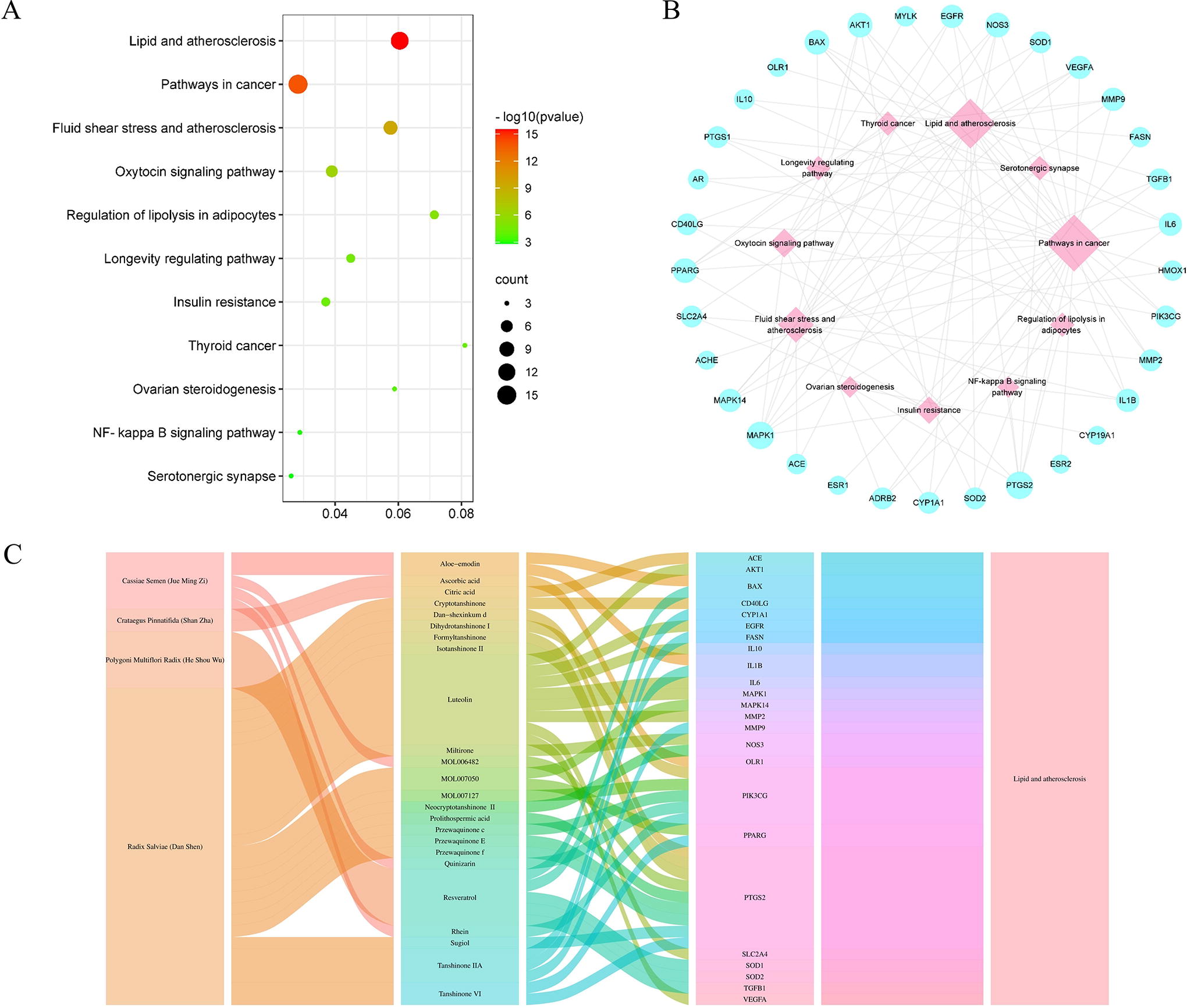
Functional analysis of common targets.
To further identify which ingredients were most important for treating hyperlipidemia, active components that affect proteins involved in the lipid and atherosclerosis pathway were detected (Fig. 6C). For example, bioactive substances such as luteolin, resveratrol, ascorbic acid, and aloe-emodin can regulate critical lipid and atherosclerotic proteins such as ATK1, SOD2, OLR1, and BAX. It was intriguing that the active ingredients came from four different core herbs. Multiple compounds simultaneously regulating the same target, as seen in the interaction of nine active ingredients with PTGS2, were evidence of the active ingredients’ synergistic effects. 30 –32 Our data support the idea that multiple herbs with hypolipidemic properties can act on the same targets and signaling pathways to treat hyperlipidemia.
Differential expression and survival analysis
The significantly enriched KEGG cancer pathway was investigated to explore which specific cancer type may be potentially associated with hyperlipidemia, considering that most targets were mostly connected to cancer-related pathways. The enrichment analysis revealed that pancreatic cancer ranked among the most significant kinds of cancer (Fig. 7A).
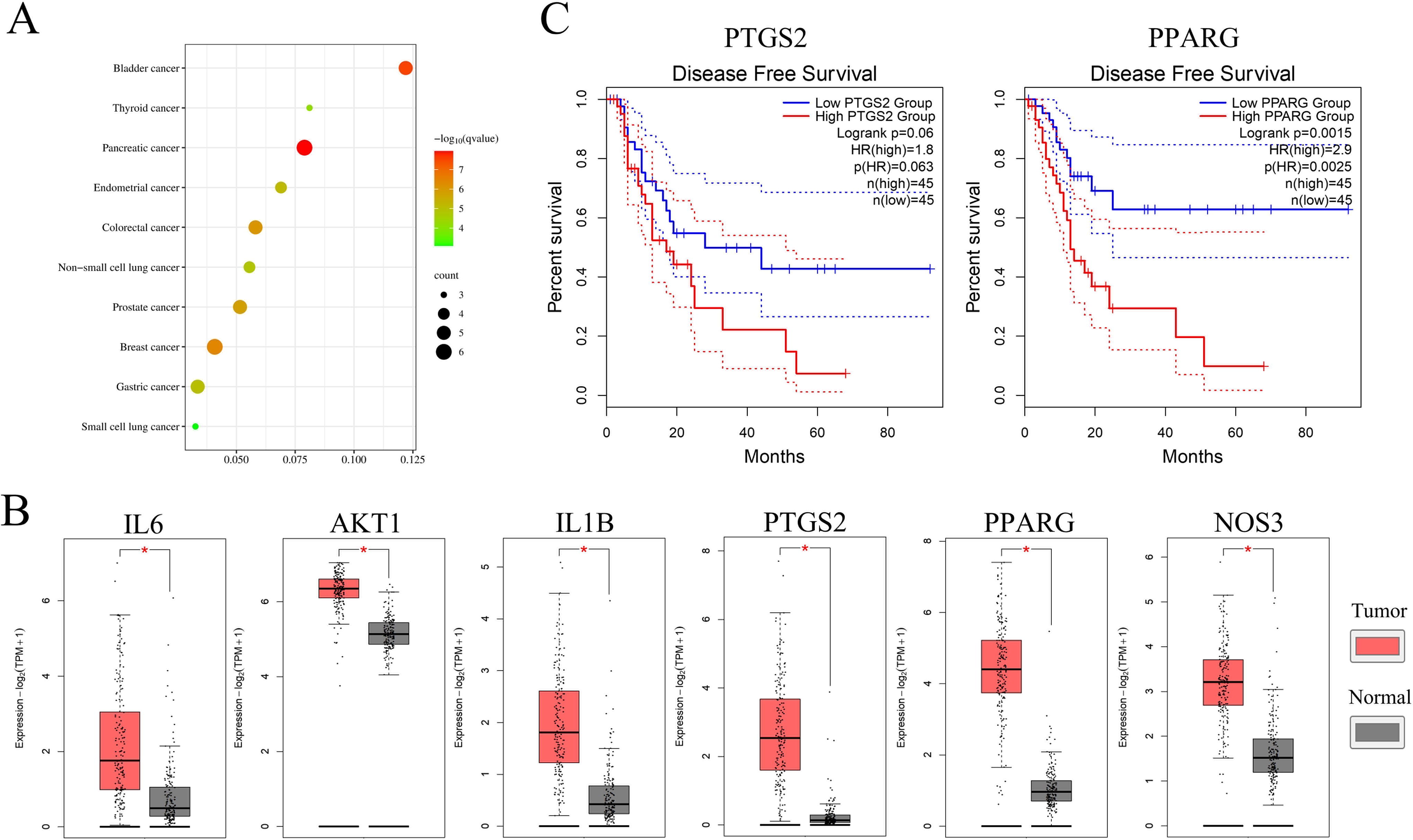
Most core targets are highly expressed in pancreatic cancer and associated with disease-free survival.
In fact, 25 out of 40 core targets had significantly altered expressions in pancreatic cancer cells compared to normal tissues (FC >2, q < 0.01, hypergeometric P value = .003, as 9219 significantly differentially expressed genes were identified for pancreatic cancer from GEPIA 33 ). Furthermore, the gene expression levels corresponding to the top seven proteins between tumor and normal samples were retrieved from GEPIA. Remarkably, mRNA expression of IL6, AKT1, IL1B, PTGS2, PPARG, and NOS3 were specifically and significantly upregulated in pancreatic cancer samples compared with normal samples (FC >2, q < 0.01, Fig. 7B).
Crucially, prognoses were significantly worse for individuals whose tumors expressed high levels of PTGS2 and PPARG than for those whose tumors expressed low levels of these proteins (P < .063, Fig. 7C). The data further indicated that the mechanism of core prescriptions in treating hyperlipidemia involves cancer pathways such as pancreatic cancer.
Molecular docking
Potential binding was analyzed using molecular docking to explore whether the active components of core herbs bind effectively to key targets in hyperlipidemia and cancer. The 96 active ingredients with the highest oral bioavailability and drug-likeness values, composing the five core herbs and the top seven core target proteins, were used in molecular docking analysis (Supplementary Table S3).
Binding energies of AKT1 with three active ingredients, including 3-beta-hydroxymethyllenetanshiquinone, danshexinkum d, and physciondiglucoside, were found to be less than −12 kcal/mol, confirming excellent affinity (Fig. 8A–C). Evaluation of AKT1 binding of other active compounds such as baicalin, 3α-hydroxytanshinoneIIa, formyltanshinone, przewaquinone B, and rutin similarly revealed a range of −10 to −12 kcal/mol. As shown in Figure 8D–E, apart from AKT1, both PTGS2 and PPARG exhibited strong binding affinity with physciondiglucoside. Moreover, przewaquinone B was found to bind NOS3 with an energy of −11 kcal/mol, indicating high affinity (Fig. 8F).
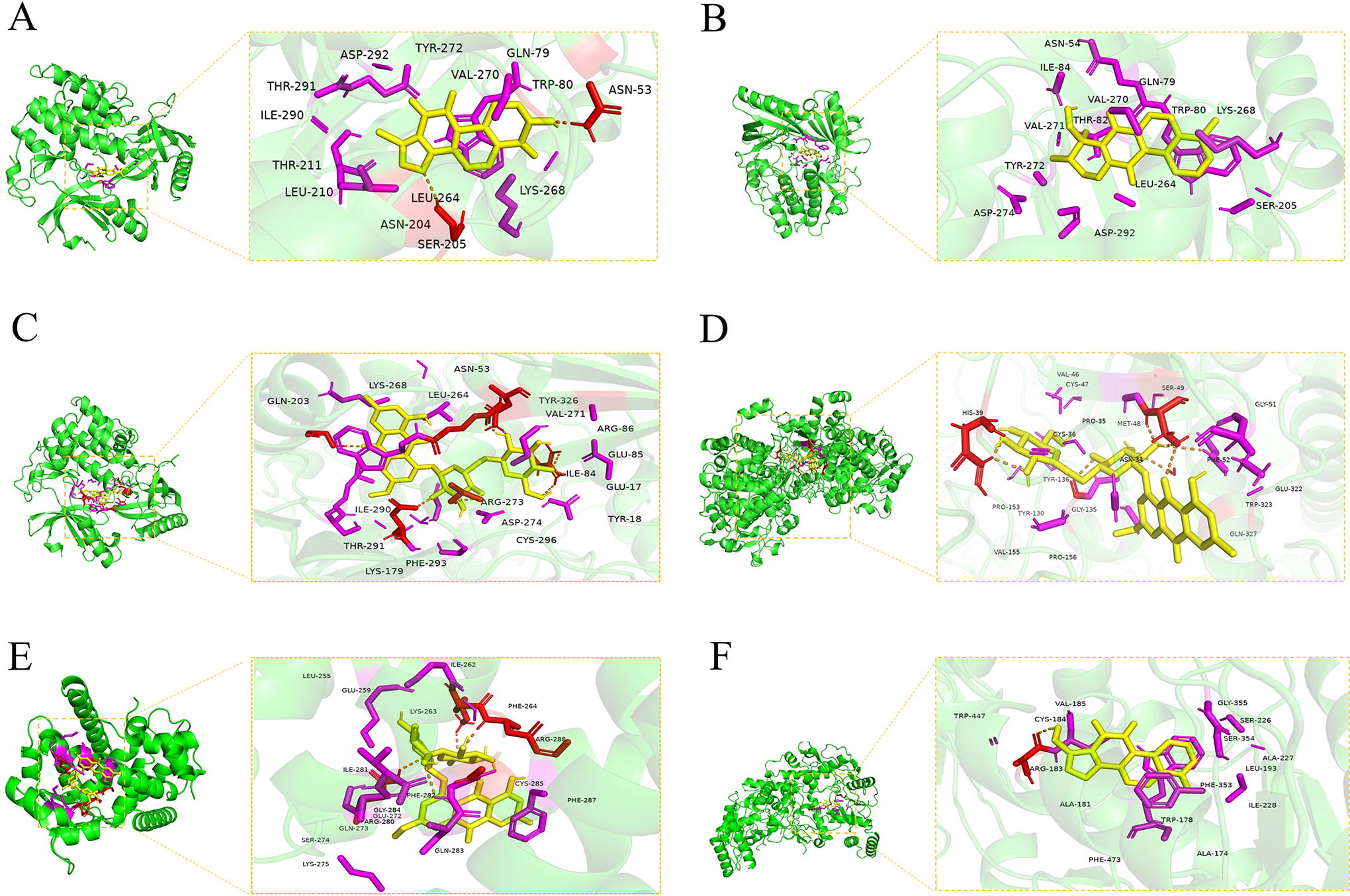
Molecular docking diagrams of target proteins with active compounds.
DISCUSSION
In this study, we first explored core herbal drugs and mechanisms of action relevant to treating hyperlipidemia. To discover efficacious herbal prescriptions for the treatment of hyperlipidemia, we used association rules, cluster analysis, and clinical data in this study. The results indicated that Crataegus pinnatifida (Shan Zha), Alisma orientale (Sam.) Juz. (Ze Xie), Salvia miltiorrhiza (Dan Shen), Poria cocos (Schw.) Wolf. (Fu Ling), and Cassiae semen (Jue Ming Zi) were the most frequently used herbs to treat hyperlipidemia. Crucially, a number of recent studies have revealed that some herb combinations, including Crataegus pinnatifida (Shan Zha), 34 Cassiae semen (Jue Ming Zi), 35 Alisma orientale (Sam.) Juz. (Ze Xie), 36 Salvia miltiorrhiza (Dan Shen), 37 and Radix Polygoni Multiflori (He Shou Wu) 38 can significantly reduce serum cholesterol and have positive impacts on the management of dyslipidemia, obesity, and atherosclerosis. Accumulating studies suggested that herbs used in combination may have stronger pharmacological effects than herbs used alone. 39 –41 The current research showed that the combined use of five herbs, including Crataegus pinnatifida (Shan Zha), Cassiae semen (Jue Ming Zi), Alisma orientale (Sam.) Juz. (Ze Xie), Salvia miltiorrhiza (Dan Shen), and Radix Polygoni Multiflori (He Shou Wu), can effectively treat hyperlipidemia.
It was demonstrated that hyperlipidemia can aggravate some serious conditions, including cardiovascular disease, which is still the leading cause of death in western nations. 42,43 In order to further explore the molecular mechanisms and therapeutic benefits of herbal medicines, core protein interactions were analyzed by establishing a PPI network. Among the 40 targets overlapped by hyperlipidemia and core herbs, there are proteins that play pivotal roles in lipid metabolisms, such as OLR1 and FASN. It was reported that OLR1, the oxidative LDL receptor 1, was upregulated in hyperlipidemia and was considered a key target for lipid lowering. 44 Studies have shown that downregulation of fatty acid synthase (FASN) can reduce de novo synthesis of lipids. 45,46
Our PPI network revealed that the top seven proteins most relevant to the treatment of hyperlipidemia are IL6, AKT1, IL1B, PTGS2, VEGFA, PPARG, and NOS3. Intriguingly, some of these targets were reported to be cancer-related proteins. Researches have demonstrated that the decrease in high-density lipoprotein cholesterol concentration was related to the increase in pro-inflammatory cytokines, including interleukin-6 (IL6) and tumor necrosis factor-a receptor, which promoted the development and multiplication of cancerous cells. 47,48 AKT1 was a serine-threonine kinase directly involved in the pathogenesis of malignancy. 49 In prior literature, AKT1 was reported to play roles in insulin signaling, endothelial function, and metabolic regulation. These unconventional roles underscore how AKT1 functions in diabetes and carcinogenesis. 50 Advanced stages of prostate cancer frequently exhibit an overactive AKT1, which could be partially responsible for this. 51 A reciprocal interaction might exist between AKT1 and SREBPs, in which an excessively active AKT1 boosted SREBP activity and the buildup of lipids, which subsequently increased AKT1 signaling. 52 This establishes a possible cause-and-effect relationship between AKT1 and lipids that promoted cell growth and proliferation in a prostate cancer context. Other cancer types, like ovarian carcinoma, have also shown similar observations, suggesting the potential benefits of chemotherapy that targets both AKT1 signaling and lipid metabolism. 53 Previous studies reported PTGS2 as an inducible enzyme that mainly promotes tumorigenesis, angiogenesis, and metastasis. 54 Cancer cell-intrinsic PTGS2 production and activity of the downstream lipid prostaglandin E2 played a crucial role in establishing the inflammatory environment within tumors and driving tumor growth by evading the immune system. 55 The clinical investigations have continuously shown that PTGS2 could be a crucial target in cancer treatments. 56 However, the release of endogenous PGI2 due to the expression of PTGS2 was regarded as beneficial in the cardiovascular system because it reduced the growth of vascular smooth muscle cells, the accumulation of cholesterol, and the activation of platelets while increasing vasodilation. 57 Researchers reported that the pharmaceutical inhibition of PTGS2 boosted the accumulation of lipid droplets during adipogenesis. 58 Similarly, PPARG, a lipid ligand-activated transcription factor, has been linked to a number of diseases, such as cancer, atherosclerosis, and type 2 diabetes. 59 The development of brown-like perivascular adipose tissue was reduced by PPARG deletion, according to studies, and this led to bigger atherosclerotic lesions with higher macrophage infiltration and local concentrations of IL-1β, IL-6, and tumor necrosis factor. 60,61 Previous research has shown that AKT1, PTGS2, and PPARG are the core targets for non-triple-negative breast cancer treatment. 62 Therefore, these three genes are common treatment targets for hyperlipidemia and cancer, as well as potential mechanistic links between these pathologies.
Recent epidemiological studies revealed that lipid metabolism had been linked to the prevalence and development of several malignancies, including prostate and breast cancer. 63,64 The association between hyperlipidemia and cancer incidence has been demonstrated by numerous investigations of various cancer types. 65 –67 For example, hyperlipidemia has been demonstrated to be a poor predictive factor for patients with small-cell lung cancer 68 and breast cancer 69 . In contrast, it has been demonstrated that antihyperlipidemic medications, including statins, lower cancer mortality through blocking cell signal transduction and encouraging cancer cell apoptosis. 70,71 It was suggested that hyperlipidemia was an environmental factor capable of regulating tumor metabolism. 72 Disrupted lipid metabolism was a significant metabolic alteration observed in cancer. 73 Research has demonstrated that targeting disrupted lipid metabolic pathways was an appropriate therapeutic strategy for cancer. 74,75
KEGG enrichment of 40 overlapping targets was performed to further verify our findings. Our findings confirmed these targets to be mainly involved in lipid and atherosclerosis pathways, as well as cancer pathways. Herbs include a wide range of chemical components, but it will need more investigation and confirmation to determine which of these contributes to the management of hyperlipidemia. In order to determine the active components that are crucial in the treatment of hyperlipidemia, the ingredients that can regulate lipid and atherosclerosis proteins were obtained (Supplementary Figure S1). For example, OLR1, also known as LOX-1, was regulated by ascorbic acid, a well-known antioxidant isolated from Crataegus pinnatifida (Shan Zha). Ascorbic acid has been shown to decrease LOX-1 mRNA expression and inhibit LOX-1 activity. 76,77 AKT1 and NOS3 were regulated by active components originally from Salvia miltiorrhiza (Dan Shen), which were luteolin and neocryptotanshinone, respectively. Luteolin inhibits the phosphorylation of AKT1 and induces apoptosis in human tumor cells. 78 Nitric oxide synthase (NOS) expression may be downregulated by neocryptotanshinone. 79 Aloe-emodin from Cassiae semen (Jue Ming Zi) was found to upregulate BAX protein levels and significantly enhance cell apoptosis. 80,81 Accumulated studies have shown that resveratrol from Radix Polygoni Multiflori (He Shou Wu) can upregulate the expression of SOD2. 82 –84 As shown in the lipid and atherosclerosis pathway (Supplementary Figure S1), these lipid proteins eventually induced apoptosis. In this process, the active ingredients of the five core herbs affected the targets through synergism and finally produced the effect of regulating the lipid and atherosclerosis pathway. It is also important to note that proteins that were affected by the bioactive components of Alisma orientale (Sam.) Juz. (Ze Xie) were associated with other lipid metabolism pathways (such as regulation of lipolysis in adipocytes pathway). Therefore, the concept of herbal synergy has gained traction, as has the usefulness of multitarget combination medicines.85
The KEGG pathway enrichment analyses further indicated that pancreatic cancer was the most significantly enriched cancer pathway, suggesting a potentially significant relationship between hyperlipidemia and pancreatic cancer. Pancreatic cancer is one of the worst diseases that affect humans, with a 5-year survival rate generally less than 5%. 86 Recent studies have shown that acute severe hyperlipidemia could lead to pancreatic cancer in elderly women. 87 Remarkably, six of the top seven targets related to hyperlipidemia were significantly and highly expressed in pancreatic cancer. Previous studies have shown that certain antihyperlipidemia agents exert a growth-suppressive effect on pancreatic cancer cells, suggesting that potential targets for the prevention of pancreatic cancer were variables associated with hyperlipidemia. 88 –90 As such, our findings underscore the potential importance of identifying key treatment targets relevant to both hyperlipidemia and cancer management.
Five herbs have numerous different chemical components. In the future, greater focus should be placed on particular compounds to help with drug research and development. To identify the active constituents in producing these synergistic effects, molecular docking analysis revealed that some constituents, such as physciondiglucoside, rutin, and baicalin, possess strong binding affinities for targets common to hyperlipidemia and cancer. Notably, we found physciondiglucoside to have a strong affinity for binding AKT1, PTGS2, and PPARG, in addition to its previously reported hypolipidemic properties. 91 Numerous studies have been conducted on the antioxidant properties of rutin, a polyphenolic bioflavonoid. 92 Extensive investigations have been conducted to examine the anticancer mechanisms of this natural substance using both in vivo and in vitro examinations. 93 Many cellular signaling pathways, including Wnt/β-catenin, the p53-independent pathway, PI3K/Akt, JAK/STAT, MAPK, p53, apoptosis, and NF-κB signaling pathways, were regulated by rutin to produce its anticancer effects. 94 In addition, it has been proposed that rutin may reduce oxidative stress and lipogenesis in hepatocytes to mitigate fat accumulation. 95,96 Baicalin was one of the most powerful and prevalent flavonoids found in the radix of Scutellaria baicalensis Georgi, which had been widely used in Chinese medicine to treat hyperlipidemia. 97 Baicalin was previously reported to inhibit tumor growth and metastasis in various cancer cell types. 98,99 Therefore, the active ingredients, such as physciondiglucoside, rutin, and baicalin detected here, are considered to be viable candidates for use in the combined treatment of hyperlipidemia and cancer. Our study may be the basis for treating hyperlipidemia and providing candidate active compounds for herbal clinical applications.
CONCLUSIONS
In conclusion, we identified Crataegus pinnatifida (Shan Zha), Cassiae semen (Jue Ming Zi), Alisma orientale (Sam.) Juz. (Ze Xie), Salvia miltiorrhiza (Dan Shen), and Radix Polygoni Multiflori (He Shou Wu) as the core herbs in the context of combined hyperlipidemia and cancer treatment. Core proteins, including AKT1, PTGS2, and PPARG, were found to be therapeutic targets for both hyperlipidemia and cancer. Furthermore, the bioactive compounds of these herbal medicines, such as physciondiglucoside and baicalin, are promising candidates for use in combined management strategies for these two related pathologies. The results of our study provide recommendations for experimental validation and clinical application studies.
Footnotes
AUTHORS’ CONTRIBUTIONS
C.H. and Y.L. are responsible for concept and design; X.C. G.S., W.C., L.M., Y.L., J.W., X.Z., and H.X. are responsible for data analysis; X.C. and G.S. are responsible for data interpretation; C.H. and Y.L. drafted the article; C.H. and Y.L. supervised the study; all authors participated in the interpretation of data and approved the final article.
DATA AVAILABILITY STATEMENT
The data used to support the findings of this study are available from the corresponding author upon request.
AUTHOR DISCLOSURE STATEMENT
The authors declare that the research was conducted in the absence of any commercial or financial relationships that could be construed as a potential conflict of interest.
FUNDING INFORMATION
This work was supported by the
SUPPLEMENTARY MATERIAL
Supplementary Figure S1
Supplementary Table S1
Supplementary Table S2
Supplementary Table S3
References
Supplementary Material
Please find the following supplemental material available below.
For Open Access articles published under a Creative Commons License, all supplemental material carries the same license as the article it is associated with.
For non-Open Access articles published, all supplemental material carries a non-exclusive license, and permission requests for re-use of supplemental material or any part of supplemental material shall be sent directly to the copyright owner as specified in the copyright notice associated with the article.
