




Abstract
Abstract
Purpose:
Gamunex 10% (Talecris Biotherapeutics, Research Triangle Park, NC), a commercially available preparation of pooled human immunoglobulin G, has been proposed as an antitoxin therapy against bacterial toxins released in infectious endophthalmitis. Its biocompatibility with two commonly used intraocular infusion fluids was evaluated to determine feasibility of its clinical application in endophthalmitis treatment.
Methods:
Gamunex 10% was mixed with BSS or BSS Plus (Alcon Laboratories, Fort Worth, TX) such that it constituted a range of 1.25%–50% by volume. Osmolality, pH, optical density, and ionic strength were measured across this range of concentrations.
Results:
The amount of pH reduction with increasing concentrations of Gamunex 10% was similar for both BSS and BSS Plus. In BSS Plus, solutions containing up to 20% by volume of Gamunex 10% remained at near-physiologic pH (∼7.0 or above). No physiologically significant changes in osmolality or optical density measurements that would be anticipated to have profound physiological effects were observed at any of the measured concentrations, nor was there visual evidence of tubidity/precipitation. A gradual increase in ionic strength was observed with increasing concentrations of Gamunex 10%.
Conclusions:
Potentially therapeutic mixtures of Gamunex 10% in 2 commonly used intraocular infusion fluids, BSS and BSS Plus, showed no evidence of bioincompatibility when the solutions were evaluated for changes in osmolality, pH, ionic strength, aggregation, or precipitation.
Introduction
Certain drugs are known to cause retinal toxicity when injected intravitreally. 4 It has been hypothesized that low pH of antibiotic solutions injected intravitreally may contribute to retinal dysfunction. 5 Lowering pH has been demonstrated to cause decreased rate of glycolysis in isolated retinas. 6 The pH of any solution used for intraocular injection must be evaluated and care must be taken to select a vehicle with appropriate buffering capacity.
Change in osmolality is also capable of influencing cell survival and function. Cellular responses to osmotic changes may include apoptosis, cytokine secretion, as well as altered cell signaling. Specific signaling pathways can be activated by osmotic stress resulting in the secretion of proinflammatory cytokines. (Pan et al. IOVS August 2010). 7 Thus, changes in either pH or osmolarity have the potential to dramatically alter the function of retinal cells as well as the ability to induce apoptotic cell death. It is imperative to evaluate these properties in drugs destined for intravitreal use.
Because of volume constraints within the eye, Gamunex 10% would likely be administered in conjunction with a vitrectomy procedure, an adjunctive intervention known to improve visual prognosis in certain forms of acute bacterial endophthalmitis. 8 Its use in this setting would necessarily result in admixtures with intraocular infusion fluids integral to the procedure. The aim of this study was to assess pH, optical density (OD), osmolality, and ionic strength of various mixtures of Gamunex 10% and BSS or BSS Plus (Alcon Laboratories, Fort Worth, TX), two commercially available intraocular infusion solutions used during vitrectomy.
Methods
Gamunex 10% was mixed with BSS or BSS Plus such that it constituted 1.25%–50% by volume of the tested mixtures. These mixtures represented a range of concentrations that could be delivered intravitreally. Gamunex 10% consists of 9%–11% protein (98% purified IgG of human origin) in 0.16–0.24 M glycine at pH 4.0–4.3 and 285–295 mOsm. For ease of clinical applicability of this particular product, we calculated our results as a function of volume of Gamunex 10% in BSS or BSS Plus rather than as a function of absolute concentration of IgG.
For each experiment, mixtures were prepared in triplicate sets using aliquots from single bottles of BSS or BSS Plus and Gamunex 10%. Each experimental run featured its own bottle of BSS or BSS Plus with a unique manufacturer's lot number. Each experiment was repeated in triplicate. Bottles of BSS and BSS Plus were obtained from the hospital operating room and were used at room temperature within 24 hours of opening. Each mixture was examined for pH, OD, osmolality, and ionic strength. Baseline parameters of the two infusion solutions (mean±standard deviation) are described as follows—BSS: pH 6.82±0.01, OD (660 nm)−0.001±0.007, osmolality 282±39 mOsm, and conductance 2.65±0.78 Mv (n=9 for all). For BSS Plus: pH 7.77±0.06, OD (660 nm) 0.001±0.007, osmolality 281±39 mOsm, and conductance 53.20±3.20 Mv (n=9 for all).
Osmolality was measured using a Wescor Vapro 5520 vapor pressure osmometer (Wescor, Logan, UT). Both ionic strength and pH were tested using an Orion PerpHecT LogR Meter, Model 370, with Orion Ross Sureflow pH microelectrode (Thermo Scientific, Waltham, MA). Optical density was used as a measure of turbidity to detect aggregates formed during mixing. 9 Optical density at 660 nm and wavelength scans were performed with Beckman DU-64 and DU-800 spectrophotometers (Beckman Coulter, Brea, CA).
Statistical comparisons were made using Sigma Plot (SSPS, Chicago, IL). Values of pH, OD, osmolality, and ionic strength were compared to like measures as a function of Gamunex concentration by analysis of variance. Nonlinear regression analyses were used to evaluate the change of these parameters as a function of Gamunex concentration.
Results
The pH, osmolality, OD, and ionic strength of the BSS and BSS Plus with Gamunex 10% preparations are shown in Figs. 1–4. These graphs show change in these parameters with increasing amounts of a 10% solution of Gamunex added to BSS or BSS Plus. Each data point represents the mean of triplicate experiments±standard deviation. For each experiment triplicate samples were tested at each concentration. Minimal variation was noted between samples and between triplicate experiments.

Change in pH with increasing amounts of a 10% solution of Gamunex added to BSS or BSS Plus. Varying amounts of commercially prepared solutions of 10% Gamunex were added to (•) BSS or (○) BSS Plus, and the pH was recorded. Each data point represents the mean of triplicate experiments±SD. In some cases the SD is so small it is hidden by the data point. SD, standard deviation.
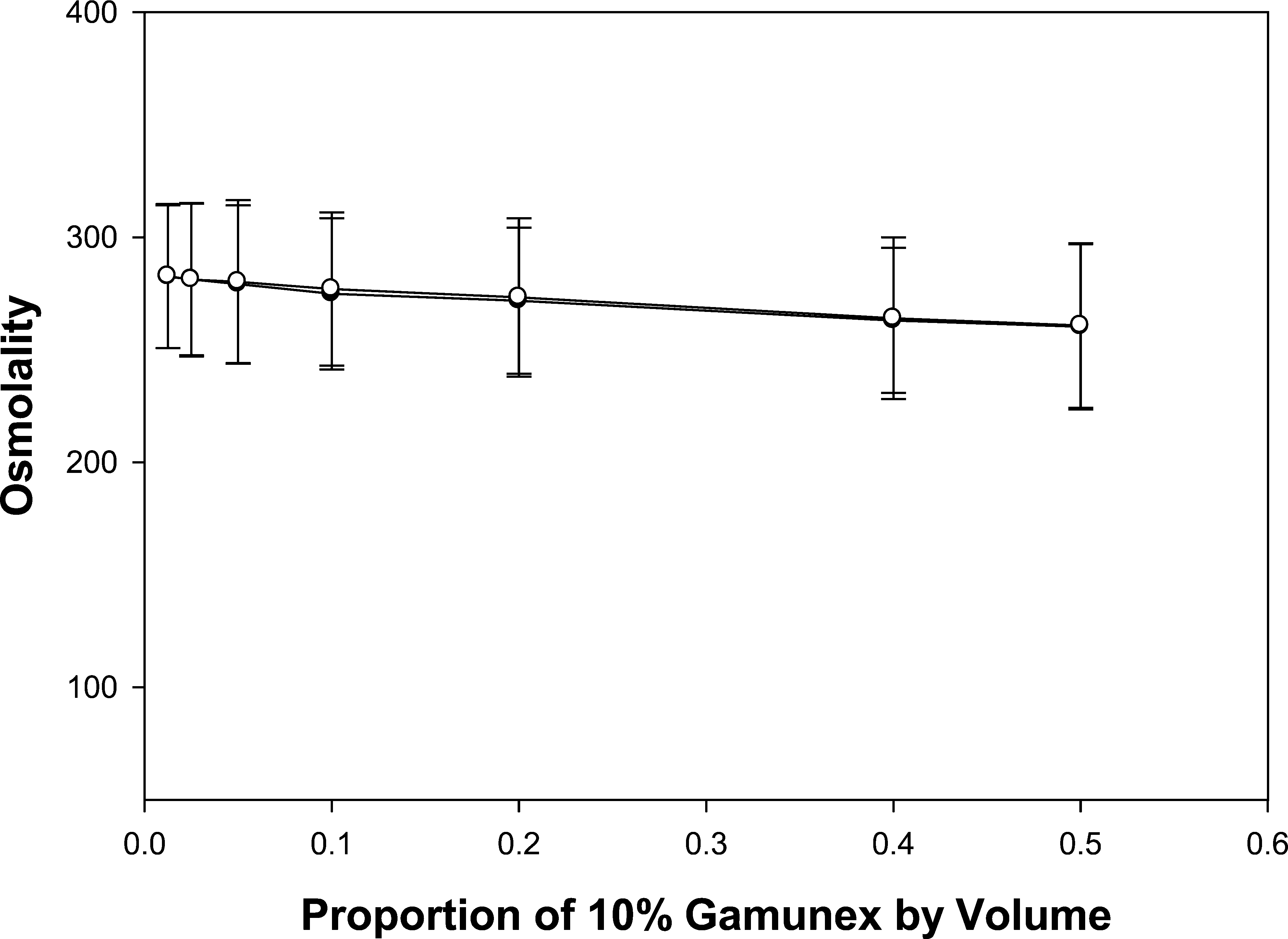
Change in osmolality with increasing amounts of a 10% solution of Gamunex added to BSS or BSS Plus. Varying amounts of commercially prepared solutions of 10% Gamunex were added to (•) BSS or (○) BSS Plus and the osmolality was recorded. Each data point represents the mean of triplicate experiments±SD. In some cases the BSS data points are hidden by the BSS Plus data points because the data are overlapping.

OD of solutions of BSS and BSS Plus containing varying amounts of 10% Gamunex. Varying amounts of commercially prepared solutions of 10% Gamunex were added to (•) BSS or (○) BSS Plus, and the absorbance at 660 nm was recorded. Each data point represents the mean of triplicate experiments±SD. OD, optical density.
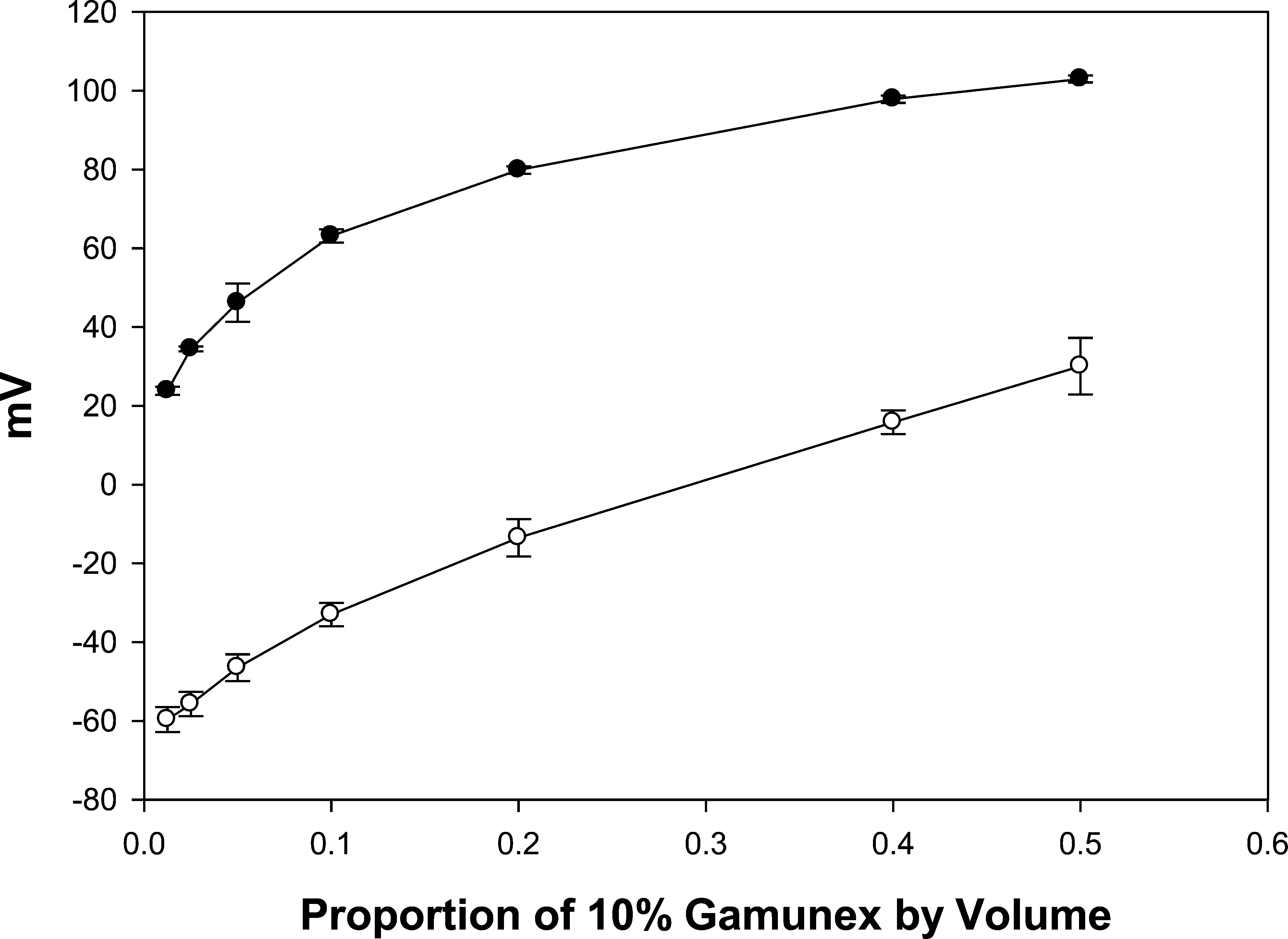
Change in conductance in millivolts of solutions of BSS and BSS Plus with increasing amounts of 10% Gamunex. Varying amounts of commercially prepared solutions of 10% Gamunex were added to (•) BSS or (○) BSS Plus, and the conductance was recorded. Each data point represents the mean of triplicate experiments±SD.
Differences existed in the pH of BSS and BSS plus solutions as well as the buffering capacity of the citrated/acetate buffer versus the bicarbonate buffer, respectively. Although the initial pH of the BSS seemed low, it was within the manufacturing tolerances permitted by the FDA. The pH of solutions containing proportions of 0.1 or greater of 10% Gamunex were significantly different (P<0.001) from solutions containing no Gamunex or a proportion of 0.0125 Gamunex. The extent of change as a function of Gamunex added was similar for both BSS and BSS Plus. BSS Plus would be the preferable buffer to use because the pH of solutions containing up to 30% by volume was maintained at a pH that one would expect to have few effects on the retina.
No physiologically notable or statistically significant changes in osmolality were noted with increasing concentrations of Gamunex 10%. In addition, no significant change in the turbidity of the solutions of Gamunex was observed either visually or by OD measurement, indicating that protein aggregation or precipitation was minimal or absent. The measurement of absorbance at 660 nm would be expected to be influenced if particles did exist in solution due to denaturation, aggregation, or precipitation. 9 The scan of the visible and ultraviolet spectra shows only the peak of absorbance at 280 nm as would be expected for a protein containing solution (Fig. 5).
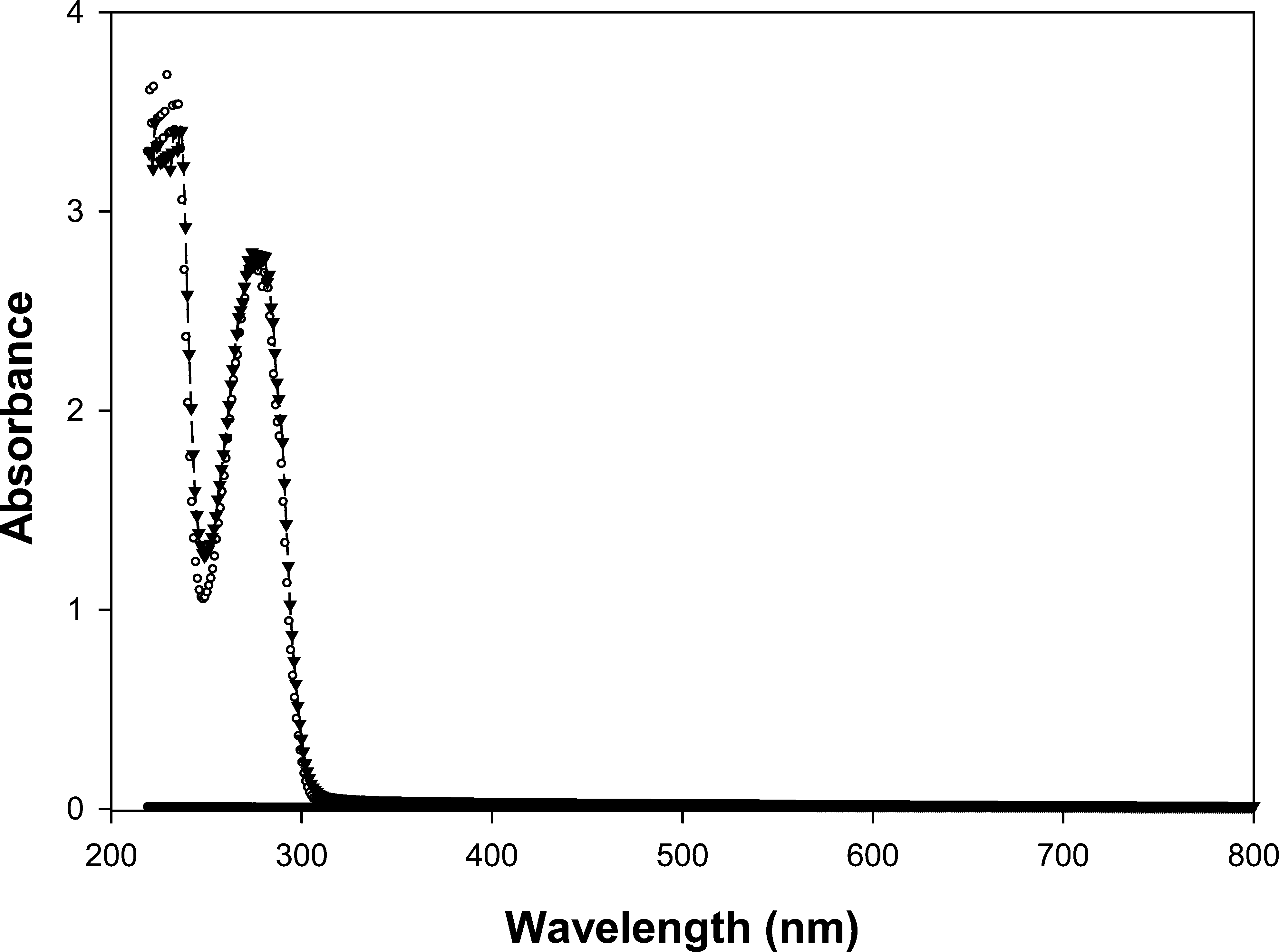
Change in absorbance as a function of wavelength. A fixed amount of 10% Gamunex was added to (▾) BSS or (○) BSS Plus, and absorbance was recorded as a function of wavelength relative to BSS or BSS Plus alone. Milli-Q water (18 MOhm-cm) served as a control (solid line).
Gradual and statistically significant increases (P<0.001) in ionic strength of both BSS and BSS Plus were observed with proportions of Gamunex 10% exceeding 0.1 relative to solutions containing less Gamunex. The physiologic significance of this finding with respect to retinal toxicity is not known.
Discussion
In a rabbit model of toxin-mediated endophthalmitis, a protective effect against retinal destruction by S. aureus exotoxins was observed when Gamunex 10% (formerly Gamimmune N, 10%, Bayer Corporation, Elkhart, Indiana) was injected intravitreally in quantity such that it occupied 20% of the vitreous cavity volume. 2 A similar proportion of Gamunex 10% is likely to be required in the human eye, due to its relative nonspecific activity against foreign antigens, which includes as a small part of its activity the binding and inactivation of bacterial exotoxins. 1 The pH and osmolality of Gamunex 10% (pH 4.00–4.3) differ notably from experimentally derived physiologic levels (pH 7.3–7.4) of the vitreous.10,11 In contrast, the osmolality of Gamunex 10% (285–295 mOsm/L) does not appear to differ substantially from physiologic levels of the vitreous humor (∼300 mOsm/L). 12
The current study suggests potential ocular tolerance of certain admixtures of Gamunex 10% with two commonly used infusion fluids. However, the exact threshold for intraocular toxicity with respect to the various parameters studied is not known. It can be projected that dose-dependent changes in pH, osmolality, and ionic strength would likely occur within the eye from increasing mixtures of Gamunex 10%. Notably, a 20% mixture, a concentration suggested to have therapeutic effects experimentally in the rabbit vitreous humor,2,3 was associated with a reduction of pH to a potentially tolerable level of 7.0. Our quantification of the change (delta) in pH and osmolality may be as important as absolute values, since baselines values might depend on co-existing factors within the eye, such as infection, inflammation, instilled antibiotics, and variations in the manufactured pH of the infusion solutions themselves. In a previous study, intravitreal injection of doses of Gamunex 10% (previously marketed as Gamimune N, 10%, Bayer Corporation, Elkhart, Indiana) of up to 30 mg (300 μL) in the rabbit eye showed no evidence of inflammation biomicroscopically or ophthalmoscopically, and no evidence of retinal injury by immunohistopathologic studies. 3
It is not possible to advocate use of the Gamunex 10% formulation of human immunoglobulin G for intravitreal use based solely on this data, since the effects of other components in this preparation when injected intravitreally have not been studied. Glycine (0.16–0.24 M), a component of Gamunex 10% that is used as a stabilizing agent, has been associated with suppression of the electroretinogram and reduced visual-evoked potentials in visually symptomatic patients receiving glycine-containing infusion fluids during transurethral resection of the prostate.13–16 In an experimental mouse model, intravenous infusion of glycine 1.5% (0.2 M) was associated with cardiac death due to electrophysiologic disturbances. 17 Glycine toxicity may thus be of relevance when considering various preparations of human IgG for intraocular therapy. Currently, not all commercial preparations of human IgG contain glycine.
In summary, potentially therapeutic mixtures of Gamunex 10% in two commonly used intraocular infusion fluids, BSS and BSS Plus, show no evidence of bioincompatibility when evaluated for changes in pH, osmolality, ionic strength, protein aggregation, or precipitation. Our findings suggest the possibility that the mixing of small amounts of Gamunex 10% with BSS or BSS Plus might not compromise the biological activity or physiologic benefits of either component. However, our study did not evaluate these measures directly. The risk–benefit ratio of intraocular use of Gamunex 10% or other preparations of pooled human IgG has yet to be established, as has yet the value of antitoxin therapy in clinical endophthalmitis. However, our findings indicate that mixtures of Gamunex 10% with BSS and BSS Plus in potentially therapeutic concentrations would not be expected to have profound physiologic effects relating to bioincompatibility as measured by pH, osmolality, OD, or ionic strength.
Footnotes
Acknowledgments
Supported in part by NIH grants P30 EY01931; the Thomas M. Aaberg, Sr., Retina Research Fund, Milwaukee, WI; the Jack A. and Elaine D. Klieger Professorship; and an unrestricted grant from Research to Prevent Blindness, Inc., New York, NY. Facilities construction was supported in part by C06 RR 016511.
Author Disclosure Statement
Dennis P. Han: Author's employing institution has received an honorarium from Alcon Laboratories, Inc., within the last 2 years, relating to his role as an advisor/consultant. The other authors have no competing financial interests.