




Abstract
Abstract
Purpose:
The purpose of this study was to report a case hypersensitive to topical bimatoprost and dexamethasone, but with no responsiveness to both latanoprost and travoprost.
Case:
A 41-year-old Chinese female presented with unilateral glaucoma secondary to iridocyclitis and long-term use of topical steroid. Trabeculectomy only worked for 9 months and then additional topical glaucoma medications were required to control the intraocular pressure (IOP). All commonly used IOP-lowering medications failed, except for bimatoprost, which significantly lowered the IOP. Topical dexamethasone increased IOP and caused ocular hypertension. Ultrasound biomicroscopy (UBM) was used to evaluate the anterior segment of the affected eye. Genomic DNA was extracted for sequence analysis of gene of prostaglandin F receptor (FP), E receptor 1 (EP1) and 2 (EP2) and myocilin.
Results
: UBM revealed cyclodialysis in the patient's affected eye after a single dosage of bimatoprost. The cyclodialysis resolved when IOP was elevated with the topical use of dexamethasone. The dexamethasone-induced high IOP could only be controlled by bimatoprost, whereas the bimatoprost-induced low IOP could only be elevated by topical dexamethasone. Allele C of rs3753380 and allele A of rs3766355 in FP gene and a −224T>C variation of myocilin gene were found in this patient. In addition, a novel heterozygous Cys346Tyr mutation was identified in EP2 gene. No sequence variation was found in EP1 gene.
Conclusions:
The hypersensitivity of the affected eye to topical bimatoprost may be a result, at least in part, of cyclodialysis. The sequence analysis results suggested that, besides the polymorphism of FP gene, there might be some other mechanisms underlying the irresponsiveness of this patient to both latanoprost and travoprost. The mechanisms underlying the bimatoprost-induced cyclodialysis might correlate with its receptor selectivity. The −224T>C variation in the myocilin gene may affect the regulation of expression of this gene by dexamethasone.
Introduction
Case Report
The study was approved by West China Hospital, Sichuan University Institute Review Board. Informed consent was obtained from the patient according to the tenets of Declaration of Helsinki.
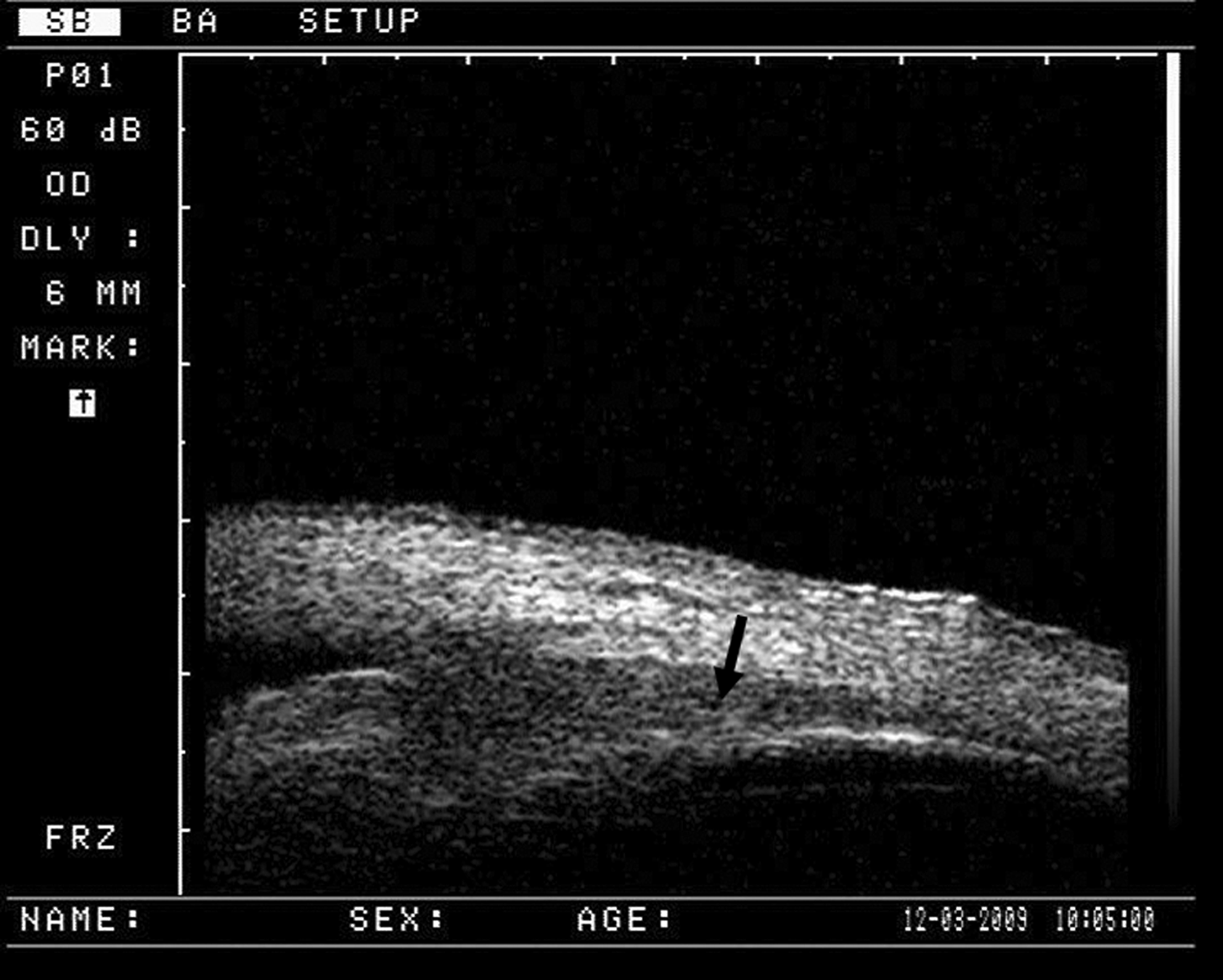
A 41-year-old Chinese woman presented with refractory unilateral glaucoma secondary to history of iridocyclitis and long-term use of topical steroid in her right eye. The eye was quiet and trabeculectomy was performed with successful IOP control for about 9 months. Then her right eye IOP was noted to rise above 40.0 mmHg while the left eye IOP remained normal (15.7 mmHg). On examination, she was found to have visual acuity of 0.4 in the right eye and 1.5 in the left eye. Anterior chamber was deep and quiet. Topical IOP-lowering medications, including latanoprost, travoprost, timolol maleate, and brimonidine, failed to lower the IOP, but 1 drop of bimatoprost used the night before decreased the right eye IOP to 8.5 mmHg (left eye IOP remained at 15.2 mmHg). Bimatoprost was discontinued, but the right eye IOP continued to decrease to about 5 mmHg the following day and stayed at this level without any further use of bimatoprost for 2 weeks. She then complained of blurry vision in her right eye. IOP was 5.6 mmHg in the right eye and 15.1 mmHg in the left eye. The anterior chamber was shallow but quiet. Ultrasound biomicroscopy (UBM) showed cyclodialysis in her right eye (Fig. 1). The eye was very sensitive to topical steroid as evidenced by the fact that the IOP became as high as 40 mmHg again when topical dexamethasone was used for several times. UBM showed the reattachment of the ciliary body to the sclera and the resolution of the cyclodialysis in the right eye (Fig. 2). However, the steroid-induced high IOP could not be controlled by any IOP-lowering medications other than 1 drop of bimatoprost. Decreased IOP recurred and cyclodialysis cleft was noted again by UBM after bimatoprost application. Pranoprofen was used in the affected eye occasionally at both situations (high or low IOP). After 5 cycles of alternating dexamethaosne and bimatoprost, the patient developed secondary cataract in the right eye (Fig. 3). Cataract surgery with posterior chamber intraocular lens implantation was performed (Fig. 4). Pranoprofen eye drops were postoperatively used. She had a normal postoperative recovery without recurrence of iridocylitis and the IOP was kept at about 12 mmHg, with visual acuity of 0.4 in the right eye and 1.5 in the left eye. Anterior segment optical coherence tomography (OCT) showed that ciliary body was in normal anatomical position (Fig. 5).

UBM showed cyclodialysis and choroidal detachment (indicated by arrow) in the right eye after application of 1 drop of topical bimatoprost. UBM, ultrasound biomicroscopy.
UBM revealed reattachment of the ciliary body and the resolution of the choroidal detachment (indicated by arrow) in the right eye after using topical dexamethasone.
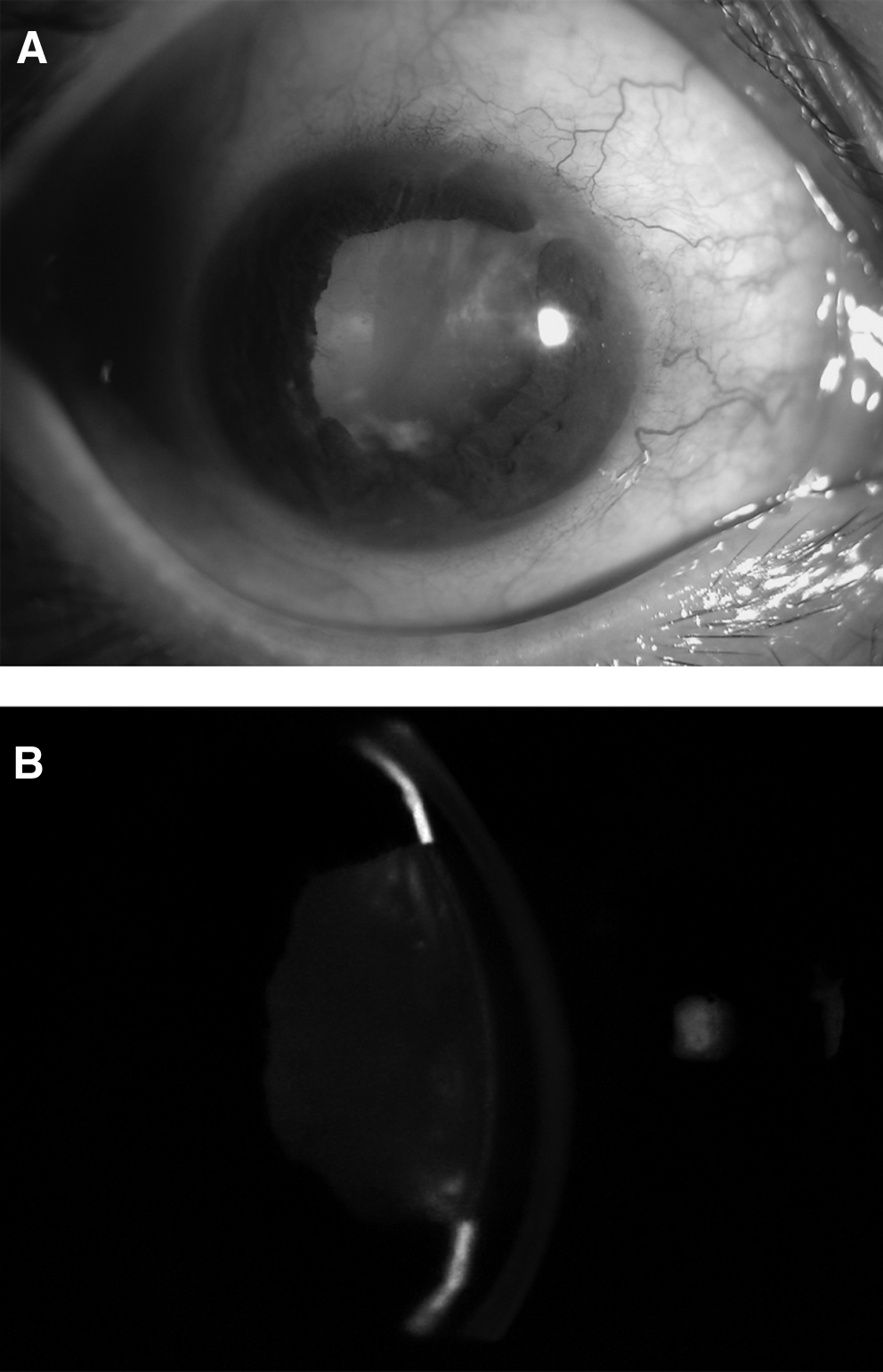
Cataract in the right eye.
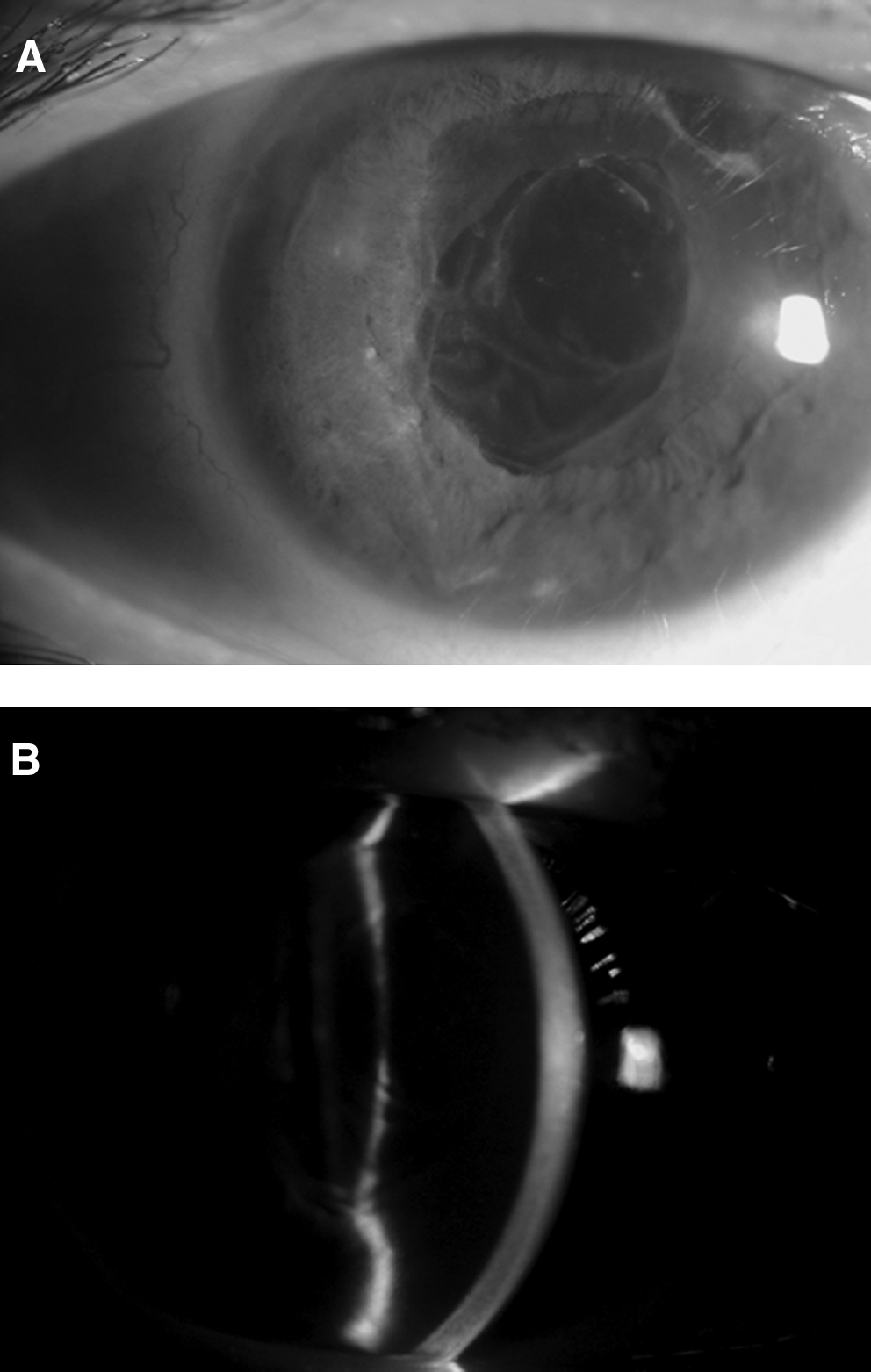
Cataract surgery in the right eye.
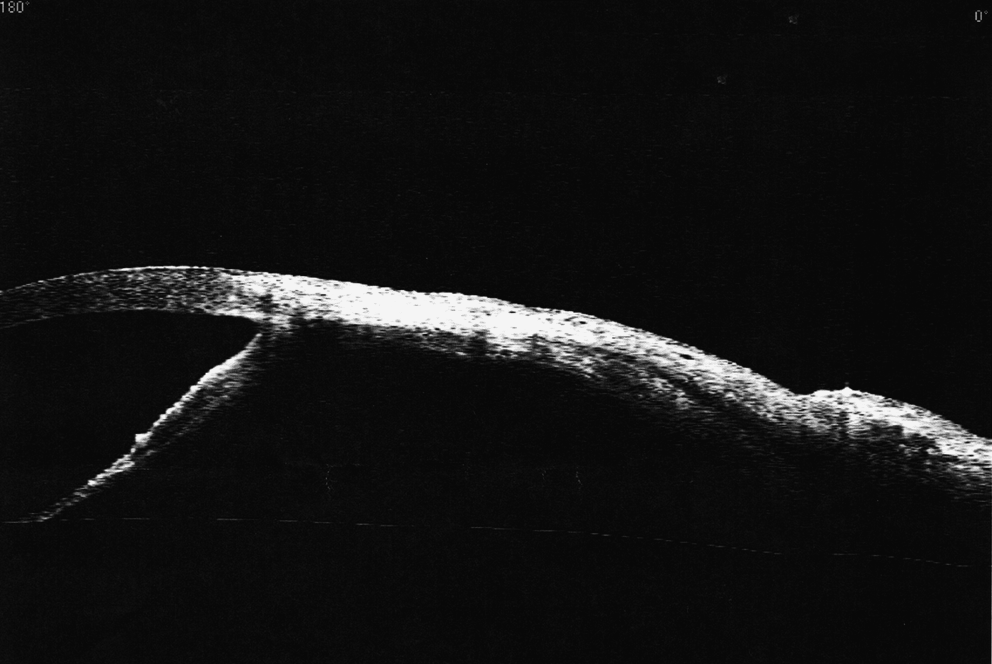
Anterior segment OCT showed ciliary body in normal anatomical position. OCT, optical coherence tomography.
Molecular Genetic Analysis
Peripheral blood was collected. Genomic DNA was extracted from leukocytes using QIAamp DNA Blood Mini Kit (Qiagen, Hilden, Germany) by standard protocols. Polymerase chain reaction (PCR) amplification and direct sequence reaction were performed to screen mutation of gene of prostaglandin F receptor (FP), E receptor 1 (EP1) and 2 (EP2) and myocilin. The primers designed for PCR amplification are listed in Table 1. The 30 μL of PCR mixture included 1×PCR buffer, 30 ng DNA, 2.5 mM MgCl2, 0.3 mM of each of dNTPs, 1.5 U Taq DNA polymerase, and 1.0 μM of each of the sense and antisense primers. The reactions were incubated at 94°C for 3 min, followed by 35 cycles of 94°C for 10 s, optimum annealing temperature (see Table 1) for 30 s, 72°C for 60 or 90 s, and a final extension at 72°C for 5 min. Purification of PCR products and automated sequencing were commercially performed.
FP, prostaglandin F receptor; EP2, prostaglandin E receptor 2.
The genome analysis demonstrated allele C of rs3753380 and allele A of rs3766355 in FP gene (Fig. 6), Cys346Tyr mutation in EP2 gene (Fig. 7), and −224T>C variation in the upstream of myocilin gene (Fig. 8).

A portion of the nucleotide sequence of FP gene of our patient.

Heterogeneous G>A mutation (Cys346Tyr) on exon 2 of EP2 gene. EP2, prostaglandin E receptor 2.

The −224 allele C of the myocilin gene (indicated by arrow).
Discussion
In the present case, it is clear that bimatoprost decreased IOP by inducing cyclodialysis. As no clinically visible evidence for the correlation between administration of bimatoprost and uveitis was noticed, the hypersensitivity of the affected eye to topical bimatoprost was considered as a result, at least in part, of cyclodialysis. The irresponsiveness of this patient to travoprost and latanoprost indicated that the mechanism underlying the bimatoprost-induced cyclodialysis might correlate with its receptor selectivity. Receptor binding assays revealed that bimatoprost acid (17-phenyl-trinor-PGF2a), with a relatively high affinity and activity at the FP receptor, also avidly interacted with and activated human EP1 and prostaglandin E receptor 3 (EP3).5–7 It is proposed that the activation of EP1 and EP3 by bimatoprost might incur the breakdown of blood-aqueous barrier and cyclodialysis, which would subsequently cause low IOP. The EP2 receptor was also present in ciliary muscle.8–10 Even though EP2 had a relatively low affinity to bimatoprost,6,7 the Cys346Tyr mutation of EP2 receptor may change the conformational structure of the protein, leading to changes in its binding status to bimatoprost. This may explain why a single drop of bimatoprost dramatically lowered IOP (possibly by inducing cyclodialysis). Further studies are definitely needed to verify the mechanisms proposed.
Previous studies showed that some patients failed to respond to latanoprost treatment.1–3 As latanoprost is a highly selective agonist for the FP receptor, the reduction of IOP by latanoprost is considered to be mainly mediated by the FP receptor. 11 The FP polymorphism, rs3753380 in the promoter and rs3766355 in intron 1, are closely involved in the responsiveness of patients to PGAs. 12 The promoter assay revealed that allele T of rs3753380 and allele C of rs3766355 were found in constructs with lower transcriptional activity of FP gene. 12 The presence of allele C of rs3753380 and allele A of rs3766355 in the patient reported in this study suggested that there might be some other mechanisms underlying the irresponsiveness of this patient to both latanoprost and travoprost.
Glucocorticoids (GCs) treatment can lead to the development of glaucomatous ocular hypertension and secondary open-angle glaucoma because of increased resistance to aqueous humor outflow, which is associated with morphological and biochemical changes in the trabecular meshwork. 13 Most of the effects of GCs on trabecular meshwork are likely due to GC-mediated expression of genes including myocilin, fibronectin, and others.14,15 There are significant differences in steroid sensitivity among the population. Topical administration of GCs causes elevated IOP in a greater percentage of patients with primary open-angle glaucoma and their descendants compared with normal individuals.16,17 In this case, the patient presented with glaucoma and ocular hypertension likely induced by topical dexamethasone medication. A reported sequence variation, −224T>C,18,19 in the upstream of myocilin gene was found. Although no correlation was found between this variation and glaucoma or ocular hypertension, some new putative transcriptional factor binding sites, including c-Ets or PEA3, Fli-1, MAF, and E1A-F, brought about by this variation, might affect the regulation of expression of this gene by dexamethasone.
Conclusions
The hypersensitivity of the affected eye to topical bimatoprost may be due to, at least in part, cyclodialysis. The sequence analysis results suggested that, besides the polymorphism of FP gene, there might be some other mechanisms underlying the irresponsiveness of this patient to both latanoprost and travoprost. The mechanisms underlying the bimatoprost-induced cyclodialysis might correlate with its selectivity on various prostanoid receptors, including FP and EP. The −224T>C variation in myocilin gene may affect the regulation of expression of this gene by dexamethasone.
Bimatoprost is considered as a synthetic PGA and selectively mimics the effects of naturally occurring substances called prostamides. Previous studies suggested that bimatoprost may act as an endogenous ligand at its own receptor (prostamide receptor),20–22 which remains to be identified. Nevertheless, bimatoprost activity has not, till date, been demonstrated in the absence of FP receptor activity. To clarify the mechanisms, elucidating the particular receptor(s) involved in bimatoprost-mediated events is needed.
Footnotes
Acknowledgment
The authors thank Dr. Yun Liu from the Permanente Medical Group, Stockton, CA, for proofreading the manuscript.
Author Disclosure Statement
No competing financial interests exist.