




Abstract
Abstract
Purpose:
To evaluate the ocular penetration of daptomycin, a new antibiotic agent targeted against Gram-positive organisms.
Methods:
Thirty-two New Zealand white rabbits were divided into 4 equal groups. One drop of 50 μL 1% daptomycin was administered to group 1. In group 2, 1 drop of 1% daptomycin was administered after the corneal epithelium was scraped. In group 3, 1 drop of 1% daptomycin was administered every 15 min for 1 h (keratitis protocol). In group 4, the keratitis protocol was applied after the corneal epithelium was scraped. In groups 1 and 2, aqueous humor samples were collected 30 min, 1 h, and 2 h after the single drop under general anesthesia. All the animals in groups 3 and 4 were humanely killed. Cornea, aqueous humor, and vitreous samples were collected 1 and 2 h after the last drop. Daptomycin concentrations were measured by high-performance liquid chromatography.
Results:
Each group comprised 8 rabbits. Daptomycin was not detected in the aqueous humor in groups 1 and 2. In group 3, the mean values at 1 h in the aqueous humor and cornea, respectively, were 1.90±0.15 μg/mL and 3.93±0.67 μg/g, and at 2 h were 1.71±0.42 μg/mL and 4.13±0.46 μg/g. In group 4, the mean values at 1 h were 5.19±0.50 μg/mL and 7.10±0.35 μg/g, and at 2 h were 4.96±0.47 μg/mL and 7.22±0.34 μg/g. Daptomycin was not detected in vitreous samples in groups 3 and 4.
Conclusions:
Single-drop administration does not yield a detectable daptomycin concentration in aqueous humor in neither nonscraped nor scraped group. In the multiple-drop regimen, daptomycin seems to penetrate well into the aqueous humor and cornea both in nonscraped and scraped groups. However, this concentration may not cover the minimum inhibitory concentration (MIC) of organisms such as Enterococcus fecalis.
Introduction
Daptomycin is a cyclic lipopeptide antimicrobial agent that is rapidly bactericidal in vitro against most clinically important Gram-positive bacteria. Daptomycin acts by inserting itself into and disrupting of the functional integrity of the Gram-positive plasma membrane, with resultant rapid loss of membrane potential, cessation of macromolecular synthesis, and cell death. 5 The mechanism is calcium dependent, and daptomycin activity is enhanced by calcium supplementation in vitro. 6 The MIC90 values of daptomycin for the most common endophthalmitis isolates ranges from >1 to 8 μg/mL, with the upper limit corresponding to the value for Enterococcus, which represents the most difficult genera to eradicate. 7 On the other hand, little is known about the intraocular penetration of daptomycin. According to the sole published case report, daptomycin achieved 28% serum concentration in vitreous (12.43 mg/L) 42 h after the intravenous administration of a 10-mg/kg dose in a patient with endogenous endophthalmitis. 8
To our knowledge, topical administration of daptomycin has not been studied before. In this study, we aimed to evaluate the penetration of daptomycin in to aqueous humor, cornea, and vitreous after topical administration in an experimental rabbit model.
Methods
This study was performed at Konya Training and Research Hospital, Department of Ophthalmology, Konya, Turkey. New Zealand white rabbits weighing between 3.0 and 3.5 kg were divided into 4 equal groups, receiving 1 of 4 dosing regimens. Animals were treated in accordance with the Association for Research in Vision and Ophthalmology's Statement for the Use of Animals in Ophthalmic and Vision Research.
Dosing
Group 1: single-drop protocol
In this experiment, the rabbits received a preparation of topical liquid daptomycin (Cubicin, Novartis, Turkey) at a concentration of 10 mg/mL (1%). A drop of 50 μL of the preparation was delivered through a micropipette to the inferior conjunctival fornix of the right eye of each rabbit; the total amount of daptomycin applied was 500 μg.
Group 2: single-drop protocol with mechanical corneal epithelium debridement
In this experiment, after mechanical corneal epithelium debridement of the right eyes of the rabbits, the same protocol was used as in group 1.
Group 3: multiple-drop protocol
In this experiment, the following keratitis dosing protocol was used: 1 drop of 10 mg/mL daptomycin administered every 15 min for 45 min. Thus, the right eyes of the rabbits received 4 applications, for a total dose of 2 mg per eye.
Group 4: multiple-drop protocol with mechanical corneal epithelium debridement
In this experiment, after mechanical corneal epithelium debridement of the right eye, the same protocol was used as in group 3.
Sample collection
In groups 1 and 2, aqueous humor samples were collected at 30 min (n=3), 1 h (n=3), and 2 h (n=2) after the single drop of daptomycin was administered. The samples were taken with the rabbits under ketamine-induced general anesthesia (15 mg/kg of body weight), delivered through an auricular vein catheter. In groups 3 and 4, after the rabbits were humanly killed, cornea, aqueous humor, and vitreous samples were collected at 1 h (n=4) and 2 h (n=4) after the last drop of daptomycin was administered. Samples were immediately stored at −80°C until analysis.
Aqueous humor (0.2 mL) was collected using a 30-gauge needle mounted on a 1-mL syringe introduced at the limbus. Vitreous (0.2 mL) was aspired with a 15-gauge needle mounted on a 5-mL syringe, introduced at 3.0 mm of the limbus, directed toward the center of the globe. Corneas were separately removed using microsurgical instruments. After their removal, the corneas were washed with a sterile irrigating solution before being dried, weighed, and frozen at −80°C.
Daptomycin concentrations in cornea, aqueous humor, and vitreous were determined by an independent laboratory using a validated high-performance liquid chromatography–tandem mass spectrometry method.
Statistical analysis was performed using Mann-Whitney U test, which is a nonparametric test, to detect differences between the scraped and nonscraped groups. The values are expressed as mean±standard deviation.
Results
A single-drop application of daptomycin on intact corneal epitheliums (group 1) and on corneas with scraped epitheliums (group 2) resulted in undetectable daptomycin levels in the aqueous humor after 30 min, 1 h, and 2 h. The detection limit of the method was 0.5 μg/mL.
The mean aqueous concentration of daptomycin was 1.90±0.15 μg/mL at 1 h and 1.71±0.42 μg/mL at 2 h in the nonscraped group, and 5.19±0.50 μg/mL at 1 h and 4.96±0.47 μg/mL at 2 h in the scraped group, respectively (Table 1; Figs. 1 and 2) These levels were statistically significant between the nonscraped and scraped groups at 1 and 2 h. There was no statistically significant difference when comparing 1 and 2 h values in aqueous humor in groups 3 and 4 (P value>0.05).

Aqueous humor (μg/mL) and cornea (μg/g) concentration of daptomycin in the nonscraped group.
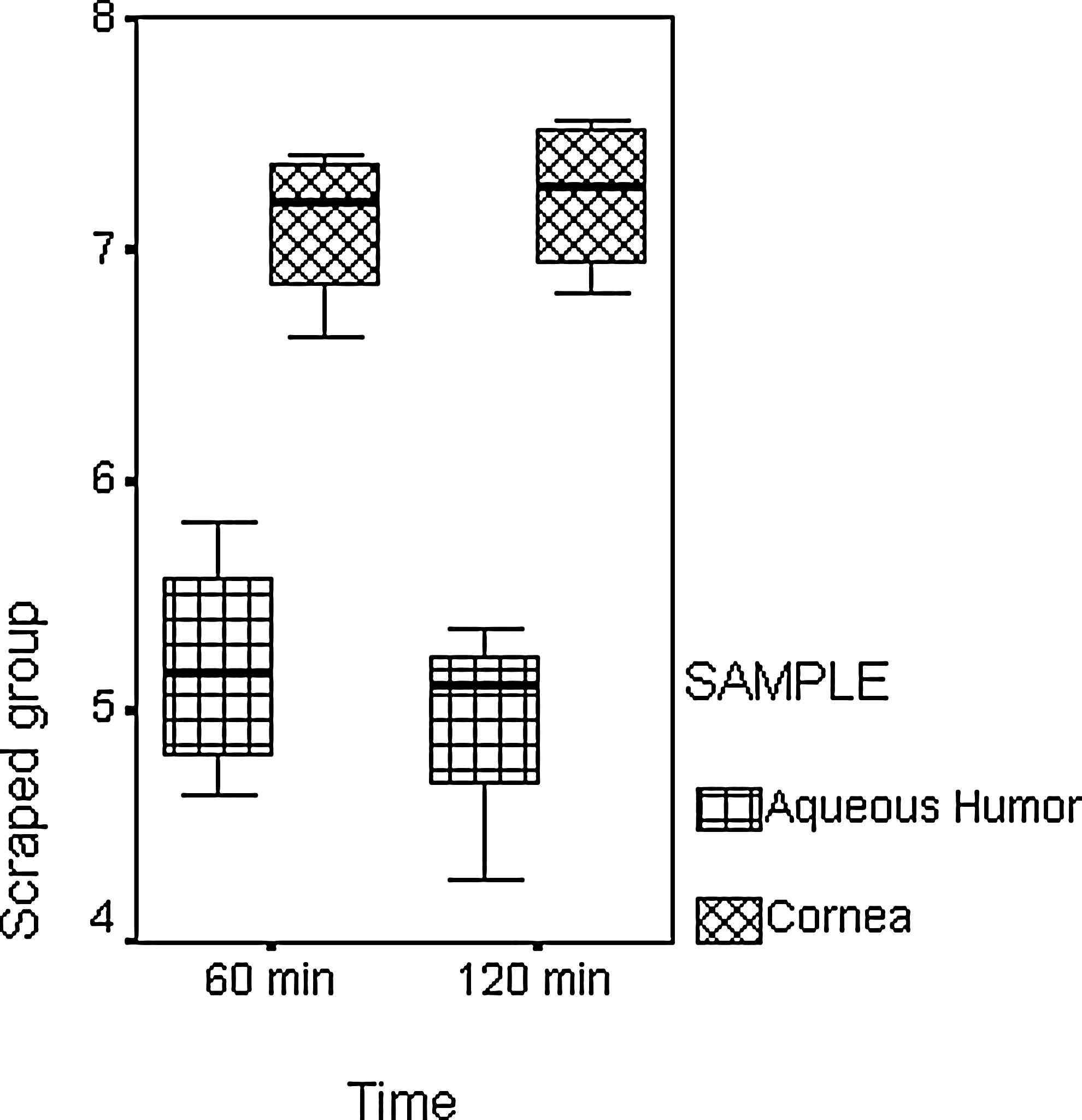
Aqueous humor (μg/mL) and cornea (μg/g) concentration of daptomycin in the scraped group.
Values expressed as mean±standard deviation (median).
Aqueous humor: μg/mL; cornea: μg/g.
The mean cornea concentration of daptomycin was 3.93±0.67 μg/g at 1 h and 4.13±0.46 μg/g at 2 h in the nonscraped group, and 7.10±0.35 μg/g at 1 h and 7.22±0.34 μg/g at 2 h in the scraped group, respectively (Table 1; Figs. 1 and 2). These levels were statistically significant between the nonscraped and scraped groups at 1 and 2 h. There was no statistically significant difference when comparing 1 and 2 h values in corneas in groups 3 and 4 (P value>0.05).
The mean cornea concentration of daptomycin was 2.06-fold higher at 1 h and 2.41-fold higher at 2 h than aqueous in the nonscraped group, and 1.36-fold higher at 1 h and 1.45-fold higher at 2 h than aqueous in the scraped group (Table 1; Figs. 1 and 2).
Discussion
Daptomycin is a newer antibiotic that has been developed to treat resistant Gram-positive infections, including methicillin-resistant staphylococcus aureus (MRSA). It has in vitro bactericidal activity superior to that of vancomycin for antibiotic-susceptible and antibiotic-resistant strains of bacteria that cause endophthalmitis, such as S. epidermidis, S. aureus, Streptococcus pneumonia, E. faecalis, and E. faecium, at MIC90 values between >1 and 8 μg/mL.7,9,10 Our study showed that topical application of a 50-μL volume (200 μg) of daptomycin as a single drop at a 10-mg/mL concentration level did not achieve measurable levels in the aqueous humor or cornea at 30 min, 1 h, or 2 h in either the group with intact corneal epithelium (group 1) or the group with scraped corneal epithelium (group 2). In the keratitis groups with intact corneal epithelium (group 3) and with scraped corneal epithelium (group 4), daptomycin concentrations in the aqueous humor and cornea at 1 and 2 h were above the MIC of many pathogens. Daptomycin was not detected in vitreous in groups 3 and 4.
No previous study has provided data on the ocular penetration after topical administration of daptomycin. To determine the penetration level, we chose a rabbit model. Numerous pharmacokinetic studies are performed using rabbits, because the size of the globes and the turnover rates of the aqueous humor of rabbit eyes are comparable to those of the human eye. In our study, we also scraped corneal epithelium to simulate keratitis, which involves corneal epithelial disruption. Not all antibiotic agents reach therapeutic concentration levels in corneal stroma and aqueous humor. It was shown that, daptomycin penetrated cerebro-spinal fluid at a level of 6% of serum concentration in a rabbit meningitis model. 11
The average rabbit corneal thickness is around 370 μm and the average human corneal thickness is around 520 μm. 12 We can assume that daptomycin concentrations will be lower in humans since a thicker cornea may slow the drug's entry to the cornea and aqueous humor.
Antibiotic overuse and misuse have largely contributed to the emergence of multidrug-resistant (MDR) pathogens. 13 Daptomycin is one of the few options currently available to treat serious infections caused by MDR S. aureus, including isolates with reduced susceptibility to vancomycin. 14 The development of isolates of MRSA with reduced susceptibility to daptomycin has also been reported. 15 However, daptomycin has been proven to be a potent concentration-dependent bactericidal agent, and initial use of high-dose daptomycin may limit the development of resistance as a result of its more rapid bactericidal activity.16,17 Daptomycin's rapid bactericidal action makes it a useful addition to the therapeutic armamentarium for the treatment of Gram-positive infections, providing a valuable alternative to vancomycin when it is inappropriate or resistance is a problem. 18
In conclusion, single-drop administration does not yield a detectable daptomycin concentration in aqueous humor in neither nonscraped nor scraped group. In the multiple-drop regimen, daptomycin seems to penetrate well into the aqueous humor and cornea in both nonscraped and scraped groups. However, this concentration may not cover the MIC of organisms such as Enterococcus fecalis. Further studies of the penetration and tolerability of daptomycin in the human eye are required.
Footnotes
Acknowledgments
This work was supported by grants from Konya Training and Research Hospital (KTRH-28), Konya, Turkey.
Author Disclosure Statement
The authors have no financial or proprietary interest in any material or method mentioned. The authors report no conflicts of interest. The authors alone are responsible for the content and writing of article.