




Abstract
Abstract
Purpose:
To evaluate the efficacy of mineralocorticoid-receptor antagonists in comparison to acetazolamide and observation in the treatment of central serous chorioretinopathy.
Methods:
Retrospective, interventional cohort study on 93 patients with acute or chronic central serous chorioretinopathy (37 patients: acetazolamide group, 20 patients: mineralocorticoid-receptor antagonist group, 8 patients: observation group, and 27 patients with a therapy switch between both medications). Main outcome measures were the change in best-corrected visual acuity, subretinal fluid (SRF) volume, central retinal prominence, and highest retinal prominence (HRP) at 12 weeks.
Results:
HRP and SRF volume improved with statistical significance (P ≤ 0.05) after mineralocorticoid-receptor antagonist (P = 0.0000003 for the prominence, P = 0.008 for the volume) and acetazolamide (P < 0.0000001 for the prominence, P = 0.0000007 for the volume) treatment. HRP and SRF volume also improved after observation, but without statistical significance (P = 0.08 for the prominence, P = 0.72 for the volume). Corresponding visual acuity improved significantly in acetazolamide (P = 0.002) and mineralocorticoid-receptor antagonist (P = 0.03) treated patients. Interestingly, HRP and SRF volume in acetazolamide nonresponsive patients improved after switch to mineralocorticoid-receptor antagonists, whereas no benefit was seen in patients switching vice versa.
Conclusions:
Both medical treatments are effective first-line treatment options for central serous chorioretinopathy. In patients who are nonresponsive to acetazolamide, therapy switch to mineralocorticoid-receptor antagonists could be beneficial.
Introduction
A
It commonly occurs in patients between 30 and 50 years and affects men more often than women.3,4 Bilateral involvement is reported in as many as 40%, although it tends to be much lower on first diagnosis with only 4%. 5 Risk factors include psychological stress, type A personality, systemic steroid use, hypertension, and pregnancy.6–8
The precise mechanism of CSCR is not known, but abnormalities in the choroidal layer, such as dilatation of choroidal vessels resulting in choroidal thickening, are proposed to play a major role9,10 refined by new technologies such as enhanced depth imaging—optical coherence tomography (OCT). 11 Fluorescein angiography aids identification of specific pigment epithelial leaks and assists differentiation from other choroidal pathologies such as (CNV) and polypoidal choroidal vasculopathy, whereas indocyanine green angiography shows more diffuse hyperfluorescent plaques on mid-phase, demonstrating inner choroidal staining. 12
CSCR is classified in an acute or chronic form, whereas chronicity is defined as persistent fluid for at least 4 months.13,14 Although acute episodes resolve spontaneously, the disease can progress slowly to chronic CSCR with persistent serous detachment, widespread RPE alterations, and cystoid retinal degeneration in 5%–10%. 12
Treatment is still based on small clinical trials and institutional experience. Acute CSCR is traditionally managed by observation. Treatment options include focal laser coagulation, 15 photodynamic therapy (PDT),16,17 and various medical therapies, for example, oral carbonic anhydrase inhibitors (acetazolamide). 18 Furthermore, intravitreal anti-VEGF inhibitors are indicated in patients with a secondary CNV. Recent advances in technology led to a refinement of established treatment options to prevent treatment-related vision loss such as half-dose 19 or half-fluence 20 PDT or to the development of new treatments such as retinal navigation laser therapy.21,22,23
According to a new animal model, the mineralocorticoid-receptor seems to play a major role in the pathophysiology of CSCR. 24 Since there is still no evidence-based therapy for nonself-limiting CSCR, antagonists of this receptor (spironolactone or eplerenone) have recently gained much interest.
The aim of our retrospective study was to evaluate the effect of acetazolamide and mineralocorticoid-receptor antagonist (MRA) treatment compared with observation. Furthermore, we analyzed patients with a therapy switch between the 2 medications.
Methods
Study design
In this interventional, controlled, and retrospective cohort study, 99 eyes of 93 consecutive patients, seen between 2011 and 2016 at the Department of Ophthalmology of the University of Berlin, Charité, Germany, who received medical therapy initially (acetazolamide or MRA) or were observed only, are presented. All procedures conformed to the tenets of the declaration of Helsinki; patient informed consent and the Institutional Review Board approval were obtained prior study initiation.
Baseline
At baseline and all follow-up visits, OCT measurements were performed and the following parameters were extracted retrospectively: highest retinal prominence (HRP) in μm, defined as the distance from the RPE to the internal limiting membrane (ILM) at the highest point within the macula, using the macular thickness map on OCT (Heidelberg Spectralis, Heidelberg Engineering, Heidelberg, Germany). We also assessed the PED height in μm by a manual measurement of the distance between the RPE and the Bruch Membrane at the highest concavity. Central foveal prominence was determined by using the “calliper” option for a manual measurement of the distance between the ILM and the outer border of neuroretina within the fovea. For a more accurate analysis of the therapeutic effect, we also assessed the subretinal fluid (SRF) volume. For the volume calculation, the area with SRF was manually selected and calculated in mm2 by using ImageJ (US National Institutes of Health, Bethesda, MD) for each individual slice of the OCT images. The area was then multiplied by the distance between the B-scans (extracted from the Heidelberg software) to approximate the volume.
Patients were further divided, into patients with center involving or peripheral CSCR, whereby center involvement was defined as fluid accumulation within the 5.5 mm diameter of the macula. The presence of a fluorescein angiography was also mandatory for diagnosis confirmation, and it was repeated in every patient who was suspicious for a CNV.
Treatment and follow-up
Treatment of naïve patients with either an acute or chronic CSCR, defined as symptoms for more than 3 months according to Bousquet et al., 25 who were either treated with acetazolamide or MRA or only observed, is presented. Exclusion criteria were treatment with acetazolamide or MRA at baseline, pretreatment with any invasive therapy (intravitreal injections, laser treatment or PDT), or any confounding retinopathy.
The initiated treatment consisted of acetazolamide: 250 mg 3 times daily, in addition to potassium substitution or MRA; spironolactone: 100 mg/day or eplerenone 50 mg/day for 6 weeks. Plasma potassium concentrations were monitored at baseline and periodically according to the drug manufacturer's instructions.
Patients were observed initially, if they did not suffer from any subjective visual deterioration, if they had known contraindications against medical therapy, or if they denied any treatment. In all other patients, medical therapy was initiated. The rationale for using either acetazolamide or MRA was based on the fact that MRA were first introduced as a treatment modality for CSCR in 2012 and on clinical preferences of the treating physician.
As of its retrospective nature, follow-up visits were divided into 2 timeframes: 4–6 weeks (visit 2) and 7–12 weeks (visit 3). At visit 2, the initial therapy was continued, if the serous detachment (and/or PED) decreased, but residual fluid was detected. A therapy initiation from observation to treatment or a therapy switch between the medical therapies was considered in patients, without any improvement or worsening in SRF (and/or PED) or in case of intolerable treatment-related adverse events under the current medication. In case of a therapy switch, the patient data before therapy initiation (visit 1) and at their last visit before the patients were switched (visit 2) were analyzed. Furthermore, the change in clinical parameters at the first visit after the switch (visit 3) was analyzed and the treatment duration of the first-line therapy before the switch was recorded. Criteria for discontinuation of medical therapy were the absence of SFR (and/or PED) or only residual fluid.
The main outcome measures were defined as reduction of the HRP and SRF at 12 weeks (visit 3). Secondary outcome measures were the change in best-corrected visual acuity (BCVA) and central retinal prominence (CRP), the occurrence of foveolar atrophy and subretinal fibrosis, treatment-related adverse effects, and the percentage of eyes achieving complete resolution of SRF at 12 weeks.
In most of the patients, no further treatment was necessary after visit 3. Any ongoing treatments after visit 3 were recorded, but not included in this study, as there was a large variance in treatment modalities applied as well as time-points of follow-up visits, which made an accurate analysis impossible.
All results are expressed in mean ± standard deviation (SD). Normally distributed variables were compared by using a 2-way ANOVO with Tukey's post hoc test for multiple comparisons. Patients with missing data were excluded from the study. The results were regarded as statistically significant, if P was equal to or below 0.05. All P values are referred to as being descriptive due to small group sizes in partial correlation. Statistics were performed with SPSS Version 11.5 (IBM, Armonk, NY).
Results
Patients
In total, 99 eyes of 93 patients (75 men and 18 women) with CSCR and with a mean age of 44 ± 7.5 years were included into the study. The CSCR was unilateral in 83 patients and bilateral in 10 patients. The details for each group are listed in Table 1.
The table shows an equal distribution of patients between all groups regarding male (M)/female (F) ratio, age, and follow-up time. The number of patients per group and the duration of symptoms before the study begins vary.
Two-way ANOVA of baseline versus last visit.
HRP, highest retinal prominence; SD, standard deviation; SRF, subretinal fluid volume; MRA, mineralocorticoid-receptor antagonist.
Efficacy
Medical therapy leads to a significant improvement of HRP and SRF at 12 weeks (mean change in HRP: −192 μm for acetazolamide and −165 μm for MRA; mean change in SRF: −1.44 mm3 for acetazolamide and −1.07 mm3 for MRA, Table 1, Fig. 1). There was also a trend toward reduction of HRP and SRF in the observation group, but without statistical significance (mean change in HRP: −71 μm, SRF: −0.40 mm3). A group of patients who showed only a slight reduction in HRP and SRF after acetazolamide treatment (visit 2, HRP: −23 μm, SRF: −0.58 mm3, Table 2) significantly improved after therapy switch to MRA (visit 3, HRP: −144 μm, SRF: −0.81 mm3, Fig. 2). Before the switch, acetazolamide treatment had been applied for a mean duration of 5.7 weeks. In detail, among the 21 patients switching from acetazolamide to MRA, 12 patients were switched at their second visit and 9 patients were switched at the third visit. Vice versa, patients who showed just a slight reduction of HRP and SRF under MRA (visit 2, HRP: −61 μm, SRF: −0.02 mm3) worsened after therapy switch to acetazolamide (visit 3, HRP: +44 μm, SRF: +0.19 mm3). Patients were treated with MRA for a mean duration of 5.6 weeks, before being switched to acetazolamide. In detail, 3 out of 5 patients were switched at the second visit and 2 out of 5 patients were switched at their third visit.

Optical coherence tomography images of 3 study patients.
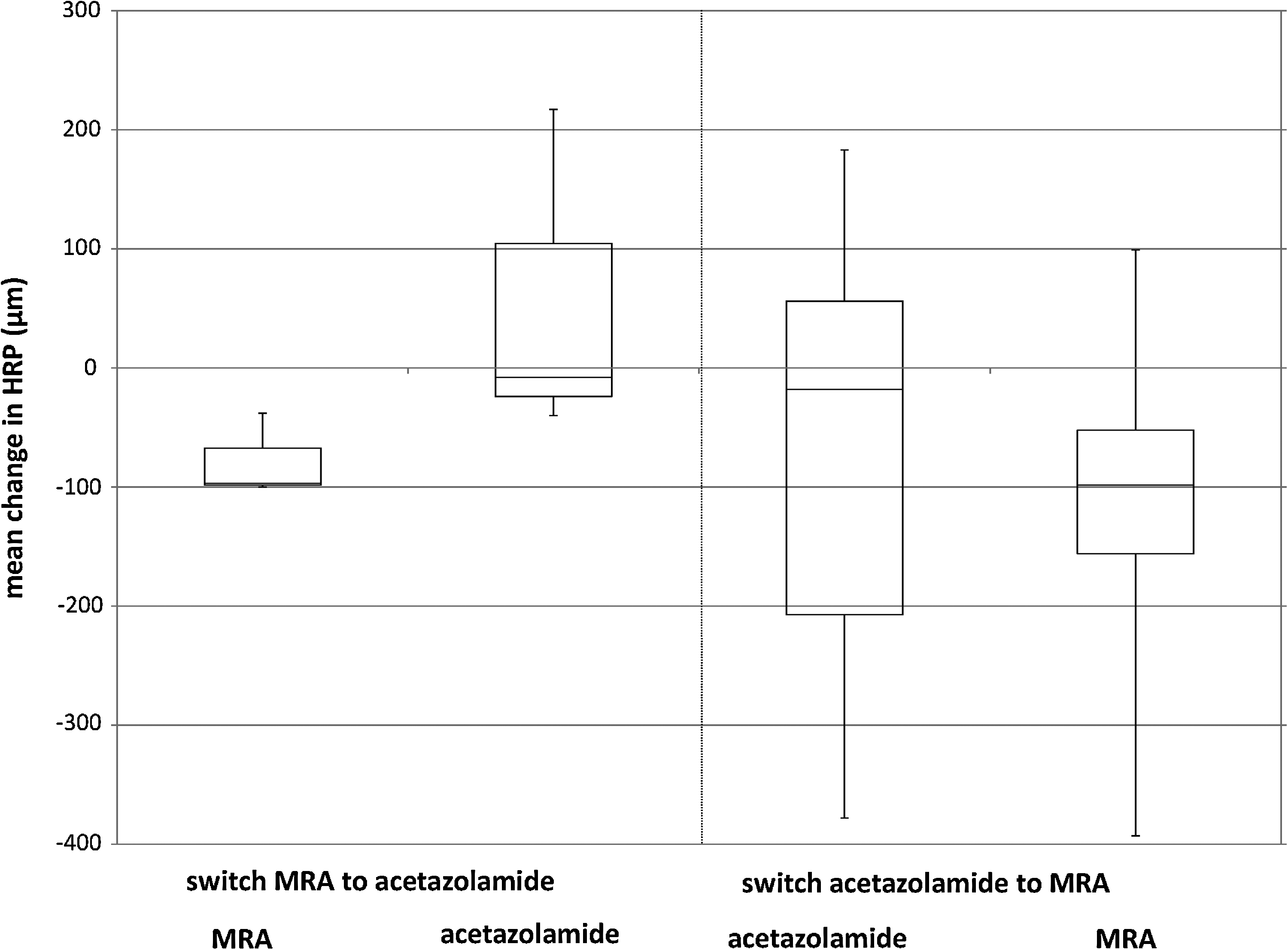
Therapy efficacy of medical treatment in patients with a therapy switch between the medical treatments. The figure shows the difference in mean change in the highest retinal prominence in μm for patients with a therapy switch between the medical therapies. first plot: visit 1–baseline; second plot: visit 2–visit 1. HRP, highest retinal prominence.
The table shows an equal distribution of patients between all groups regarding male (M)/female (F) ratio, age, and follow-up time. The number of patients per group and the duration of symptoms before the study begins vary.
Two-way ANOVA of visit 2–baseline.
Two-way ANOVA of visit 3–visit 2.
A PED on OCT was detected in 24 out of 93 (25%) patients at baseline (Table 3). The PED height decreased after medical therapy initiation (mean change: −68 μm, P = 0.005 for acetazolamide; mean change: −57 μm, P = 0.33 for MRA). The PED height also decreased, if patients were only observed (mean change: −35 μm, P = 0.54). A complete resolution of PED could be achieved in 3 out of 8 (37.5%) patients in the acetazolamide group, 1 out of 8 (12.5%) patients in the MRA group, and 0 out of 3 (0%) patients in the observation group.
Patients with acute and chronic CSCR and their therapy response to medical therapy or observation are listed separately.
CSCR, central serous chorioretinopathy.
Patients were further distinguished into patients with acute or chronic CSCR, and their individual response rates were evaluated. The mean decrease in HRP of all acute CSCR patients treated with acetazolamide was 193 and 26 μm in chronic CSCR patients (Table 3). The MRA treatment led to a mean decrease of 215 μm for acute CSCR patients and 90 μm for chronic CSCR patients. The mean decrease in HRP of observed patients was 54 μm among acute CSCR patients and 30 μm among chronic CSCR patients.
The proportion of the patients with center involving CSCR was 96%. The CRP reduced within the study period in all patients. In patients with a chronic CSCR, baseline CRP was significantly lower compared with patients with an acute CSCR (176 ± 54 μm vs. 199 ± 29 μm, P = 0.05), along with a higher rate of foveolar atrophy among chronic CSCR patients.
Regarding the mean change in BCVA, a significant improvement could be achieved in the acetazolamide group (P = 0.002; Table 4), in the MRA group (P = 0.03), and after therapy switch to MRA in patients nonresponsive to acetazolamide treatment (P = 0.01). The BCVA also improved after observation (P = 0.5), but without statistical significance and decreased after therapy switch from MRA to acetazolamide.
logMAR = logarithm of minimal angle of resolution.
Two-way ANOVA: for groups 1–3: last visit–baseline or group 4, 5: visit 2–baseline.
Two-way ANOVA of visit 3–visit 2.
BCVA, best-corrected visual acuity.
Complications and follow-up
Retinal pigment epithelial atrophy was seen in 3% of patients because of longstanding CSCR. Subretinal fibrosis was seen in 11% of patients, with 50% of these already having a chronic CSCR before study inclusion. Most of the patients with central fibrosis (87.5%) also exhibited foveolar atrophy, with significantly lower CRP already at first examination. Overall, foveolar atrophy was seen in 20% of the patients at the end of the study period, with 76% of these patients having chronic CSCR.
Within the follow-up period (21 ± 12 months), 8 patients received further more invasive treatment. Anti-VEGF injections were administered in 4 out of 93 (4.3%) patients. Focal laser treatment (including retinal navigation therapy) was initiated in 4 out of 93 (4.3%) patients, and 1 out of 93 (1.1%) patients underwent PDT. Five of these 8 patients suffered from a chronic disease course, with symptoms ranging between 4 and two 24 months prior medical treatment initiation.
Some mild side effects were observed, such as diarrhea, nausea, and vomiting, in 19% of all patients treated with acetazolamide and in 15% of all patients treated with MRA, and there were no clinically relevant laboratory abnormalities. For a detailed overview, see Supplementary Table S1 (Supplementary data are available online at www.liebertpub.com/jop).
Discussion
As CSCR could be self-limiting, observation is an appropriate approach for the first 4 months. In their retrospective series of 68 eyes, Gilbert et al. found that 57% resolved without intervention with a return to a BCVA of almost 6/6 within 1 year. 26 Our results, with a resolution of SRF in only 50% of the patients and a nonsignificant decrease in HRP and SRF, are in accordance with 2 other studies. In these studies, where treatment-naïve patients served as a control group 18 or received only placebo, 25 a significant benefit of the medical therapy compared with observation could be demonstrated regarding the reduction of highest retinal thickness (HRT).
Oral acetazolamide has been investigated in 3 smaller trials, with the rationale that inhibition of carbonic anhydrase IV in the RPE seems to promote resorption of SRF and retinal adhesion.27,28 Patients treated with acetazolamide had faster subjective improvements and resorption of SRF, with a mean time to resolution of 3.3 ± 1.1 weeks in the treatment group compared with 7.7 ± 1.5 weeks in the control group (P < 0.001). There was no difference in final BCVA or recurrence rate between these groups. 18 Our acetazolamide group showed a significant reduction in HRP (P < 0.0000001) and SRF (P < 0.001), in addition to a significant improvement in BCVA (P = 0.002), implicating that acetazolamide accounts as an effective first-line treatment.
Glucocorticoids play a major role in the pathogenesis of CSCR. In addition, it has been proposed that excessive glucocorticoid-dependent choroidal mineralcorticoid receptor (MR) activation in choroid vessels may be involved in the pathogenesis of CSCR. 24 Animal models and case reports have demonstrated that aldosterone-induced thickening was inhibited by the presence of an MR antagonist.24,29 Therefore, the use of MR drugs such as oral eplerenone or spironolactone has been considered a treatment option for patients with CSCR. Recently, a prospective, randomized, double-blinded, and placebo-controlled crossover study has gained much interest. 25 In detail, HRT improved in patients with chronic CSCR switching from placebo to MRA and worsened again in the same patients after switching from MRA to placebo. Two recent case series on MRA for chronic CSCR patients demonstrate a reduction of SRF between 52% 30 and 93% 31 of all reviewed patients. Our MRA group also demonstrated a significant reduction in HRP (P = 0000003) and SRF (P = 0.008), with an improvement in 18 out of 20 (90%) patients and a complete resolution of SRF in 12 out of 20 (60%) of the chronic CSCR patients. Therefore, our response rates lie within a similar range compared with the literature. In contrast to Chin et al., who report a less dramatic decrease in HRP and SRF after MRA treatment in recalcitrant patients compared with treatment naïve patients, 30 we found MRA to be similarly effective in treatment-naïve patients and in patients pretreated with acetazolamide in a larger patient cohort. In this context, we could demonstrate a significant benefit in SRF and HRP reduction in patients switching from acetazolamide to MRA.
If we compare the clinical outcomes of both applied medications on treatment-naïve patients only, the levels of significance for BCVA gain, decrease in HRP and SRF are a bit lower in the MRA compared with the acetazolamide group. This might be due to the higher number of patients with a chronic CSCR in the MRA group (40% in the MRA group vs. 5% in the acetazolamide group) and might be due to the different numbers of patients in both groups.
A separate analysis of patients with a chronic disease course in the MRA group (not applicable for the acetazolamide group, with only 2 patients with chronic CSCR) shows that MRA led to an improvement of SRF in 6 out of 8 patients (75%). This poorer result compared with Salz et al., who stated an improvement in 93% of their chronic CSCR patients, 31 could be due to the shorter duration of fluid accumulation in their study of 6 months (range 3–49 months) versus 25 months (3–65 months) in our study. Overall, our results and current literature implicate that MRA are an effective treatment modality for patients with acute and chronic CSCR and in patients with a poor response to acetazolamide. This could be explained by the mechanism of action of the different medications. Mineralocorticoid-receptor antagonists directly influence the disease pathomechanism, whereas acetazolamide simply drains the fluid.
Regarding the response rates of the 24 patients with an additional PED, we could not demonstrate a significant difference in treatment response and a reduction in PED height between the 2 medications, but there was a trend toward a better outcome for acetazolamide treatment with a complete resolution of PEDs in 37.5% versus only 12.5% in the MRA group. Notably, none of the patients in our observation group achieved a complete resolution of PED, although a reduction could be detected. As for the natural course of PED flattening, it is known from the literature that a complete resolution of PEDs occurs in 65% of patients without treatment and they are associated with a good visual prognosis, especially extrafoveal PEDs. 32 The discrepancy between the literature and our findings might be due to the smaller number of patients in our observation group and the fact that we have not distinguished PEDs according to their location.
We observed a significant change in BCVA in the MRA and acetazolamide group and after therapy switch from acetazolamide to MRA, corresponding to the achieved significant reduction in HRP and SRF. We could not detect a significant increase in BCVA in the observation group, although SRF and HRP improved as well. A discrepancy between resolution of SRF and improvement of BCVA has also been observed in other studies. 33 These less favorable results in terms of visual acuity and morphologic reconstitution can be expected for patients with recurrent and chronic disease courses, 3 as longstanding fluid accumulation results in irreversible damage of the photoreceptor and of the RPE. In this context, in our study, we could demonstrate a higher incidence of foveolar atrophy in patients with chronic disease.
There are several limitations to this study. The data are retrospective and, thus, carry the risk of selection bias, with small sample sizes in several groups with an in-part heterogeneous composition. Because CSCR often regresses spontaneously, it is quite difficult to distinguish the benefit of the applied medications from the natural course, regarding the small number of patients in the observation group. However, spontaneous resolution is rather a feature of acute than of longstanding CSCR. To minimize the effect of spontaneous regression, we evaluated a high number of patients with a chronic disease course in the MRA and observation group.
Depending on study type and length of follow-up, recurrence rates that ranged from 15% to 50% were observed without treatment,6,34 with as much as 50% within the first year.2,35 In our study, recurrence rates were equally distributed in all groups (9%; 3 patients treated with acetazolamide, 3 patients treated with MRA), within a range of 2–14 months after treatment discontinuation. Therefore, no conclusion could be drawn toward a benefit of a prompt treatment initiation and the number and time-points to relapses. However, since the MRA has low toxicity and tolerable side effects, a long-term treatment should be discussed. In selected patients, they may prevent recurrent episodes of CSCR, resulting in further vision loss.
Conclusion
With all the inherent limitations of a retrospective study, MRA seems to have at least comparable efficacy to acetazolamide under real-world conditions in patients with CSCR. Furthermore, in patients nonresponsive to acetazolamide, we could demonstrate a benefit from switching toward MRA. In case of good BCVA and only minimal symptoms, observation could also be discussed, because spontaneous resolution of acute episodes is not uncommon.
Footnotes
Author Disclosure statement
No competing financial interests exist.
References
Supplementary Material
Please find the following supplemental material available below.
For Open Access articles published under a Creative Commons License, all supplemental material carries the same license as the article it is associated with.
For non-Open Access articles published, all supplemental material carries a non-exclusive license, and permission requests for re-use of supplemental material or any part of supplemental material shall be sent directly to the copyright owner as specified in the copyright notice associated with the article.
