




Abstract
Abstract
Purpose:
The purpose of the study was to determine the concentrations of Flarex® and Lotemax® when shaken and not shaken. Many patients fail to shake or inappropriately shake suspensions of corticosteroids before instillation as directed. This study was designed to help determine what concentration of corticosteroid these patients are receiving. In addition, independent confirmation of loteprednol etabonate ophthalmic gel dose uniformity was determined and compared as a possible alternative.
Methods:
Drug concentrations of shaken versus unshaken Flarex and Lotemax were determined over a 20-day simulated tapered course in our institutional laboratory. Collected samples were analyzed by reversed-phase high-performance liquid chromatography with photodiode array detection at 240 nm.
Results:
Flarex had a mean concentration of 93.7% of the declared concentration when shaken and 7.25% when not shaken. The difference between these groups was statistically significant (P = 0.0001). Lotemax had a mean concentration of 96.74% of the declared concentration when shaken and a mean concentration of 98.97% when not shaken. The difference between these groups was not statistically significant (P = 0.194).
Conclusions:
Flarex maintains dose uniformity when shaken. When not shaken, it has poor dose uniformity. Lotemax was consistent whether shaken or not in our study and can be considered to eliminate the variability of poor patient compliance with shaking. The manufacturers of both drugs recommend shaking before application.
Introduction
T
Fluorometholone acetate (Flarex®; Alcon Laboratories, Inc., Fort Worth, TX) is a commonly used corticosteroid suspension that requires vigorous shaking before application. 5 Loteprednol etabonate (LE) ophthalmic gel 0.5% (Lotemax®; Bausch and Lomb, Inc., Tampa, FL) is a newer formulation with comparable efficacy to other corticosteroids and the manufacturer recommends inverting the closed bottle and shaking once to fill the tip before instilling drops. Lotemax has equal dose uniformity whether shaken or not. 6 Both medications are used in the treatment of steroid-responsive inflammatory conditions of the palpebral and bulbar conjunctiva, cornea, and anterior segment of the eye.5,7 They are frequently used following refractive surgery in managing inflammation and modulating wound healing.1,8
LE ophthalmic gel 0.5% is a formulation of LE approved by the US Food and Drug Administration (FDA) in 2012. This drug is unique compared with many other ocular corticosteroids in its ability to change from a gel to a liquid upon increased shear stress, thus converting to a liquid form when squeezed from the bottle. 9 After application to the corneal surface, it remains liquid owing to its polycarbophil polymer that promotes its more viscous structure on the ocular surface. 9 Lotemax gel has been shown to have dose consistency after dispersion analysis demonstrated no sedimentation of drug particles. 10
Due to its gel formulation, Lotemax remains homogeneous and should not require shaking to achieve dose uniformity. This property eliminates dependence on patient compliance to shake before dosing. One previous study demonstrated that LE gel (Lotemax) has superior dose uniformity compared with prednisolone acetate suspension when not shaken. 10
The goal of this study was to determine the difference in the concentrations that patients might actually be receiving when corticosteroid suspension Flarex is adequately shaken versus not shaken. We also sought to independently confirm Lotemax gel dose uniformity.
Materials
Drugs and chemicals
Fluorometholone acetate ophthalmic suspension, 0.1% (Flarex), was obtained from Alcon Laboratories, Inc. LE ophthalmic gel, 0.5% (Lotemax), was obtained from Bausch and Lomb, Inc. Fluorometholone acetate USP Reference Standard (200 mg) was obtained from US Pharmacopeia (Rockville, MD). Methanol [high-performance liquid chromatography (HPLC) grade] was obtained from Sigma-Aldrich (St. Louis, MO).
HPLC analysis of fluorometholone acetate and LE
HPLC analysis of fluorometholone acetate and LE was performed on a Waters Acquity Ultra-Performance Liquid Chromatographic System equipped with an Acquity Binary Solvent and Sample Manager, Acquity Photodiode Array Detector, Empower 3 software, and a Phenomenex Luna C18 reversed-phase column (2.0 × 150 mm, 5.0 μ, Cat. No. 475946-1). The HPLC mobile phase was methanol (100%), the chromatographic flow rate was 0.25 mL/min, and quantitation of both drugs was performed at 240 nm.
Methods
This is an institutional experimental laboratory study without human subjects.
Six commercial bottles of Lotemax gel (0.5% 5 mL container) and 6 commercial bottles of Flarex (0.1% 5 mL container) were purchased and stored at room temperature. The bottles were individually labeled and then shaken as per manufacturer instructions 2 days before day 1 of the experiment to establish a consistent baseline for when the bottles were last shaken or handled.
Three Flarex bottles were vigorously shaken for 5 s immediately before dispensing, and 3 designated bottles were unshaken. The unshaken samples were collected by tipping the bottle 180°, dispensing the drops, and then returning the bottle to its original upright position. Two drops were dispensed for each sample. Days 1–5: drops were dispensed 4 times daily, but only collected for analysis on the first and last times. Days 6–10: drops were dispensed 3 times daily, but only collected for analysis on the first and last times. Days 11–15: drops were dispensed twice daily, both of which were collected for analysis. Days 16–20: drops were dispensed once daily and collected for analysis. Figure 1 illustrates pictures taken of the solution at different points in time.
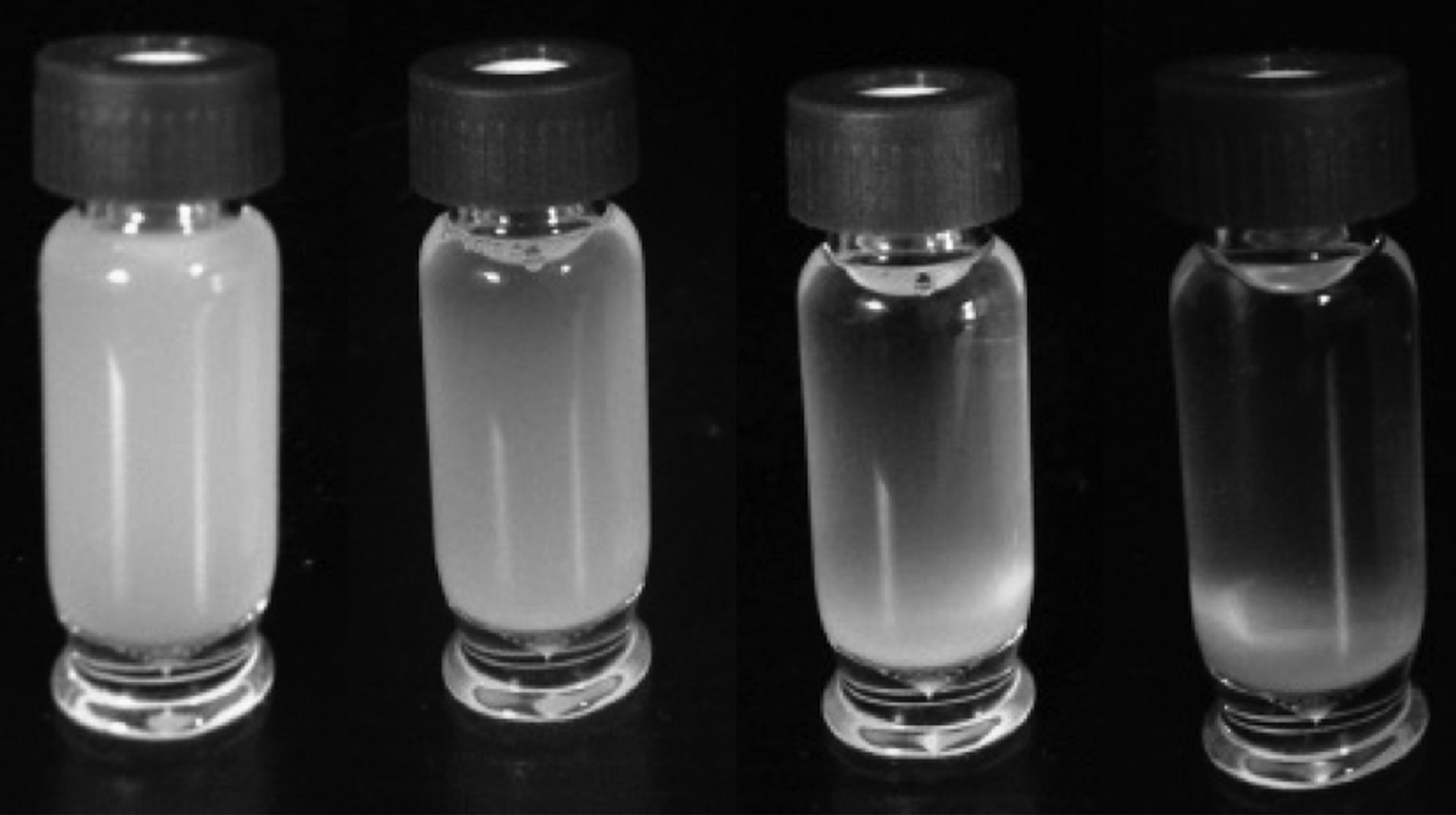
Settling affect of Flarex® with time. From left to right: immediately following shaking, 4 h after being shaken, 8 h after being shaken, and 12 h after being shaken. The picture is a collection of individual images.
Similarly, 3 Lotemax bottles were shaken and 3 others were unshaken. Collecting method and course for Lotemax shaken and unshaken bottles were exactly the same as described for Flarex. Figure 2 illustrates pictures taken of the solution at different points in time.
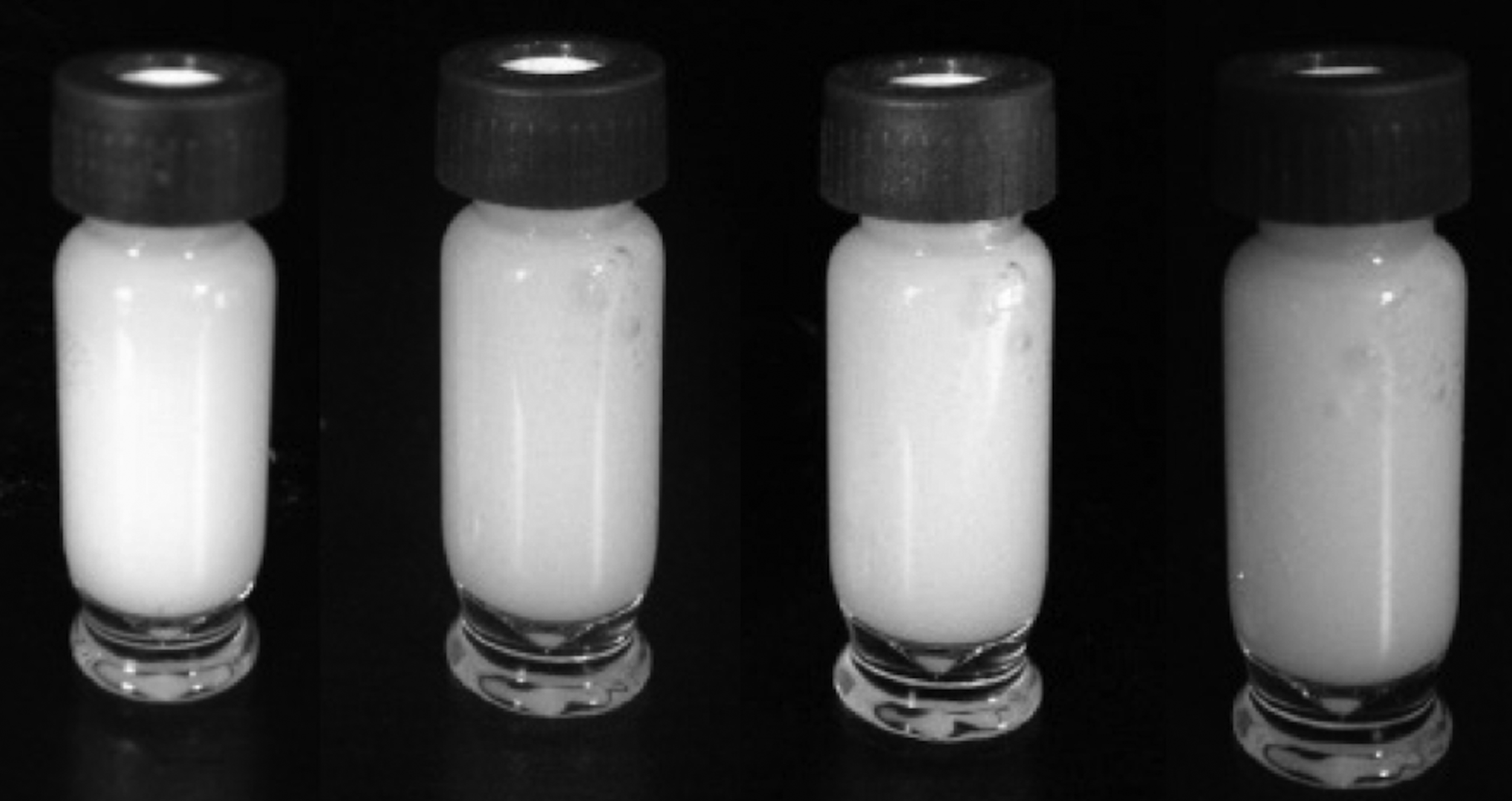
Nonsettling effect of Lotemax® gel with time. From left to right: immediately following shaking, 4 h after being shaken, 8 h after being shaken, and 12 h after being shaken. The picture is a collection of individual images.
Three bottles for each subgroup, of shaken versus unshaken, were tracked independently to account for variability. A 20-day tapered course was chosen to determine the dosing concentrations through the span of a full bottle with a volume of 5 mL (which contains ∼100 drops). The 2 arms of the study required a total of 420 samples (35 samples from 12 separate bottles) to be analyzed.
Results
The drug concentrations were determined and reported as percent of the declared bottle concentration. The declared bottle concentrations were 0.1% and 0.5% for Flarex and Lotemax, respectively.
Figure 3 shows the drug concentrations of Flarex comparing shaken with unshaken samples. The difference between Flarex shaken and unshaken for the declared concentration was found to be statistically significant (P = 0.0001) using repeated measures analysis of variance (RM ANOVA). The average concentration for the Flarex, not shaken, was 7.25% of the declared concentration (with a standard deviation of 2.44%), whereas shaken was 93.79% of the declared concentration (with a standard deviation of 2.95%). Figure 1 demonstrates visual appearance of the settling of the solution.
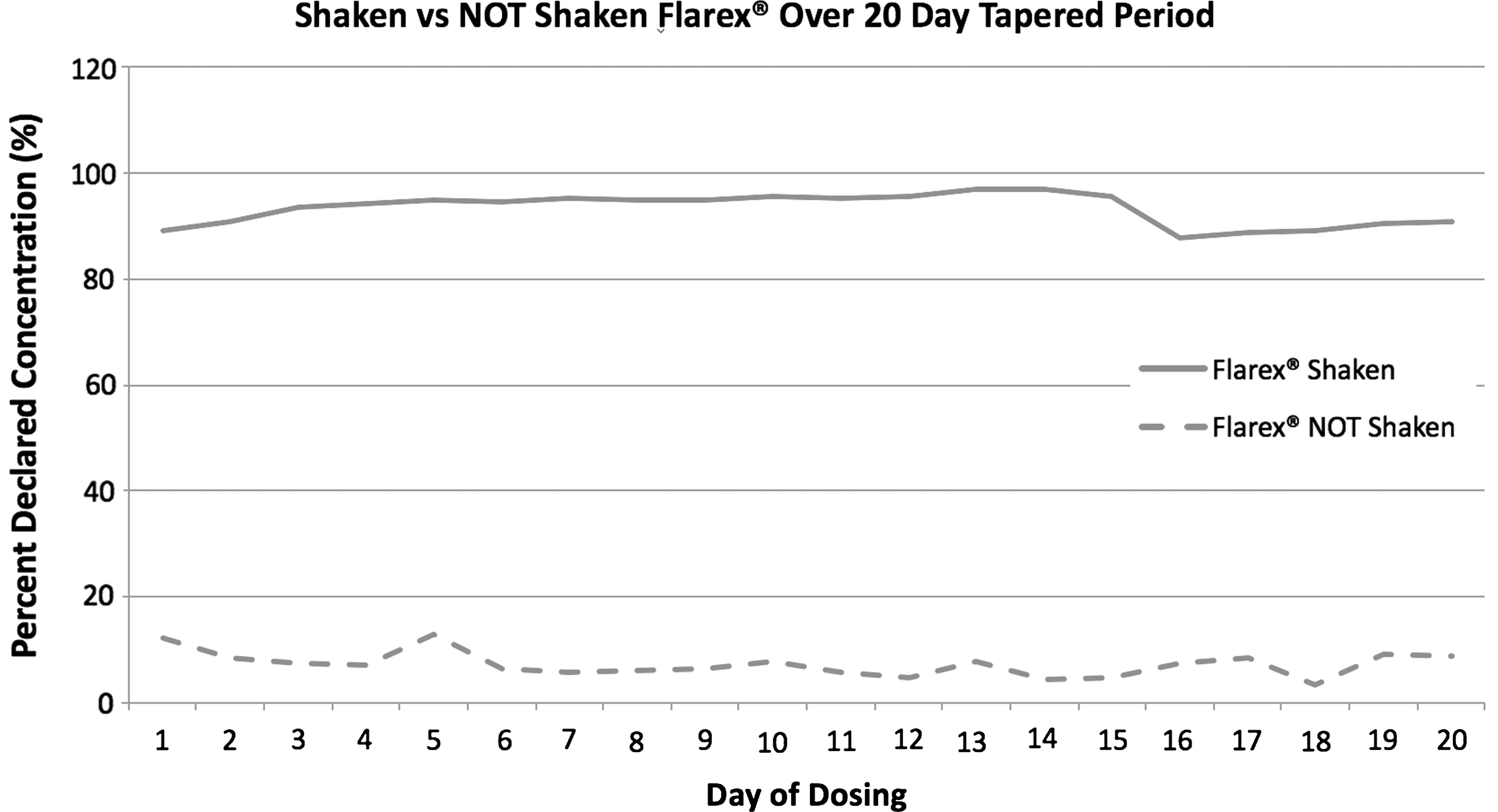
Drug concentrations in drops of Flarex® comparing shaken immediately before simulated dosing with not shaken.
Figure 4 shows the drug concentrations of Lotemax gel comparing shaken with unshaken samples. The difference between Lotemax gel shaken and unshaken for the declared concentration was not found to be statistically significant (P = 0.194) using RM ANOVA. The average concentration for the Lotemax gel not shaken was at 98.97% of the declared concentration (with a standard deviation of 1.39%), whereas shaken was 96.74% of the declared concentration (with a standard deviation of 1.73%). Figure 2 demonstrates visually the lack of settling of the solution.
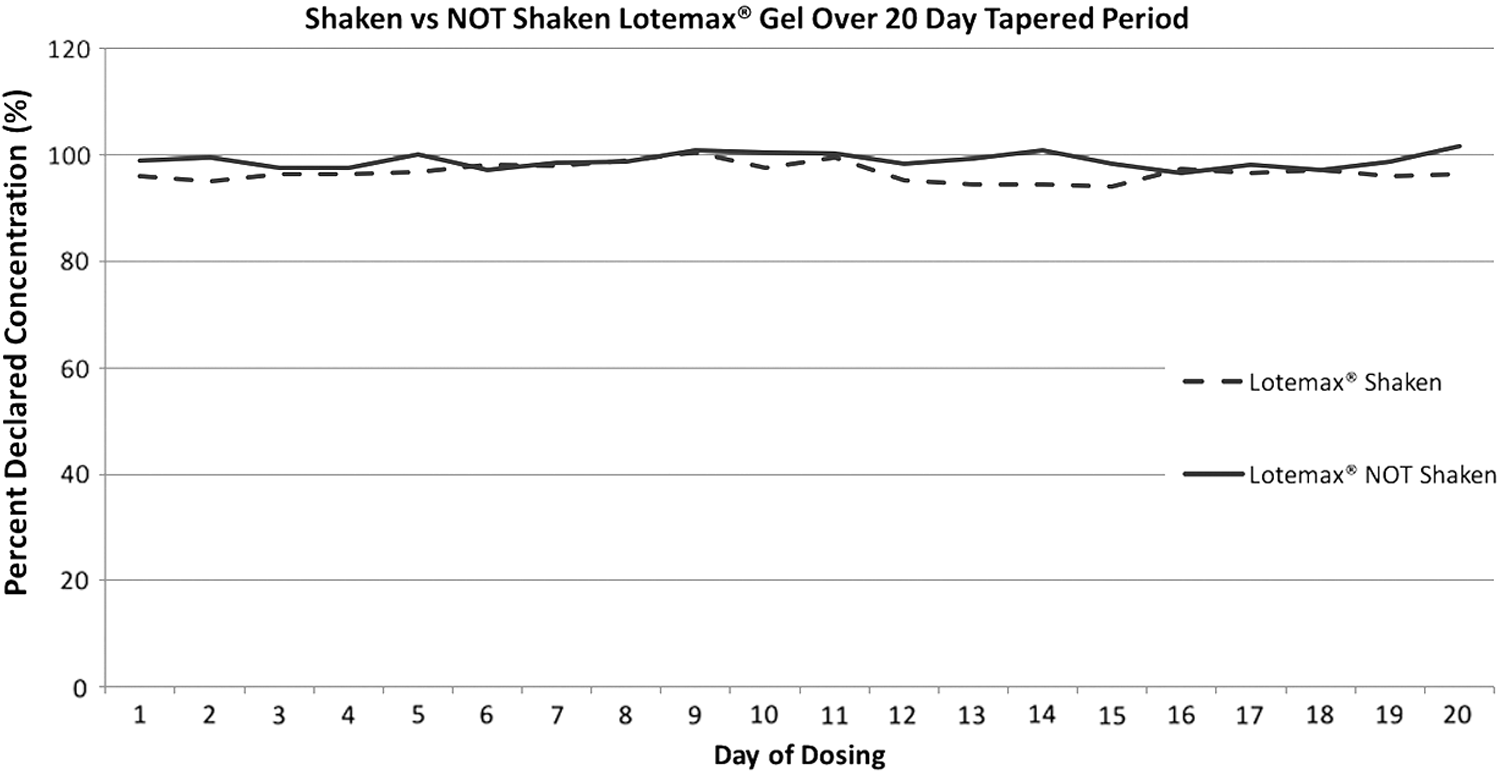
Drug concentrations in drops of Lotemax® gel comparing shaken immediately before simulated dosing with not shaken.
The unshaken Lotemax gel was on average within 1.10% [standard deviation (SD) 1.39%] of the declared concentration, whereas the unshaken Flarex was on average within 92.72% (SD of 2.44%) of the declared concentration.
Discussion
Often poor patient compliance leads to improper dosing of topical corticosteroid suspensions such as Flarex despite clear instructions by the manufacturer and prescriber. According to this study, if not shaken, patients would receive only 7.25% of the intended concentration. This much lower dose could have a clinically significant impact. However, when shaken appropriately, a satisfactory concentration is consistently obtained. This reiterates the importance of properly instructing patients to shake the suspension as per manufacturer instructions before instillation as well as the need for good patient compliance.
Lotemax gel 0.5% on the other hand eliminates the reliance on shaking. The ability of the drug to maintain a gel formulation until sheer stress is applied and then remain liquid upon application results in a homogeneous solution that does not require mixing before application. This uniform dosing, whether shaken or not, was confirmed in this study. Figure 1 illustrates the settling effect of Flarex with time. Figure 2 illustrates the preservation of homogeneity of Lotemax gel with time despite not being shaken.
Results for this study were consistent with a study by Marlow and Davio demonstrating that Lotemax gel maintains a homogeneous solution. Marlow and Davio demonstrated that the average percent declared concentration of unshaken Lotemax gel was 102%. 10 This was compared with unshaken prednisolone acetate 1% (brand name and generic), which demonstrated highly variable drop concentrations and mean concentrations of 18.5% and 22.0%, respectively. Our study also showed low mean concentrations when not shaken, but did not show the same high variability. The results for their shaken medications were consistent with our study. Their study demonstrated that after being shaken for 5 s, Lotemax gel had an average declared concentration of 102%. Both the prednisolone acetate 1% formulations had average declared concentrations of 103% when shaken.
Another study done by Stringer and Bryant compared dose uniformity of difluprednate ophthalmic emulsion (Durezol®) with prednisolone acetate (brand name and generic). 11 Similarly, prednisolone acetate 1% brand name and generic showed high variability when not shaken, whereas difluprednate had consistent dose uniformity whether shaken or not.
Clinical correlation of poor dose uniformity has not yet been determined and is an area of possible future investigation. Meanwhile, it is reasonable to assume that having consistent uniform dosing should lead to more predictable outcomes in management. If patients follow manufacturer instructions for either product, no dose nonuniformity is expected. Thus, the importance of properly shaking corticosteroid suspensions such as fluorometholone acetate should be stressed or the need for shaking may be avoided altogether by using other formulations such as LE gel.
Footnotes
Acknowledgments
Funding was provided by the US Air Force. The views expressed are those of the authors/presenters and do not reflect the official views of the Department of Defense.
Author Disclosure Statement
No competing financial interests exist.