




Abstract
Purpose:
To compare the duration of vascular endothelial growth factor (VEGF) suppression in the aqueous humor of macaque eyes after intravitreal injection of brolucizumab and aflibercept.
Methods:
Clinical dose of intravitreal brolucizumab (IVBr; 6.0 mg/50 μL) or intravitreal aflibercept (IVA; 2 mg/50 μL) was injected into the right eye of each of 8 macaques. Aqueous humor samples (150 μL) from both eyes were obtained just before injection and on days 1, 3, 7, 14, 21, 28, 42, 56, 84, and 112 after IVBr injection or IVA injection. VEGF concentrations were measured using enzyme-linked immunosorbent assays.
Results:
In the injected eyes, the mean VEGF suppression durations (range) were 4.9 (3–8) weeks for IVBr injection and 6.8 (6–8) weeks for IVA injection (P = 0.04). The VEGF concentrations returned to the preinjection level in the aqueous humor at 12 weeks both after IVBr and IVA injection. In the noninjected fellow eyes, the aqueous VEGF concentrations had decreased least at 1 day after IVBr injection and at 3 days after IVA injection, but were still detectable. The VEGF concentrations in the fellow eyes returned to the preinjection level in the aqueous humor at 1 week after IVBr injection and at 2 weeks after IVA injection.
Conclusions:
The duration of VEGF suppression in the aqueous humor after IVBr injection may be shorter than that after IVA injection, which may be related with clinical usage.
Introduction
Currently, anti-vascular endothelial growth factor (VEGF) drug therapy is the first choice for neovascular age-related macular degeneration (nAMD) and other diseases in which VEGF is part of the pathogenesis. Brolucizumab, which was first approved to treat nAMD in 2019, is a single-chain antibody fragment with a low molecular weight and a structure that differs significantly from other VEGF inhibitors, making it a durable and therapeutic next-generation anti-VEGF drug. 1 Brolucizumab is the smallest of the anti-VEGF drugs, with a molecular weight of 26 kDa, compared with 48 kDa for ranibizumab and 115 kDa for aflibercept.2,3 Its design allows brolucizumab to be concentrated to 120 mg/mL, allowing 6 mg to be administered in a 50-μL intravitreal injection. On a molar basis, 6 mg of brolucizumab equals approximately 12 times the 2-mg dose of aflibercept. 3 Two large trials, HAWK and HARRIER, demonstrated noninferiority of brolucizumab and an overall safety profile similar to that of aflibercept. 4
However, it is not possible to evaluate the duration of VEGF suppression after treatment with brolucizumab and aflibercept because of the different control drugs, doses, and durations of administration in the aforementioned randomized controlled trials. A longer period of intraocular VEGF suppression with anti-VEGF drugs reduces the frequency of injections. In the HAWK and HARRIER studies, >50% of patients treated with intravitreal brolucizumab (IVBr) injection were able to extend the dosing interval up to 12 weeks, 4 but in the ALTIR study >60% of patients treated with intravitreal aflibercept (IVA) injection were able to extend the interval up to 12 weeks. 5
Because of the different study designs, the duration of intraocular VEGF suppression after IVA injection and IVBr cannot be compared directly, so it is difficult to determine which agent has a longer duration of VEGF suppression based on clinical studies alone. There is only 1 study simulating VEGF suppression after IVBr 6 and another study measuring pharmacokinetics of intravitreally injected brolucizumab. 7 In humans, it is very ethically difficult to collect aqueous humor only for the purpose of measuring VEGF concentrations in the aqueous humor for several months after a single dose of anti-VEGF drug without additional treatment. Therefore, we tested macaques in this study, to compare the duration of VEGF suppression in the aqueous humor after IVBr injection and IVA injection.
Methods
Study design
All treatments were in accord with the principles of the Association for Research in Vision and Ophthalmology Statement for the Use of Animals in Ophthalmic and Vision Research, and the animal research protocol was approved by the Animal Experimentation Committee at Shiga University of Medical Science (approval no. 2020-1-2, 2021-11-2).
First, 4 macaques each were randomly assigned either an initial IVA injection or IVBr injection for the experiment. Each macaque was anesthetized before injection and every aqueous extraction with 5 mg/kg intramuscular ketamine hydrochloride and 1 mg/kg intramuscular xylazine hydrochloride. Povidone iodine was placed on the conjunctiva of each eye. Using a 29-gauge needle, brolucizumab (6 mg/50 μL) was injected into the vitreous cavity of the right eye of 4 macaques. The left eyes received no intravitreal injections and served as controls. Using a 29-gauge needle, aqueous humor samples (150 μL) from both eyes were obtained just before injection and on days 1, 3, 7, 14, 21, 28, 42, 56, 84, and 112 after IVBr.
Aflibercept (2 mg/50 μL) was injected into the vitreous cavity of the right eye of 4 macaques. Six months after the first drug administration, the 4 macaques that had initially received the IVA injection were given an IVBr injection, and the 4 macaques that had initially received the IVBr injection were given an IVA injection. Drug administration and anterior aqueous humor sampling were performed using the same protocol. Aqueous humor samples from both eyes of all 8 monkeys were obtained just before injection and on days 1, 3, 7, 14, 21, 28, 42, 56, 84, and 112 after IVA injection. The samples were stored in a freezer at −80°C until analysis.
Measurement of VEGF
VEGF concentrations in the aqueous humor were measured using an enzyme-linked immunosorbent assay (Quantikine Human VEGF Immunoassay; R&D Systems, Minneapolis, MN) as previously described.8–10 The limit of detection (LOD) for VEGF was set at 18.0 pg/mL. VEGF concentrations less than the LOD were set equal to 0 in the calculation of the mean.
Statistical analysis
The mean durations of VEGF suppression were compared between IVBr injection group and IVA injection group, using Mann–Whitney test. Statistical analyses were performed using GraphPad Prism 8 software (GraphPad Software, Inc., La Jolla, CA).
Results
The mean aqueous VEGF concentration of the injected eyes was 82.3 pg/mL (n = 8; range 46.6–118.6) before IVBr injection. The concentrations remained completely suppressed until week 3 in 1 eye, week 4 in 4 eyes, week 6 in 2 eyes, and week 8 in the remaining subject eye. At 12 weeks after IVBr injection, the VEGF concentration returned to the preinjection level in the aqueous humor (Figs. 1 and 3).
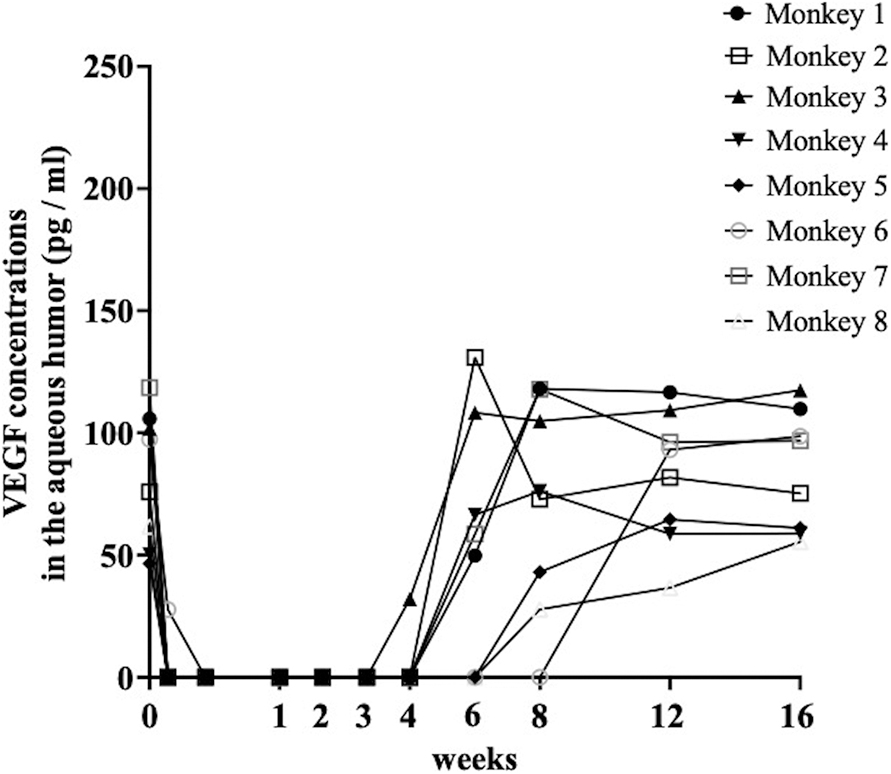
VEGF concentrations in the aqueous humor of injected eyes after IVBr injection. The scale was enlarged up to the first week to make it easier to understand the changes in VEGF concentration up to the first week after injection. IVBr, intravitreal brolucizumab; VEGF, vascular endothelial growth factor.
The mean aqueous VEGF concentration in the injected eyes was 97.2 pg/mL (n = 8; range 54.1–239.7) before IVA injection. VEGF remained undetectable until week 6 after IVA injection in 5 eyes and until week 8 in the other 3 eyes. At 12 weeks after intravitreal injection of aflibercept, the VEGF concentration returned to the preinjection level in the aqueous humor (Figs. 2 and 3).
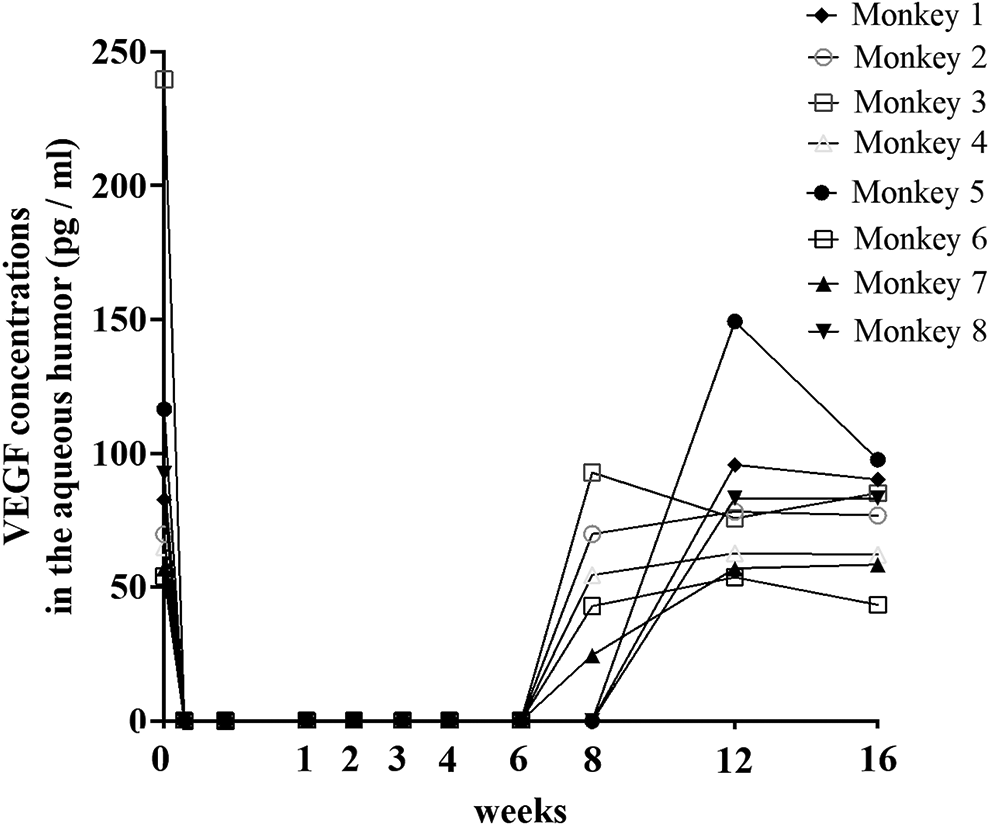
VEGF concentrations in the aqueous humor of injected eyes after IVA injection. The scale was enlarged up to the first week to make it easier to understand the changes in VEGF concentration up to the first week after injection. IVA, intravitreal aflibercept.

The mean change in VEGF concentrations in the aqueous humor of injected eyes after IVBr injection (n = 8) and IVA injection (n = 8) from the VEGF concentration before injection. The scale was enlarged up to the first week to make it easier to understand the changes in VEGF concentration up to the first week after injection.
The mean VEGF suppression durations (range) were 4.9 (3–8) weeks for IVBr injection and 6.8 (6–8) weeks for IVA injection (P = 0.04).
The mean aqueous VEGF concentration of the noninjected eyes was 58.2 pg/mL (n = 8; range 23.0–123.6) before IVBr injection. One day after IVBr injection, the aqueous VEGF concentrations decreased; however, the VEGF concentration returned to the preinjection level in the aqueous humor at 1 week after IVBr injection (Fig. 4).
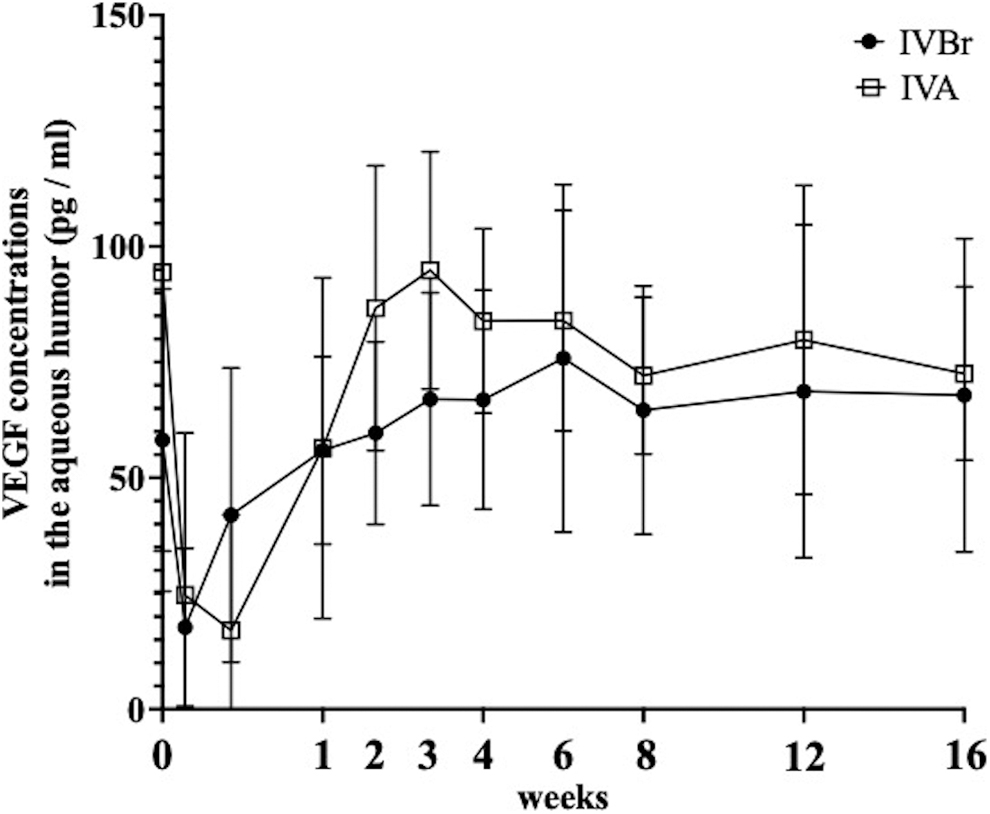
The mean change in VEGF concentrations in the aqueous humor of the noninjected fellow eyes after IVBr injection (n = 8) and IVA injection (n = 7) from the VEGF concentration before injection. The scale was enlarged up to the first week to make it easier to understand the changes in VEGF concentration up to the first week after injection.
The mean aqueous VEGF concentration of the noninjected eyes was 94.4 pg/mL (n = 7; range 52.8–224.0) before IVA injection. Three days after IVA injection, the aqueous VEGF concentrations decreased; however, the VEGF concentration returned to the preinjection level in the aqueous humor at 2 weeks after IVA injection (Fig. 4).
The comparison of the mean change in VEGF concentrations from the VEGF concentration before injection in aqueous humor between after IVBr injection and after IVA injection in the injected and noninjected eyes was shown in Figs. 3 and 4. No complications, such as uveitis or endophthalmitis, developed after IVBr or IVA injection.
Discussion
In this study, we measured how long a single intravitreal injection of brolucizumab or aflibercept could suppress VEGF in the aqueous humor of macaques. We showed that IVBr injection may be less effective than IVA injection in suppressing VEGF concentrations in the aqueous humor.
A previous study of anti-VEGF drugs in macaques investigated the ocular half-life of brolucizumab and aflibercept up to 6 weeks, and showed that the ocular half-life was 2.28 days for brolucizumab and 3.13 days for aflibercept. After intravitreal injection of the anti-VEGF drugs, smaller molecular weight drug may disappear more quickly from the eye. 7 Eissing et al. investigated whether VEGF suppression durations contribute to our understanding of clinical trial outcomes, by simulating vitreous molar concentrations of brolucizumab and aflibercept using pharmacokinetic modeling. 6 The pharmacokinetic-modeled average VEGF suppression duration for IVBr injection was substantially shorter than the published values for IVA injection and may not be sufficient to effectively suppress VEGF between every 12-week dosing.
Thus, the simulations of pharmacokinetics with intravitreal administration of anti-VEGF drugs support the results of this study. These reports suggested that the period of VEGF suppression in the aqueous humor after IVBr injection may be shorter than after IVA injection. However, to our knowledge, there have not been any publications that directly compared the durations of VEGF suppression in the aqueous humor in humans or monkeys after IVBr injection versus IVA injection. In this study, VEGF concentrations were directly measured for as long as 16 weeks, and we found that concentrations of VEGF were almost completely suppressed for 4.9 weeks after IVBr injection and 6.8 weeks after IVA injection.
A meta-analysis showed that aflibercept and brolucizumab seem to similarly improve visual acuity under comparable treatment conditions (treat-and-extend protocol) for up to 24 months, whereas a treatment interval extension to ≥12 weeks was achieved in 47.7% and 41.7% in the 2 treatments after 24 months. 11 This meta-analysis suggests that, in clinical practice, brolucizumab suppresses intraocular VEGF for a shorter period than does aflibercept. 11
In this study, although both IVA injection and IVBr injection suppressed the VEGF concentration in the aqueous humor of the noninjected fellow eye, the IVBr injection had a milder VEGF suppressive effect on the fellow eye than did the IVA injection. In a primate model, anti-VEGF drugs were detected in the body after their intravitreal injection. 12 Moreover, there have already been several reports on the suppressive effects of VEGF on the noninjected fellow eye.13–16 Therefore, it is possible that the anti-VEGF drug that migrated into the body suppressed VEGF in the noninjected fellow eye.
There were some limitations to this study. Because this experiment was performed on normal macaques, it is unclear whether the findings are applicable to animals with a disease associated with VEGF. Furthermore, the sample size was small.
Conclusion
In summary, the period of VEGF suppression in the aqueous humor after IVBr injection may be shorter than after IVA injection.
Footnotes
Acknowledgments
We thank Fumiko Kimura for her technical support. We thank Claire Barnes, PhD, from Edanz, for editing a draft of this article.
Author Disclosure Statement
Brolucizumab was marketed by Chugai Pharmaceutical Co. Ltd. and aflibercept was marketed by Bayer Yakuhin and Santen Pharmaceutical. M.O. reports grant and/or personal fees from Santen Pharmaceutical, Bayer Yakuhin, and Chugai Pharmaceutical Co. Ltd., unrelated to the submitted study. O.S and S.O report personal fees from Bayer Yakuhin, unrelated to the submitted study. The other authors declare that they have no conflicts of interest.
Funding Information
This research was funded by the Department of Ophthalmology, Shiga University of Medical Science.