




Abstract
Optic neuropathies, such as glaucoma, are some of the leading causes of irreversible blindness worldwide. There has been a lot of research for potential therapies that could attenuate and even reduce the impact of the pathological pathways that lead to the loss of retinal ganglion cells (RGCs). In recent years, vitamin B3 (nicotinamide) has gained some interest as a viable option for these neurodegenerative diseases due to its fundamental role in enhancing the mitochondria metabolism of the RGCs. This review focuses on elucidating the impact of vitamin B3 on retinal cells, especially when in a dysfunctional state like what happens in optic neuropathies, especially glaucoma. This review also summarizes the existing and future research on the clinical effects of vitamin B3 in these optic neuropathies, and determines appropriate recommendations regarding its dosing, efficacy, and eventual side effects.
Introduction
The optic nerve is anatomically an extension of the central nervous system (CNS) and consists of the retinal ganglion cell (RGC) axons. Up to 90% of the RGCs extend to the lateral geniculate nucleus, which then transmits information to the visual cortex. 1
The RGCs are the main damaged neurons in glaucomatous optic neuropathy, which is the most common form of neurodegeneration involving the CNS and the leading cause of irreversible vision loss worldwide. 2 Major risk factors for glaucoma include increased intraocular pressure (IOP), age, and race (west African). 3 However, in many individuals, glaucoma continues to progress despite significant IOP reduction. 4
RGCs are responsible for transmitting visual information from the retina to the brain and, therefore, require a relatively large amount of energy.5,6 Since lamina cribrosa is where the axons of the RGCs are unmyelinated, it is more susceptible to early microenvironmental changes such as mitochondrial dysfunction.2,5
Studies in DBA/2J mice models (with chronic elevated IOP and glaucoma) and in an inducible model of ocular hypertension in rats have shown that these mitochondrial changes occur even before detectable neurodegeneration 7 and, therefore, there is a need to investigate neuroprotective strategies targeting RGC health.
It has been shown that even after a prolonged period of functional loss due to acute and chronic elevated IOP insults, RGC function can be restored with nicotinamide supplementation. 8 In contrast, there is also growing evidence supporting a link between vitamin intake and neuronal function, maintenance, and recovery.9,10
Nicotinamide (or niacinamide or NAM), 1 of 3 vitamers of vitamin B3 [along with niacin/nicotinic acid (NA) and nicotinamide riboside (NR)], is an essential nutrient that constitutes a precursor of the coenzyme nicotinamide adenine dinucleotide (NAD+), which is a critical molecule for mitochondrial health throughout the body, especially in neurons.10,11 Note that intestinal flora can convert both NR and NAM to NA 12 and that NR has a slightly better bioavailability than NAM in humans.13,14
NAD+ levels decrease with normal aging and are reduced in patients with primary open-angle glaucoma (POAG), which may correlate NAD+ levels with susceptibility to neurodegeneration.2,5 Thus, the reduction of NAD may limit adenosine triphosphate (ATP) production, and result in an inability to provide sufficient energy to maintain cell health, ultimately leading to RGC degeneration. 5
Currently, there is an unmet need for neuroprotective agents, and NAM/NAD+ supplementation would be a promising intervention in diseases such as glaucoma, alone or possibly in combination with other nutraceutical agents such as saffron, zeaxanthin, or pyruvate.4,15
Discussion
Vitamin B3 function in the retina
The retina is one of the most energy consuming tissues in the body and this energy is vital to maintain its homeostasis.
Optic neuropathies are diseases in which the function of retinal cells is compromised. Glaucoma is one of them and it is characterized by progressive dysfunction and loss of RGCs. 16 Although elevated IOP is the main modifiable target, glaucomatous damage can arise in eyes with IOP in the normal range. 17
Nicotinamide is a precursor of the coenzyme NAD+, which is an essential molecule for mitochondrial health throughout the body. 11 Mitochondrial dysfunction and decreased NAD+ levels are hallmarks of aging in many organs,15,18 and their association with CNS impairment has been documented since the discovery of pellagra, in which the neurological dysfunction is one of the early manifestations of the disease caused by low levels of vitamin B3.13,15
Vitamin B3 role in optic neuropathies
Specifically, there is a strong association between NAD+ deficiency and some retinal neurodegenerative disorders. Leber hereditary optic neuropathy (LHON) is the most common disorder caused by mutations in mitochondria and it is caused by variants in genes that affect the reduced nicotinamide adenine dinucleotide (NADH) dehydrogenase system. Another disorder associated with nicotinamide deficiency is OPA1-related dominant optic atrophy. These 2 share an overutilization of nicotinamide to provide the redox cycle with enough electrons for NADH dehydrogenase, resulting in a deficiency of NAD+. 19
A note on Leber's congenital amaurosis, an inherited disorder caused by mutations in NMNAT1 (nicotinamide mononucleotide adenylyltransferase 1), which is a key NAD+ biosynthetic enzyme, underlining the importance of this molecule for retinal neurons. 20 In addition, in ischemic optic neuropathies (IONs), the physiopathology is not yet understood, but due to their ischemic mechanism, stress oxidation levels are known to be high. 21 Therefore, this is another group of diseases in which NAD+ may potentially act (Fig. 1). Finally, glaucoma is also profoundly related to NAD+, mainly due to the high energy demand of RGCs (Fig. 2).15,20
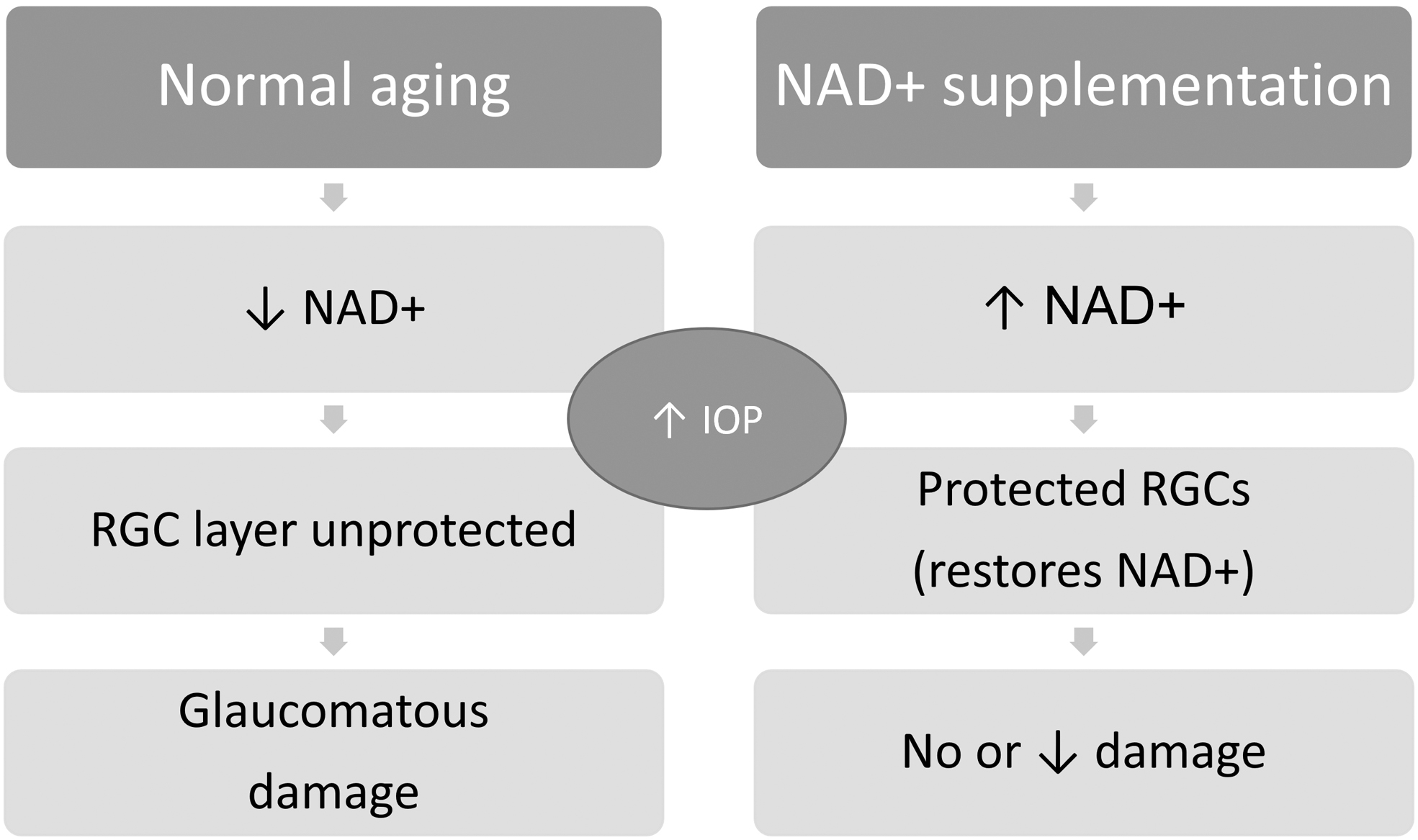
Overview of vitamin B3's potential role in ischemic optic neuropathy, resulting in anti-inflammatory, antioxidant, and antiapoptotic effects. IL1β, interleukin 1beta; Nf-κB, nuclear factor kappa B; Nrf2, nuclear factor erythroid-2-related factor 2; TNFα, tumor necrosis factor alpha.
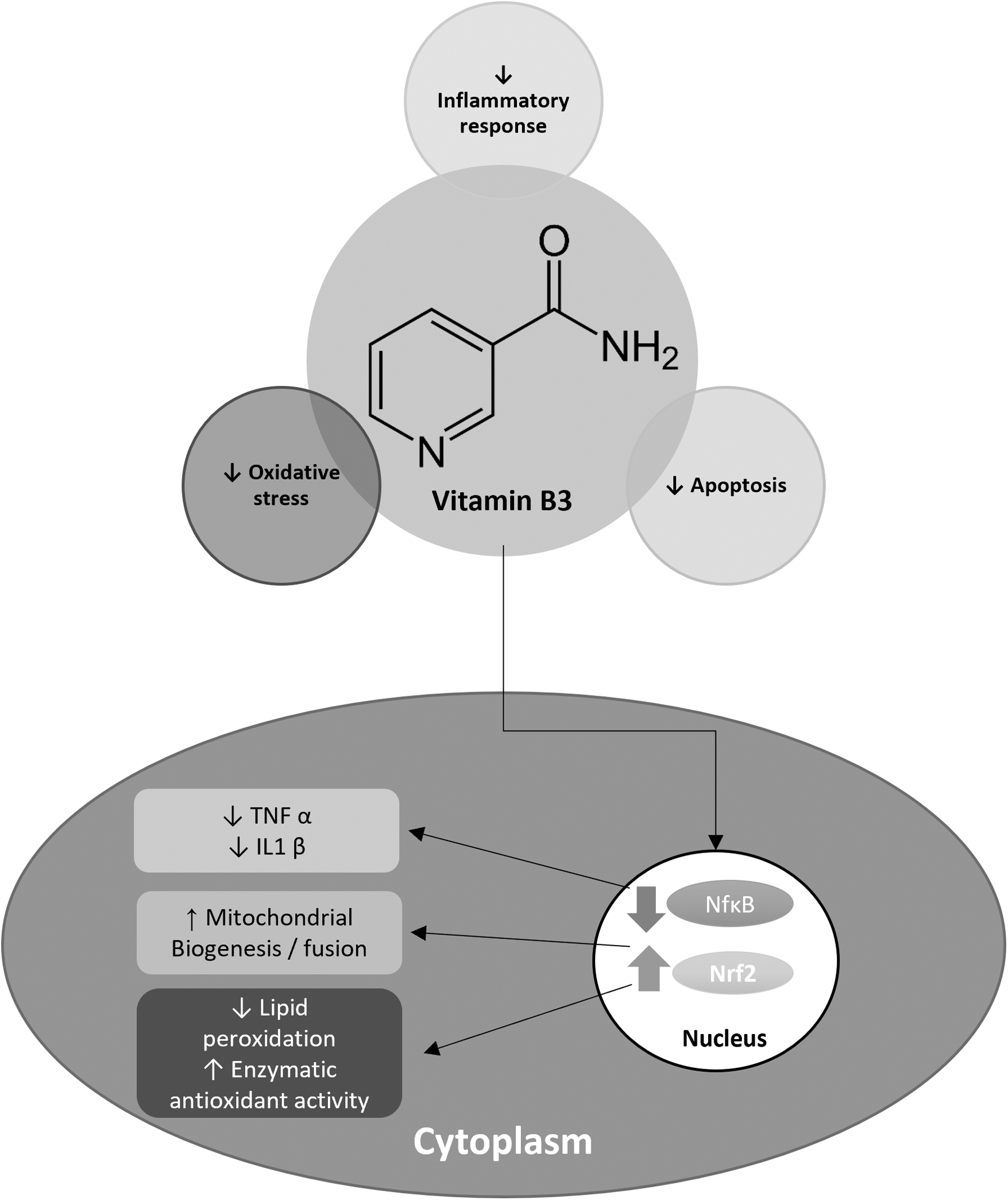
Summary of the potential neuroprotective effects of nicotinamide supplementation in glaucoma. IOP, intraocular pressure; NAD+, nicotinamide adenine dinucleotide; RGCs, retinal ganglion cells.
Given the decrease of NAD+ with aging, retinal neurons become more vulnerable due to limited ATP production, resulting in mitochondrial dysfunction, and ultimately RGC degeneration. 13
Nzoughet et al. demonstrated in a cohort of 34 patients with POAG a significantly lower plasma concentration of nicotinamide versus a control group. 5 The combination of the decline in NAD+ levels with age 11 and the stress of elevated IOP causes mitochondria to become dysfunctional and predisposes to RGC loss. 20 Another study in mice corroborated that low NAD+ increases the sensitivity of RGCs to metabolic damage, particularly during periods of elevated IOP. 11
Because RGC death is preceded by several structural and functional changes that are not clinically defective, there may be a window of opportunity for neuroprotective interventions such as nicotinamide. Studies have focused on the potential protective effects of nicotinamide in glaucoma (NAMinG).
Vitamin B3 supplementation in clinical studies
Animal studies
Williams et al. conducted a study on the correlation between nicotinamide and glaucoma using DBA/2J mice, a mouse model that simulated glaucoma. They identified mitochondrial abnormalities and decreased concentrations of NAD+ in these models compared with controls. 12 Subsequently, it was shown that the exogenous administration of NAD+ in the form of nicotinamide supplementation (at a dose equivalent to 2.5 g per day for a 60 kg person) was capable of restoring RGC function in aged and glaucoma-prone mice. This resulted in a 10-fold decrease in the likelihood of developing glaucoma.7,12,15
Chou et al. and Zhang et al. also studied the effects of nicotinamide (equivalent dose of 2 g per day) on the RGC function in mice models using pattern electroretinography. They both observed an improvement in RGC density in the treated group compared with the control group.22,23
Another study by Tribble et al. on mice with ocular hypertension revealed beneficial effects of nicotinamide treatment. They showed that at a cellular level, nicotinamide can improve mitochondrial function, and induce a neuroprotective effect on these impaired RGCs. 24
Chen et al. is the only study to focus on the effects of vitamin B3 in anterior ION mice models. They found that vitamin B3 treatment had a neuroprotective role, reducing inflammation and RGC death through the inhibition of oxidative stress and mitochondrial dysfunction. 21
Human studies
In an observational study conducted in the United States of America with >5,700 patients, researchers identified a correlation between daily niacin consumption and glaucoma in individuals older than 40 years. The study also found that a greater intake of niacin (>21 mg per day, quartile 3–4) decreased the risk of glaucoma in comparison with those with a lower intake, regardless of IOP levels. They suggested that the protective effect of niacin is not through IOP reduction. 13
Similarly, a large observational study conducted in Korea revealed that reduced niacin intake is linked to glaucoma, specifically normal tension glaucoma (NTG). 25 Although the pathophysiology of NTG remains incompletely elucidated, the mechanism of cellular damage bears certain similarities to those of other forms of glaucoma. 17 Therefore, nicotinamide is believed to have potential benefits in this specific type of glaucoma.
In a clinical trial comprising 57 glaucoma patients, Hui et al. found that administering 3 g per day of NAM for a duration of 12 weeks led to a notable enhancement in inner retinal function, measured by electroretinography and standard automated perimetry. 8
In a recent randomized clinical trial, De Moraes et al. treated 21 patients with POAG with a combination of nicotinamide and pyruvate and observed a statistically significant improvement in visual function based on the number of improving test locations on standard automated perimetry. In addition, they also noted a significant variation in the rate of change of visual fields (evaluating the pattern standard deviation), resulting in improved global perimetric sensitivity. 4
All these studies suggest an association between nicotinamide and other vitamin B3 precursors with neuroprotective effects in glaucoma. In contrast, a review highlighted that although there is some evidence suggesting that niacin may lower the risk of glaucoma, there is currently inadequate data to support vitamin supplementation. 26
Crucial details regarding the methods and results were extracted from selected articles and summarized in Table 1. To date, no previous systematic reviews with meta-analysis have been identified on this topic.
Summary of Selected Studies on Vitamin B3 for Optic Neuropathies
ERG, electroretinogram; ION, ischemic optic neuropathy; NAM, nicotinamide; NR, nicotinamide riboside; OCT, optic coherence tomography; RGCs, retinal ganglion cells; TUNEL, terminal deoxynucleotidyl transferase dUTP nick and labeling.
Vitamin B3 safety profile
All supplementation products are well tolerated and safe when given within the therapeutic range. Mild side effects, such as flushing, chills, and gastrointestinal symptoms, may occur, but hepatotoxicity is a potential risk with toxic doses. 14 Niacin is the precursor that is most likely to cause adverse effects, particularly at doses >50 mg per day. Daily doses of nicotinamide up to 3,000–3,500 mg are well tolerated, although chronic intake might predispose some gastric disturbances.15,20,27 NMN (from 100 to 500 mg per day) and NR (up to 2,000 mg per day) have a similar safety profile, but their long-term effects in humans are yet to be determined.15,20 Regarding ocular effects, there is only 1 case report of elevated IOP after taking 500 mg of oral niacin. 28
Upcoming clinical trials
Right now, 4 known ongoing clinical trials are worth mentioning.
Nicotinamide in glaucoma
This is a randomized, placebo-controlled, multicenter, phase 3 trial from the University College of London (in the United Kingdom, main investigator: Dr David Garthway-Heath). They estimate a total of 496 patients with open-angle glaucoma (OAG) who will receive 3,000 mg per day of nicotinamide (initial dose of 1,500 mg per day for 6 weeks) versus placebo over 27 months. The primary outcomes will focus on visual field progression and quality of life. The scheduled end date is November 2026. 29
The glaucoma nicotinamide trial
This is a prospective, randomized, placebo-controlled, double-masked trial from the Umea University (in Sweden) and the Centre for Eye Research Australia (in Australia). They estimate a total of 660 patients with OAG who will receive 3,000 mg per day of nicotinamide (initial dose of 1,500 mg per day for 6 weeks) versus placebo >2 years. The outcome will focus on visual field progression. The scheduled end date is December 2026. 30
NR as a neuroprotective therapy for glaucoma
This is a prospective, randomized, placebo-controlled trial from the Chinese University of Hong Kong (in China). A total of 125 patients with OAG will receive 300 mg per day of NR versus placebo over 2 years. The main outcome will be the progression of the retinal nerve fiber layer in the optic coherence tomography (OCT) and visual field progression. The scheduled end date is March 2023. 14
Nicotinamide and pyruvate for open angle glaucoma: a randomized clinical study
This is an interventional, randomized, clinical trial from Columbia University (in the United States of America). They estimate a total of 188 patients with OAG who will receive nicotinamide and pyruvate (doses not specified) versus placebo over 20 months. The primary outcomes are changes in the central visual field and in the retinal nerve fiber layer and ganglion cell layer by OCT. The scheduled end date is January 2028. 31 All these trials will recruit patients with early-to-moderate OAG, including those with POAG, normal-tension glaucoma, and pseudoexfoliation glaucoma, who have not undergone prior glaucoma surgery. Note that the final 3 studies will exclude patients with IOP >25–30 mmHg, and the third study will exclude patients who have experienced visual field progression. In addition, the last study will exclude patients with any previous incisional glaucoma surgery. Throughout all trials, the patients will continue their antihypertensive drops.
Summary
To conclude, it is crucial to elucidate the connection between the homeostasis of mitochondrial metabolism and nicotinamide in retinal cells, therefore, linking their dysfunction with optic neuropathies such as LHON or glaucoma. Ongoing trials will help to better determine the role of nicotinamide in healthy, untreated, and treated patients with optic neuropathies. Further research is needed to establish the most effective doses of vitamin B3 supplementation and the optic neuropathies that may benefit the most from such treatment.
Footnotes
Acknowledgments
This study was developed in the context of the project Smart Drug Delivery Device for Glaucoma Treatment: SmartGlauco (PTDC/CTM-REF/2679/2020). I am thankful for the opportunity to be part of such an interesting and stimulating project.
Authors' Contributions
J.A. contributed to conceptualization (equal), writing—original draft (lead), review, and editing (equal); T.C., M.V., and C.M. were involved in writing—original draft (equal); F.T.V. and L.A.P. carried out writing—review and editing (equal) and supervision (equal); Q.F. and I.P. were involved in writing—review and editing (equal) and validation (equal); and J.T.F. was in charge of conceptualization (lead), writing—original draft (equal), review and editing (lead), and supervision (lead).
Author Disclosure Statement
No competing financial interests exist.
Funding Information
No funding was received for this article.