




Abstract
In 2023, Xdemvy® (0.25% lotilaner ophthalmic solution) was approved by the U.S. FDA for treating Demodex blepharitis in humans. This article reviews lotilaner’s history, physicochemical properties, pharmacokinetics, pharmacology, clinical outcomes, and other indications for which it is being evaluated clinically. Furthermore, the article discusses Demodex blepharitis, alternative treatments used in the clinic to ameliorate its symptoms, and other drugs in development. Prior to its approval in humans, lotilaner found extensive application in treating parasitic infections in cats and dogs. Lotilaner was previously approved in 2017 as an oral veterinary medicine (Credelio®) for canines to treat demodicosis, other mite infections, and tick infections. Lotilaner belongs to the isoxazoline class of drugs and is a potent arthropod-selective gamma-aminobutyric acid-gated chloride ion channel inhibitor. Like several other drugs in the isoxazoline class, lotilaner has a long plasma half-life and high plasma protein binding of about 99.9%. When used as indicated, lotilaner treats infested Demodex blepharitis in 42 days, with its antiparasitic action starting within 24 h. Furthermore, lotilaner is also being evaluated for its efficacy in other conditions such as Lyme disease and dry eye disease. Other products evaluated for treating Demodex blepharitis include ivermectin eye ointment, ivermectin-metronidazole gel, permethrin cream, terpinen-4-ol wipes, and hypochlorous acid spray. Along with these, azithromycin eye drop, azithromycin/loteprednol eye drop, and other treatments are being evaluated for treating blepharitis. Other drugs from the isoxazoline drug class including afoxolaner, sarolaner, and fluralaner, could also be potentially explored for human use.
Introduction
In 2023, the U.S. FDA approved 55 new molecular entities for various disorders, 1 including the first ophthalmic drug product for the treatment of Demodex blepharitis, Xdemvy® (lotilaner 0.25% solution eye drop). This drug can eradicate Demodex mite infection in about 50%–68% of infested patients with 6 weeks of treatment. 2 The focus of this article is to discuss the chemical, pharmaceutical, pharmacological, and clinical features of lotilaner along with its development history.
Demodex Blepharitis
Blepharitis is inflammation of eyelids caused by various conditions, including congestion of the oil glands (meibomian gland dysfunction or MGD), inflammation of the skin (acne rosacea), allergies (e.g., due to eye drops, poor make-up hygiene, and contact lens solutions), dry eyes, seborrheic dermatitis (dandruff), and infection with mites or lice (demodicosis; consisting of collarettes formation, scaling, and crusting on eyelashes).3,4 Blepharitis can affect anterior as well as posterior surfaces of the eyelids. 3 Demodex blepharitis is caused by demodicosis infection or infestation of Demodex brevis and Demodex folliculorum, ectoparasites found on the human skin.4–6 In addition, these mites work as vectors for bacteria such staphylococci and streptococci, which induce blepharitis.3,5 Apart from these bacteria, Demodex brevis and Demodex folliculorum can also carry Bacillus oleronius, which causes rosacea by triggering proliferation of peripheral blood mononuclear cells. 5 Demodex parasites are innocuous to human skin and prevail in sebaceous secretions. They become rather troublesome when present in abnormal numbers (>5 mites/cm2) due to poor hygiene or other conditions that favor their growth causing them to deposit on the eyelash follicles.5,7 These mites inhabit sebaceous and meibomian glands, burrows of eyelashes, and follicles. The infection leads to abrasions and hyperplasia in the epithelial regions, provoking inflammation and itching. Infection spreads when the eyes are rubbed, which increases microbial counts and overgrowth of the mites, leading to collarettes formation. The development of collarettes is due to digestive enzymes/waste, eggs, dead mites, keratinized cells, and live mites on eyelid tissue.2,6–8 It may not cause vision loss but causes eyelid abnormalities, affects meibomian gland function, and if not treated within a reasonable amount of time, it can lead to dry eye disease (DED), rosacea, chalazia, pterygia, and hordeola (Table 1) .2,7,8
Lotilaner and Other Drugs Approved, in Clinical Trials, or in Off-Label Use for Demodex Blepharitis
GABA, gamma-aminobutyric acid.
Epidemiologically, Demodex-based blepharitis has a significant distribution. It was found in 79.2% of patients in a study of more than 500 chronic blepharitis patients conducted in 2018, while it was also present in 31% of the control group.5,12 In another study of DED with 1,015 participants, 58.4% eye care patients undergoing slit-lamp examination for any reason were found to have Demodex blepharitis. 13 In a meta-analysis of 13 controlled clinical studies, 44.5% of cases involved Demodex-infested blepharitis compared with 16.7% in the control group.5,14 Thus, these mites can be symptomatic or asymptomatic. Demodex infestation increases with age, and it is not gender specific. Among patients with Demodex blepharitis, the incidence rate is about 84% in patients older than 60 years and 100% in patients older than 70 years. 15
Key Treatments for Demodex Blepharitis Prior to 2023
Until July 2023 there was no FDA-approved treatment for Demodex blepharitis, but various treatments were in place. Among the various treatments, tea tree oil eyelash wipes are considered the most effective; for severe cases, hypochlorous acid is used as a cleansing spray.16,17 Among the orally available drugs, ivermectin,6,18,19 tetracycline, 20 and metronidazole 6 are known to have antiparasitic, antibacterial, or anti-inflammatory activity against Demodex-based infections.21,22 However, D. folliculorum is reported to be resistant to tetracycline. 17 Other in-office treatments such as intense pulsed light 23 and microblepharoexfoliation6,24,25 are also available. However, all these methods aid to manage the symptoms and/or reduce the number of mites, but none of them totally eradicate the mites. Table 2 describes interventions in various phases of clinical trials and different formulations for Demodex blepharitis.
Additional Interventions for Blepharitis in Clinical Trials, with their Phases and Formulation Type. The Data is Based on Clinicaltrials.Gov. Some Trials May have been Completed or Terminated
The green boxes indicate FDA-approved products; pink boxes indicate commercial products from other countries.
bid, twice daily; DED, dry eye disease.
Lotilaner for Demodex Blepharitis: Mechanisms, Chemistry, Pharmacokinetics, and Efficacy
Lotilaner (ATC vet code QP53BE04) is an ectoparasiticidal drug that inhibits Demodex parasites. Since 2017, it has been a popular veterinary oral medicine (Credelio®, by Elanco) for canine demodicosis and to kill flea, ticks, and mites in cats, dogs, and puppies (≥8 weeks old).26,27 Additionally, lotilaner was approved in 2023 for treating Demodex blepharitis in humans, as a topical ophthalmic solution at 0.25% strength (Xdemvy®). 28
Pharmacological activity of lotilaner
Lotilaner at the indicated topical dose (0.25% ophthalmic solution dosed twice daily for 42 days) is expected to act as an arthropod selective, noncompetitive antagonistic inhibitor of gamma-aminobutyric acid (GABA)-gated chloride ion channels in parasitic mites (Fig. 1).2,29 GABA acts as a central nervous system (CNS) neurotransmitter in vertebrates and for both the peripheral nervous system and CNS in invertebrates. 30 These GABA receptors belong to the super family of Cys-loop, which are loop linked with chloride ion channels. The GABA receptor has 5 transmembrane subunits with each of them weaved with 4 transmembrane helices. 31 GABA stimulates chloride ion influx on postsynaptic tissues, causing hyperpolarization, and inhibits action potential generation.29,32 Although the exact binding site is unknown, lotilaner binds to one of these helices in the invertebrates, thereby inhibiting the stimulation of chloride ion influx, which leads to depolarization, paralysis, and death of the mites. Hypothetically, the drug binding site is in a pore between the region of T9′ to S15′ strands of the receptor.2,29 As per the in vitro testing, it did not inhibit mammalian GABA-mediated chloride ion channels up to 30 µM (18 mg/mL) in vitro, which is 1,100 times higher than the recommended human ophthalmic dose.28,33 The ex vivo studies suggested death of 95% of Demodex mites within 24 h by lotilaner at 0.25% (2.5 mg/mL) strength. 33 No observed adverse effect levels (NOAELs) of lotilaner in rats based on preclinical studies were observed at the dose of 20 mg/kg/day. The NOAEL for humans was 0.006 mg/kg/day for a 60-kg patient, if we consider 4 drops administered per day, where one drop is administered for each eye by a twice daily dosage, BID; one drop is assumed to be 35 µL (i.e., 0.35 mg/day from 140 µL) (Fig. 1).
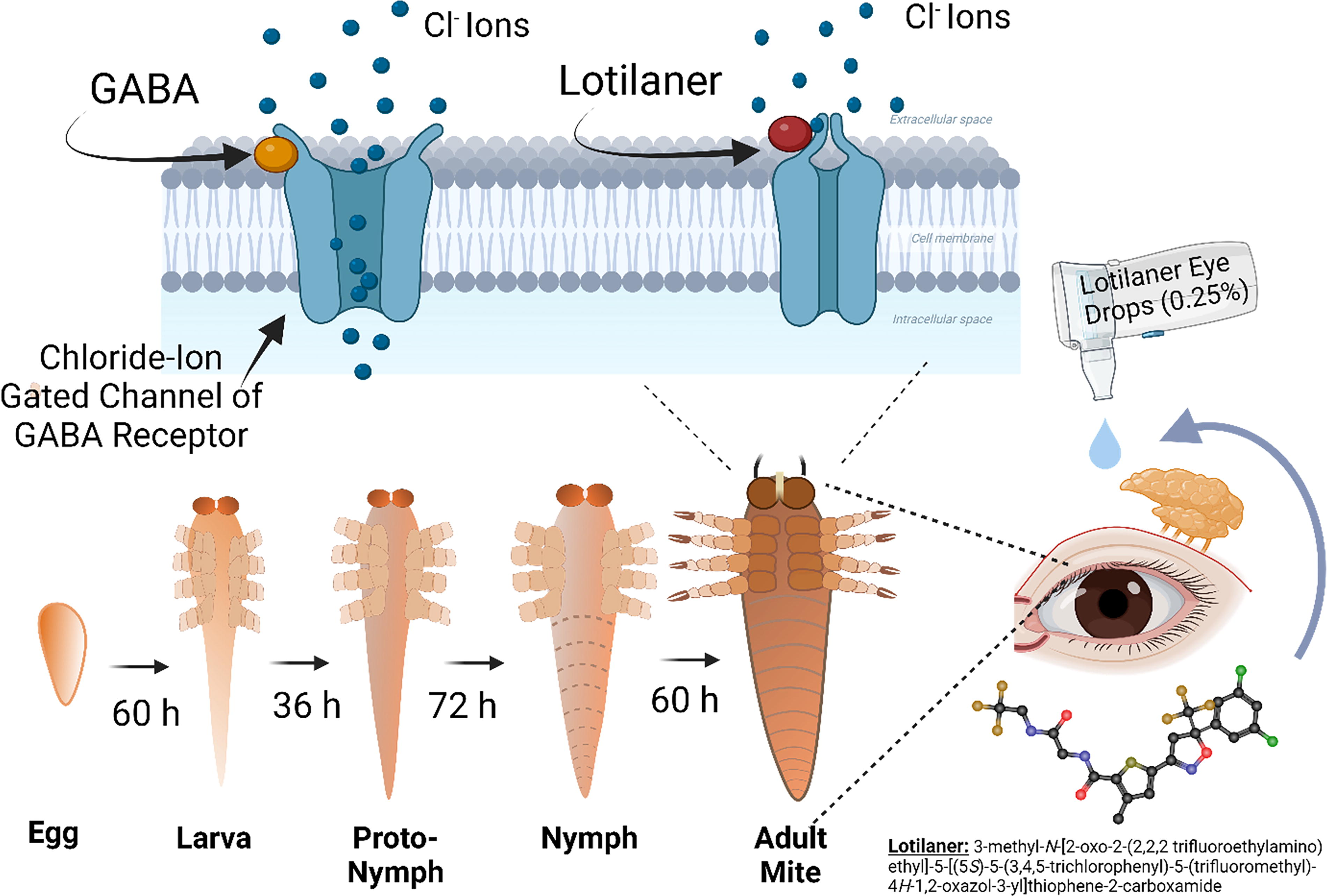
Lifecycle of Demodex mite and inhibition of GABA chloride channels by lotilaner in mites, which leads to their paralysis and death. GABA, gamma-aminobutyric acid.
Physicochemical properties and drug formulation
Lotilaner is a lipophilic molecule with a log P of 6.64, log D of about 5.81 in the pH 5–7 range, pKa (acidic) of 11.15, and pKa (basic) of 0.94, with 4 H-acceptors and 4 H-donors. It has a molar refraction of 120.89 m3/mol, polarizability of 49.71 Å3, and a polar surface area of 79.79 Å2.28,34 Lotilaner in the ophthalmic preparation is in the form of S enantiomer. It is noteworthy here that the oral chewable tablet of lotilaner is also the pure S enantiomer of the drug, which is reported to have greater activity than the R enantiomer in vivo. 29
The lotilaner eye drop product is an aqueous-based formulation that contains a viscosity-enhancing agent, hydroxypropyl methylcellulose, to potentially increase the residence time on the eye surface and to assist with lubrication. 35 While Polyoxyl 35 castor oil is a nonionic surfactant present in the formulation, which could be a solubilizing agent in the preparation. Furthermore, glycerin and edetate disodium may serve as lubrication/tonicity and chelating agent, respectively. 36 Other ingredients include dibasic sodium phosphate and monobasic sodium phosphate to adjust the pH of the solution to the pH 5–7.5 range. 37 It is a multiuse ophthalmic preparation, which is preserved with potassium sorbate. 38
Structure activity relationship
As per the ATC vet code, lotilaner belongs to the class of isoxazoline compounds and has a molecular weight of 596.76 g/mol. Chemically, this drug consists of 3 pharmacophoric moieties including isoxazoline and thiophene rings and a linear bisamide functional group, all of which impart the pharmacological properties of the molecule.39,40 Isoxazoline is a well-known pharmacophore contributing to potent insecticide/acaricide, antifungal, antimicrobial, antiparasitic, and anti-inflammatory properties.39,41 A few previously FDA-approved insecticide/acaricide drugs have isoxazoline as the pharmacophore (Table 1); these include afoxolaner (NexGard, Boehringer Ingelheim), sarolaner (Simiparica, Zoetis), and fluralaner (Bravecto, Merck). 42 All these drugs treat mite infestations by targeting glutamate-gated chloride channels and GABA receptor chloride ion channels. 32
All these compounds consist of 2-isoxazoline framework, which has a proven pharmacological role in veterinary ectoparasiticides. 32 The 2-isoxazoline derivatives contribute some unique features to a compound, which affect pharmacological activity as well as efficacy.32,41,42 For instance, compounds with isoxazoline framework show high plasma protein binding of about 99.9%; clearance takes place mainly via hepatic route, good bioavailability has been reported via oral administration with reference to intravenous administration; and they typically exhibit a long half-life.32,43 The bioavailability of lotilaner is increased by ∼10-fold when it is given with food. The reported bioavailability of lotilaner is 81.7% and 100% in dogs and cats, respectively, when it is administered with food. When it is administered in fasting condition, the bioavailability was 24.3% in dogs and 8.4% in cats (Table 3). No data are available for bioavailability of lotilaner in humans after ocular or oral dosing. The majority of 2-isoxazoline drugs with antiparasitic and insecticidal activity target glutamate-gated chloride channels and GABA-gated chloride ion channels. 32 The 2-isoxazoline drugs with ectoparasiticide activity are reported to impart side effects such as seizures, tremors, and ataxia in mammals upon frequent administration. 32 These features suggest the reason behind categorizing these drugs under the isoxazoline class, despite having thiophene and bisamide pharmacophoric moieties.
Half-Life and Plasma Protein Binding of Lotilaner and Related Drugs
What pharmacological and pharmacodynamic roles are played by thiophene and bisamides? Thiophene is a bioisostere of phenyl group and contributes to various therapeutic properties including antimicrobial, anti-inflammatory, and analgesic activities. 40 It will be interesting to note here that major commercial drugs approved with thiophene pharmacophores are anti-inflammatory drugs. 47 Thiophene pharmacophore-based compounds are reported to impart an anti-inflammatory effect by targeting cytokines and chemokines. 47 Demodex mite infestation induces changes in tear cytokine levels, IL-17 and IL-12, which may cause eyelid margin inflammation, ocular surface discomfort, and telangiectasias, all of which are found frequently in Demodex blepharitis patients.6,48 Is lotilaner imparting anti-inflammatory effects too? What is the effect of lotilaner on inflammation of the eyelids? Furthermore, it has yet to be explored whether lotilaner 0.25% ophthalmic solution will be equally effective to treat posterior blepharitis (outside of the inner edge of the eyelid where it meets the eyes). These gaps in knowledge need to be addressed in future.
Pharmacokinetics and clinical efficacy
For Demodex blepharitis, the recommended dose is 1 drop of 0.25% (2.5 mg/mL) lotilaner solution twice a day every 12 h for 42 days. At this dose, it reaches the peak systemic concentration at about 2 h after administration on the first day and at about 1 h after administration on the 42nd day.28,38 Table 3 shows pharmacokinetic data including half-life and plasma protein binding for lotilaner and related drugs. Lotilaner has a half-life of 11 days, as calculated by the accumulation ratio at a dosage interval of 12 h over 42 days.2,38 It has a high plasma protein binding potential of over 99.9% and about 10% partitioning into human blood. It is not metabolized by cytochrome P450 (CYP) enzymes. 38 As per the clinical data with 138 patients, who received the ophthalmic solution of lotilaner BID for 42 days, the mean systemic concentration is 12.0 ng/mL (20 nM) with a range of 0.4–46.1 ng/mL (0.7–77 nM) (Table 3).2,8 These concentrations are well below the concentration of 30 µM, shown to be not effective in inhibiting mammalian GABA-gated chloride channels. 28
Clinical trials titled Europa, Io, Mars, and Jupiter (all Phase 2 studies), Saturn-1 (Phase 2b/3 study), and Saturn-2 (Phase 3 study) extensively evaluated the pharmacokinetics, safety, and efficacy of lotilaner eye drops.2,4,8,38 The trial features and outcomes are summarized in Table 4. The most common adverse reaction of lotilaner eye drops is injection site pain and burning, occurring in 10% of the patients. Other adverse reactions occurring in less than 2% of the patients are chalazion/hordeolum and punctate keratitis.
Summary of Demodex Blepharitis in Clinical Trials Conducted with Lotilaner for Eye Indications
Lotilaner 0.25% ophthalmic solution is the first FDA-approved treatment targeting the cause of Demodex blepharitis. Given its ability to eradicate the Demodex mites, it may eventually be accepted as a first-line therapy.
History of Lotilaner as a Veterinary Product
Before approval as an ophthalmic preparation, lotilaner was available in an oral chewable tablet (Credelio®, Elanco Animal Health Incorporated, Indianapolis, IN) for veterinary use, as an ectoparasiticide drug for cats, dogs, and puppies when it was approved by the U.S. FDA Center for Veterinary Medicine in 2017. 51
Formulations
Lotilaner formulations studied in dog, cat, puppy, and rodent models against fleas, ticks, and mites include chewable tablets, intravenous injections, and eye drop formulations.26,29,52,53
Different doses were studied in dogs and cats for various routes of administration including oral (20 mg/kg) and intravenous (3 mg/kg) routes.26,27 In humans, the eye drop dose is estimated to be 36 mcg/kg. 2 Table 5 shows various parasitic infections of dogs and cats for which lotilaner has been approved or evaluated. These parasites are also known to cause infections in humans in certain manifestations, as they may attack our skin and eyes (Table 5).
List of Ectoparasites Lotilaner That Has Been Approved for or Studied as a Veterinary Drug
Efficacy of lotilaner differs depending on the route of administration since pharmacokinetic parameters are significantly affected.4,26,38
Lotilaner was approved in January 2017 as an oral chewable tablet product for dogs, cats, and puppies (Credelio® by Elanco) at 56.25, 112.5, 225, 450, and 900 mg strengths with a minimum dose of 20 mg/kg per month. 60 It is prescribed for various tick, mite, and flea infestations. The observed adverse reactions of this oral product in dogs during clinical studies were weight loss (1.5%), polyuria (1%), diarrhea (1%), elevated blood urea nitrogen (1%), elevated creatinine, elevated potassium, elevated phosphorus, dyspnea, and polyphagia. 61
After intravenous dosing, adverse effects such as head tremors, muscle tremors, loss of coordination (abnormal gait), and seizures were observed within 1.5 h (e.g., one dog experienced seizures after 1.5 h post-administration). After frequent doses, side effects were experienced in a few cases (e.g., a dog with a history of seizures experienced seizures after 6 days and recovered later without treatment).60,62,63 Some reports suggest that side effects such as ataxia, tremors, myoclonic jerks, and muscle twitching, are more common in immunocompromised animals or the ones with multidrug resistance-1 gene mutation.62,64 Thus, GABA receptor chloride ion channels of mammals, which exhibit more than 95% structural homology between canine and human species, may result in similar responses with the drug binding at sufficiently high doses.
Other indications for lotilaner
Most recently, lotilaner was approved as a topical ophthalmic preparation to treat Demodex blepharitis in human eyes. Lotilaner is being evaluated for malaria and Lyme disease.65,66 Lotilaner has been evaluated in an ex vivo model of Lyme disease. In these studies, employing a tick feeding model, the drug killed adult and nymph ticks as early as 2 h post-dosing. It showed sustained efficacy against the tick with decreased survival until day 151.
Other Drugs in the Pipeline for Demodex Blepharitis
Other drugs in clinical studies for Demodex blepharitis include topical ivermectin and a combination of ivermectin and metronidazole.18,67 Ivermectin (1% cream) is an antiparasitic drug approved by the U.S. FDA in December 2014 for human use, to treat Demodex infested rosacea (Soolantra, Galderma Laboratories) 18 ; and under clinical trials for Demodex blepharitis (Table 6). 19 NCX 4251 is a fluticasone propionate nanocrystal suspension therapy, which was evaluated in preclinical studies for blepharitis. 68 ISV-305 is an ophthalmic formulation of 0.1% dexamethasone by InSite Vision, 69 being evaluated for blepharitis in phase III studies. AXR-270 by Axero Vision is a 0.2% glucocorticoid eye cream, which is in clinical trials for blepharitis, meibomian gland dysfunction, and DED. A patent filed for chloroquine and/or hydroxychloroquine (0.01%–1% for each) claims to inactivate Demodex parasites via various routes of administration including topical ocular route (Table 6). 9
Physicochemical Properties of Lotilaner and Related Drugs
Conclusions
Lotilaner is an antiparasitic drug with proven potential to target a plethora of parasites in canines and humans. It has been approved by the U.S. FDA as oral preparations in dogs and cats for treating parasitic infections. And its recent approval as an ophthalmic preparation in humans for Demodex blepharitis treatment was based on successful treatment of 68% of patients in a span of 42 days during clinical trial studies. Demodex blepharitis causes considerable discomfort in affected patients. Lotilaner is under further studies and is being evaluated for Lyme disease and malaria. Drugs under evaluation for treating Demodex blepharitis include AXR-270, ivermectin, and ivermectin in combination with other drugs. Lotilaner’s approval has again brought attention of the medicinal field to the scope of testing veterinary drugs in humans and vice versa. Lotilaner belongs to the isoxazoline class of drugs, with other key agents in this class being sarolaner, fluralaner, and afoxolaner. These potent and very effective antiparasitic agents may also be tested for ophthalmic indications.
Footnotes
Author Disclosure Statement
No competing financial interests exist.
Funding Information
This work was supported in part by the NIH grant R21EY035764.