




Abstract
Abstract
Background and purpose:
Reviews of the literature have consistently highlighted significant gaps with regard to research associated with family caregivers within the context of palliative care. We sought to determine a priority driven research agenda for this field of inquiry.
Methods:
A Web-based survey was sent to 80 people who had previously expressed interest in, or were members of The International Palliative Care Family Carer Research Collaboration (http://centreforpallcare.org/index.php/research/ipcfcrc/).
Results:
Fifty-five participants completed the survey (response rate, 70%) from 12 countries. Priority research areas included: intervention development and testing; underresearched caregiver groups; access to services; unmet needs; bereavement; experience and implications of the caregiver role; and development of assessment tools. Qualitative responses complemented these data and also acknowledged the importance of collaboration and development of a critical mass of researchers focusing in this area in order to progress knowledge.
Conclusions:
These results reinforce the findings of systematic reviews that have demonstrated a need for the evolution of intervention development focused on improving family caregiver support. However, there are other key areas that also warrant comprehensive attention, including marginalized family caregivers and strategies to assist health professionals to identify family caregivers who have significant psychosocial issues.
Introduction
Methods
In the absence of an appropriate standardized measure to identify research priorities, the research team from Melbourne, Australia, developed the survey. The questions (mix of qualitative and quantitative) were based upon examples drawn from other organizations who had embarked upon similar surveys (for example, the Psycho-Oncology Co-operative Research Group: www.pocog.org.au/). In addition, the relevant topics were drawn from systematic literature reviews that had highlighted specific areas of research inquiry that had been and/or should be explored in the future. The survey questions were also pilot tested by six other local academics familiar with family caregiver research and relevant modifications were made. Key elements of the final version of survey are summarized in Figure 1. The survey was administered online using LimeSurvey® software. A link to the survey was sent via an e-mail to each participant, along with introductory comments outlining the purpose of the survey and informed consent related matters. A reminder e-mail encouraging participation was sent 2 weeks later to those who had not responded. Ethics approval was obtained from St Vincent's Hospital, Melbourne, Australia.
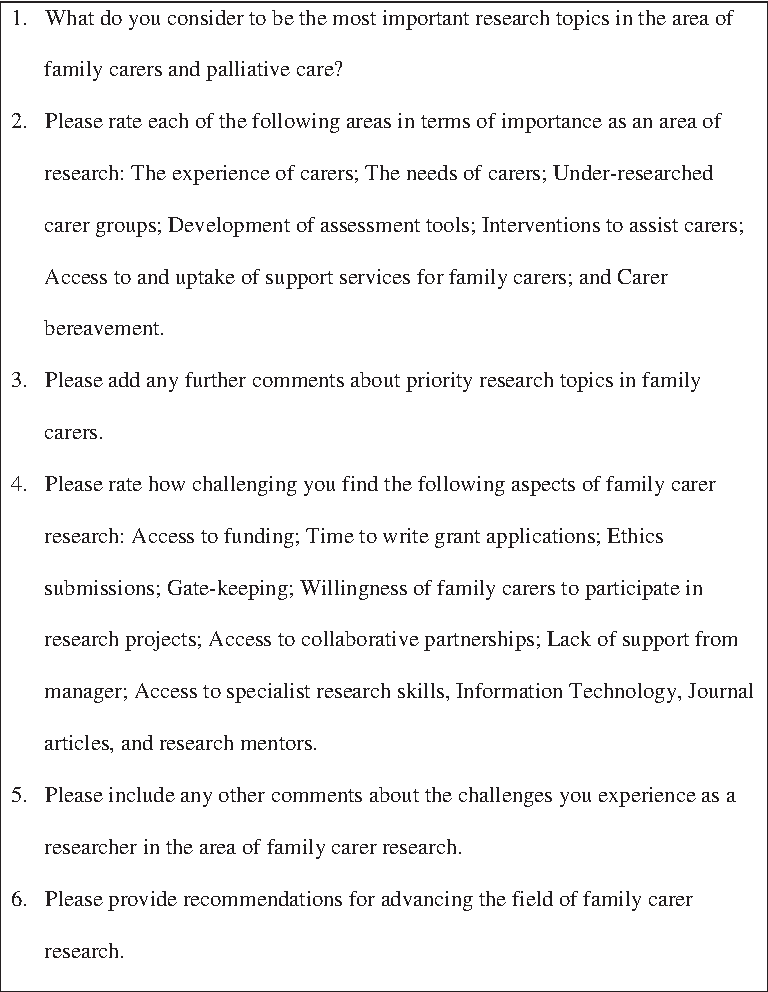
Summary of survey questions.
The sample comprised members of the IPCFRC, those who had attended past IPCFRC meetings, and directors of international research collaborations (n = 6) (European Palliative Care Research Network, National Palliative Care Research Centre USA, Palliative Care Research Society UK, Compass Collaborative UK, Cancer Experiences Collaborative UK and The Dame Cicely Saunders Foundation UK.), corresponding to a total sample of 80 participants. From the data available related to IPCFRC members/meeting attendees, approximately 70% were female, 50% were nurses, 20% were doctors, 10% were psychologists and/or social workers. Approximately 20% were from Australia or the United Kingdom, 9% Canada or the United States, and the remainder were from Denmark, Norway, Sweden, Germany, and Ethiopia.
Quantitative data were analyzed using Statistical Package for the Social Sciences (SPSS) software, version 13 to produce descriptive statistics (SPSS Inc., Chicago, IL). The qualitative data were analyzed using thematic analysis, for identifying, analyzing, and reporting patterns (themes) within the data. 3 In conjunction with thematic analysis, the data was also subject to a standard content analysis. 4
Results
Sociodemographic profile
Fifty-five participants completed the survey equating to a response rate of 70%. One invitation e-mail resulted in failed delivery. Relevant sociodemographic information is outlined in Table 1. In addition, 91% of respondents reported that they worked specifically in the palliative care area.
% add up to more than 100% as participants were able to choose more than one type of occupation.
Priorities for future research
Three questions focussed on participants' perspectives of the priorities for future research. The first question was qualitative, and respondents were not limited by the number of topics they could recommend. Forty-five participants responded to this question and Table 2 provides a summary of the responses. The topic most commonly acknowledged was the development of interventions. Bereavement research was the second most commonly reported topic closely followed by underresearched groups. Psychosocial assessment and assessment of unmet needs were equally popular areas of inquiry as were site of care and research describing the family caregiver experience. Remaining topics received five or less comments each and included: family dynamics; the family caregiver role; respite care; advanced care planning; family meetings; health professional communication with family caregivers and training to work with caregivers; financial implications of the caregiver role; caregivers of patients with non-malignant disease; policy; quality of life; theoretical frameworks and definitions; and spiritual issues.
AIDS, aquired immune deficiency syndrome.
As identified in Table 2, where pertinent, specific areas of focus within the priority research area were also recorded. In bereavement research for example, it was recommended that attention should be directed to pre-loss/anticipatory grief as well as caregiver issues in the bereavement phase.
The second question relating to research priorities provided participants with an opportunity to rate a set of predetermined research areas using a 5-point Likert scale with the extreme ends labeled “less” and “more.” Using this response format, there was a neutral middle point but this was not specifically labeled as such and left to the participant to interpret. Of the 55 respondents who returned surveys, many (between 26 and 44) did not respond to the subsections of this question. Of those who did, more research in all the areas presented (i.e., experience of caregivers; development of assessment tools; bereavement; caregiver needs; support services; underresearched groups and intervention research) was endorsed by between 91% and 100% of respondents, respectively. Hence, all respondents to this question felt that more intervention research was required. Only one respondent consistently indicated that there should be less research in all these areas.
The final question relating to research priorities provided respondents with an opportunity to note any other comments they had with regard to this topic. Typically comments complemented information provided in the earlier qualitative question on this topic. However, several additional pertinent recommendations were made. These included a recognition that future needs based inquiry should target under researched groups such as parents of young adults with terminal illnesses. It was also highlighted that family caregiving research in resource poor continents such as Africa is really in its infancy. Some participants reinforced the view that intervention research, including ways to determine caregivers at risk of poor psychosocial well-being, should be investigated further.
Challenges associated with family caregiver research
Participants' responses to the challenges related to conducting family caregiver research are outlined in Table 3. As shown, the two most challenging aspects of research were time to write grant applications and access to funding.
Participants were also given the opportunity to include any other comments about the challenges associated with research related to family caregivers. Most respondents provided additional information which linked directly to the aforementioned question on this topic. For example, some respondents acknowledged that ethical boards can occasionally act inappropriately as gatekeepers as they may perceive family caregivers to be a particularly vulnerable population, leading to lengthy delays in gaining approval for studies to proceed. One respondent reinforced the challenge of not being able to access suitable mentorship: “I am keen to commence research in this area but need a mentor to gain experience … To be able to join an established group and work collaboratively would help develop skills and provide an excellent basis for furthering independent research later.”
Other challenges included: (1) Practical issues associated with accessing family caregivers for data collection such as being able to meet with the caregiver alone (i.e., without the patient); interviews being postponed or canceled due to caregiver responsibilities (e.g., transferring their relative to hospital); their relative dying sooner than expected; difficulty determining who is the primary family caregiver; and complexities associated with caregiver(s) living quite a distance from their relative; (2) An inadequate critical mass of researchers focusing on family caregiving; fostering equitable collaborative links in recognition of the need to assist resource poor countries to develop family caregiver research; and (3) Accessing funding for studies that focus specifically on family caregiver outcomes. This issue was well described by the following comment: “Many times you don't get funding if you cannot prove that there is a direct impact of your research on the patient. The patients are still the priority in getting funded projects.”
Recommendations for advancing the field of family caregiver research
Approximately half of the respondents made recommendations for enhancing the development of family caregiver research. A summary of these is outlined in Figure 2.

Recommendations for improving the field of family caregiver research.
Many of the responses which centred around collaborations and development of a critical mass of researchers involved in family caregiver inquiry.
Discussion and Conclusions
These results reinforce the findings of systematic reviews which have demonstrated a need for the evolution of intervention development focused on improving family caregiver support. 5 Additionally, other key areas that warrant research attention include: underresearched family caregiver subpopulations (e.g., young caregivers, ethnic minorities); the bereavement experience and support; and, assessing unmet needs and development of methods (e.g., assessment tools) to identify family caregivers at risk of poor psychosocial well-being.
Respondents acknowledged several challenges related to family caregiver research, the most common barrier being access to funding followed by lack of time to write grant applications. Recommendations for enhancing family caregiver research included fostering collaborations; developing specific research programs; dedicated conferences that focus on family caregivers; and lobbying organizations to promote capacity building in this area.
The results of this project provide a basis for discerning the priority areas for research inquiry related to family caregivers within the context of palliative care. Future work might focus on elaborating on these areas by comprehensively scoping specific research questions. There are several limitations associated with this research including the sample that was inherently biased toward this area of research, and participants were thus likely to support all research in this area. Nonetheless, as far as we are aware this is the first time the research priorities for this population have been systematically discerned. The response rate was reasonable, and perspectives from researchers from 12 countries were obtained. We anticipate that the findings will enable a more strategic and focused approach to research, which is desperately needed to enhance the support provided to family caregivers.
Footnotes
Acknowledgments
We thank Professor Phyllis Butow for information that assisted in the design of the survey. The preliminary findings of this project were presented at European Association for Palliative Care, Glasgow, Scotland, June 2010.
Author Disclosure Statement
No competing financial interests exist.