




Abstract
Abstract
Background:
Opiates are commonly used for symptoms at the end of life (EOL). Little is known about the decision-making process physicians go through when deciding to prescribe opiates for their EOL patients. The study's objective was to explore physician factors affecting EOL opiate prescribing.
Methods:
Qualitative study of 38 physicians in the Denver area in the specialties of outpatient and inpatient medicine, geriatrics, oncology, and palliative care. Semi-structured qualitative interviews by trained interviewers asked physicians about their knowledge, attitudes, and experiences in prescribing opiates, reasons for prescribing opiates, barriers to prescribing opiates, changes in prescribing habits, and perceived patient factors that influence prescribing. Interviews were analyzed using ATLAS.ti qualitative analysis software and independently coded by two reviewers.
Results:
We found a spectrum of beliefs ranging from the viewpoint that opiates are underused at EOL to overused. We found five key themes: practices in when and how to use opiates, barriers to prescribing, personal experiences drive prescribing, social meaning of opiates, and differences in the role of physician. Physicians interviewed described experiences, both personal and professional, that influenced their opiate-prescribing habits. All respondents expressed positive experiences with prescribing opiates in being able to ease patients' suffering at EOL and to improve their functionality and quality of life.
Conclusions:
Differences in prescribing habits, attitudes, and experiences of physicians influence opiate prescribing, which may lead to over- and underprescribing. Knowledge, barriers, and fears about EOL opiate prescribing need to be addressed to ensure EOL patients are receiving appropriate symptom relief.
Background
Although there is variation in opiate prescribing,10,11 we thought there would be agreement on using opiates at the EOL, thereby giving a basis to build from to further explore opiate variation. We hypothesized that opiate use at the EOL would have relatively little variation compared with opiate use in other settings. This study explores physician factors affecting opiate prescribing at the EOL.
Methods
We conducted semi-structured qualitative interviews of physicians between October 2008 and March 2009. Purposive sampling was used to recruit physicians in five different specialties in the Denver, CO, metro area. We posted fliers at multiple practices and e-mailed university departments, local medical societies, and other potential recruits to start the sample and then used snowball sampling to complete the interviews. We started the recruitment process by sending out e-mail blasts to administrative assistants in the relevant departments of area hospitals, and by drawing on our own contacts to find referrals to eligible participants. Two professional research assistants trained in qualitative interviewing asked physicians about their knowledge, attitudes, and experiences in prescribing opiates, barriers to prescribing, changes in prescribing habits over the course of their career, and patient factors that influence prescribing. Interviews lasted 20 to 60 minutes. Upon completion of the interview, participants were asked to refer others who might be willing to be interviewed for the project, and we received the majority of subsequent participants this way. We audio-recorded the interviews and a professional transcriptionist transcribed them. Two members of the research team served as primary data analysts using ATLAS.ti qualitative software (ATLAS.ti GmbH; Berlin, Germany). We developed a preliminary codebook as codes emerged from the data, and we tested these with ongoing coding and team discussion. A constant comparative approach derived from grounded theory, including inductive and deductive reasoning, was used to analyze the data for key themes and findings. 12 The primary analysts met with the research team frequently to discuss patterns, to seek confirming and disconfirming cases, and to reach consensus regarding key themes and their implications.
Results
We conducted 38 interviews with physicians distributed among five specialties (Table 1). We expected similarities in views about opiate use based on specialty, gender, and years in practice such as people with more years in practice would be more comfortable with opiate prescribing, but instead we found divergent views within each of these groups as later quotes illustrate. We a priori defined EOL as a 6 month or less life expectancy, but found physicians had varying definitions. One physician (geriatrician) commented that almost everyone in geriatrics can be defined as EOL, but some have “the accelerator on and some have the brake on.” Another (internist) defined EOL as “minutes, hours, days.” From the interviews, we found five key themes (Table 2).
Practices in when and how to use opiates
Physicians prescribed opiates for EOL pain if reported by the patient or family, or assumed by the physician. Physicians had divergent opinions about using opiates for treating EOL anxiety and “life pain” with one respondent (hospitalist) routinely prescribing opiates, while another (internist) commenting it was “never appropriate.” We found a full spectrum of belief in that opiates are underused at EOL to overused. One physician (internist) stated, “I used to feel like anytime I prescribed an opiate it was this very dangerous medication that I'm putting in the hands of another person.” There was also a spectrum of understanding about how to use opiates in terms of dose adjustment and switching opiates (e.g., one person switched type of opiate in 2 days, whereas others switched in 2 weeks).
Barriers to prescribing opiates
Barriers to prescribing included high cost of certain opiates, restrictive insurance policies requiring prior authorizations or pill quantity limits, need for a written prescription, and stigma about addiction surrounding opiates. Many physicians noted a fear of Drug Enforcement Administration (DEA) investigation, even though no one had personally experienced an investigation. Several physicians had heard of others who had been investigated by the DEA or had been scrutinized for reasons including opiate prescribing or patients overdosing on opiates and dying. One physican (internist) noted, “There are providers who have had their DEA license confiscated or they got in trouble for reasons that have been unclear. It's very, very scary to be in trouble.” Physicians had concerns their patients would experience side effects, inadvertently misuse medication (not taking the medication consistently, or forgetting that they had taken the medication), or overdose, or that family members would use or sell the medications, or the opiates would be ineffective for pain. Physicians varied prescribing rates depending on a patient's diagnosis, physician's experience with opiate prescribing, and if there was a history of substance abuse. Physicians had less fear about substance abuse or drug-seeking behavior.
Personal experiences driving prescribing
Physicians expressed personal and professional experiences that influenced their opiate-prescribing habits. Negative experiences included treating patients who had committed suicide or overdosed on opiates, working with patients who had been dishonest about their opiate use, hearing of colleagues undergoing disciplinary action for suspected overprescribing, personally experiencing family addiction to opiates, or having a family member die from a painful disease. A physician (internist) said, “I did have a patient on methadone commit suicide. Fortunately, she left a note … so I think that experience made me a little more cautious with methadone, but it wasn't an accidental overdose. It was intentional. Fortunately for me. … I probably would be really cautious about doing that again.” All respondents expressed many positive experiences in prescribing opiates to ease patients' suffering and improve their quality of life.
These personal experiences appear to drive opiate prescription decisions. From an oncologist: “I've had two or three patients in my career who have committed suicide in violent fashion … But I have had talks with patients who are approaching end of life—very frank open discussions-‘If you were to decide to take your own life I think it would be very inappropriate for you to do it in a violent fashion both for your family and for others, and it would be much wiser for you to take this whole bottle of Dilaudid or whatever … I'm prescribing this for your pain control and management but if you were to take this whole bottle, and didn't throw it up, you would probably stop breathing.’” Another physician (hospitalist) does not use opiates because it can be “informal euthanasia.” One physician (hospitalist)'s experience of his dying mother's cancer pain ruefully admitted, “Now I believe [cancer patients'] pain more.” Finally, personal experience with opiates being helpful or harmful for their own symptoms influenced prescribing. A geriatrician stated, “You know … I don't do well with opiates so I'm very sympathetic and I try not to say openly to the patient, ‘Oh yeah I hate that, too!’” Another physician (oncologist) mentioned, “Six years ago I had back surgery … and had just terrible pain. I never had an appreciation for the need of pain control until I lived through it. And I don't mean to suggest that before that I was too conservative, but certainly after that … [I used more].”
Social meaning of opiates
Overlaying the prescribing decision was a pervasive perception of opiates as a “social/emotional/spiritual issue. To know what [opiates] mean for people and how that impacts how they take them or how they interpret them, or how their family interprets them” (from a palliative care physician). Some physicians noted patients sometimes declined medication because feeling their pain helped them know their illness progression or a belief that they need to suffer because of punishment for wrongs. Patients and families may be concerned about stigma, addiction, and dependence. A few physicians noted they struggle with treating the patient's versus the family's distress. Finally, physician thought about opiates' impact on the value of life ranged from “Life is valuable no matter what quality” (a hospitalist) to “It's essential to treat symptoms even if this shortens life” (a palliative care physician).
Role of physician
Physicians had differences in role perception. Some felt being a physician was a therapeutic role–“my job is to relieve pain” (a hospitalist), whereas others saw themselves in “a cop or detective role” to figure out if pain is real and how the patient is using opiates” (an internist). “Part of that is a reflection … on training settings, but part has to do with our societal beliefs and … the roles physicians are placed in” (a palliative care physician).
We reviewed the literature to find factors that might influence prescribing to construct a model of EOL opiate prescribing before we conducted the study.4,5,7,13 Upon study completion, we revised the model (Fig. 1). Specifically, we centralized the physician box to reflect how the ultimate prescribing decision lies with the physician, particularly because of attitudes and past experiences.
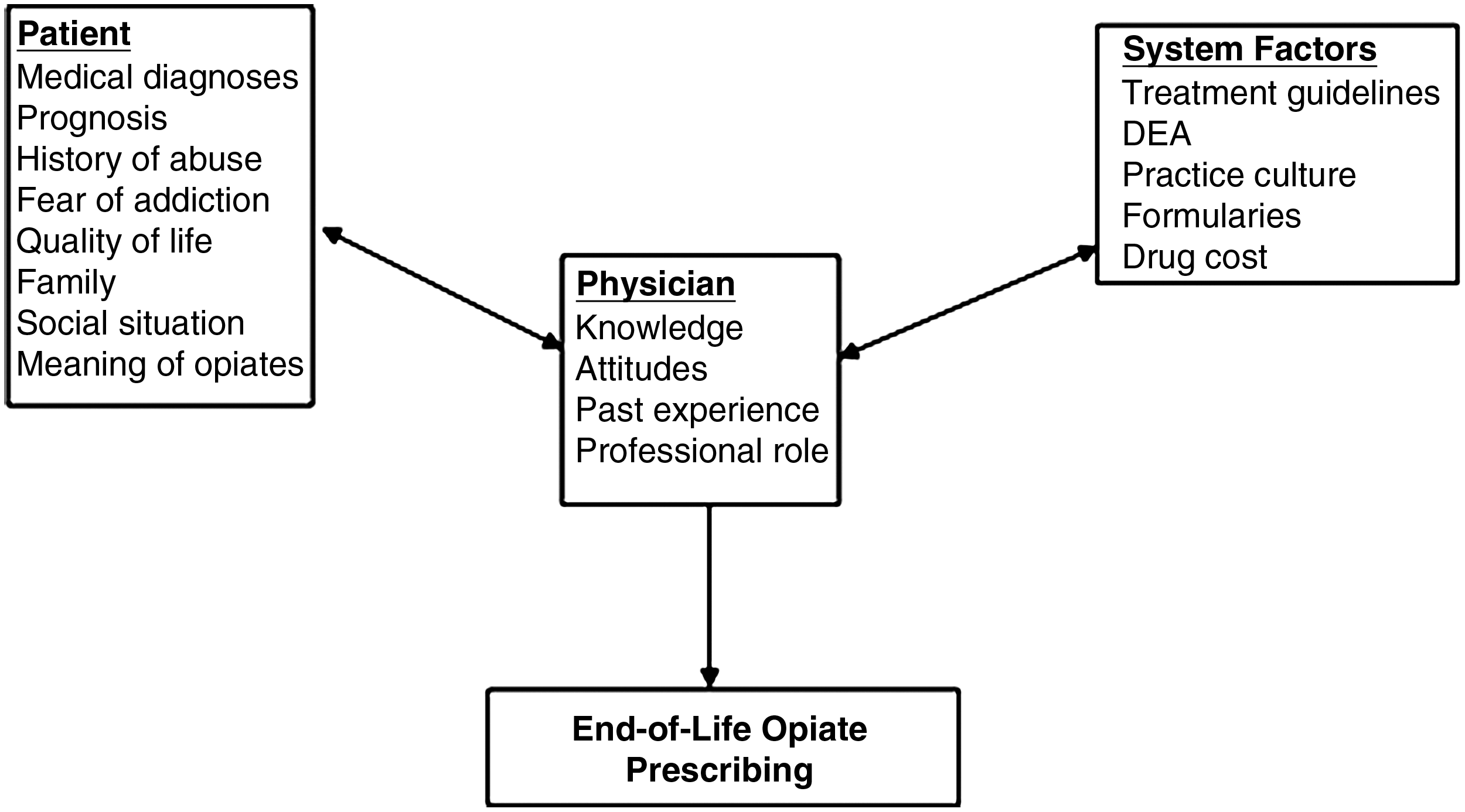
Model of EOL opiate prescribing.
Conclusion
Physicians view opiates as helpful for pain at EOL, but there is wide variation in when and how to use them, likely because of physicians' lack of preparedness and discomfort with EOL issues.1 6-8,13 This study shows knowledge and attitudinal barriers exist in prescribing EOL opiates as in other areas of palliative care. There were many barriers to opiate prescribing, with one of the most frequently mentioned being a fear of DEA investigation, despite no one knowing of this occurring. Overall, physician experiences and attitudes seem to drive prescribing more than patient request.
Limitations of this study include that it occurred in a single metro area. Despite this limitation, physicians in other areas may share the expressed opinions. Because this is a qualitative study, it did not have the scope to link physician responses to actual prescribing behavior.
This study is unique because it is the first qualitative approach to explore physician views about EOL opiate prescribing with multiple specialty types. One other qualitative study has examined hospitalist practice in EOL care, and it found similar gaps in knowledge. 14 In addition, this study suggests that despite the growth of the palliative care movement, knowledge gaps about opiate prescribing may remain.
To provide good EOL patient care, physicians need more information about how to use opiates and to decrease the fear of regulation. There is a great need for physicians to consider their own internal biases when talking with patients about opiates. More education in exploring personal biases in medical school and residencies may help young physicians. It appears that there is still wide-spread variation in prescribing opiates at EOL including over- and underprescribing. Finally, further study to quantify how prescribing patterns are linked to attitudes and beliefs about opiate prescribing may suggest ways to improve opiate prescribing for patient symptom control at the EOL.
Footnotes
Acknowledgments
The results of this study were presented at the 32nd SGIM Annual Meeting in May 2009. This study was funded from the University of Colorado Denver General Internal Medicine Small Grants Program.
Author Disclosure Statement
No competing financial conflicts of interest exist.
Appendix
Interview Framework for Opiate Prescribing Study
Thanks for agreeing to talk to us so that we can better understand opiate prescribing decisions at EOL. Your experiences as a physician will help us understand why and how physicians make decisions about opiate prescribing.
As we meet today, I have a range of questions I'd like to ask you and I'll ask you about your personal experiences. If at any time you have questions please ask me, or if you want to stop for any reason please let me know.
First:
What is your specialty? How long have you been practicing? How would you define EOL care? (Our study defines it as care within the last 6 months of life.) How many EOL patients do you typically see in a month? How often do you think you prescribe opiates for pain management? 1. To get started, could you tell me a story or instance about a patient—it could be a recent patient, or a memorable one—that you took care of at the EOL that you prescribed opiates for pain control.
Probing questions if needed:
Why did you make those decisions? What factors affected your decisions? Or what influences your decisions? 2. Now tell me a story about a recent patient you took care of at the EOL that you did not prescribe opiates for pain control. Why did you make those decisions? What factors affected your decisions? Or what influences your decisions? 3. EXPERIENCE What do you talk about with your patients about opiates and pain treatment options? In general, why do you decide to or not to use opiates at EOL? ∘ How do you decide when to start prescribing opiates to a patient? What influence have families of EOL patients had on your prescribing decisions? What illnesses do your patients at EOL typically suffer from that you prescribe opiates for? ∘ Have you ever prescribed opiates to an EOL patient who did not have cancer? ∘ -What are the differences between how you think about or use opiates in EOL cancer patients versus noncancer EOL patients? Have you ever had any patients who refused opiates? ∘ What reasons did they give? ∘ How did you handle that situation?
These next questions refer to your experience overall with opiate prescription, so they are asking about a broader perspective than the stories you just shared.
4. ATTITUDES Do you think opiates in EOL care need to be used more or less? What do you think the advantages of using opiates in EOL patients are? What are the disadvantages? What fears or concerns do you have when you prescribe opiates? Do you think opiates are a treatment of last resort in EOL care? Do you worry about titrating the dose of opiates up or down? How do you think your practices are different from your colleagues? How do you think your practices are similar to your colleagues? 5. BARRIERS Are there any barriers to prescribing opiates in the last 6 months of life? ∘ For example, regulatory or formulary barriers? Are there patient factors that make you less likely to prescribe opiates for EOL care? Are there patient factors that make you more likely to prescribe opiates for EOL care? Have you ever treated an addict/addicted patient (to opiates, alcohol, something else) at the EOL and did that change how you used opiates? 6. KNOWLEDGE: Have you done anything to increase your knowledge of opiate prescribing at EOL since completing your residency or fellowship training? Are there areas of EOL opiate prescribing you wish you knew more about? 7. CLOSING: How have your thoughts about opiate prescribing at the EOL changed over the course of your career? Are there any particular positive or negative opiate prescribing experiences that have influenced your practice style? Do you have any thoughts or ideas about why there might be such variation in opiate proscribing rates among physicians? What if any differences have you seen in the opiate prescribing habits of residents/fellows compared with attending physicians for EOL patients?