




Abstract

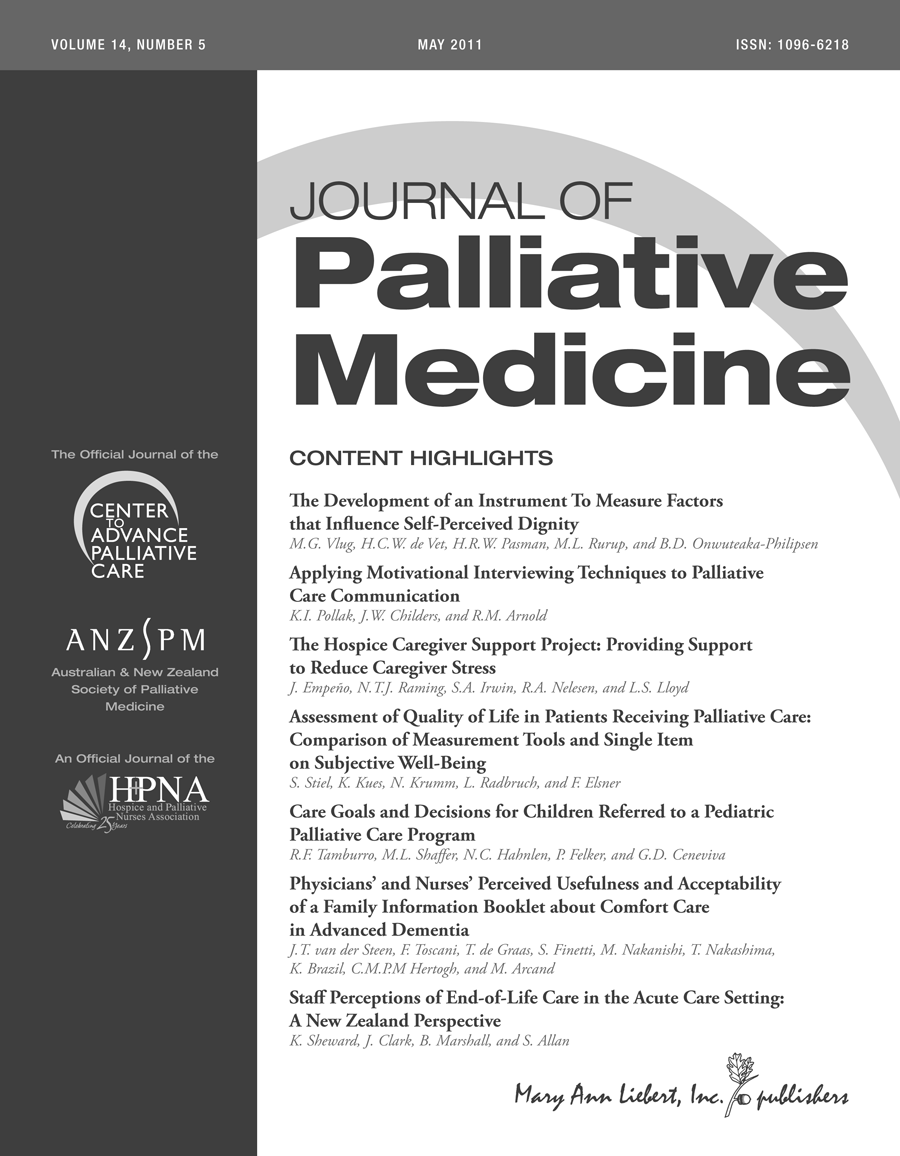
Letters to the Editor
To limit the concept of palliative care to the dying only reinforces the current Western dichotomous view of life and death, which could be summarized as “all or nothing” or “fight or flight.” (page 538)
Brief Reports
Sleep aid prescribing practices of oncologists treating women receiving adjuvant or neoadjuvant chemotherapy for breast cancer at a single institution. (page 565)
Fast Facts and Concepts
#201 Palliative Care for Patients with Huntington's Disease
#206 Genetic Screening and DNA Banking at the End of Life. (page 665)
Personal Reflection
“You never know where the conversation is going to go until you start, but at least you can hope to get it pointed in the right direction from the beginning.” (page 668)
Case Discussions in Palliative Medicine
Although it is important to rule out infection, an early trial of naproxen is inexpensive and, in patients who can tolerate NSAIDs, may provide good control for NF. (page 675)
Book and Media Reviews
(page 679)
Recent Literature
(page 681)
Factors for Dignity
For 292 patients with ill health responding to a 31-item advance directives study instrument, mean scores for presence of the four domains showed large differences: evaluation of self in relation to others, functional status, mental state, and care and situational aspects. These findings support the challenging construct of dignity and how it's preservation is not easily predicted in an individual. (page 581)
Motivational Interviewing
As palliative care moves from being a choice to being the standard of care, it's a challenge to communicate with patients who express ambivalence or resistance. Clinicians also struggle with how to support patient autonomy when they disagree with patient choices. Motivational Interviewing (MI) techniques such as reflective statements and summarizing can help reduce a patient's resistance, resolve ambivalence, and support patient autonomy. Not all the MI techniques are applicable, however. (page 591)
Providing Support to Reduce Stress
The vast majority (80%) of care provided to hospice patients is given by informal and unpaid caregivers, who are often family members. Hospice social workers referred caregivers identified as needing additional support into a special project that funded services not provided by the hospice program and that the family could not afford to purchase. Self-reported caregiver stress decreased by 52% (t122 = 10.254; p < 0.0001). Use of the hospice respite benefit decreased. (page 597)
Single-Item Well-Being Measurement
Many quality-of-life assessment tools are not feasible in palliative care settings because of the severe impairment of the physical, cognitive, and psychological status of patients. This study investigated whether comprehensive instruments can be replaced by a single item concerning the well-being of patients. Sadly, the single item is unable to completely replace comprehensive questionnaires, but it is useful to initiate communication on quality of life and can be recommended as a substitute for physical-functional aspects of QoL assessment in the palliative care setting. (page 603)
Pediatric Goals of Care
Parent and pediatric patient goals of care were categorized into one of four quality-of-life domains: 1) physical health and independence, 2) psychological and spiritual, 3) social, and 4) environment. The median patient age was 4.6 years. Neuromuscular disorders accounted for more than half of the diagnoses. Nearly all patients identified at least one goal pertaining to physical health and independence. Anticipating this expectation may foster communication and improve patient care. (page 611)
Pediatric Nurses and EOL Care
Nurses rated the most important goals as managing pain, maintaining the child's quality of life, and improving communication. Commonly cited problems were lack of opportunity to debrief after a patient's death, uncertainty about the goals of care, and the health care team's reluctance to discuss hospice with family. The hospital unit was the most important factor in predicting nurses' degree of collaboration with the palliative care team even after accounting for individual characteristics. (page 637)