




Abstract

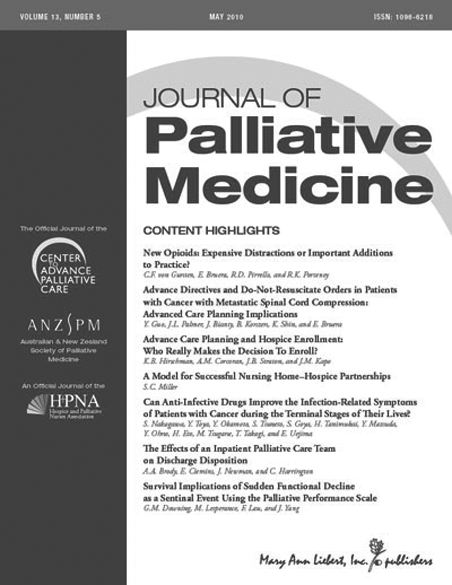
Letter to the Editor
How to best meet the needs of patients and families wishing to withdraw life-sustaining treatment in the home with hospice care.
Brief Reports
Study conducted to gain a better understanding of factors influencing preservation of dignity in the last chapter of life.
Fast Facts and Concepts
#198 Regulatory Issues for Prescribing Schedule II Opioids at the End of Life
#211 Guided Imagery for Anxiety
Personal Reflection
How is it that the care rendered when cure is no longer possible is so bad? Why is non beneficial treatment offered? Why do six subspecialty consultant notes immediately precede my death note?
Case Discussions in Palliative Medicine
Four terminally ill patients with malignancy, who developed petechiae on their bilateral palms and fingers during the week prior to their deaths. Drug-induced eruption, injury, and mechanical stimuli were thought to be unlikely causes of the petechiae.
Book and Media Reviews
Recent Literature
Advance Care Planning
Three articles in this issue explore aspects of advance care planning. In the first, despite strong evidence showing short survival times for patients with malignant spinal cord compression, it seems many patients do not have an advance care planning directive. This suggests that a diagnosis of metastatic spinal cord compression (MSCC) should trigger communication and initiate a goals of care discussion with documentation. (page 513)
In the second article, a survey of families of patients enrolled in hospice care regarding the decision to enroll, nearly half said the patient was not involved in the decision. These data suggest that a self-determination model of decision making is not particularly prominent, at least for enrollment in hospice care. (page 519)
In a third study, there was only modest correlation between living will directives and telephone wishes for life-sustaining treatment in specific scenarios. This further helps to elucidate the living will′s poor performance as a tool for advance care planning. (page 567)
Nursing Home and Hospice Care
Hospice home care teams collaborating with nursing home staff improves patient outcomes. Yet, interorganizational conflicts can impede such collaboration. In this study, while successful collaborators were organizationally aligned, acknowledgement that palliative care provision in nursing homes is complex and unique was an additional feature of those collaborations that are successful. (page 525)
In interviews, families of patients who died in nursing homes often felt the need to advocate for their dying relative because of low expectations or experiences with poor quality nursing home care. Interviews also identified ways hospice care affected families, including helping to relieve family burden. (page 573)
Antibiotics and Symptoms
Whether antibiotics improve symptoms in patients with advanced disease is hotly debated. In this study, symptom improvement was seen in approximately one third of cases. However, minimal change was noted when the anti-infective drug was administered during the last week of life. (page 535)
Hospital Palliative Care and Disposition
Patients admitted to a large nonprofit multisite hospital seen by the palliative care team were matched to usual care patients on age, mortality risk, prior year hospitalized days, and disease severity. Compared with usual care, patients who received a palliative care consultation were 3 times more likely to be discharged to hospice care, 1.5 times more likely to be discharged to a nursing facility, and 1.6 times more likely to be discharged home with services. Patients seen by the palliative care team were also referred to hospice earlier in their disease trajectory, rather than in the last few weeks of life. (page 541)
Pain Control from Bone Metastases
The overall incidence of severe pain was approximately 50% in three centers. Geographic differences in adequacy of analgesic management for painful bone metastases exist between Canadian specialized outpatient palliative radiotherapy (RT) clinics and between centers globally were found. (page 589)