




Abstract
Abstract
Background:
Research on the teaching experiences and knowledge of medical students on end-of-life decisions in medicine is important because it provides information on the competency of future doctors with respect to an important field of clinical practice and can support the development of a curriculum.
Method:
A multiple-choice and free-text survey on the teaching experiences and knowledge of final-year medical students at the universities of Bochum (Germany; n=212) and Tours (France; n=108) regarding end-of-life decisions in medicine was conducted during the last months of their studies.
Results:
Our results indicate that even though students had training in ethico-legal aspects of end-of-life care and participated in clinical practice there is considerable lack of knowledge among students with respect to the ethico-legal framework for the limitation of treatment at the end of life.
Conclusion:
The study indicates that even with the recent changes in both medical schools there seems to be a further need to prepare students better for end-of-life issues.
Background
Research on this matter is important because it provides information on the competency of future doctors with respect to an important field of clinical practice and can support the development of a curriculum. In addition, comparative analysis between different countries can provide information about possible sociocultural and country-specific variations relevant to medical education on end-of-life issues. In this article we present and analyse the results of a survey on the teaching experiences and knowledge of final-year medical students at the universities of Bochum (Germany) and Tours (France) regarding end-of-life decisions in medicine.
Methods
The survey was directed to all medical students in Bochum (n=212) and Tours (n=108) of one academic year (Bochum from 2006; Tours from 2007) and was conducted during the last months of their studies. The questionnaire (see Appendix 1 online at www.liebertonline.com/jpm) is a slightly modified version of an instrument used in previous surveys conducted at two medical schools in Germany.13,14 It consists of multiple-choice questions and spaces for free text. Items with three response options (“yes,” “no,” or “don't know”) were used for the assessment of knowledge regarding the legal background of the limitation of therapy and ending a patient's life on request. Questions regarding attitude are effected by means of 5-point Likert scales (from “strongly disagree” to “strongly agree”).
At the time of the survey the obligatory medical curriculum in Bochum comprised teaching on history, theory, and ethics in medicine, which included ethico-legal aspects at the end of life. In Tours, end-of-life aspects were covered by training on ethics and law in medicine as well as by a course in palliative medicine.
The collection of data and analysis were performed with SPSS for Windows, version 17.0 (SPSS Inc., Chicago, IL). Explorative statistical analysis regarding group differences in response behavior was conducted by means of cross-tabulation and the χ2 test (level of significance p<0.05).
Results
The questionnaire was completed by 159 of 211 medical students in Bochum (response rate=75.4%) and 81 of 108 students in Tours (response rate=75.0%). In Bochum, 65.3% of participants had studied within the new curriculum, which included teaching on history, theory, and ethics in medicine, whereas the rest had studied within the old curriculum without ethics as a compulsory course. Table 1 shows sociodemographic characteristics of the participants.
In Bochum 65.4% of students and in Tours 76.5% indicated experiences with a dying person. Table 2 shows the contexts in which students gathered such experience. In Bochum 42.3% of students and in Tours 50.6% of students had been asked by patients about the limitation of medical treatment, and 8.3% of students in Bochum and 19.8% in Tours (p=0.02) had been asked about ending life on request by patients.
Of the students, 64.7% in Bochum and 46.7% in Tours (p<0.01) knew that forgoing or limiting life-sustaining therapy could be legal. When confronted with various scenarios regarding the limitation of medical treatment, approximately one third of respondents of both medical schools classified the withdrawal of medical measures as “active euthanasia” (see Table 3). Whereas almost all respondents knew that ending a patient's life on request was illegal (97.4% in Bochum and 100% in Tours), there was a significantly higher proportion of Tours students who viewed ending of a patient's life in some cases as ethically acceptable (50.6% vs. 38.7%; p=0.03) (see Table 4). Table 5 indicates the reasons medical students gave for their personal attitude concerning ending a patient's life on request.
Tested with χ2 test on significant differences: Bochum versus Tours.
The majority of students in both medical schools ranked the relevance of ethical questions at the end of life for the clinical practice as “moderate” or “high” (55.5% in Bochum and 63.3% in Tours). On a 5-point Likert scale 54.8% (Bochum) and 60.8% (Tours) stated that their studies prepared them “poorly” or “very poorly” for normative questions at the end of life (Fig. 1). Those students from the Bochum group who had attended the recently introduced course on history, theory, and ethics in medicine within the framework of the new 2002 curriculum rated their preparedness for ethical questions at the end of life as significantly better (p=0.02). There was no significant difference regarding legal knowledge between these two groups of students.
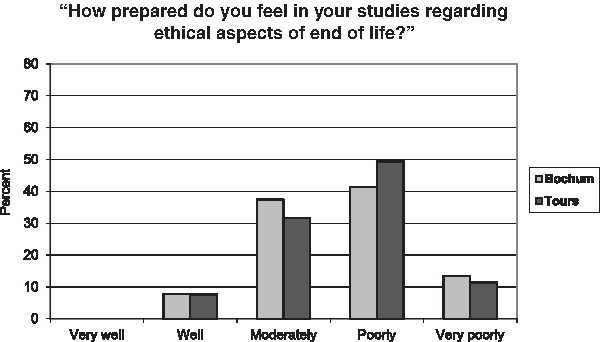
Preparation in ethical questions at the end of life.
Discussion
This study provides information about the experiences of and knowledge regarding different end-of-life practices of final-year medical students in Bochum (Germany) and Tours (France), as well as about the students' evaluation of their medical education on end-of-life issues. The sample was representative of both universities, with a response rate of about 75% for each of the two groups. However, due to the limitation to one medical school in each country the results are not representative for the situation in Germany or France.
Our results indicate that even though students had training in ethico-legal aspects of end-of-life care and participated in clinical practice, there is considerable lack of knowledge with respect to the ethico-legal framework for the limitation of treatment at the end of life. The results are comparable to earlier research conducted by our own as well as other study groups.13, 14,19–21 With respect to the even lower number of knowledgeable students in Tours, one explanation may be that the change of the legal framework at the time of our survey created an insecurity among the students. This hypothesis is supported by a governmental evaluation report published in 2008, which reported that many French physicians were not aware of the new law at that time. 22
A notable difference between the student groups is the significantly higher percentage of Tours students who viewed the ending of a patient's life on request in some situations as ethically acceptable (see Table 4). One explanatory factor for the difference could be the much higher percentage of Bochum students with a religious affiliation (see Table 1).23,24 Interestingly, the murdering of sick people during the Nazi regime was cited as argument by approximately the same proportion of students in Bochum and Tours (see Table 5).
The already discussed objective lack of ethico-legal knowledge is illustrated by students' poor rating of training on end-of-life care (Fig. 1). The majority of students in both groups indicated experiences with dying persons. The greater amount of time spent at the bedside in Tours (bedside teaching during 4 years) compared with Bochum (bedside teaching mostly during the final year) may explain why the Tours students experienced more end-of-life situations as part of their training. Although the cohort of Bochum students who had ethics as an obligatory part of their teaching rated their preparedness better than the rest of the Bochum students, we did not find any differences between both groups regarding ethico-legal knowledge. More trainings and a structured integration of theoretical and clinical teaching may improve knowledge regarding end-of-life care. 25
Limitations
In addition to the already mentioned restrictions on representativeness there is also a bias due to social desirability as well as due to the challenge of framing questions related to controversial ethics issues in an intelligible and nonjudgemental form should be taken into account when interpretating the data. 26 The values for statistical significances in this article need to be interpreted with caution due to the explorative nature of the statistical analysis. In addition, the data on students' attitudes and perceptions should be interpreted with caution because these don't predetermine necessarily respondents' future practice. Finally, it is important to note that such a survey does not provide a full account of the quality of training on end-of-life issues. Other approaches to assess the quality of current training and further needs must be taken into account as part of curriculum planning.
Conclusion
This study indicates that even with the recent changes in both of the medical schools surveyed there seems to be a further need to prepare students better for end-of-life issues. In this respect, the results of this study may serve as reference for the future monitoring and evaluation of teaching on professional competency at the end of life.
Footnotes
Acknowledgment
The authors would like to thank all participating students and those who facilitated the realization of the study within the teaching hospitals. The authors thank Professor Pierre-François Dequin (Intensive Care Unit, University Hospital of Tours) very much for his support during the realization of the study as well as for enriching contributions to the manuscript. We also would like to thank Dr. Ruth Horn (Marie Curie Postdoctoral Fellow, Centre for Ethics in Medicine, University of Bristol) who contributed to this research through her own work as well as through her feedback on this research.
Dr. Jan Schildmann's work is supported by a major grant from the Ministry for Innovation, Science and Research of the German state of North Rhine-Westphalia, which funds the NWR-Junior Research Group “Medical Ethics at the End of Life: Norm and Empiricism” at the Institute for Medical Ethics and History of Medicine (Director: Prof. Dr. Dr. Jochen Vollmann), Ruhr-University Bochum.
Author Disclosure Statement
No competing financial interests exist.