




Abstract
Abstract
Rationale:
Volunteers are essential to the functioning of palliative care programs and serve as important members of the hospice team. They devote much time, effort, and diverse skills and talent to enhance the quality of care at Roger's House – a pediatric palliative care hospice.
Objectives:
To evaluate volunteering in a pediatric palliative care hospice and to assess the level of satisfaction from the perspective of hospice volunteers.
Methods:
A survey was sent to all active Roger's House volunteers. Questions were related to their demographics, their overall impression of their volunteering experience, and 47 closed (fixed-choice) statements, divided into 6 parts: 1) Orientation; 2) Training; 3) Feedback / Performance; 4) Communication; 5) Social Contacts; and 6) Value and Respect. Each statement was rated by the participants using a six-point Likert rating scale.
Results:
Volunteers fully completing the survey were 159 online and 4 on paper, giving a response rate of 66%. The greater number (66, 40.5%) of respondents were 50 years or older and they were mostly female (141, 86.5%). Successes identified included the volunteers' orientation, training, and feedback and performance. Challenges identified included certain aspects of communication, social contacts, and respect/value for the volunteer.
Conclusion:
Volunteers at Roger's House are generally satisfied with their volunteer position and the environment in which they work. Greater insight into volunteer satisfaction and factors that bring feelings of reward and/or dissatisfaction to the volunteers have allowed Roger's House to identify informed and effective interventions to improve the quality of and satisfaction with the hospice volunteer program.
Introduction
Pediatric palliative hospices are a relatively new concept in Canadian health care, compared to the longstanding adult model. For this reason, development and implementation of volunteer programs in pediatric hospices is not yet well represented in the literature. A few years ago, the Canuck Place Children's Hospice in Vancouver, Canada, reported some perceived areas for enhancement in the volunteer program.
1
These include the following: (1
Roger's House is a freestanding eight-bed pediatric palliative care hospice located on the grounds of the Children's Hospital of Eastern Ontario (CHEO) that provides a comprehensive model of care and support for children with progressive life limiting illness, and has been doing so since it first opened its doors in May 2006. Roger's House offers services including respite, pain and symptom management, transition, end-of-life care, and grief and bereavement support.
This study was undertaken to evaluate the satisfaction of volunteering in a pediatric palliative care hospice. A greater insight into volunteer satisfaction and factors that bring feelings of reward and/or dissatisfaction to the volunteers will allow Roger's House to make informed evaluations and effective improvements to the hospice volunteer program.
Methodology
Study setting and participants
Trained pediatric hospice volunteers actively working at Roger's House in Ottawa, Ontario, in Canada.
Study design
A prospective questionnaire-based survey was developed using Survey Monkey, an online survey website, as the platform. The coordinator of volunteer services emailed all active volunteers a Web link that directed the recipient to the online questionnaire. The online survey was posted for four weeks, from March 10 to April 7, 2010. The survey was sent by regular mail for those volunteers without an email address. The survey took approximately 10 minutes to complete by the participant. The volunteers were sent weekly email reminders to complete the survey.
Questionnaire
The survey was designed based on current successes and challenges experienced by Canuck Place Children's Hospice, 1 bereavement and/or coordinator of volunteer services in New Zealand, 2 and from previous Roger's House volunteer satisfaction and exit surveys.
The first portion of the survey consisted of demographic questions and overall impression of their volunteering experience including these variables: (1) gender, (2) age, (3) volunteer position title, (4) number of volunteer hours worked per month, (5) length of time as an active volunteer, (6) whether they received a volunteer position description, (7) training staff provided, (8) what they liked about volunteering at Roger's House, and (9) what they disliked about volunteering at Roger's House.
The second portion of the survey consisted of 47 closed (fixed-choice) statements, divided into the following six parts: (1) orientation (4 questions), (2) training (8 questions), (3) feedback / performance (12 questions), (4) communication (8 questions), (5) social contacts (4 questions), and (6) value and respect (11 questions). Each of these statements was rated by the participants using a six-point Likert rating scale (strongly disagree, disagree, no opinion, agree, strongly agree, and does not apply).
Statistical analysis
All individual survey responses collected from the fixed-choice questions were reported as percentages in Survey Monkey. The online responses were then exported and stored in an Excel database for subsequent analysis. The closed questions were analyzed using descriptive statistics. The two open-ended qualitative questions were repeatedly and systematically read by a single-rater and organized into the most prevalent themes, some of which have been previously described. 2 Cross-tabulation analysis using Fisher's exact test was performed to compare the proportion of “not disagree” (strongly agree, agree, or no opinion) among groups for all responses of closed-ended survey questions.
Results
Response rate
The survey was sent to 247 active volunteers, either by email (n=230) or by regular mail for those volunteers without an email address (n=17). A total of 175 volunteers started the survey and 163 fully completed the questionnaire (93%), representing a 66% response rate.
Characteristics of the survey participants
The respondents to the survey represented 66% (163/247) of the total number of active volunteers in the hospice. Demographics of the survey respondents were comparable to those of all hospice volunteers (Table 1). Nearly half (66, 40.5%) of the sample were 50 years or older and respondents were mostly female (141, 86.5%) (Table 1). Respondents were to indicate the area(s) in which they provide support, from a list of 13 volunteer position titles. Many respondents occupied more than one role, and the top five positions represented were respite care (51, 31.3%), family support (42, 25.8%), reception (41, 25.2%), special events (21, 12.9%), and as a memory box artist (15, 9.2%).
Volunteer orientation
Nearly all respondents considered their orientation to the volunteer program (154, 95.1%) and to the organization itself (159, 96.4%) to be sufficient. In addition, they were in agreement that their orientation was appropriate (104, 95.1%) and clearly understood their role as a volunteer at Roger's House (160, 96.4%).
Volunteer training
The majority of respondents found their volunteer training was adequate (149, 91.7%) and timely (147, 93.6%); their role was clearly taught (144, 91.1%); and following training they felt comfortable starting their work (144, 92.3%). Some however did not feel that their training prepared them well enough for the emotional challenges of their position (12, 24%) or for appropriate communication with guests of Roger's House (14, 28.7%) or with family members of the guests (18, 37.7%). Almost all volunteers responded that they would benefit from further training in their ongoing work as a volunteer (45, 97.4%).
Feedback and performance
Overall, respondents were in agreement that should they have questions about their volunteer work, they felt comfortable to ask (152, 93.2%) and someone was available to answer them (154, 94.5%). In addition, they received adequate (140, 88%), constructive (140, 89.7%), and useful (141, 89.8%) feedback from the coordinator of volunteer services. Generally, respondents either agreed or strongly agreed that they received adequate (107, 75.3%), constructive (110, 79.7%), and useful (108, 78.8%) feedback from Roger's House staff. Similarly, respondents agreed that they received adequate (103, 73.6%), constructive (105, 76.1%), and useful (106, 76.3%) feedback from other Roger's House volunteers. Overall, respondents agreed or strongly agreed that they received adequate feedback about their performance at Roger's House (132, 83.5%).
Communication
A proportion of respondents did not feel well informed about the medical (43, 35.5%) and social needs (25, 19.7%) of the Roger's House guests. They disagreed or strongly disagreed that they were well informed about broader hospice issues at Roger's House (40, 29.2%). Respondents agreed or strongly agreed that good communication existed between the coordinator of volunteer services (149, 95.5%) and volunteers (136, 89.5%). Volunteer satisfaction with the communication with the nursing staff (89, 69%) and other Roger's House staff (112, 77.8%) was somewhat lower. Almost all respondents were well informed about Roger's House events (148, 92.5%). Cross-tabulation analysis using Fisher's exact test found statistically significant findings between years of experience as a volunteer and having good communication between themselves and Roger's House (p=0.003), where volunteers with more than two years of experience reported good communication between other Roger's House staff and themselves.
Social contacts with staff and other volunteers
Responses from volunteers pertaining to their social contacts with staff and other volunteers varied greatly between agreement, disagreement, and having no opinion (Table 2). Cross-tabulation analysis using Fisher's exact test found statistically significant findings between the age of volunteer and the need to want more social contacts (p=0.018), where younger volunteers would like the opportunity to have more social contacts with Roger's House staff.
Value and respect
Generally, respondents agreed that they were a valued member of the hospice team (125, 85.6%), that their volunteer work is important (155, 96.3%) and needed (153, 95%), and that they helped improve the quality of life for the guests at Roger's House (131, 90.3%). Respondents found their volunteer position to be as they expected it to be (141, 88.7%) and were happy in their position (141, 92.5%). Respondents agreed that communication was respectful with the coordinator of volunteer services (151, 96.8%), nursing staff (123, 90.4%), other Roger's House staff (138, 93.9%), and other volunteers (151, 97.4%). However, a small proportion of respondents felt that their skills as a hospice volunteer were not used to their full potential (22, 15.4%).
Overall likes and dislikes of volunteer work
Respondents voluntarily commented on what they liked most (149 comments) and least (65 comments) about their volunteer work (Tables 3 and 4).
Discussion
This study describes the volunteers' satisfaction and evaluated the volunteer program in a pediatric hospice. Overall, volunteers describe themselves as generally satisfied with their volunteer position, and are valued and respected by members within the hospice.
Results from this study should be examined in light of limiting factors. Study limitations include not having 100% response rate and that only active volunteers were included.
In Canada, the United States, and the United Kingdom, most hospice palliative care volunteers are middle-aged and older white females.4–11 This finding correlates with our study in which the vast majority of our respondents were female, and over half of them in their forties and fifties.
Substantial training equips volunteers with the knowledge to carry out their role with competence and confidence, and helps retain these volunteers within the hospice. The majority of respondents found their training to be sufficient for beginning their work and that it was offered in a timely fashion. Hospice volunteers involved in patient care provide emotional support to family caregivers 12 and experience a wide range of emotions as a result of their interactions with dying patients and their caregivers. 13 Volunteers need to be adequately trained so that they are able to meet the emotional challenges of the role. Being in close contact with the difficult emotions and anguish of grief is psychologically demanding. 14 Volunteers from our study highlighted difficulties associated with the emotional distress associated with being involved with dying and bereaved people (Figure 1). This has been reported elsewhere by Payne and colleagues, where they found that 50% of their sampled volunteers working within a hospice found their job to be emotionally distressing and requiring additional support services. 2 Similarly, about a quarter of the volunteers sampled in this study reported that the training received was not sufficient for handling the emotional challenges of their position. In the adult setting, Relf and colleagues highlighted the advantages of involving volunteers in bereavement support, but cautioned that volunteers need to be carefully selected, trained, and supported. 15 The need for establishing standards in training and providing additional bereavement training may be necessary for certain volunteer positions within the hospice. At Roger's House, the volunteers currently undergo bereavement training by a social worker as part of their 30-hour volunteer palliative care training.
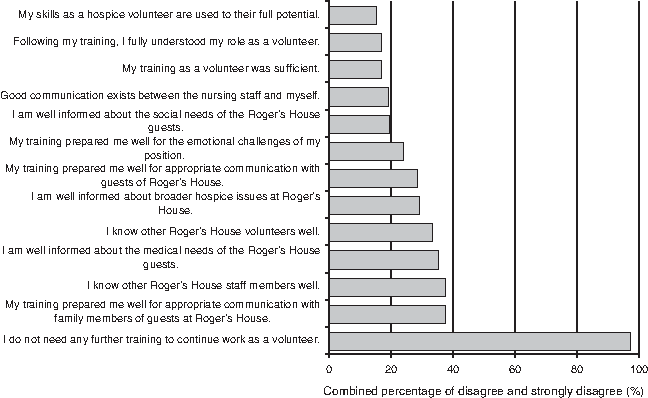
Response summary for questions relating to satisfaction with combined “disagree” and “strongly disagree” greater than 15%.
This study identified the need for our volunteers to improve their ability to communicate with guests of Roger's House or with family members of these guests (Figure 1). Training programs should include information on how to support family members of the patient. 12 Since study completion, Roger's House has implemented improvements to the training of its volunteers. All volunteers must attend an information session prior to orientation. A “buddy system” has also been established as part of the training program. The buddy training has been an excellent way to ease the transition of new volunteers by pairing them with an experienced volunteer for an entire shift. The literature agrees that the buddy pairing is a valuable system. 10 Finally, written documents are provided to the new volunteer as an additional resource.
Achieving effective communication when working within a multidisciplinary environment is difficult in any context, and is an area identified by this study as requiring attention. Studies have noted that the relationships between volunteers and paid hospice staff are critical for volunteers to feel valued and accepted as members of the team participating in the patient's overall care, and are important factors for volunteer satisfaction.3,16,17 Although this study generated positive responses in terms of mutual respect and team dynamics, at Roger's House the existing communication between volunteers and paid hospice staff requires improvement (Figure 1). This observation is not unique and has been reported elsewhere.2,8,18 One comment made was “on rare occasions, members of the care team appear unappreciative of the time donated by the volunteers.” Volunteers should be made to feel that their contributions are as important as those of paid hospice staff. Ongoing efforts to improve communication between staff and volunteers should continue in order to help volunteers feel more a part of the team. The coordinator of volunteer services participates in all professional development days for nursing staff. A time is allocated for training/debriefing regarding volunteer and staff relations.
Respondents were invited to indicate their likes and/or dislikes and/or to make comments. They listed twice as many “likes” compared to “dislikes.” Volunteers appear more satisfied if they feel they are able to make a difference in the patient's life.17,18 Volunteers in our survey most valued the reward, satisfaction, fulfillment, and personal growth from their work at the hospice. This finding corresponds to that found by Field and colleagues who reported that volunteers commonly rated their work to be rewarding/satisfying/fulfilling. 8 In addition, a study conducted in 26 New Zealand adult hospices reported that hospice volunteers benefit from personal growth, improved self-esteem and self-worth from their interactions with patients and staff. 2 The volunteers surveyed in our study identified that among the top positive aspects of their work were friendly contacts with hospice staff and a good atmosphere within the pediatric hospice. The main source of negative comments found by Field and colleagues was the attitudes of some paid staff towards volunteers. 8 Although our study did not identify this to be a major complaint of our volunteers, there were some responses related to team dynamics/hierarchy/unfriendliness. Also in line with what has previously been reported, 8 some respondents indicated that they would like to know more about the medical and social needs of hospice guests.
Volunteers are essential members of the hospice interdisciplinary team, and a feeling of being properly utilized is an important factor for volunteer satisfaction. 3 Our study sample indicated that what was most disliked in volunteer work was the feeling of being underutilized and not knowing what to do during periods of inactivity. This is most likely due to variability in need for volunteers due to relatively short lengths of stay and fluctuating conditions among the patients. Respondents also felt that their skills as a hospice volunteer are not used to their full potential (22, 15.4%). Volunteers who do not feel that their time and skills are being well used may become dissatisfied and leave the hospice palliative care program.10,19 In contrast, if the volunteer is doing work he or she finds valuable and in line with his or her expectations of the assigned volunteer position, then satisfaction will be improved and contribute to the retention of hospice volunteers. Since study completion, a few ‘Boredom Buster’ lists have been created, one for reception volunteers and one for residence volunteers. The lists are comprised of easy tasks that volunteers can perform when the activity level in the house is lower. Such tasks may be: ensuring supplies in all bedrooms are adequate (facial tissues, toilet paper, gloves, etc). The recommendations for use of these lists have wide application to both adult and pediatric hospices alike.
One of the recommendations made as a result of these study results has been the addition of a volunteer management database at Roger's House. The software allows the coordinator of volunteer services to house the volunteer information in one location. The system greatly supports the use of volunteers at our pediatric hospice, because as the number of volunteers continues to increase, the computerized system will serve as an efficient tool for administration purposes.
As pediatric palliative care programs become established, coordinator of volunteer and upper management need to be aware of common problems faced by hospice palliative care volunteers so that they can proactively tailor their programs to ensure volunteer satisfaction and retention.
Conclusion
Volunteers are essential members of the hospice palliative care team at Roger's House and are generally satisfied with their volunteer position and the environment in which they work. Areas of improvement to the pediatric hospice volunteer program identified in this study include aspects of training for effectively handling emotional challenges in volunteer work, providing effective communication to hospice guests and their families, and addressing underutilization of the volunteers' time and skills. The team at Roger's House will continue to work towards improving the volunteers' work experiences, thereby optimizing volunteer satisfaction and ensuring retention within the pediatric hospice.
Footnotes
Acknowledgments
The authors wish to thank the survey participants and for their contribution as volunteers at Roger's House. This study was funded internally by Roger's House in Ottawa, Canada
Author Disclosure Statement
We certify that the manuscript is original and has not been published elsewhere. None of the material is under consideration or has been accepted by another journal. All authors have approved the manuscript. We have no affiliation or financial involvement with any company; there are no conflicts of interest.