




Abstract

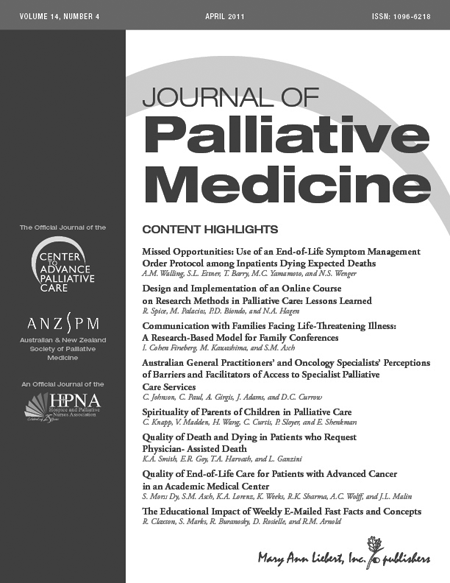
Letters to the Editor
I think it is time to bring old age back to medicine. People are living longer and naturally suffer from more morbidities than ever. It seems that it makes more sense and it is easier and more acceptable by the public to consider old age as the cause of death. (page 386)
Brief Reports
We found that neuromuscular and somatosensory disorders occurred when milnacipran was used as an adjuvant analgesic. (page 403)
Fast Facts and Concepts
Cannabinoids in the Treatment of Symptoms of Cancer and AIDS, 2nd edition #93
Blocks of the Sympathetic Access for Visceral Pain, 2nd edition #97. (page 509)
Personal Reflection
Across the ocean patients are just humans. Across the ocean doctors are just humans. Across the ocean we celebrate life through humanity, science, laughing, and palliative care. (page 513)
Case Discussions in Palliative Medicine
While surgery is the mainstay of therapy for primary cutaneous melanoma, some very locally advanced lesions are either unresectable or the morbidity of resection is unacceptably high in the setting of metastatic disease. (page 521)
Book and Media Reviews
(page 525)
Recent Literature
(page 526)
Missed Opportunities with a Dying Protocol
Only half of patients who died in an academic medical center received end-of-life symptom order protocol care. An opioid infusion was used for 95% of patients and it was titrated up at least once for 67% of those patients. Uninsured patients, patients admitted from a nursing home, and patients considered for or post-transplant were significantly less likely to be placed on the protocol prior to death. (page 407)
Family Meetings
From 24 videotaped family conferences, emotional engagement by health care providers (emotion work) appears central to the successful outcome of the conference. Family conference participants place specific value on the “simultaneous presence” of conference attendees that leads to general agreement about the situation and plans for the future. (page 421)
Symptomatology and Palliative Care
All doctors in Australia consider the presence and complexity of physical symptoms, stage of the disease, and treatment orientation as important in decisions to refer for specialist palliative care. Less important were the psychosocial wellbeing and cultural characteristics of the person and their family. The predominant view that palliative care is only for management of physical symptoms may result in nonreferral of those who have complex problems without physical symptoms. Routine use of objective measures of unmet and complex needs that do not require a physician decision may help identify people who are likely to most benefit, regardless of timing, stage of disease and treatment orientation. (page 429)
Physician Assisted Death in Oregon
Physician assisted death (PAD) was legalized in 1997 by Oregon's Death with Dignity Act (ODDA). Through 2009, 460 Oregonians have died by lethal prescription under the ODDA. Does this affect the quality of dying? In a cross-sectional survey minimal or no significant differences were noted in items that measured domains of connectedness, transcendence, and in global ratings of the moment of death and overall quality of death. Those receiving PAD prescriptions had higher quality ratings on items measuring symptom control (e.g., control over surroundings and control of bowels/bladder) and higher ratings on items related to preparedness for death (saying goodbye to loved ones, and possession of a means to end life if desired) than those who did not pursue PAD or, in some cases, those who requested but did not receive a lethal prescription. (page 445)
Why Does Palliative Care Prolong Life?
Seven palliative care clinicians provided consultation to 67 patients with advanced lung cancer in a trial that received national attention when published in the New England Journal of Medicine in the summer of 2010 because it showed early palliative care prolongs life. The median total time spent with patients for the initial visit was 55 minutes (range, 20–120). Consultations focused on symptom management, patient and family coping, and illness understanding and education. Lower quality of life predicted greater consultation time with more time dedicated specifically to symptom management. (page 451)