




Abstract
Abstract
Called in after discussions about prognosis between referring clinicians and patients, palliative care consultants sometimes find that the patient does not seem to understand what the referring clinician believes he or she explained. However, holding a more explicit discussion about prognosis may compromise the palliative care clinician's rapport with both the patient and the referring clinician. We therefore propose a two-part approach to explore apparent prognostic misunderstandings: first, generate a differential diagnosis for why the patient and referring clinician have different reports of what was said, and second, cultivate a partnership with the referring clinician to provide a unified patient care plan.
Case Description
The patient is a 21-year-old man with advanced lung cancer followed in the outpatient clinic by his oncologist and his palliative care consultant. He has had a rapid, difficult disease trajectory; shortly after diagnosis of extensive visceral disease, he was found to have brain metastases. The oncologist reports that the patient has been told that his cancer is not curable, that it is very aggressive, and that his time is short.
During his palliative care appointments, the patient is focused solely on treatment and recovery. He cannot discuss worries or concerns about the future. Nor will he discuss the possibility that the treatments may not work. He is not emotional. Even though his parents accompany him to oncology appointments earlier in the day, he attends his palliative care appointments alone. Because he does not seem to understand his prognosis, the palliative care consultant begins to wonder what the patient has been told by the referring clinician.
Introduction
Little attention is paid to the challenges faced by palliative care consultants in such situations, called in to meet a patient after bad news about prognosis has been given. In the case above, the palliative care consultant has a difficult problem as she tries to negotiate between the patient and referring clinician. She hears contradictory messages from the patient and referring clinician and she is not sure what the patient has been told about prognosis. The palliative care clinician also feels an urgency to talk with the patient about prognosis. The patient is severely ill and his struggle to understand and come to terms with his prognosis may harm him and his family. His treatment focus may preclude personal and familial work around life closure. However, having a more explicit discussion with the patient about prognosis could compromise the palliative care consultant's relationships with both the patient and the referring clinician.
Palliative care clinicians can find themselves wondering how the patient and the referring clinician could have such different reports of prognostic discussions. Furthermore, it is difficult for the palliative care clinician to proceed with consultation and the development of a unified care plan without understanding these differences. In this paper, we propose an approach that enables the palliative care clinician to explore these differences while cultivating a partnership with both the referring clinician and the patient.
Generate a Differential Diagnosis
Miscommunication or misunderstandings between patients and physicians about prognostic information are common.1,2 For example, Fried found that in 46% of patient/clinician pairs, the clinician reported saying to the patient that he or she could die from the underlying disease, whereas the patient reported no discussion. 3 Other work has shown that only 55% of a group of patients with metastatic cancer reported their disease had spread 4 and that 30% of patients whose cancer treatment was palliative believed the goal of treatment was cure. 5 Even when protocols are in place to educate patients, such as in a group of patients consented and enrolled in a palliative care trial, many patients report the goals of therapy incorrectly. 6
Instead of assuming that the referring clinician did not adequately convey the prognosis or that the patient is “in denial,” it is helpful to generate a differential diagnosis for what happened when the patient and referring clinician discussed prognosis (see Table 1). A differential diagnosis gives the palliative care clinician many possible explanatory models. By holding the referring clinician in high regard and investigating with curiosity 7 areas where miscommunication or misunderstanding may have occurred, the palliative care consultant can work more effectively and collaboratively. 8
Generating a differential diagnosis can also yield important clinical information about the patient's ability to process information, preferences for receiving information, and coping style. With this information, the palliative care consultant can more effectively work with the patient to understand the prognosis and likely disease trajectory. What follows is a differential diagnosis for why patients and clinicians may have different reports of what was said about prognosis.
Patients may be too overwhelmed to understand what was said
Unexpected bad news, whether from a new diagnosis or from a rapid or unexpected deterioration from a known condition, often overwhelms patients and limits their abilities to understand or remember information accurately. In one study of parents who were told about their child's diagnosis of cystic fibrosis, 54% report initial shock-like reactions. 9 Other work has shown that patients with a poorer prognosis recall less, and as more information about prognosis is provided, patients also recall less. 10
In our experience, most patients process serious prognostic information slowly and need several repetitions before fully understanding it. In many situations we observe, clinicians do an expert job at giving patients serious prognostic information in a manner that is clear, thoughtful, and kind. It is also not uncommon for us to watch the referring physician communicate prognostic information clearly, and when we check for understanding in a later conversation, the patient is unable to report back what was said or has a completely different understanding. Research suggests that clinicians infrequently check for understanding,2,11 and omitting this step can offer an opportunity for emotionally overwhelmed patients to interpret information in an overly optimistic light.
Patients may avoid discussing prognosis
At other times, patients understand but do not want to acknowledge prognostic information. When patients give verbal or nonverbal cues that they are uncomfortable with prognostic information, their reluctance should be gently explored. For example, some patients may hesitate to discuss frightening topics with a new clinician. Developing trust can be particularly hard in the hospital where clinician continuity may be limited to a few days. Patients may also be too exhausted from the emotions raised by the bad news to discuss it. These issues may be aggravated by seeing different providers in quick succession or by holding an intense discussion with one provider prior to the palliative care consultation. In other cases, cultural or family norms may preclude direct discussion about prognosis.12,13 To complicate things more, patients may keep silent in order to protect family from bad news. Once the family leaves the room, the palliative care consultant may find the patient more willing to have a direct discussion. Finally, undertreated anxiety and depression are common reasons patients avoid discussions of prognosis. One study found that patients who did not acknowledge their prognosis had rates of depression nearly three times greater as compared with those who demonstrated partial or complete acknowledgement. 14 In summary, the clinician may have done an excellent job discussing prognosis, but the patient cannot tolerate discussion of the prognostic information they have heard.
Patients may show healthy coping
Surprisingly, patients with healthy coping are not always realistic and can give the mistaken impression that they do not understand prognosis. Even when prognostic information is expertly presented and discussed, most patients need time to accept their prognosis. Some patients ask several clinicians the same question as if they were not told the prognosis, hoping for a different response. This struggle with acceptance is usually neither a failure by the clinician who discussed prognosis nor is it maladaptive patient coping, but rather an adaptive and healthy way to cope with life-changing information.15,16 In order to defend against the anxiety and fear that accompany a terminal diagnosis, patients move their awareness between places of more and less realistic hope (see Figure 1). 16 For example, a patient who understands the prognosis can discuss funeral plans in one conversation, and in another conversation, say that when his cancer is better he plans to return to his job. This oscillating coping pattern can be misleading, however, and clinicians may misinterpret the statements of unrealistic hope as evidence that the patient denies, misunderstands, or was not told the prognosis. The last interpretation, in particular, is the biggest threat to the relationship between the palliative care consultant and the referring clinician.
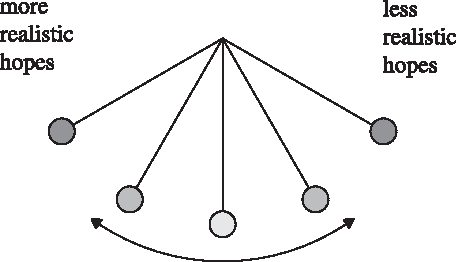
Oscillation between more and less realistic hopes.
Patients may not understand the prognostic information
For a variety of reasons, patients often cannot understand prognostic information. First, patients and clinicians may not speak a common language or come from a similar culture. Such barriers are hard to overcome when discussing complex issues like illness trajectory and prognosis, even with a skilled interpreter. 17 Second, health professionals, especially physicians, can struggle to translate complicated pathophysiology and treatment algorithms into language that patients can understand, and may resort to confusing medical jargon and euphemisms.18,19 Third, despite the clinician's best efforts at clear communication, illness may impair a patient's thinking. For example, hypoactive delirium is common and is easily misidentified as anxiety, depression, or other psychiatric disorders.20,21 Neurological disorders such as mild encephalopathy, stroke, seizures, encephalitis, or brain metastases can also have subtle presentations and should be considered when a patient struggles to process or remember information.
Patients may be confused by differing estimates of prognosis within the medical team
In some cases, patients may seem to not understand prognosis because they have received conflicting information from the medical team. Prognostication is uncertain 22 and variable, and clinicians' estimates may differ. One study of physicians and hospice outpatients found that physicians overestimate prognosis by a factor of about five. 23 Physicians' ability to prognosticate accurately also depends on the patient's survival time. Physicians are more accurate in patients with very short or very long survival times, but less accurate in patients with survival times between one and twelve months. 24 Predictions are also influenced by how long the physician has known the patient and by the level of physician experience. 23 Given these uncertainties, the prognosis from the referring clinician and palliative care consultant may differ and result in mixed messages to the patient. Cultivating a partnership with the referring clinician, as we will describe, can address this type of discrepancy.
Referring clinicians may struggle to balance honest information with hope
Finally, patients may seem to not understand prognosis because clinicians sometimes give contradictory information about the future. Many physicians worry that discussing prognosis may take away hope, 25 precipitate unmanageable emotion, or cause emotional harm to patients.22,26-28 In the struggle to balance hope and emotional comfort with honest prognostic information, clinicians may give mixed messages. For example, a clinician may comment that the patient has a strong heart even though she is dying from metastatic cancer. Confused by the apparent contradiction and hoping for more time, the patient may understandably focus on the information that conveys more optimism and misinterpret the prognosis. Similarly, clinicians may be uncomfortable with the strong patient emotions generated by prognostic information and backpedal. For example, a clinician may recommend hospice but when faced with patient and family distress may add that rehabilitation is a possibility. By understanding that contradictory information may have been communicated in an effort to maintain hope, the palliative care consultant can empathize with the struggle of the referring clinician to discuss prognosis and more effectively guide both the referring clinician and the patient towards more attainable hopes.
Cultivating a Strong Partnership with the Referring Clinician
After reflecting on the differential diagnosis of what happened when the patient and referring clinician discussed prognosis, the next step is to cultivate a partnership with the referring clinician. Partnership begins with direct communication between the two providers.
Direct communication can be initiated by approaching the referring clinician to share and discuss the reasons why the particular situation is so difficult. Explicitly naming the complexities in a particular case can ease the isolation both the referring clinician and palliative care clinician might feel in trying to manage it and enable collaboration. Both clinicians can then develop a better understanding of the clinical challenges and strategize how to approach the difficulties together. An opening approach that can be helpful includes questions such as the following: What is your sense of how this patient will do with this illness? How has it been to care for him? What is your sense of what the patient understands about his illness and prognosis? I feel like it has been really hard to discuss the future with him. Have you found that too?
It is important to remember that productive communication between the referring clinician and palliative care consultant can be inhibited by the intense emotions evoked by a case, such as sadness, frustration, anger, inadequacy, helplessness, and even shame. For example, in difficult cases such as the one at the beginning of this article, the referring clinician may feel frustrated that the patient may die so soon after receiving chemotherapy and then avoid direct conversation with the palliative care consultant. Similarly, the palliative care consultant may feel helpless after failing to help this young person in facing his terminality and making preparations for the end of his life. Rather than confront the difficult emotions and insecurities that this case evokes, the referring clinician and palliative care consultant may instead limit their communication. In extreme cases, both clinicians practice without communicating at all, struggling with similar problems and frustrations but unable to learn from or support each other.
Opportunities for direct communication arise when both clinicians share similar concerns about the patient; these are illustrated in the case. Both clinicians worry because the patient is young and because his aggressive disease trajectory may not give him enough time to accept what is happening. Both his clinicians are also having a hard time giving him prognostic information, since they are worried that he and his parents will not be able to cope. His parents add another layer of complexity, since they are unwilling to discuss anything other than treatment with the oncologist and do not attend his palliative care appointments, thereby limiting opportunities to discuss prognosis and creating greater worry for the clinicians about how this family is coping.
In the case, the palliative care clinician actually approached the oncologist with her concerns about the patient's ability to cope and make decisions. “I asked the patient if he had any worries or concerns for the future and he would not make eye contact and changed the subject. I have not been able to meet with his parents. I am worried that the patient and his family are struggling to cope and may never be able to have a discussion about prognosis or make informed decisions about his future treatments.”
When discussing the complexities of a case, both clinicians should also share and discuss their own estimates of the prognosis. The palliative care physician might say, “I am worried that time is short, maybe only a few weeks, but I feel uncertain because he is young and might also respond to the Tarceva. What is your estimate of his prognosis?” A common understanding of prognosis helps the clinicians to anchor clinical decisions and brings a consistent message about prognosis and plan of care to the patient. In contrast, practicing without direct communication about prognosis can send a confusing message to the patient that both clinicians do not agree about the course of treatment. In our experience, when patients are emotionally vulnerable and easily overwhelmed, mixed messages about treatment options can be particularly confusing and emotionally destabilizing.
In the case, the oncologist shared with the palliative care clinician that she too was worried the prognosis was short. She also shared that she felt it was important to continue to offer chemotherapy despite his declining functional status because the patient was so young and because he and his family were struggling to cope. She hoped that with a bit more time, he might achieve greater acceptance and readiness for end-of-life decision making. This clinical intuition is supported by recent research that suggests that a subset of patients who self-report high levels of emotional numbness may not benefit from end-of-life discussions. 29 As a result of their discussion, the clinicians made a plan to see the patient together in a joint visit.
Patient joint visits
Once clinicians have a shared understanding of the difficulties of the case and the likely prognosis, a joint visit helps to partner in the care of the patient. Joint visits can give real-time data about why a patient is challenging and offer clinicians the opportunity to support each other, both in the room with the patient and afterwards during a debriefing. In addition, joint visits give the palliative care consultant the opportunity to better assess the differential diagnosis as to why the patient does not seem to understand the prognosis. For example, did the referring clinician tell the patient the prognosis and then backpedal or was the patient too emotionally overwhelmed to process the news? At times when patients have intense emotions, the palliative care clinician can work to support the referring clinician by exploring or containing strong emotion. Joint visits also allow the palliative care consultant to model another way of delivering difficult information. In this case, the palliative care consultant observed during a joint visit that the oncologist tried to be very honest with the patient and his family about prognosis. However, when difficult discussions arose, the patient's mother became emotionally overwhelmed and this reaction limited further discussion.
Alas, even when the partnership between clinicians is strong, the case may continue to be challenging. Forecasting potential struggles and setting realistic and sometimes very low expectations can help both clinicians face ongoing challenges. For example the palliative care consultant might say, “My worry is that even if we do this right, this patient and his family may struggle and his end of life may not be as comfortable as we would hope.” Setting realistic expectations helps the referring clinician feel validated that this situation has no easy answers (if the palliative care consultant is also struggling, this case must really be hard).
Conclusion
When patients have had a discussion about prognosis and do not seem to understand what was said, the palliative care consultant must sort through several sources of confusion. An important first step is to generate a differential diagnosis for the discrepant reports. Once the reasons are better understood, the palliative care consultant can partner with the referring clinician and patient in order to build a collaborative relationship and better care for the patient and family.
Footnotes
Author Disclosure Statement
No competing financial interests exist.