




Abstract
Abstract
Background:
Atypical genital bleeding due to gynecologic cancer not only impairs patients' quality of life (QOL), but also becomes a major causative factor of death. We report the clinical usefulness of Mohs' paste for genital bleeding from the uterine cervix or vaginal stump in patients with recurrent gynecologic cancer.
Method and Results:
Eight patients with gynecologic cancer were enrolled between January 2010 and March 2012. Mohs' paste was directly applied to the bleeding tumor. In patients with recurrent genital bleeding after the application of Mohs' paste, the technique was repeated. The effect of this procedure continued for 4 days to 1 year. The effect of Mohs' paste continued for 3 months or more in three patients. None of the eight patients have died of genital bleeding.
Conclusions:
The use of Mohs' paste is safe and convenient for massive genital bleeding from the uterine cervix or vaginal stump due to recurrent gynecologic cancer. However, our study does have some limitations including the small number of enrolled subjects and heterogeneous cancer types.
Introduction
In the 1930s, Mohs first reported that chemical fixation using 20% zinc chloride causes tissue necrosis. He developed a method of microscopically controlled tumor excision as a chemosurgery technique. Mohs' paste has been commonly applied to perform chemosurgery of skin cancers. Regarding the therapeutic benefits of Mohs' micrographic surgery for recurrent patients with basal-cell carcinoma, a prospective study demonstrated that Mohs' micrographic surgery was associated with significantly fewer recurrences than surgical excision. 7 As a result of tissue fixation, there was no bleeding in those micrographic surgical operations. A recent study showed that the use of this paste was effective in stopping local bleeding from advanced malignant wounds such as breast and neck cancer. 8
In the present study, we first describe the clinical usefulness of Mohs' paste for massive genital bleeding from the uterine cervix or vaginal stump in patients with recurrent gynecologic cancer.
Patients
Five patients with cervical uterine cancer, two with endometrial cancer, and one with ovarian cancer were enrolled between January 2010 and March 2012. Initial treatments included hysterectomy, anticancer chemotherapies, and chemoradiation. During follow-up periods, all subjects experienced massive genital bleeding from the uterine cervix or vaginal stump despite suppression by gauze. For four patients suffering from recurrent life-threatening genital bleeding, blood transfusions (mean volume: 1100 mL) were performed several times before treatment with Mohs' paste.
Method
The ingredients of Mohs' paste have been described previously, 8 but the application of Mohs' paste to the vaginal cavity is described for the first time in the present study. Mohs' paste (Fig. 1) was made of a mixture of zinc chloride (50 g), distilled water (25 mL), zinc starch (19 g), and glycerol (15mL) (Table 1). Mohs' paste has a general and uniformly used content. Glycerol is used to adjust viscosity. Although this mixture can be preserved at room temperature, it may soften at body temperature after pasting. This paste can be stored in a plastic ointment jar for 1 year at room temperature. To prevent skin irritation, the paste should be applied while wearing plastic gloves. 8 Before Mohs' paste application, fentanyl was routinely administered intravenously when the patient was unconscious. Penetrative fixation of Mohs' paste may cause severe pain and intravenous fentanyl administration can relieve pain rapidly. Mohs' paste was directly applied to the bleeding tumor using a large pledget, with care being taken not to adhere it to the vagina, and soft pressure was applied to the tumor for a few to 40 minutes. The pledget was removed 24 hours later, and the process was completed when the surface was dry and hard without bleeding. Mohs' paste tends to cause inflammation of mucous membranes such as in the vaginal wall. Thus, pasting should be selectively done to malignant tissues. As is the case with neck cancer, when the paste is used at a thickness of 1 mm in order to cover the surface of the tumor, the tumor should be fixed to about 5 mm in depth. 9 In patients with recurrent genital bleeding after the application of Mohs' paste, this technique was repeated. Massive genital bleeding was defined as a bleeding volume of more than 400 mL per day.
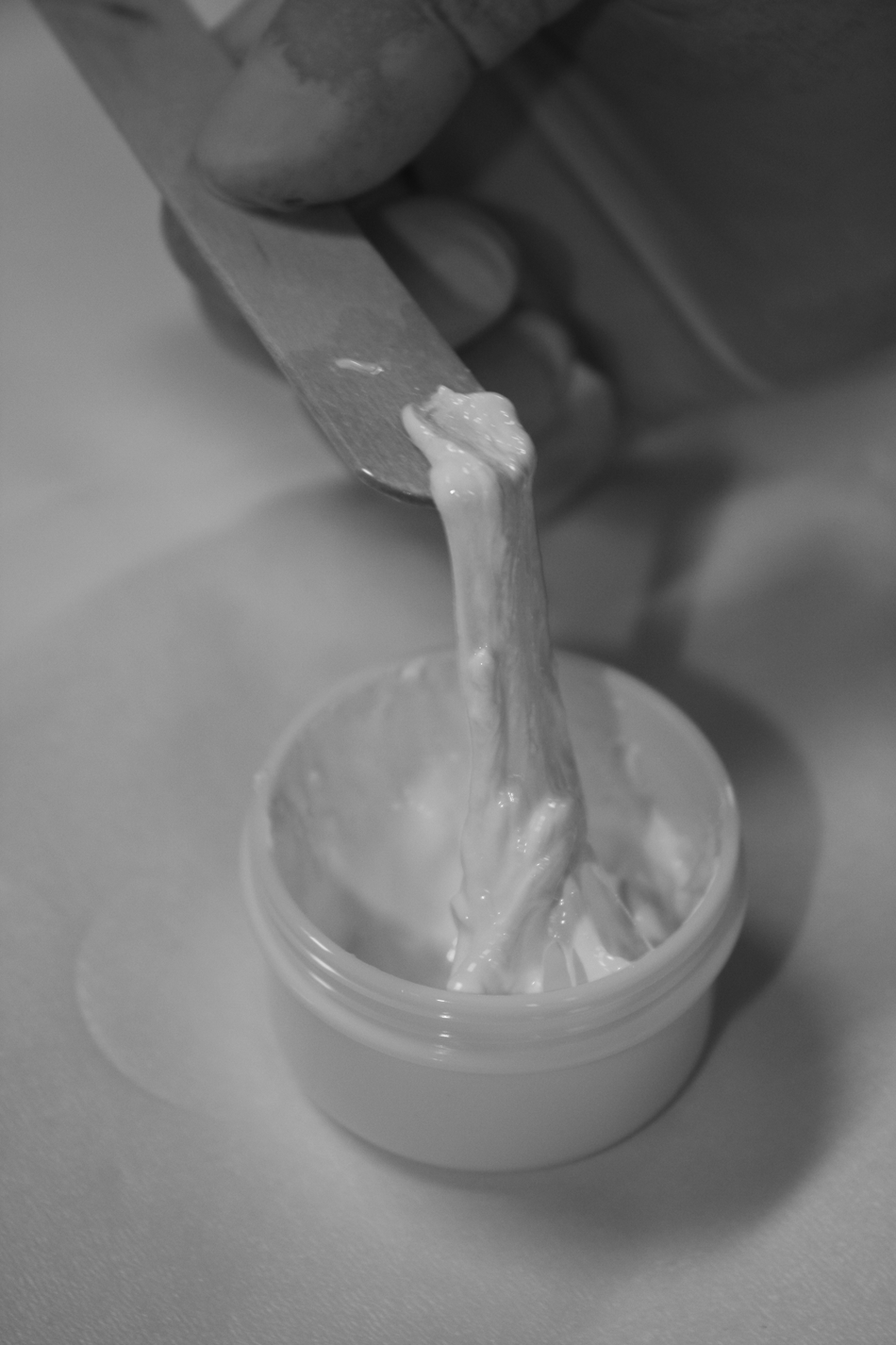
Mohs' paste.
Results
The baseline characteristics of eight patients are shown in Table 2. Mean age was 65.5 years and cervical cancer was the most common disease. Patients had undergone various anticancer therapies including hysterectomy, anticancer chemotherapy, and chemoradiation. Wound width ranged from 20 mm to 82 mm in caliber (mean: 55.0 mm). Almost complete hemostasis in all patients could be achieved by a single use of Mohs' paste (Table 3). Patients with recurrent genital bleeding received the same procedure again. After fixation with Mohs' paste, the surgical field surface was hard without bleeding.
Serous=Serous cystadenocarcinoma
SCC=Squamous cell carcinoma
Endometrioid=Endometrioid adenocariconma
Blood transfusion was performed immediately after the hemostasis.
Mean.
In most patients, blood transfusion from 800 to 1600 mL was performed before the application of Mohs' paste. Mohs' paste was utilized after confirming hemoglobin levels of 10.0 g/dL or more. However, hemoglobin levels did not change during the application of Mohs' paste. The effect of this procedure continued for 4 days to 1 year. The effect of Mohs' paste continued for 3 months or more in three patients. None of the eight patients have died of genital bleeding. There were no side effects, except for pain requiring opioids. Pain was caused not only by stimulation with Mohs' paste, but also by the procedure of vaginal extension.
Case 8
We describe the details of the clinical course of case patient 8 (Table 3) as follows. A 70-year-old woman was diagnosed with recurrent squamous cell carcinoma of the uterine cervix. Although she had undergone concurrent chemoradiation therapy at 67 years of age, she had a relapse in the uterine cervix. The patient underwent aggressive interventions including hysterectomy, palliative radiation, and systemic chemotherapy. However, the tumor invaded to the vulva and bleeding with a penetrating odor would not stop (Fig. 2A). Under epidural anesthesia, Mohs' paste was used for the vulvar tumor. Pasting was thinly applied to the entire surface using a medical spatula (Fig. 2B), and then the area was covered with gauze for 24 hours. Bleeding completely stopped with one application and the foul odor decreased (Fig. 2C). After fentanyl administration with an epidural tube for 12 hours, there was no complaint of pain.

Case 8; (
Discussion
Torrential bleeding occurs in approximately 6% to 10% of patients with advanced cancer. 10 Massive genital bleeding from malignant wounds in the uterine cervix or vaginal stump is one of the most common and serious complications in patients with gynecologic cancer in advanced stages. In addition, these events can be extremely distressing for family members or caregivers. 10 Only limited guidelines are available regarding the management of genital bleeding in the palliative period.11,12 There have been several reports evaluating the local management of vaginal bleeding in patients with recurrent gynecologic cancer.3,4,6,10,13 In conservative management, a wide gauze bandage is tightly packed in order to tamponade exudates from the tumor. Patsner showed that two patients with life-threatening vaginal bleeding from recurrent gynecologic cancer were successfully treated with the application of topical acetone or placement of an acetate-soaked pack, with immediate control of hemorrhage and no immediate side effects other than pain. 13 Palliative radiation therapy using either external beams or brachytherapy is one of the most effective strategies for hemostasis.2,5 In this study, hemostasis was also achieved in patients previously treated with radiation therapy. Thus, it is likely that combined treatment of radiation therapy and Mohs' paste can lead to excellent hemostasis and durable tumor control in radiation naive patients. Invasive treatment for advanced cervical cancer, including uterine artery embolization or laparoscopic arterial ligation, has been reported to control massive bleeding as a life-saving hemostatic procedure.3,4,6
In Mohs' paste, zinc chloride changes into zinc ions by water and zinc ions precipitate wound proteins. Tissues, vessels, and bacteria are fixed chemically. 14 This paste has been commonly used for the micrographic excision of a cutaneous tumor followed by serial excision. The physician performs a sequential series of excisions until no residual tumor can be found in the bottom layer of the specimen by microscopic examination. 8 In 2008, it was reported that Mohs' paste completely controlled local bleeding in palliative breast cancer patients. 8 All patients succeeded in the hemostatic treatment on first application and bleeding was controlled from 11 days to more than 1 year. Odor and exudates were also reduced and tumor volume was decreased. However, only limited data are available regarding the use of Mohs' paste for genital bleeding from recurrent gynecologic cancer. The present study demonstrates that, in most patients, genital bleeding was stopped when the procedure was performed 1 to 3 times, despite primary disease or age. No patients died of vaginal bleeding after performing this procedure. There were no additional complications due to repeated application of the paste. However, repeated application of Mohs' paste may have a potential risk of vesicovaginal or rectovaginal fistulas. In necrotic tissues, anaerobes induce odor and exudate with infection. In our cases, however, Mohs' paste was effective in controlling bad odor or exudates. Zinc chloride paste has the effect of stimulating normal skin and often causes irritant contact dermatitis accompanied by pain. However, none of our patients have suffered from sores in the genital organs, and pain could be controlled by intravenous or epidural fentanyl administration. Stimulation of genital organs could be avoided by selectively using a pledget in malignant tissues. However, our study does have some limitations including the small number of enrolled subjects and heterogeneous cancer types.
Conclusions
This study suggests that the use of Mohs' paste is safe and convenient for massive genital bleeding from the uterine cervix or vaginal stump due to recurrent gynecologic cancer. Bleeding can be stopped rapidly by direct application of the paste without performing any surgical procedure. Mohs' paste may have a potential use for bleeding tumors in rectal cancer patients. Mohs' paste improves QOL and survival time. If the use, availability, and storage of Mohs' paste can be realized in developing countries, especially where cervical cancer and massive genital bleeding due to end-stage gynecologic cancer are common, Mohs' paste may become a very useful treatment modality.
Footnotes
Author Disclosure Statement
No competing financial interests exist.