




Abstract
Dear Editor:
Physicians in palliative medicine are subject to fatigue as they care for patients at the end of life. 1 Although many studies have examined fatigue in patients, there are few studies with physicians. No studies address fatigue in palliative medicine fellows.
Expressive art may relieve fatigue.2,3 In light of this, we conducted a small pilot study to see if expressive art could influence fatigue in a group of palliative medicine fellows.
At San Diego Hospice and the Institute for Palliative Medicine (SDHIPM), palliative medicine fellows spend 60 minutes a week in a self-care reflective discussion session, led by a licensed marriage and family therapist (LMFT). After approval by the SDHIPM institutional review board, our study was incorporated into these self-care sessions.
Methods
Six palliative medicine fellows participated in four 60-minute self-care sessions over four weeks. The Brief Fatigue Inventory (BFI) and the Pittsburg Sleep Quality Index (PSQI) were administered prior to each of these sessions.4,5 Fellows participated in an expressive art activity during Session 1 (drawing) and Session 3 (sculpture), immediately after which the BFI was administered.
Data analyses were conducted using Systat 13 for Windows (Cranes Software, Chicago, IL) in two stages. First, baseline differences in the BFI and PSQI scores were examined across the four-week intervention period using the general linear model (GLM) for repeated measures. Second, the effect of the expressive art on BFI scores in Sessions 1 and 3 was examined using factorial repeated measures on evaluation time (2 [Session 1 and Session 3]) and on intervention (2 levels: pre- and post-expressive art).
Results
Two-thirds of the pre-session PSQI scores were greater than 5, associated with poor sleep quality. Pre-session BFI scores were below 7, indicating moderately severe fatigue. Both were unchanged across the study period. BFI scores showed a significant decrease in fatigue immediately following the art sessions (F1, 5=26.96, p=0.003) (see Fig. 1.)
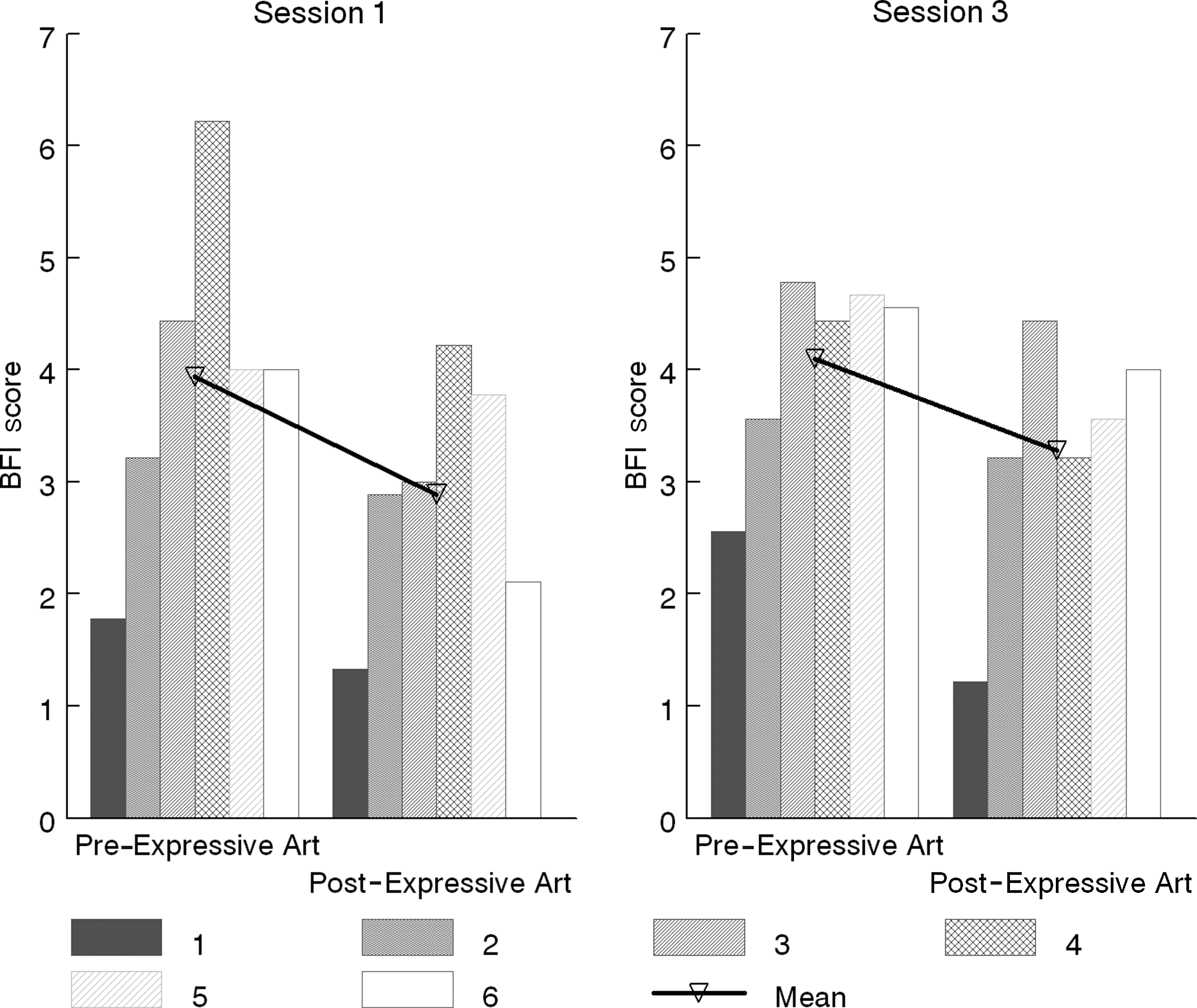
Brief Fatigue Inventory.
Our participants had poor sleep quality; two-thirds of study participants had PSQI scores greater than 5. Despite poor sleep quality, there was a change in fatigue scores. Pre-session BFI scores indicated moderately severe levels of fatigue. After the expressive art activity, BFI scores were significantly lower. It appears that the expressive art may have had an immediate salutary effect on fellows' self-reported fatigue.
Limitations to our study include a low number of participants and lack of a randomized control group with which to compare findings. We also did not include a post-session PSQI administration for the four sessions. And there is a question as to whether the reduction of fatigue may have been due to the usual therapeutic “self-care” session and not attributable to the expressive art. We did not measure a post-session BFI on the weeks without expressive art.
This is the first study of its kind to explore the effect of expressive art on fatigue in palliative medicine trainees. These initial positive results make us believe there is much more to be studied on this potential therapy for fatigue.
Footnotes
Acknowledgments
The authors would like to thank San Diego Hospice and the Institute for Palliative Medicine for support in this research. Also, many thanks to the fellows for their contribution to this study.