




Abstract

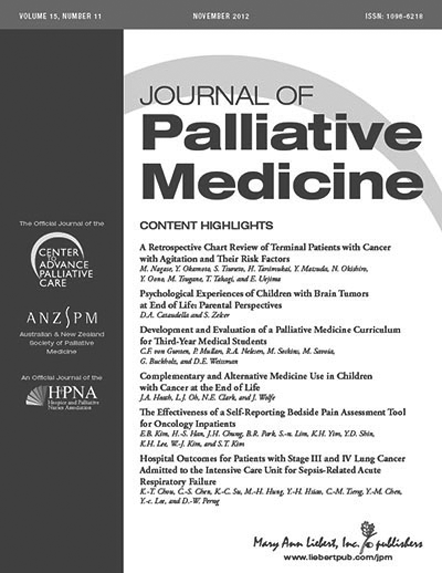
Letters to the Editor
Increased pediatric HIV survival would essentially mean an increased demand for adolescent and young adult palliative care. (page 1167)
Brief Reports
A pilot study to evaluate the current rates of grief and burnout among health care professionals in the pediatric infant care unit (PICU), and to explore facilitated support sessions as a method of reducing grief perceptions and burnout among providers. (page 1178)
Fast Facts and Concepts
#207 Withdrawal of Dialysis: Decision Making (page 1270)
#208 Clinical Care Following Withdrawal of Dialysis (page 1271)
Personal Reflection
“I was emotional and uncomfortable. I was struggling to wrap my brain around how she had chosen to end her life and donate her organs. I'm an organ donor and would gladly donate after brain death, but I don't know if I could make the decision she made. Talk about guts.” (page 1279)
Case Discussion in Palliative Medicine
A report on five types of challenges that our team experienced when implementing concurrent care, illustrated through case studies of three medically complex pediatric patients. (page 1281)
Book and Media Reviews
(page 1284)
Recent Literature
(page 1285)
Sustained Learning of Palliative Care
Charles von Gunten, David Weissman, and colleagues analyzed the results of a required didactic and experiential palliative care curriculum for nearly 600 third-year medical students on the clinical wards from 2002–2007. Compared to national benchmarks, they found significant and sustained effects on learning, which indicate students are better prepared than a national sample of residents and attending physicians. (page 1198)
Teaching Interprofessional Palliative Care
The authors combined online learning with live interactive simulation to teach spiritual, cultural, and interprofessional aspects of palliative care to medical, nursing, chaplaincy, and social work students. Despite the challenges of representing each profession, the program was highly rated and may be useful in other educational settings. (page 1240)
Alternative Medicine in Children with Cancer
In qualitative interviews, 30% of parents caring for a child with cancer reported using complementary and alternative medicine (CAM) during the end-of-life period, with 44% of families using more than one type. The most common therapies were organic foods, faith healing, and homeopathy. There was a strong correlation between open discussion with the treating physician and parents' use of CAM for their children. The majority (78%) felt CAM use significantly benefited their child and most felt it did not cause additional suffering. (page 1218)
Effects of Pain Self-Assessment Tool
In this observational prospective study, 50 cancer inpatients used a bedside pain board to report pain levels to hospital staff. Patient reliability over staff's pain assessment increased from 74% to 96% after initiation of the bedside board (P = 0.004). The gap between pain levels reported by patients and those recorded in medical records decreased (P < 0.001), and patient satisfaction increased (P = 0.002). (page 1222)
Timing of Palliative Care Referral
Researchers conducted qualitative interviews with medical specialists to examine factors influencing palliative care referrals. They found significant barriers in perception and communication, and advocate for streamlined practices that are sensitive to specialty needs and patient desires. (page 1248)
Physician Culture and Grief
Researchers interviewed 20 oncologists at three cancer centers in Canada about their experiences of grief related to patients. Grief was most acute when physicians felt close to patients and families, when patients died young, when they had long-term patients, and when deaths were unexpected, among other factors. These losses occurred within a physician culture of stigma around death and dying, viewing emotion as weakness, and focusing on cure. (page 1254)
Psychological Experiences of Children with Brain Tumors
Interviews with parents of children who died of brain tumors identified a distinct set of progressive neurologic deteriorations that impacted children's cognitive and emotional states, interpersonal relationships, and potential for personal growth. (page 1191)
Risk Factors for Delirium
A retrospective chart review of 126 advanced cancer patients found a 42% prevalence of agitated delirium, most commonly in the last week of life. Risk factors included older age, male gender, smoking history, lung cancer, diabetes, and high C-reactive protein (CRP). Using these factors, the authors recommend risk-stratifying patients to prevent and/or mitigate the course of delirium. (page 1185)