




Abstract

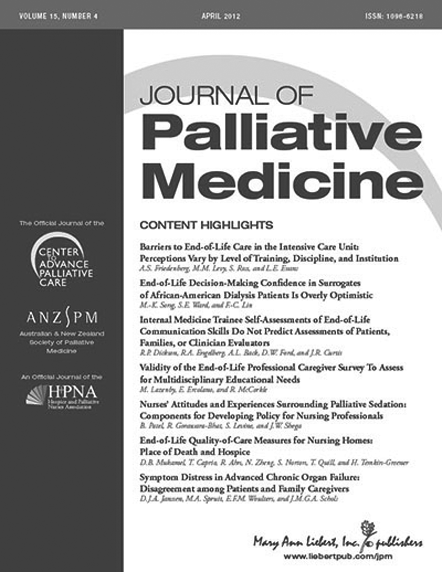
Letters to the Editor
Hemodialysis and end-stage renal disease provide an interesting paradigm for exploring the tension that often exists with practicing evidence-based medicine, using technology, and appreciating cost in the health care system. (page 390)
Brief Reports
Assessment of whether a patient's dying trajectory, potentially recognizable on emergency department (ED) evaluation, impacts subsequent palliative-care provision for those hospitalized. (page 392)
Fast Facts and Concepts
#248 Counseling Patients on Side Effects and Driving when Starting Opioids (page 484)
#252 Borderline Personality Disorder and Palliative Care (page 485)
Personal Reflection
“It occurred to me that this could be her legacy. She could make a CD of her favorite songs to leave to her family. I suggested the idea to her and I could tell by her enthusiasm that we had found her legacy project.” (page 492)
Case Discussions in Palliative Medicine
Case of a palliative care consult conducted across language barriers to frame a discussion about the use of interpreters for family meetings, including the evidence for using a professional interpreter and the burden experienced by interpreters involved in end-of-life discussions. (page 494)
Book and Media Reviews
(page 499)
Recent Literature
(page 500)
Learners' Self-Assessments: Off the Mark?
In a randomized trial, researchers compared internal medicine residents' self-evaluation scores on end-of-life communication skills with scores of their performance by their patients, families, and clinician-evaluators. The trainees' self-assessment did not predict the others' view of the quality of their communication. (page 418)
Nurses' Attitudes Toward Palliative Sedation
In developing a hospital policy on palliative sedation, the authors conducted focus groups of nurses to elicit their perspectives and concerns in creating effective guidelines and training programs. (page 432)
Measuring Quality in Nursing Homes
Using the Centers for Medicare and Medicaid Services' web-based report card, the authors identified “place of death” and “hospice enrollment” as quality measures available from data sources at any nursing home around the country. (page 438)
Proxy Report of Symptoms
Patients with advanced chronic obstructive pulmonary disease, congestive heart failure and chronic renal failure and their family caregivers rated their symptoms, treatments and satisfaction with their care. Results were mixed, reflecting that proxies do not always accurately represent patients' experiences. (page 447)
Surrogate Decision Making in Dialysis
Researchers reviewed the responses of 58 dyads of African-American dialysis patients and their surrogates on surveys of patients' values and goals of care. Surrogates' confidence had little association with their actual understanding of patients' values and goals. (page 412)
The Compassionate Hospital
The authors define three characteristics of a “compassionate hospital” and explore how leadership can promote compassion and renew meaning and purpose among health care workers. (page 457)
Nurses' Recognition of Depression
This Australian study explored nurses' confidence and skill in detecting and treating depression in palliative care patients. They found a need for training in the diagnosis of major depression and how it differs from grief. (page 463)
Staff Perceptions of the Liverpool Care Pathway
In focus groups, staff at a 194-bed New Zealand hospital reported the Liverpool Care Pathway for the dying patient had increased their knowledge and confidence, reduced patients' symptom burden, decreased practice variation, and improved continuity of care, communication, and teamwork. (page 468)
Assessing Educational Needs
This study examined the validity of the End-of-Life Professional Caregiver Survey as a tool for assessing the educational needs of palliative care professionals among multiple disciplines. (page 427)
Barriers in the ICU
The authors surveyed residents, fellows, attendings, and nurses in intensive care units (ICUs) at two academic medical centers and found that the perceived barriers to high-quality end-of-life care differed significantly by level of training, discipline, and institution. (page 404)