




Abstract

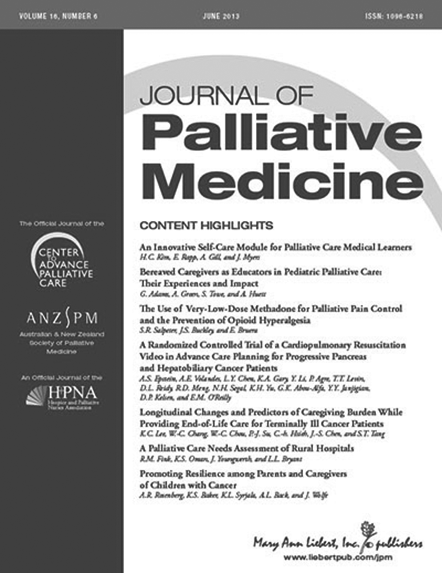
Letter to the Editor
In order to reach a wider range of individuals across generations and promote continuous engagement of the Journal of Palliative Medicine's readership worldwide, we developed the JPM Social Media portal. (page 599)
Brief Report
The sexual health needs of people with advanced incurable diseases are underexplored and underassessed by health care practitioners and understudied by researchers. (page 686)
Fast Facts and Concepts
#215 Opioid Poorly Responsive Cancer Pain (page 696)
#270 Pain in Sickle Cell Disease (page 697)
Personal Reflection
“The majority of physicians I have encountered over many years experience some difficulty discussing alcohol abuse, drug addiction, sex, and dying with patients. If health care providers shy away from these discussions, perhaps I am naïve in expecting regular folks to embrace these kinds of discussions.” (page 708)
Case Discussions in Palliative Medicine
Opioids are the preferred medications to treat cancer pain; however, several barriers to cancer pain management exist. We describe one such situation in which a family member prevents the patient from receiving adequate pain management at the end of life despite interdepartmental and interdisciplinary efforts. (page 709)
Recent Literature
(page 713)
Growth of Outpatient Palliative Care
Alexander Smith and colleagues obtained in-depth information about 20 palliative care clinics in diverse care settings. Once established, outpatient palliative care practices experienced rapid growth. The authors recommend that practices must plan for increased staffing and develop a sustainable financial model. (page 661)
Categorizing Conversations about Prognosis
The authors recorded and analyzed 71 conversations between palliative care clinicians and patients and families at a large academic medical center, and found three discrete types of prognosis conversations: navigating options (56%), facilitating quality of life (23%), and preparing for the end of life (21%). The authors recommend our interventions should be tailored to each of these common, yet distinct, conversations. (page 653)
Finding Resilience
In a qualitative analysis of small group interviews with bereaved family members of children with cancer, the authors identified factors of resilience and developed a testable framework that, once validated, may guide interventions to promote resilience in family members of children with cancer. (page 645)
Low-Dose Methadone for Pain Relief
In this retrospective study of community hospice patients, the use of very-low-dose methadone with adjuvant haloperidol resulted in excellent pain control without dose escalation or opioid-induced hyperalgesia in both cancer and noncancer diseases. (page 616)
Self-Care Module for Learners
The authors describe a novel, structured module on self-awareness and reflection for postgraduate and undergraduate learners completing a palliative care rotation. (page 603)
Causes of Death in Advanced Cancer
Autopsy studies describing the immediate causes of death in advanced cancer patients were first published 20 years ago. The authors analyzed autopsy reports from patients in 2004–2010 for causes of death since the wider use of broad-spectrum antibiotics and prophylactic anticoagulation. The results found causes of death unchanged. (page 669)
Developing Palliative Care in Rural Communities
A descriptive survey of 236 rural hospitals found significant barriers to developing palliative care, including lack of administrative support, mentorship, access to resources, and limited training or skills in palliative care. Respondents who had contractual relationships with local hospices and/or used online courses reported greater success in advancing palliative care. (page 638)
Videos for CPR Education
Researchers randomized cancer patients to an educational video about cardiopulmonary resuscitation (CPR) or a similar CPR narrative. Rates of advance directive documentation were 40% in the video arm compared to 15% in the narrative arm. Post-intervention knowledge was higher in both arms, and preferences for CPR changed only in the video arm. The majority of subjects in both arms reported the information as helpful, comfortable to discuss, and recommended it to others. (page 623)
Measures of Caregiver Burden
In this prospective, longitudinal study of 193 Taiwanese family caregivers, important determinants of caregiver burden were patient symptom distress, confidence in caregiving, social support, psychological resources, and intensity of caregiving. (page 632)
Parents' Attitudes toward Trainees in Pediatric Palliative Care
This qualitative study described the motivations, expectations, challenges, possible benefits, and meaning-making for bereaved parents involved in pediatric palliative care education. Both parents and clinicians identified more advantages than disadvantages in parent participation in palliative care training. (page 609)