




Abstract
W
Case 1: The chart told the medical story: “61-year-old female with progressive glioblastome multiforme, third-line chemotherapy, progressive decline in performance status. Recent admission for failure to thrive.” The patient was a cachectic woman in a wheelchair. Her husband John and her best friend Sarah explained that she probably would not understand most of what I asked or said to her. Although Jane smiled when I introduced myself (she was unable to shake my hand because of right-sided weakness), she did not otherwise acknowledge our conversation.
John had brought a binder, meticulously organized, with important documents, medication logs, her advance directives. He confirmed the medical history I had read and updated me. At the time of her discharge two weeks ago Jane could walk with John and Sarah by her side. She was interactive, though occasionally confused. Now she was weaker: unable to move her right arm or leg at all, she was confined to a wheelchair. And she had become completely aphasic, her confusion more persistent. John needed to help with bathing and toileting. What to do? I could read the tension in his face. He and Sarah were waiting for me to come up with a plan.
Her steep decline and increasing care needs pointed to two medical options: admission to the hospital, or hospice. I could see from the notes that she had shared with her oncology team a clear wish to focus on quality of life and a desire to stop further disease-directed treatments. Had they spoken with the team about hospice care? John looked a little hesitant. Not yet: they had not expected the decline to be this fast.
We were facing a big transition. Yet I could not feel Jane's personal presence, and I knew she would never be able to talk to me directly. It felt like we were deciding in a vacuum, that something was missing.
I paused for a moment, wondering how to proceed. Remembering that she was an artist, I mentioned that I had just been to an art show in Miami, where they have a home. “I loved it,” I told her. Jane's eyes widened, and she brightened. Sarah said, “She's registering something.” I turned to talk directly to Jane. “I know you're an artist—what medium do you use?”
John said, “Take a look at this,” and swiped open his iPhone. The screen revealed a breathtaking bronze sculpture of a woman throwing back her head and arms in exaltation. “It's a sculpture of her Mom,” John said. “She usually paints in watercolors and oils,” he added. “Would you mind showing me more of her work?” I asked. Through the images on his phone he showed me Jane's world—and it went far beyond her wheelchair. His phone held a museum of her imagination—gorgeous images—each giving me a glimpse of something deep within the frail woman in the wheelchair. There was the painting of three girls on a dock looking at their reflections in the ripples of water beneath them, beautiful in its simplicity (Fig. 1). And watercolor landscapes, in brilliant fuschias and yellows: flowers blooming, a field with a home in the horizon. Then drawings: a woman brought to life with a few strokes of charcoal.
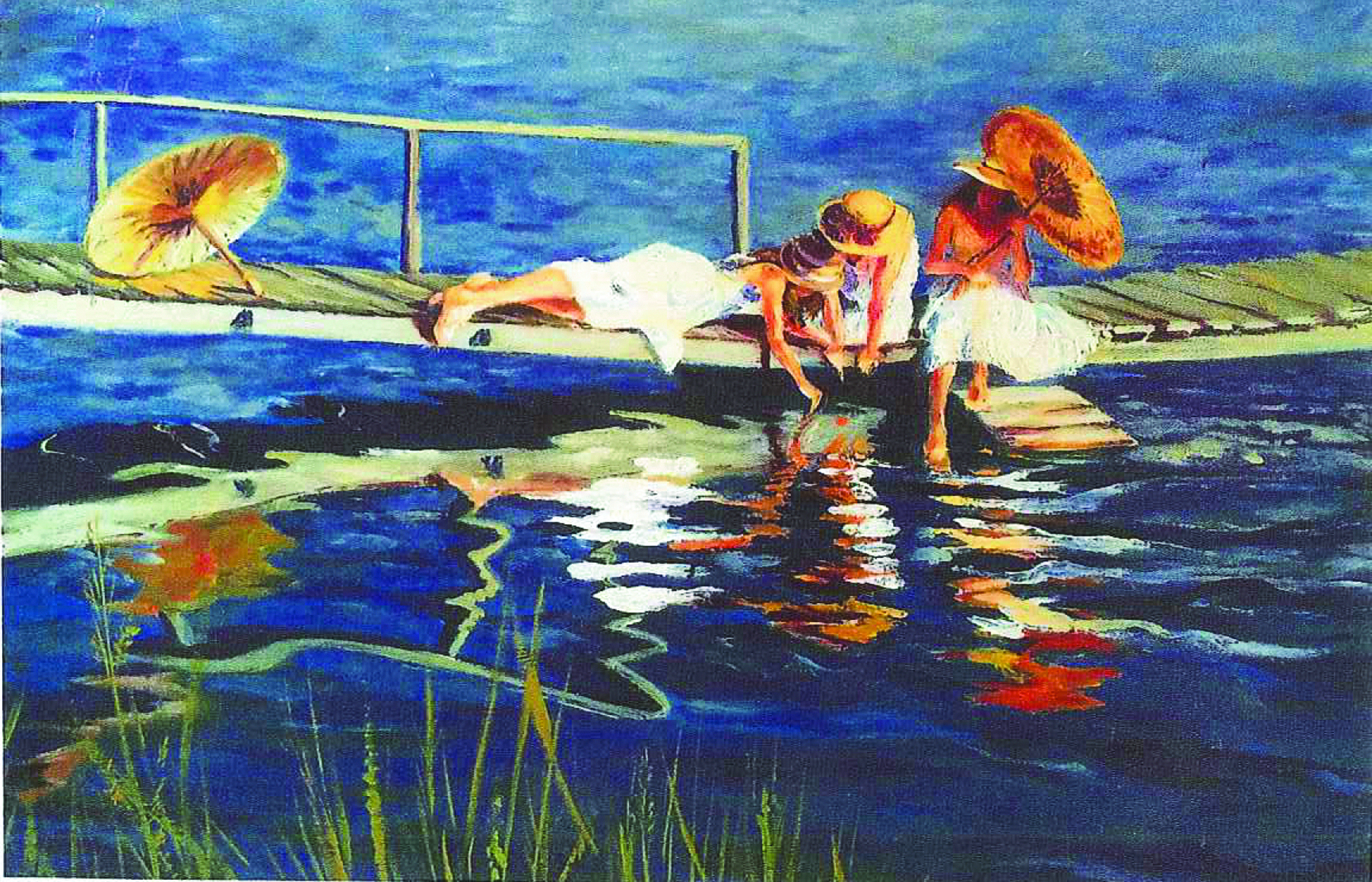
Painting by Cynthia Brown.
I looked up to see her eyes welling up with tears. Assuming her tears must be about loss or grief, I prepared to say, ‘This must be so difficult for you’—but Sarah interjected, “These are tears of happiness—this work has brought Jane such joy. She loves to share it.”
I thought, this is what I was looking for: a glimpse of the person within. The photo stream of her art illustrated what she valued, and enabled me to experience her in a way that went beneath the diagnosis, medical history, chemotherapy, and hospitalizations. I said to her, “I know that you have not been able to speak to me, but I feel that I have gotten to know a bit of a very important part of you.” She smiled again. The feel of the room shifted. John smiled, a tiny smile. Did John and Sarah feel more at ease? I can't be sure, but I felt a slight lifting of tension in the room. Now, I felt, we're ready to talk about the options.
Case 2: “I (ALB) was talking about a CT scan with Bob, a gentleman with metastatic colon cancer, and, for a change, the news was good—the liver mets were a tad smaller. “Good news!” I said. Bob's daughter grabbed her phone and began texting the news to her siblings. I looked at Bob, whose eyes looked a little moist. “Thank you,” he said. “I can't quite believe it.” “I think a little celebration is in order,” I said. Bob looked at his wife, who regulated his diet rigorously. “Chocolate cake?” he said. She smiled. “Oh yes.”
We enjoyed the moment. Then Bob said, “Ok, now what?” I said, “It looks like we should make some more plans.” But wanting to keep the big picture in view, I added, “Besides the chemo, what would you like to add to the calendar?” He brightened. “Ah—the warblers will be at home in two months. I'd like to see them.” Bob was from the Midwest, now living with his daughter for his cancer treatment. He explained that he and his wife were avid bird watchers. Every year they went to see the warblers arrive in the hills nearby.
“Could you show me a picture?” I said. He pulled out his mobile phone. He showed me pictures of warblers, their habitat, his birding haunts—all in a few flicks of the screen. “Who are they?” I asked about one of his photos. And he told me about his birding buddies, their long friendships, and the places they had been—all over the United States, Costa Rica, Canada—in pursuit of birds. His values were right there in color: friends, travel, love—but now I really had a sense of them. I had never seen him so energized. He flicked open a birding app, to play a warblers' call for me. “Honey,” his wife said, “I think the doctor is busy.”
We've been reflecting: How do we get to know the person who is located beneath the layers of patient? Sometimes we have the luxury of a longitudinal relationship and can build up a sense of the person over many conversations. Other times we are sitting with a patient we've just met. Either way, we're often facing big, life-changing decisions, and we're struggling to find the right words. That's when a few mobile phone snapshots can help us see, in a new way. The view of the world through the patient's snapshots brings out our inner anthropologist. It's usually not the subject of the photo that grabs us—it's the friend smiling from the corner of the frame, or the detail like the warbler's tail we're directed to see. So even when a patient can't express herself in the words that mean ‘values,’ we find ourselves turning to these pocket photo albums as another way to talk about what's important. We ask: “Could you show me a photo on your phone that tells me something about you?”
Footnotes
Acknowledgments
This work was supported by R25CA092203 from the National Cancer Institute at the National Institutes of Health.