




Abstract
Abstract
Background:
The prevalence of constipation among patients in palliative care has varied in prior research, from 18% to 90%, depending on study factors.
Objectives:
The aim of this study was to describe and explore the prevalence and symptom distress of constipation, using different definitions of constipation, in patients admitted to specialized palliative care settings.
Methods:
Data was collected in a cross-sectional survey from 485 patients in 38 palliative care units in Sweden. Variables were analyzed using logistic regression and summarized as odds ratio (OR).
Results:
The prevalence of constipation varied between 7% and 43%, depending on the definition used. Two constipation groups were found: (1) medical constipation group (MCG): ≤3 defecations/week, n=114 (23%) and (2) perceived constipation group (PCG): patients with a perception of being constipated in the last two weeks, n=171 (35%). Three subgroups emerged: patients with (1) only medical constipation (7%), (2) only perceived constipation (19%), and (3) both medical and perceived constipation (16%). There were no differences in symptom severity between groups; 71% of all constipated patients had severe constipation.
Conclusions:
The prevalence of constipation may differ, depending on the definition used and how constipation is assessed. In this study we found two main groups and three subgroups, analyzed from the definitions of frequency of bowel movements and experience of being constipated. To be able to identify constipation, the patients' definition has to be further explored and assessed.
Introduction
C
The prevalence of constipation is described with great variations in the palliative care setting, from 18%–90%.9,10–12 There are numerous explanations to this variation. Different perceptions of the definition of constipation by patients and by clinicians might be one explanation. 9 Patients may consider themselves constipated if they do not have bowel movements every day, while others perceive having bowel movements once a week as normal. 13 One study reported differences between the patientsԛ and the physician's definition of constipation, namely that patients define constipation as changes in their experience in passing stools, in frequency or consistency, and physicians as a physical symptom with changes in frequency. 14 Another explanation might also be the lack of a common agreement regarding the definition. 9
Furthermore, patients' self-reports may not be adequate,15,16 the presence of several other severe symptoms makes identification difficult, 17 and clinicians' assessment might not be optimal. 18 Constipation is also reported to be poorly documented in medical and nursing records, 19 but even when it is well documented it has low concordance with actual patient reports. 20 A mix of patients with different diagnoses, different stages of illness, and different organizations of palliative care units may be other sources for variations in study results. 5 Constipation may also be overlooked as a problem; 21 and therefore it can be assumed that there are an additional number of unknown cases, 15 which further explain the various numbers in prevalence.
In palliative care, constipation is still poorly defined, both in research and clinically, but a consensus definition is needed for clinical improvement. Assessment of the history of bowel function, current physical dysfunction, the patient's subjective sensation of constipation, stool consistency and frequency have been suggested to improve the definition. 8 Another definition is the Rome criteria and parts from this definition are often used for studies in palliative care,8,18,19 although it has been developed and validated for a rather divergent patient group with functional constipation. 22
To summarize—and patients suffer due to constipation—the prevalence of constipation has varied in previous studies and patients may define constipation differently compared to physicians. Therefore, the aim of this study was to describe and explore the prevalence, definition, and symptom distress of constipation by applying different definitions of constipation, in patients admitted to specialized palliative care settings in Sweden.
Methods
Design
This was a national cross-sectional survey. Specialized palliative care units registered in the Swedish Palliative Care Guide (Palliativguiden 2010; www.nrpv.se) were approached to participate. The units offer specialized palliative care for patients in their own homes and/or at a specialist palliative ward.
Participants
We used a two-step inclusion process: First we selected specialized palliative care units and in the second step we selected the patients for this study. Inclusion criteria for the units were providing patients with full access to health care personnel every day, 24 hours a day, and having ≥10 patients admitted. Written permission from the heads of the departments was obtained before the start of the study. Thirty-eight specialized palliative care units in Sweden out of 65 agreed to participate.
For this study, 1287 patients were eligible for participation, since they were admitted to the specialized palliative care units that were selected. Inclusion criteria for the patients were to have been admitted to a specialized palliative care unit, over 18 years of age, with or without diagnosed constipation. Even patients without diagnosed constipation were included, since there are patients undiagnosed, but still having symptoms. 15 Exclusion criteria were not speaking Swedish and having cognitive failure, as identified by the nurses or physicians. A total of 319 (25%) patients were excluded from the study because they did not meet the inclusion criteria: not speaking Swedish (n=87) or cognitive failure/were unable to give informed consent (n=143). For other reasons for not participating, see Figure 1.

Flowchart of patient selection process.
Procedure
The study was approved by the Swedish regional ethical review board in Linköping (Dnr: 2012/203-31). Data was collected between October 11, 2012 to November 11, 2012. Informed consent from the patients was collected by the health care personnel (nurses and physicians). Patients could choose to fill out the questionnaire with assistance, if needed.
Data collection
A questionnaire was developed by the authors to capture the prevalence, risk factors, definition, and distress of constipation. This paper presents the prevalence, definitions, and distress. The questionnaire consisted of 26 questions, with four questions to be completed by clinicians and 22 questions by patients. As there is no instrument that totally captures different descriptions of constipation in palliative care, most items were retrieved from validated instruments, with the exception of four items—on bowel movements, information, and the patient's view of constipation and self-care—which were constructed by the authors. The appropriateness 23 of the developed questionnaire, its readability, the patients' understanding and work effort were discussed with four patients admitted to specialized palliative care and eight health care professionals, prior to data collection.
Prevalence of constipation
Previous studies have reported patients' different definitions of constipation: changes in experience in passing stools, in frequency or consistency.13,14 To identify the prevalence of constipation, and as used in previous studies, 24 one criterion about frequency from the Rome criteria was used: “fewer than three defecations a week.” 22 This question was formulated, “How often have you had your bowel moved the last two weeks?” with several response alternatives.
The Memorial Symptom Assessment Scale (MSAS) was used to identify patient-perceived prevalence of constipation, by the question, “Have you experienced yourself as constipated the last two weeks” (yes/no)? MSAS is a multidimensional tool for prevalence, severity, and distress of symptoms. 25
Quality of life, nutrition, toilet facilities, and self-care
To minimize the burden of filling out questionnaires, we used relevant items from previous questionnaires to assess several aspects related to constipation (see Table 1).
HRQoL EQ-5D, health related quality of life; EORTC QLQ-C15 PAL, European organization for research and treatment of cancer-palliative care questionnaire; MNA, minimal nutrition assessment.
Patient's view of constipation
To explore the patient's own view of their definition of constipation, one question was added: “How would you describe what constipation means to you?” Patients had the possibility to answer in terms of days between bowel movements (1–≥6 days); in terms of their experience (“a little straining—hard straining to be able to defecate,” “hard straining with very little outcome”); or in terms of the appearance of feces (“straining with small, hard lumps coming out”). To describe the appearance of the stool form, the Bristol Stool Form Scale (BSFS) was used. Colored, illustrated images, on a 1–7 grade Likert scale, of the appearance of feces were used: 1 (lumpy, hard stool) to 7 (mushy, watery stool). Patients were asked to fill out their “average form” during the last two weeks (grade 1–2 is considered as constipation). 26
Distress
The MSAS was also used to measure the distress of experienced constipation, using three questions: (1) “How often?” 1 (rarely) to 4 (almost constantly); (2) “How severe?” 1 (slightly) to 4 (very severe); and (3) “How distressful?” 1 (not at all) to 5 (very much). 25
Background characteristics
Diagnosis, medication use, and place of care were collected from the patient's record by primary clinicians. Demographic variables on gender, living conditions, age, and education were collected from the patients.
Data analysis
Descriptive statistics, with means and standard deviation (SD) values for continuous variables, and percentages for categories, were used to describe baseline characteristics. T-test and chi-square test were used for dropout calculation regarding age and gender. Questionnaires that were incomplete for the two questions regarding “number of defecations a week” and the patient's perception of “being constipated last two weeks” (n=30) were excluded. The final analysis was therefore conducted on 485 questionnaires, with a descriptive analysis for differences between groups. Patients with ≤3 defecations/week were analyzed as the medical constipation group (MCG), and patients with a “perception of being constipated during the last two weeks” as the perceived constipation group (PCG). These groups were further analyzed into three subgroups (used in this study): patients with only medical constipation, MC ONLY; patients with only perceived constipation, PC ONLY; and finally, MC&PC, which included patients with both ≤3 defecations/week and a “perception of being constipated during the last two weeks” (see Fig. 2).
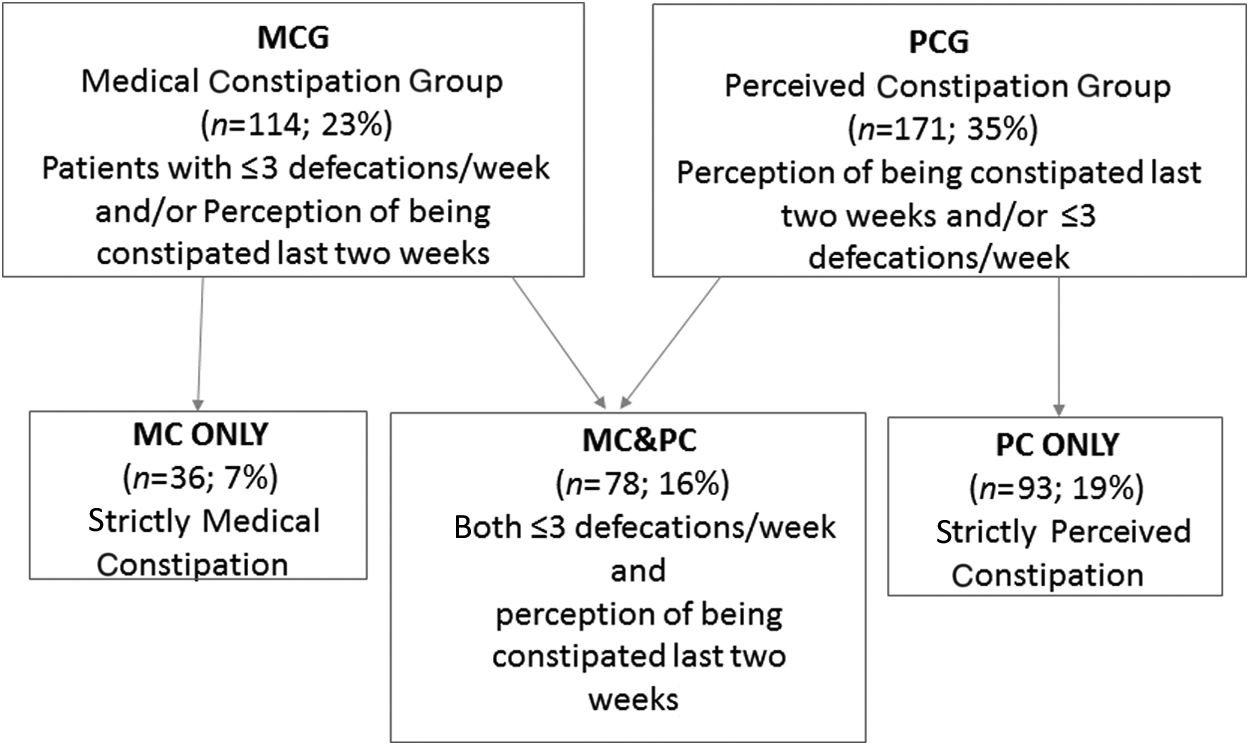
Definitions used for constipation-groups for description of different prevalence of constipation.
The dependent variables were constipation by definition (frequency, appearance, and experience) and stool appearance (BSFS type 1–7). Independent variables were all the factors for constipation presented in measurements: mobility (Health Related Quality of Life EQ-5D); 27 appetite (European Organization for Research and Treatment of Cancer–Palliative Care questionnaire–C 15 PAL); 28 meals/day and fluid/day (Minimal Nutrition Assessment); 29 toilet facilities (Norgine® Risk Assessment Tool for Constipation); 30 information, self-care, distress (MSAS); 25 as well as diagnosis, medication, place of care, gender, living conditions, age, and education. All response alternatives were dichotomized with a yes/no answer. Binary logistic regression was used and summarized as odds ratio (OR), with a corresponding 95% confidence interval (CI). A p-value of<0.05 was considered significant and all analyses were performed using SPSS 21.0 (IBM, Armonk, NY).
Results
Study participants
The sample consisted of 485 patients, with a mean age of 71 (SD 12); 261 (54%) were women (see Table 2). There were no differences in participants and dropouts (n=170) regarding age (p=0.17) and gender (p=0.40). The majority of the patients (n=390; 80%) received palliative care in their own homes, and 59% (n=286) were living together with someone. The most frequent medical diagnosis was cancer (n=419; 86%) (see Table 2).
More than one diagnosis could be chosen.
Prevalence
The prevalence of constipation varied between 7%–43%, depending on the definition used. In total, 207 patients (43%) were constipated. For the MCG, the prevalence was 23%; and for the PCG, 35%. The prevalence in the subgroups was 7% for MC ONLY, 19% for PC ONLY, and 16% for MC&PC (see Fig. 2 and Table 3).
Question to answer if constipation lasts two weeks.
MC&PC, medical constipation and perceived constipation; MC only, medical constipation only (≤3 bowel movements a week); PC only, perceived constipation only (perception of being constipated in the last two weeks).
Symptom distress
Patients who perceived themselves as constipated (PCG) during the last two weeks (n=171) were asked to continue with three following MSAS questions on how often, severe, and distressful they had experienced their constipation (see Table 3). The majority of all constipated patients (n=207) had constipation often (74%), severe (71%), and distressful (57%). Patients with PC ONLY had lower odds for having constipation more often (OR 0.17; 95% CI 0.05–0.61) and more distressful (OR 0.34; 95% CI 0.16–0.73) than patients with MC&PC. There were no significant differences in severity between the groups (see Table 4).
An odds ratio of more than 1.00 represents a higher odds, or greater likelihood of an effect from the variable.
Question to answer if constipated in the last two weeks.
MC&PC, medical constipation and perceived constipation; MC only, medical constipation only (≤3 bowel movements a week); PC only, perceived constipation only (perception of being constipated in the last two weeks).
Patient definition of constipation
More than half (64%) of all the patients (n=485) defined constipation as days between bowel movements, but there were no significant differences in OR for either constipation group. The odds were higher for patients with PC ONLY to define constipation as an experience (OR 2.70; 95% CI 1.07–6.79) than for patients with MC&PC. The result from the BSFS showed that constipated patients, overall, had higher odds for having “lumpy stools,” i.e., type 1 (OR 7.09; 95% CI 2.88–7.47) and type 2 (OR 2.27; 95% CI 1.25–4.11), than patients without constipation (see Table 4).
Discussion
This study has shown varying prevalence of constipation depending on the definition used; with the strict frequency-based definition (MC ONLY), only 7% were constipated. This could be interpreted as constipation is a minor problem, or an already well-relieved symptom in the Swedish palliative care context. But when we added the patient-reported perception of being constipated, the prevalence increased to 43%, indicating a larger problem. The current study confirms that assessment of constipation needs to be more thorough to find out more about the prevalence of constipation. Previous studies have reported that patients diagnosed with slow transit constipation and laxative use but absence of malignancy had more loose stools. 31 This study, however, showed that all constipated patients had more lumpy and/or hard stools compared to nonconstipated patients. This might be explained by the fact that not all patients in the Swedish palliative care context received laxatives regularly and that the majority of them had cancer diseases and drugs, well known to cause constipation. Slow transit constipation was not identified in this study, as functional problems are rarely explored in palliative care practice. 32 This might be a weakness but could be investigated further in the future. However, there were no differences in stool appearance between the different constipation groups. We expected that patients with PC ONLY would have more of type 3 or 4 (sausage-like, smooth), since they had their bowels moved almost every day. Patients with MC ONLY and patients with MC&PC could have been expected to have BSFS type 1 or 2, since all of them moved their bowels ≤3 times a week.
It is important to capture patients' own definitions, as they describe constipation differently. 14 Therefore, from this result, we suggest a routine use of stool appearance, for example the BSFS, which could facilitate the assessment of constipation. Even if it does not seem to be able to differentiate between different subgroups of constipation yet, it might be a useful tool for improving assessment.
Patients with MC ONLY did not perceive themselves as constipated, despite having less defecation than three a week. This group of patients would probably not report any bowel problems to a clinician. Therefore, these patients should be encouraged to communicate about their bowel movements, so it is possible to identify their need of bowel care. Still, for the clinicians, patients with MC ONLY are the easiest group to assess and identify through the frequency of their bowel movements. Patients with PC ONLY, on the other hand, could solely have a perception of being constipated, not having less defecation than three times a week, which makes it harder to identify. It has been reported that even when patients have frequent bowel movements they may report incomplete evacuation and feel constipated, 31 which is similar to the group of patients with PC ONLY in this study. Therefore it is important to explore and recognize the patient's perception of symptoms, even though it does not fit the medical definition of constipation. Developing clinical skills and exploring the patient's bowel symptoms are of significance. Clinicians need to allow patients to explain it in their own words. This would help patients express their needs, problems, and experiences; and it would help them to cope, as the perception of severity exists regardless of the frequency of bowel movements.
Patients with PC ONLY had just as severe and distressful constipation as l patients with MC&PC. Therefore this group deserves attention, but will be hard to identify if assessment is only made from frequency of bowel movements. 31 Assessment should include the appearance of stools, perception of bowel emptying, and symptom distress.33,34 This study is limited by the fact that we did not use one accepted definition of constipation. We could have used the Rome criteria for assessing constipation, but we considered whether patients in palliative care could have answered questions for example about “manual maneuvers“ and straining during more than 25% of bowel movements” or not. Further, the Rome criteria had to have been met for the previous three months, with the onset of symptoms six months prior to diagnosis. This is not possible for patients in palliative care due to the short time of care in Sweden (md=18 days) 35 and the onset of opioids and opioid-induced constipation in a late phase of the disease. It has been suggested that the context of palliative care needs a better definition of constipation that suits this patient population, 8 which we agree on.
Other authors in the area of gastroenterology have suggested a more inclusive definition of chronic constipation: “any patient experiencing consistent difficulty with defecation.” 36 Therefore in this study we wanted to focus on two aspects of constipation, namely frequency-based as well as patient-perceived constipation. We also asked patients questions about constipation during “the last two weeks,” but recall bias might have been present. The response rate in this study was 49% (485 of 986 approached), which is a typical partition rate in a population of patients in a palliative stage. 37 Although the participants did not differ in age or gender, they may have differed from those who declined to participate. The latter patients could have been weaker (as with the dropouts), having more severe symptoms or being closer to death than the actual participants. This may have consequences for our ability to generalize the results.
Conclusions
Prevalence may differ, depending on the definition used and how constipation is assessed. In this study we found two main groups and three subgroups, analyzed from the definitions of frequency of bowel movements and experience of being constipated. By using a frequency-based medical definition for assessment there is a risk of not identifying all constipated patients. The “true” prevalence of constipation is not yet possible to discover with the current lack of common agreement on definition. To improve constipation management, clinical guidelines need to be developed and the assessment of constipation needs to be more holistic and rely on a communicated common definition.
Footnotes
Acknowledgments
This study was supported by grants from the Medical Research Council of Southeast Sweden (FORSS) and Vrinnevi Hospital Research Board.
Author Disclosure Statement
No competing financial interests exist.