




Abstract

Letters to the Editor
Specific problems with the Medicare Care Choices Model (MCCM), including financial risk that would be imposed on participating hospices, and recommendations for improving the MCCM so that true innovation in hospice care can be tested. (page 1085)
Brief Reports
The use of adjuvant dexmedetomidine in a patient with metastatic sarcoma suffering from an acute postoperative neuropathic pain crisis. (page 1164)
Fast Facts and Concepts
#283 Use of inotropes in patients near the end of life (page 1178)
Personal Reflection
As we exited the room, in the hallway just outside Mr. M's door, I saw that some artwork had been hung. My first thought was that I was glad the facility made these things available to residents and Mr. M seemed to enjoy taking part. Then the lightning struck. Amongst these items of childlike art was a drawing, which I recognized immediately as a self-portrait. “This is how he sees himself,” I thought, “and it says everything.” (page 1183)
Book and Media Reviews
(page 1190)
Recent Literature
(page 1191)
Live Hospice Discharges
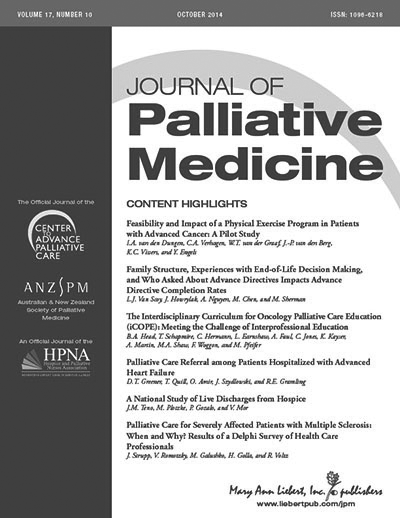
In an analysis of more than a million Medicare hospice beneficiaries, Joan Teno and colleagues found that one in five hospice patients are discharged alive with variation by geographic regions and hospice programs. Not-for-profit hospices and older hospices had lower rates of live discharge. (page 1121)
Use of Artificial Nutrition and Hydration
Researchers surveyed more than a thousand physicians and nurses in Italy about their attitudes on the use of artificial nutrition and hydration in end-of-life patients. In general, the respondents supported the use of hydration (73%) more than artificial nutrition (48%). The authors report important differences between physicians' and nurses' opinions, which may increase understanding and improve interprofessional collaboration. (page 1143)
Exercise in Advanced Cancer
In a pilot study, 26 patients with advanced cancer participated in an individualized exercise program, consisting of resistance training and aerobic exercise, twice a week during six weeks. Although the dropout rate was 35% due to disease progression, there were significant impacts on muscle strength, aerobic fitness, and quality of life. (page 1091)
Heart Failure Referrals
The authors analyzed more than 2600 hospital admissions for patients with heart failure over five years at an academic medical center, and found only 6% were referred to palliative care. They argue for additional research to identify risk factors and develop better prediction models to increase palliative care referrals for the heart failure population. (page 1115)
Palliative Care in Multiple Sclerosis
Researchers conducted an online Delphi study and expert workshop on when palliative care should be integrated into the care of patients with multiple sclerosis. More than 40 health professionals participated, including neurologists, urologists, speech therapists, and psychologists, and they identified specific areas where palliative care can be most beneficial. (page 1128)
Professional Development of Medical Students
Educators at the School of Medicine of Austral University in Buenos Aires found that medical students who chose an elective palliative care curriculum during their training had more favorable attitudes than their colleagues on interprofessionalism, holistic care, patient-centered care, self-awareness, and humanism. (page 1137)
Factors for Completion of Advance Directives
The authors interviewed 130 inpatients at a university hospital and compared those with a completed advance directive (AD) versus those without an AD. Patients were 10 times, 46 times, and 68 times more likely to complete an AD when asked by a medical professional, lawyer, or family member or friend, respectively. (page 1099)
Interprofessional Education
Members of an interdisciplinary faculty team at a large public metropolitan university describe the creation of a mandatory interdisciplinary palliative oncology curriculum and how they responded to formative feedback from medical, nursing, and social work students and chaplain interns. (page 1107)