




Abstract

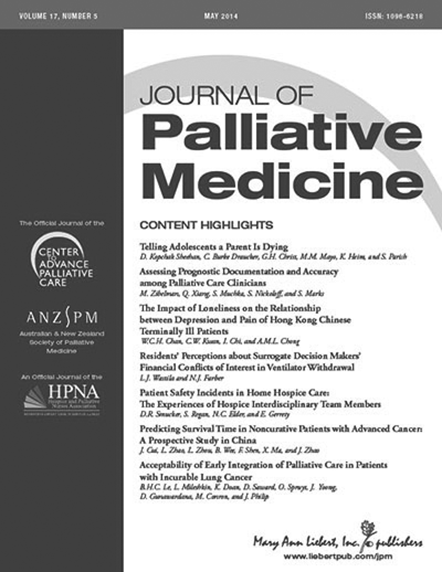
Letters to the Editor
Report of four palliative patients successfully treated with olanzapine who had previously been resistant to multiple antiemetics and who were not receiving chemotherapy. (page 503)
Brief Reports
Comfort Care Kit (CCK) consisting of nonoral and nonparenteral rescue medications devised for caregivers to use at home for symptom control in imminently dying patients who have lost their ability to swallow. The aim of this study was to evaluate the feasibility of the CCK from the perspective of bereaved caregivers. (page 575)
Fast Facts and Concepts
#279 Cannabis for Symptom Control (page 612)
Personal Reflection
One culture invades and samples the human body without hesitation. No opening? Then we will create one. The other views such trespasses into an intrinsically harmonious system as sacrilege and asking for disaster. All she needed, her traditional Eastern sensibilities told her, was medicine to gently recenter a perturbed equilibrium. (page 621)
Case Discussion in Palliative Medicine
Small, contemporary series of palliative care patients with medically intractable, unilateral, nociceptive pain demonstrated dramatic benefits in pain relief and quality of life following percutaneous cordotomy. (page 624)
Book and Media Reviews
(page 629)
Recent Literature
(page 630)
Accuracy in Prognosis
In this retrospective analysis of 400 consultations, the prognostic accuracy of palliative care physicians was similar to physician accuracy in other studies. The authors found a trend toward overestimation that was similar to previous research. Use of a template in the electronic medical record also increased documentation of estimated prognosis. (page 521)
Telling Adolescents That a Parent Is Dying
Based on interviews with hospice patients and families, the authors describe four ways that parents disclosed their own life-threatening illnesses to adolescent children: measured telling, skirted telling, matter-of-fact telling, and inconsistent telling. The authors state the results might inform interventions tailored to meet a family's communication style. (page 512)
Acceptance of Early Palliative Care
In focus groups and interviews, oncologists conveyed their needs in acceptance of early palliative care: confidence in quality of care, defined lines of responsibility and clear communication, ease of referrals, and concerns about negative patient reactions. (page 553)
Decisional Conflict and Ethnicity
Researchers examined decisional conflict among parents of children with life-threatening illnesses and found significant differences by race, ethnicity, and language spoken. They advocate identifying these issues when creating clinical care plans, engaging in shared decision making, and finding ways to alleviate decisional conflict. (page 559)
Hospice and Patient Safety
In this qualitative study, hospice team members report that patient injuries from falls or inadequate control of symptoms are the most common safety incidents at their hospices. (page 540)
Volunteers in Palliative Care
The authors present a comprehensive survey of volunteer programs in British hospice and palliative care programs. Volunteers were most commonly involved in daycare and bereavement services, but also complementary therapy, faith-based care, and sitting with dying patients. (page 568)
Surrogates and Financial Gain
The authors assessed physician attitudes about withdrawing life-sustaining treatment when surrogates' decision making included financial considerations. (page 533)
Estimating Prognosis in Cancer
Researchers are developing a new prognostic scale to predict survival in advanced cancer patients in China. (page 545)
Impact of Loneliness on Pain
The authors examined the relationship between depression and pain among Chinese terminally ill elders in Hong Kong, and explored the moderating effect of psychosocial factors including loneliness, communication, and interactions with others. (page 527)