




Abstract

Dear Editor:
The topic of quality measurement for spiritual care in health care is gaining more attention in recent years.1,2 Measuring the quality of spiritual care is a difficult undertaking due to the highly subjective nature of spirituality, and the fact that spiritual care providers can be a bit apprehensive with the idea of assigning numbers to their patients. Nevertheless, numbers are a standard method of measurement when seeking objective data. Additionally, quality measurement is essential for improved patient care and the growth and greater acceptance of spiritual care within the industry. 3
There are numerous tools for assessing the spiritual and/or emotional state of individuals in the various stages of their disease. However, unlike the medical field, spiritual care does not have a common scale for designating the level of spiritual or emotional pain of an individual. Medical pain scales, such as those that use the numbers 0–10, are based on a patient's perception of what they are experiencing, the results of which are then used to determine the effectiveness of the treatment. A simple, numeric spiritual pain scale in hospice care, which is generally accepted by spiritual care providers, would be a positive step toward quality improvement.
With this in mind, Center for Hospice Care (CHC) developed the Spiritual Comfort Measure (SCM) for its patients in 2005. The intent of its creators was to communicate the level of spiritual comfort/pain of CHC patients to the rest of the interdisciplinary team in a simple, numeric fashion. Originally, the SCM consisted of the numbers “–3” (extreme pain) to “ +3” (complete comfort), which were assigned to a patient as a way to designate a patient's level of spiritual comfort/pain. The scale was also seen as a possible means to measure the outcomes of the spiritual care being provided by the spiritual care counselor (SCC), through ongoing reassessment and reassignment. The assigned number was not intended to be a judgment of the SCC, but a direct correlation to how a patient perceived their own spiritual comfort/pain based on what they communicated to the SCC about their end-of-life experience. The 0 was to be assigned to those patients who were unable to communicate how they felt.
The SCM has served CHC well in terms of its original intent. However, CHC decided in 2014 to update the scale's numbering in order to align it with the more common 0–10 medical pain scales. It was felt that the use of negative numbers for those struggling spiritually through the end of life, as well as the use of 0 for those mentioned above, was not a dignified way to designate hospice patients. The updated scale consists of the numbers 0 (complete comfort) to 10 (extreme pain) 4 (see Fig. 1). “N/A” is assigned to those patients who are unable to communicate their level of spiritual comfort/pain. All other features of the scale have essentially remained the same. Further research will be necessary to determine whether the SCM has the potential of being the widely accepted spiritual pain scale that is needed in hospice care.
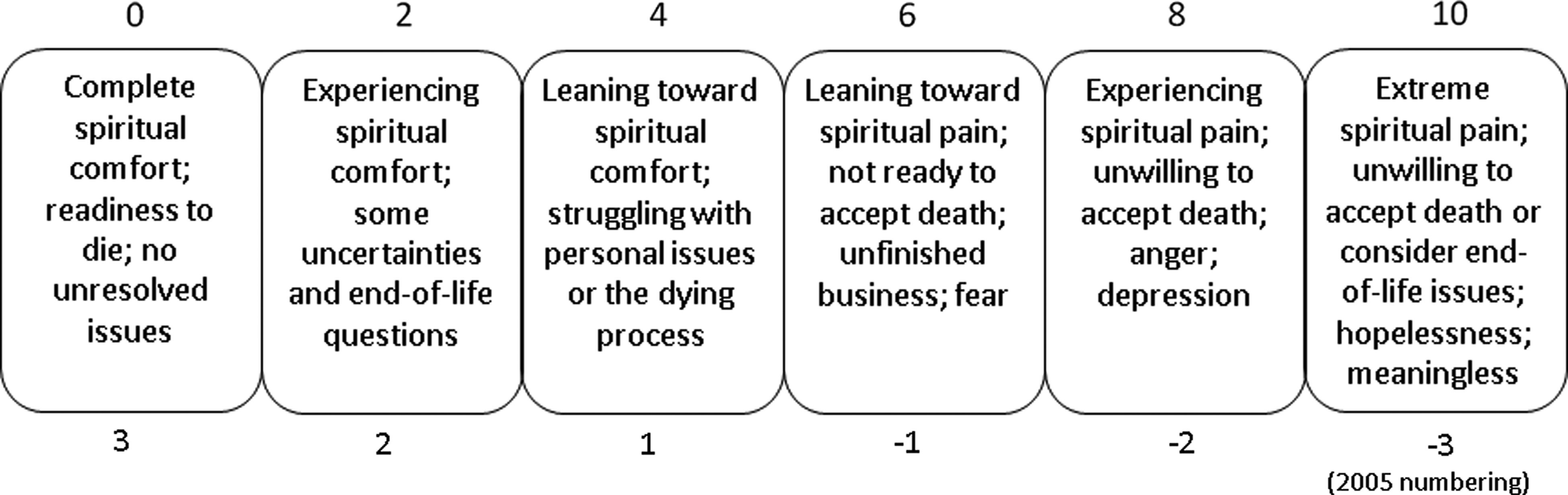
The Spiritual Comfort Measure.