




Abstract

Letters to the Editor
Therapeutic trial of low-dose dexamethasone alone or as an adjunct to treat contractures, whether or not concurrent pain per se was well controlled, in three patients with end-stage AD after other agents had failed. (page 208)
Brief Reports
Report discussing clinical supervision in detail as a source of self-care and a concrete approach to managing palliative care team well-being. (page 274)
Fast Facts and Concepts
#288 Pregabalin in Palliative Care (page 299)
Personal Reflection
Paul had been readying himself for this conversation but I was utterly unprepared. He had been seriously ill many times before, at times desperately so. Together we'd always managed to prevail. I hoped that I had been aware of the toll the preceding months had exacted but I had to question whether I'd been attentive enough. At his office visits I'd been pressured for time and overwhelmed by his growing list of unresolved problems. Had focusing on clinical details kept me from seeing the larger, more important picture? (page 301)
Book and Media Reviews
(page 310)
Recent Literature
(page 311)
Primary Palliative Care in Oncology
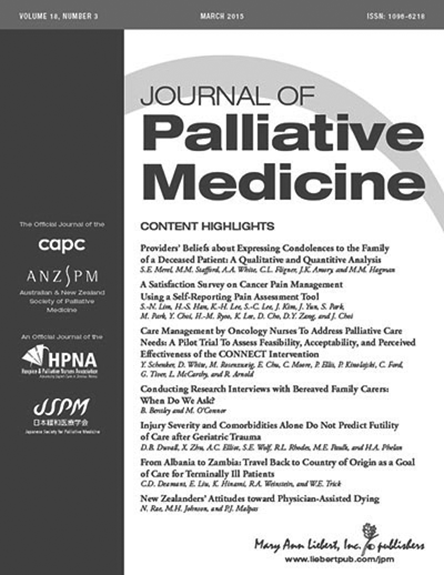
The authors describe how an oncology nurse led care management intervention was feasible, acceptable, and effective in improving access to primary palliative care for cancer patients. (page 232)
Prognostication after Severe Trauma
In an analysis of more than 570,000 patients from the National Trauma Data Bank, researchers found that injury severity and comorbidities alone do not predict futility in massively injured elderly trauma patients. They suggest that assessment of futility in these age groups may improve by incorporating measures of physiologic distress. (page 246)
Assessing Pain with Patient Self-Report
Among more than 500 cancer patients hospitalized with pain, researchers evaluated the usefulness of a patient-reported pain assessment tool on patient satisfaction and effective patient-physician communication. Both patients and physicians felt the tool was helpful; of note, there were large discrepancies in documented pain intensity between patients' self-report and physician assessment. (page 225)
International Discharges after Hospitalization
In this retrospective chart review, 38% of foreign-born palliative care inpatients expressed a desire to return to their country of origin. The palliative care team facilitated successful travel for nearly half of these patients. The authors advocate early identification of patients whose goals include travel to their country of origin. (page 251)
Attitudes about Physician-Assisted Dying in New Zealand
The authors describe a survey of New Zealanders' attitudes and opinions about physician-assisted dying (PAD). In general, 78% felt PAD was the most appropriate response in certain situations, and 82% felt it should be legalized. (page 259)
Sensitive Approaches in Bereavement Research
In this qualitative study, most bereaved family members (86%) felt comfortable being interviewed early after the death of a loved one. Family members reported their recall would be better and felt it might be helpful to talk about their experiences earlier. They stated bereaved people should be allowed to decide the best timing if involved in a research interview. (page 241)
Physician Condolences after Death
A small majority of providers at an academic medical center reported that they regularly expressed condolences to families after their patients died. Hospitalists and less-experienced providers were less likely to express condolences, and the authors advocate interventions to encourage and train these physicians. (page 217)