




Abstract
Abstract
Background:
Children's books have the potential to facilitate communication about death for children living with a serious illness and for children coping with the death of a loved one.
Objectives:
This study examines the content of children's literature relevant to the topic of dying and death and identifies books providers can share with children and their families.
Design:
A search of children's literature was conducted using four electronic databases and one additional search engine using the word “Death” or “Dying.” Storybooks about dying, death, and bereavement published in English, French, or Spanish between 1995 and 2015 were included.
Measurements:
Each book underwent content analysis by at least two independent reviewers. Strict PRISMA standard was followed. Full protocol is available as PROSPERO #CRD42016042129.
Results:
Two hundred ten books met inclusion criteria. The dying subject was primarily a grandparent (n = 78) or pet (n = 44). Books on the experience of a child dying were scarce (n = 5). The word death or dying was used in 75% of the books (n = 158), while others utilized euphemisms. The majority of books featured animals (n = 40) or Caucasian subjects (n = 122) and included spiritual elements such as heaven (n = 122). Less than one-quarter of the books included tools for readers to address the topic of death.
Conclusions:
Storybooks can be a helpful tool to introduce communication about dying and death with children. Gaps exist in current children's literature to effectively enable children to reflect on their own dying process. A general summary of available books is provided to assist those caring for children and families facing end-of-life issues.
Introduction
R
The term bibliotherapy, which traces back to Sigmund and Anna Freud, refers to the therapeutic process that occurs when learning from reading material for therapeutic benefit. 3 For children, the process includes using books that help children think about, understand, and work through practical, emotional, spiritual, and social concerns. There are examples of bibliotherapy being used to help children communicate; obtain greater insight into personal problems 4 ; and provide coping strategies for issues such as bullying, adoption, parental alcoholism, disabilities, domestic violence, self-esteem, behavior problems, eating disorders, divorce, and death. Through the creation of a safe distance, these books can facilitate a child's understanding and bring the child indirectly to the edge of sensitive issues that may be perceived as threatening.5,6 Such specialized topic books help children realize they are not alone7,8 or their experiences are unique.
Books are helpful for families as well. Parents often struggle with how to raise difficult topics with their child and may err on the side of silence due to concern for making a mistake. 6 Books can provide both the language parents may need to explain a topic and an opportunity while considering their child's understanding and feelings, while considering the child's cognitive and emotional development and understanding of their world. The ability to adapt to loss, cope with death, and express grief is critical for healthy childhood development. 9
Children living with a life-limiting illness who receive open communication about their diagnosis and prognosis experience significantly less anxiety and depression. 10 Yet, providers and parents both indicate difficulties in finding the right language and approach in addressing this topic with a seriously ill child. 11 In a prior narrative review of 65 storybooks, no books included children considering their own death or sharing their own end-of-life preparatory process. 9 The purpose of this systematic review was to learn what books are available in the children's literature to help children cope with the topic of death and dying and to assess the content of the material presented. Our goal was to provide information that will serve as a novel resource for providers to help families facilitate honest and compassionate conversations.
Methods
An expert reference librarian designed and conducted the electronic search strategy with input from pediatric specialists (oncologist, psychologist, social worker, child life specialist). To identify eligible books, a systematic search included the Library of Congress Online Catalog, Children's Literature Comprehensive Collection, Databases of Award-Winning Children's Literature, WorldCat, and Amazon in June 2015. Search terms were “Juvenile Literature” and “Death” or “Dying” with the date of publication and target age used as limits. The study team also reviewed books suggested by experts in children literature, including one best-selling children's author, two medical librarians, a child life specialist, and a pediatric psychosocial specialist. Inclusion criteria were books published between 1995 and 2015 or considered classics; on the topic death or dying; targeted an audience between 6 and 12 years of age; and published in storybook format. We choose the age range of 6–12 years of age based on developmental theory and from our own pediatric practice experience. Children in this age range are developmentally transitioning away from concrete thinking and are entering into abstract reasoning. Yet, this was the very age range that lacked books about death. This is a vulnerable age during which personal identity, family communication approach, and understanding of loss are forming a future longitudinal identity, and yet, this age range lacks book resources. Age >13+ years started to have chapter books on death available (as noted from the review of young adult and juvenile adult literature). Books were excluded if the discussion of illness was outside of the context of death and if translation was not available in English, Spanish, or French.
Eligibility screening was performed at summary level with attentiveness to the inclusion and exclusion criteria. Each book eligible for full-text review underwent qualitative content analysis that assessed the language, format, illustrations, wording or symbolism used for death communication, spiritual elements, child's emotions, coping strategies, and extra resources offered for healthy bereavement. Themes were defined based on team discussion and the final coding system was applied to all books' content.
Three reviewers independently analyzed all eligible books in full text. Each coder extracted data in different color font to allow for clear tracking of differences in perspective (inter-rater reliability consistently >80% in all coding domains). Discrepancies were discussed face-to-face between reviewers. Differences in perspective were then reconciled through review of the coded material by a fourth neutral coder with discussion to then reach consensus (utilized in 14 books).
The PRISMA statement for reporting systematic reviews and meta-analysis was followed 12 (Supplementary Table S1; Supplementary Data are available online at www.liebertpub.com/jpm) with the protocol made publicly available at PROSPERO (ID# CRD42016042129).
Results
A total of 210 books were included in data analysis, as shown in the PRISMA flow diagram (Fig. 1).
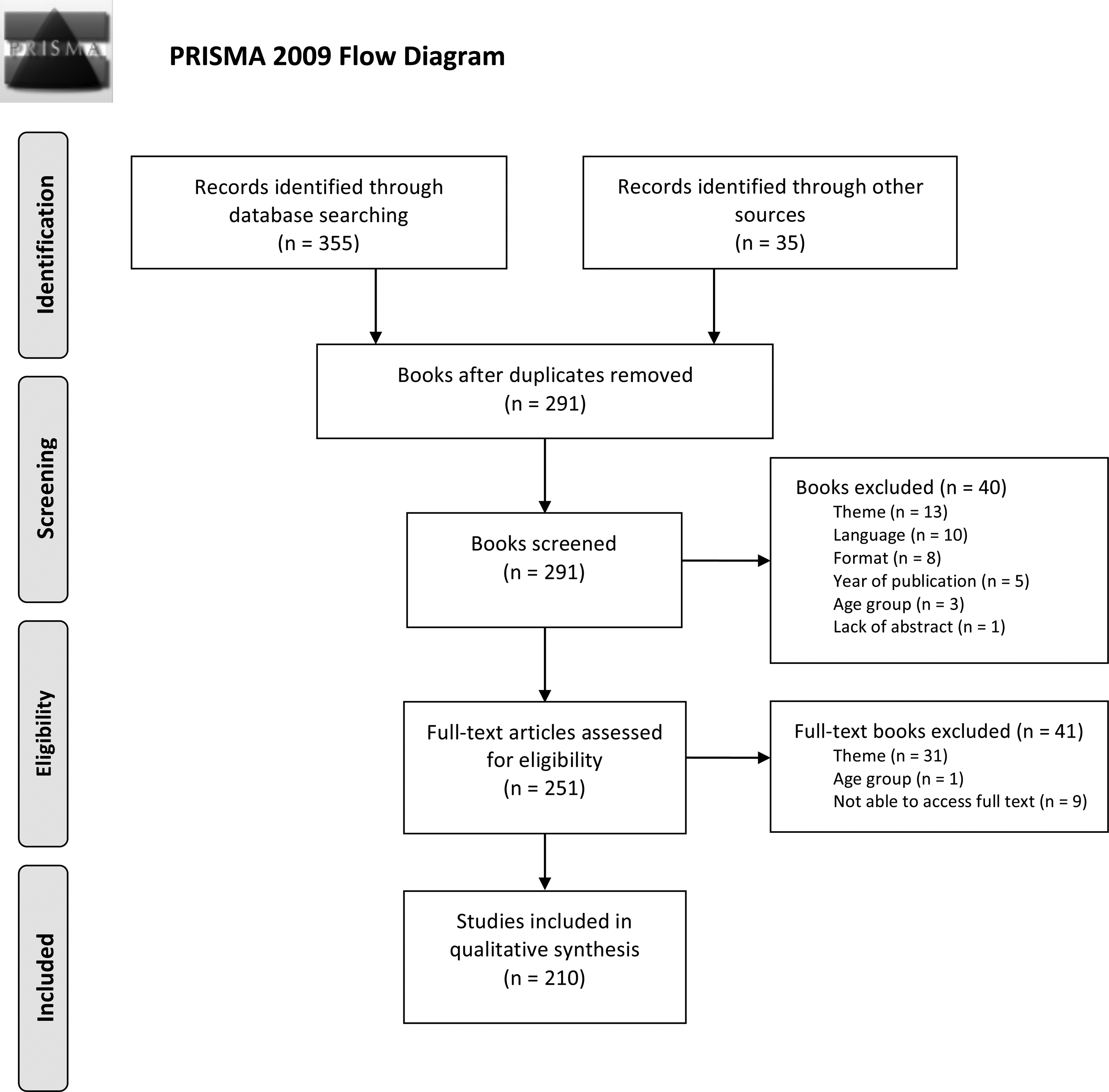
PRISMA flow. Source: Moher D, Liberati A, Tetzlaff J, Altman DG; The PRISMA Group Preferred reporting items for systematic reviews and meta-analyses: The PRISMA Statement. PLoS Med 2009;6:e1000097. DOI:10.1371/journal.pmed1000097. For more information, visit www.prisma‐statement.org
Summary of included books
The majority of the books were published in English (n = 194, 92.4%) from 1995 to 2005 (n = 130, 61.9%). Many stories were written from the perspective of a third party (n = 103, 49%) or a child (n = 88, 41.9%). Less than 22% of the books (n = 45) included tools to support readers in discussing the topic of death, such as a parent guide, coping activities for the child, or a glossary of terms (Table 1).
Character demographics
Close to 90% of the books had youngsters as main characters as either animals or children (n = 184), with only four books picturing an adult in a main role. Age was not specified in 10.5% of the books (n = 22), both due to nonhuman subjects and due to speech focused on human experience (Table 2).
The majority of books featured Caucasian subjects (n = 122, 58.1%) with a noted under-representation of black (n = 17, 8.1%), Hispanic (n = 13, 6.2%), Asian (n = 6, 2.9%), and Native American (n = 3, 1.4%) populations (Table 2). A list of the books representative of ethnic diversity is available in Table 3.
The dying subject was primarily a grandparent (n = 78, 37.1%) or pet (n = 44, 21%). The loss of friends, parents, and other family members or the experience of one's own death was less frequently described (Table 2). Books on the experience of a child dying were notably scarce (n = 5, 2.4%, Table 4).
Communication about death
The word death or dying was used in 75% of books (n = 158), while others utilized the idea of being gone, being out of sight, or departing for a journey. Symbols were also utilized in 69% of the storybooks (n = 145), namely sleep and natural elements such as the sea, mountains, and flowers.
The storybooks described communication within a family or friendship context with professional counseling occurring only twice. Almost half of the books (n = 93) explicitly valued the benefits of establishing open communication about death with children. Unique communication strategies included offering a safe space for questions (n = 11, 5.2%) and introducing death as part of a life cycle (n = 12, 5.7%). A few books portrayed parental figures avoiding the child's participation in the context of death, either by using confusing messages (n = 9, 4.3%) or lack of direct communication (n = 5, 2.4%). Other books highlighted situations in which the child avoided talking about death and adults or peers played an important role to initiate conversations (n = 6, 2.9%).
Almost 60% of the storybooks included one or more spiritual elements (n = 122), such as introducing the concept of heaven, a divine being, or a specific religious practice. The concept of heaven was associated with doctrinal beliefs in some books, while other stories represented heaven as a more universal place. Some focused on reassuring the child that the deceased is in a better place after death, with no illness or disabilities. Although different sacred beings were cited (God, Lord, Jesus, and Allah), few books explored the mourning rituals of major world religions or cultures in depth.
Knowledge about death
Approximately 95% of the books introduced death as irreversible (n = 199), sometimes along with the concept of universality (n = 11, 5.2%) and nonfunctionality (n = 12, 5.7%). Death was introduced as a natural part of the life cycle of all living beings, focusing only on the universality concept (n = 11, 5.2%). Some books highlighted the child's learning process on irreversibility of death, questioning the possibility that the deceased would come back or mentioning behaviors of looking for the deceased. Some books focused on causality (n = 27, 12.8%) with death described as a result of an illness, aging, or an accident. Another strategy used was to emphasize the sense of permanency (n = 8, 3.8%), either with the deceased continuing to take care of his loved ones or maintaining a sense of connection with the deceased, in terms of everlasting love and spiritual presence.
Impact of death
The majority of books described the emotional impact of death on children (n = 130, 60%), followed by the impact on family dynamics (n = 45, 21.4%) and parents (n = 29, 13.8%). Sadness was the emotion expressed most commonly by the child (n = 167, 79.5%), followed by anger (n = 41, 19.5%) and fear (n = 28, 13.3%). In addition to these feelings, 23 storybooks (11%) described somatic symptoms associated with grief, including loss of appetite, nausea, headache, insomnia, fatigue, and chest pain.
Coping strategies
Remembrance and sharing memories were the most frequent coping strategy addressed (n = 94, 44.8%). Receiving emotional support from others (n = 49, 23.3%), talking about death (n = 28, 13.3%), and saying goodbye (n = 24, 11.4%) were also mentioned. Interestingly, some storybooks portray children in the role of caretaker for the dying person (n = 9, 4.3%) or offering support to others (n = 5, 2.4%).
Discussion
Our findings indicate that while the majority of children's books did include the word death or dying, euphemisms or avoidance of conversations regarding death were used in a quarter of the storybooks and were sometimes perceived as confusing by children. Limited character racial/ethnic diversity as well as a paucity of literature for children processing their own deaths was found.
Part of healthy child development includes the task of learning about death, processing the natural end of life, adapting to grief experiences, and considering ways to support the bereaved.13,14 Introduced and used appropriately (Box 1), storybooks have the potential to mitigate both silence and fear surrounding the topic of death with children. Table 5 lists sample books summarized for common losses or situations experienced by children. These books offer resources on how to initiate conversations about death with children, including emotional expression, challenging themes, and coping strategies.
The items included in the box are the authors' original ideas based on their clinical work.
A troubling finding was the lack of books with a child character preparing for death. Such a book could help a child with a life-limiting illness prepare for his or her own death both in a biomedical and psychosocial perspective. This gap in the current children's literature, paired with the limited availability of parent guides, speaks to the vital need to develop developmentally and age-appropriate resources for dying children to receive information and explore feelings.
Recommendations
Developmental awareness of death
Knowledge of child development enables palliative care teams to help parents consider age-appropriate reading material and timing of introduction. While some parents may wish to shield children from the topic of death, death is informally observed early and often in a young child's world. Children are inevitably exposed to death concepts through bearing witness (noticing an elderly neighbor no longer sits on the front porch across the street); chance encounters (seeing a dead bird at the local park); and media (watching a sleeping cartoon character bounce back after a seemingly fatal fall). By age seven years, most children understand death as irreversible, inevitable, and universal. 15 The recognition that all bodily functions cease after death (nonfunctionality) is generally obtained by age 10. 16 A child's spiritual progression to the concept of afterlife or heaven is believed to start as early as preschool years.16,17 An honest compassionate approach to the inevitable topic of death enables the typical developmental search for meaning. 18
Word choice
Euphemisms for death abound in children's stories, as evidenced by use in 52 books (24.8%). While these gentler words in vernacular language are likely intended to comfort a child, the use of word choice depicting sleep, travel, or absence instead of actual use of the word death resulted in the child subject feeling confusion on the topic of death rather than clarity in description or comfort in content (My grandfather's house). Phrases such as falling asleep can instill fear at bedtime as children can wonder whether they will wake up. Similarly, death language regarding going on a journey may instill fantasies of loss when a parent is traveling. Palliative care providers are uniquely positioned to model use of the word death when discussing natural end of life with parents.
Portrayal of diversity
A key component of effective bibliotherapy is the ability for the reader to identify with or to relate to the character,7,19–21 and yet, due to the lack of literary diversity, not all families will find written or pictorial materials with characters representative of their ethnicity or race. In addition to personal identification, storybooks carry a socializing role. 22 Providers should strive to introduce families to literature that prioritizes respectful global inclusion as this will add to the richness of a child's character exposure and interpretation of content. For example, how a child is involved in funerals and memory rituals varies across cultures as does duration of mourning and community explanations of death (When Dinosaurs Die: A Guide to Understanding Death and Pearl's Marigolds for Grandpa).
Portrayal of family
Parental portrayals in the books varied from skillfully preparing the child for a loved one's death to overlooking or misreading the needs of the child. Some character parents share grief with their child, while others did not. 6 Whether in the imagery of a father turned away to hide his tears from a child (Sammy in the Sky and Waiting to Sing) or a mother pretending to be fine after a death in front of her grieving daughter (The Garden Angel), emotional isolation was portrayed. Some children's books gave examples of honest communication in an anticipatory manner, such as explanations of burials or graves before a child's attendance at the funeral. Other books depict silence and intention of protecting the child through exclusion from funeral participation (Fireflies, Peach Pies, & Lullabies) or hospital visits (Wild Girl and Gran). Grandparents were depicted as talking to their grandchildren about the natural result of age to be death, as they prepared their grandchildren for their own upcoming death in a compassionate way (Thank you, Grandpa).
Along with grandparents, 23 siblings are also too oft-forgotten grievers. 24 Sibling grief represents a substantial and profound loss experience for bereaved brothers and sisters. Sibling loss often occurs after months or years of a sibling's extended illness or even sibling absence due to frequent hospitalizations. Sometimes siblings cope by obtaining a perfect child persona or by acting out or by bottling up feelings, by carrying family feelings, or by not processing feelings.25–29 Storybooks offer an opportunity for siblings to give voice to this loss and to safely process the complex heavy feelings associated with the death of a beloved brother or sister.
Cause of death
Old age and illness were the most common cited cause of death. While certain diagnoses (primarily cancer) were referenced as cause of death, there was a notable absence of biological explanation to help the young reader process causation through scientific insight. The animal characters seemed to provide more frank conversations regarding biology. For example, a grandpa elephant explains the physical decomposition from flesh to skeleton to dust before his death (Farewell, Grandpa Elephant) and woodland creatures learn that death means the “heart quit beating and body doesn't work anymore” (Chester Raccoon and the Acorn Full of Memories). Human characters' explanations of biology varied from metaphor such as heart had gone to sleep (Janna and the Kings) to confusion as a grandson worries whether he could soon have a heart attack (Poppy's Combine). Palliative care providers may have the opportunity to help parents phrase biological explanations for death in understandable clear language. Only a few books included more raw topics such as suicide, drug overdose, and combat death situations (When Dinosaurs Die and Once a Shepherd) and yet children do realistically face these losses.
Location of death
Location of death has been previously recognized as an under-reported reality in children's literature. 9 This was a similar finding in our study, although location is an increasingly important conversational topic as families consider care transitions from hospitalizations (or long-term care facilities for grandparents) to and from home settings.
Children living with a life-limiting illness
Bereaved parents who discussed death with their child generally preferred narrative conversation format, 30 and yet, only five books provided insight into a child preparing for his or her own death (Table 4). This surprising shortage of children's literature leaves parents with few developmentally informed, gently illustrated storybook resources to facilitate important meaningful conversations. The idea of introducing children with life-limiting illness to the topic of death may seem anxiety provoking and overwhelming for parents. In reality, children with life-limiting illnesses often experience psychological, spiritual, social, or even physical distress secondary to silence surrounding end-of-life topics.31,32 There is a recognized relational price to this silence in families. 33 These conversations would be better facilitated by a wider array of children's literature resources with relatable characters for children with life-limiting illnesses.
Limitations and strengths
Although the literature search included an extended list of children's books published in the last 20 years, we may have missed books recommended by bibliotherapy lists that did not match our search and inclusion criteria. For example, publishers that were not part of mainline databases or Amazon and books with no indexing category of death or dying could have been missed. This could contribute to bias, that is, overestimating the types of books identified. Our inclusion was limited to three languages, and we may have failed to identify certain demographics due to linguistic restriction.
Conclusion
Palliative care teams carry an essential role to advocate for honest, compassionate family conversations and to support parents in discussions about death by highlighting children's communication needs and facilitating culturally informed and developmentally appropriate discussions. Provider-initiated cues to action (a shared book list, a listening conversation, or a book gift) have potential to empower and encourage families. Our findings welcome bibliotherapy partnership with stakeholders across a child's care continuum: palliative care providers, family members, primary pediatricians, teachers, religious leaders, and school counselors in fostering these compassionate, brave storybook conversations with children in a supportive community approach. This analysis of children's literature relevant to illness, death, dying, and bereavement can inform the development of future psychosocial tools and communication resources.
Footnotes
Acknowledgments
This work is supported, in part, by the Intramural Research Programs of the NIH, National Cancer Institute, Center for Cancer. The authors express appreciation to the Children's National Medical Librarian, GW Humanities Librarian, Library of Congress Children's Reading Room Library Specialist, and DC Public Library Children's Librarian for their help in revising the search terms and searching the titles; and to the National Institutes of Health Library for the support in loaning and collecting all the books included in this study. The authors would also like to thank DCR Leslie Wehrlen, RN, MSN, OCN,® who collaborated with the reading and analysis of the books published in Spanish.
Preliminary data from this study were presented at APOS 13th Annual Conference (2016).
Author Disclosure Statement
No competing financial interests exist.
References
Supplementary Material
Please find the following supplemental material available below.
For Open Access articles published under a Creative Commons License, all supplemental material carries the same license as the article it is associated with.
For non-Open Access articles published, all supplemental material carries a non-exclusive license, and permission requests for re-use of supplemental material or any part of supplemental material shall be sent directly to the copyright owner as specified in the copyright notice associated with the article.
