




Abstract
Abstract
Background:
Cardiologists need to decide which treatments are appropriate for seriously ill patients and whether they align with patient goals. Reconciling medical options with patients' wishes requires skilled communication. Although there is evidence that communication is teachable, few cardiologists receive formal training.
Objective:
To demonstrate that providing communication skills training to cardiologists is feasible and improves their perceived preparedness (PP) for leading difficult conversations.
Methods:
CardioTalk is a workshop to improve communication through short didactic sessions followed by interactions with standardized patients. Competencies include giving bad news, defining goals of care, responding to emotion, supporting religious beliefs, and withdrawing therapies.
Settings/Subjects:
First year cardiology fellows, heart failure fellows, and cardiac intensive care unit attendings.
Measurements:
Surveys evaluated the curriculum's efficacy and learners' PP before and after the workshop.
Results:
Eight cardiology attendings and 20 cardiology fellows participated. Eighty-nine percent reported having any prior education in communication. Fellows reported more prior education than attendings (100% vs. 62.5%, p = 0.017). Level of PP improved in all competencies for all learners. Ninety-six percent of respondents would recommend the training to peers. All attendings felt that it should be required for cardiologists in the cardiac intensive care unit and reported improved preparedness to teach communication to learners.
Conclusion:
All learners improved in levels of PP in communication competencies. CardioTalk is the first described training program that prepares cardiologists for the challenges they face when having conversations with seriously ill patients.
Introduction
E
Methods
CardioTalk was designed as a 2-day workshop for cardiology attendings and a two to two-and-a-half-day workshop for cardiology fellows at a large academic medical center. The goal of the workshop was to increase learners' preparedness for having difficult conversations with seriously ill patients. The curriculum is modeled after the VitalTalk model (www.vitaltalk.org), which has been shown to improve communication skills for oncologist, nephrologists, and geriatricians. Details of the teaching method and standard workshop curriculum have been published elsewhere.4–6 The teaching model includes a brief “how to” didactic session and skill demonstration, followed by intensive learner skills practice using simulated patients in a small group with observation and feedback. 7 CardioTalk focuses on scenarios common to cardiologists who practice in the cardiac intensive care unit (CICU). All first year cardiology fellows and all heart failure fellows were required to attend. CICU attendings were strongly encouraged by departmental leadership to participate.
Participants completed surveys before the start of training and on its completion, which consisted of a baseline assessment of prior exposure to communication teaching, measurement of learner satisfaction with the training, and an evaluation of perceived preparedness (PP). This utilized a five-point Likert scale to rate PP (1 = not well prepared, 3 = somewhat well prepared, 5 = very prepared). Satisfaction of the learners was assessed using a five-point Likert scale to capture the quality of the workshop. Comparisons were performed using a chi-squared or Fisher's exact test. The survey has been used in other communication courses. 4 The University of Pittsburgh Institutional Review Board and the University of Pittsburgh Quality Improvement Committee approved the study.
Results
Three workshops for 28 participants occurred between September of 2014 and September of 2015. There were 18 first-year fellows (64.3%), 2 heart failure fellows (7.1%), and 8 attending faculty (28.6%). Average age was 39.3 years; 85.7% were male. The participants were ethnically diverse with the majority of participants identifying as Caucasian (53.6%). Characteristics of workshop participants are listed in Table 1.
Data are expressed as number of participants (percentage). Denominator represents total number of participants.
Advanced fellows were in advanced heart failure and transplant medicine fellowships.
The majority of the participants reported having received some prior communication training in at least one domain (89.3%). Fellows were much more likely to report any prior training than attending faculty (100% vs. 62.5%, p = 0.017). Participants estimated their level of PP for specific communication skills before and after the workshop. PP significantly increased for all skills after the training as measured by a five-point Likert scale, with improvements ranging from 0.78 to 1.50 (p < 0.03), see Figure 1. In addition, all of the attending physicians improved in their PP to teach communication skills (p = 0.0164).
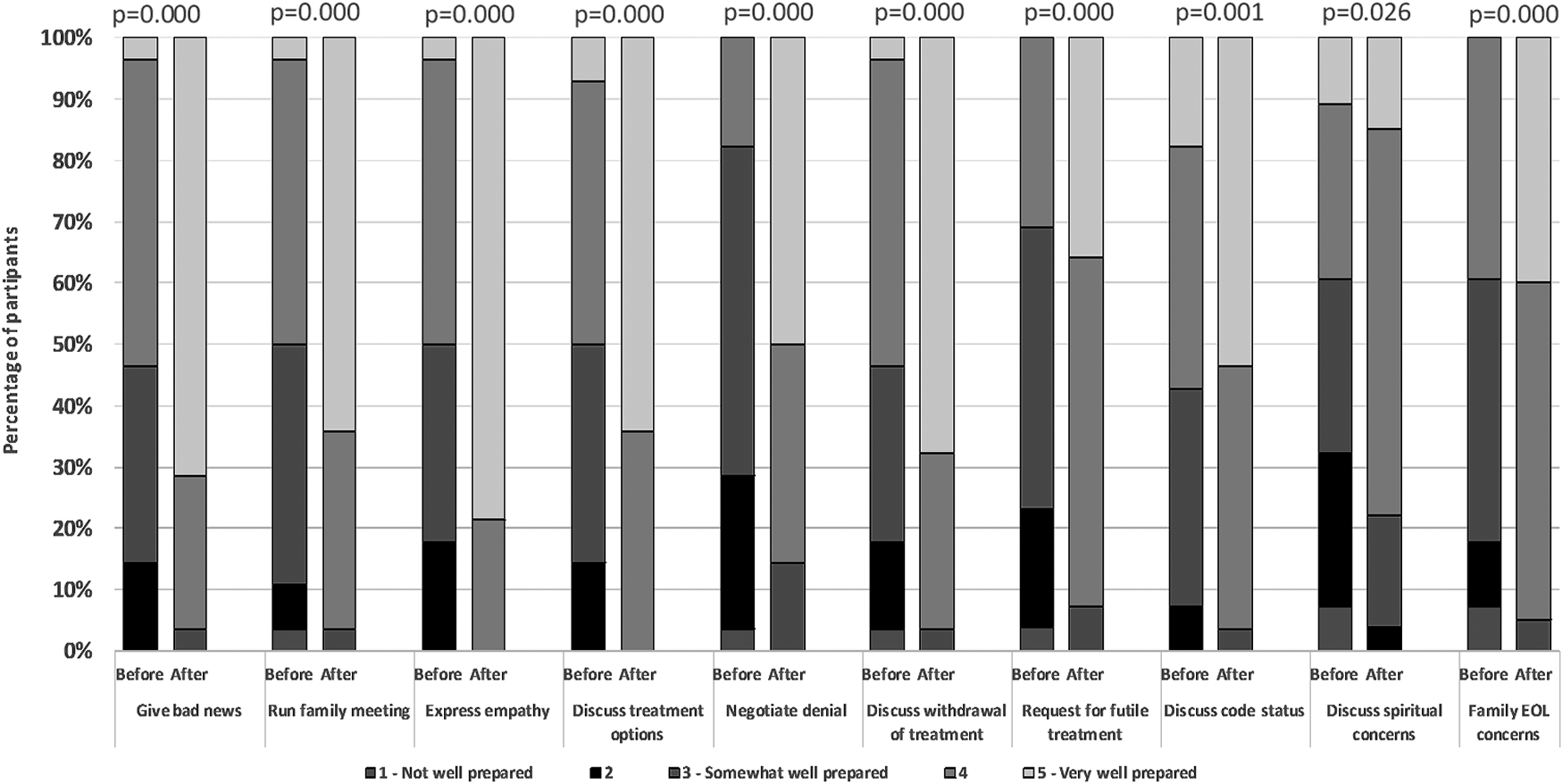
Changes in perceived preparedness to perform specific communication skills before and after the workshop. All differences were statistically significant with p value <0.05. EOL, end of life; tx, treatment.
After completing the workshop, all attendings would recommend the training to their peers and all felt that the training should be required for both CICU attendings and cardiology fellows. Ninety-five percent of fellows would recommend the training to peers and 90% felt it should be required for all fellows.
Discussion
To our knowledge, CardioTalk is the first formal description of a curriculum that focuses on improving communication skills for cardiologists. The curriculum implements the AHA and ACC recommendations for communication training.2–3 Our results demonstrate that the training is feasible, well received by all levels of participants, and results in increased PP for navigating difficult conversations with seriously ill cardiac patients. Although learners improved PP in all skills, the improvement in discussing spiritual concerns, family end-of-life concerns, and requests for futile treatment were less robust in that not as many learners reached the “very well prepared” category for those skills. This is likely because of the complex nature of those skills as compared with some others that were taught. The overwhelming majority of CardioTalk learners reported that they would not only recommend the training but also that it should be required for cardiologists of all levels.
We found it important to teach both fellows and attending physicians. By having attendings train alongside fellows, the importance of lifelong learning is highlighted as well as the importance of learning behaviors such as good communication skills. Positive role modeling is known to be an important influence in learners’ development. 8 In addition, by having attendings learn the same skillsets and approaches to difficult conversations, they are more likely to be able to teach and solidify these behaviors in fellows in the future. Finally, attendings reported improvement of their PP in all skills learned, suggesting that years of practice alone do not prepare a cardiologist to be a skilled communicator.
Owing to the success of the initial CardioTalk training and positive responses from all learners, the leadership in the division of cardiology committed to funding training for all incoming cardiovascular fellows annually. All attendings who practice in the university setting will also be required to participate in CardioTalk
Although the overall program was successful, there were limitations. The number of learners who have undergone this training thus far is small. With commitment from the system and the division, the number of learners will certainly grow in years to come. It is a single-center study thus far and will need to be validated in other centers. Owing to funding and time limitations, outcomes are based on self-assessment rather than direct observation of learners’ skills before and after the workshop.
As healthcare technology advances and the challenges of providing patient-centered care become more complicated, the need for skillful communication between cardiologists and their patients will become even more important. In order for that communication to occur, cardiologists at all levels deserve proper training in communication specific to cardiac challenges. CardioTalk is a model curriculum for communication training for practicing cardiologists and trainees.
Footnotes
Acknowledgments
This work was supported by The Beckwith Institute, Frontline Innovation Program, 200 Lothrop St, Forbes Tower 01 11 01, Pittsburgh, PA 15213, and the Heart Vascular Institute of the University of Pittsburgh Medical Center, 200 Lothrop St, 5th Floor Scaife Hall, Pittsburgh, PA 15213.
Author Disclosure Statement
Dr. R.A. is a founder and on the board of VitalTalk, a nonprofit company focusing on communication skills training. Dr. J.T. is speaker for HeartWare and CareDx; he serves on the advisory board for HeartWare, Abiomed, CareDx, Acorda Therapeutics, the clinical events committee for Thoratec, and the Data and Safety Monitoring Board for Sunshine Heart. There are no conflicts of interest for Drs. K.B., W.T., and E.R.-C.