




Abstract
Abstract
Background:
Compassion fatigue among health care professionals has negative effects on patient care. Providing end-of-life care, hospice nurses may be particularly at risk for compassion fatigue.
Objective:
The purpose of this study was to investigate self-esteem and affect as mediators between psychological distress and compassion fatigue among hospice nurses (N = 90).
Design and Measurements:
Hospice nurses working in a health care setting were recruited to complete a survey. Multiple mediation analysis was used to explore associations between variables of interest.
Results:
Psychological distress was associated with greater compassion fatigue and had an indirect effect on compassion fatigue through lower self-esteem and higher negative affect, but not through positive affect.
Conclusion:
Among hospice nurses, psychological distress may reduce self-esteem and create negative feelings, thereby increasing the risk of compassion fatigue. Interventions that target both the cognitive and affective links between psychological distress and compassion fatigue may be most effective.
Introduction
H
Self-esteem, positive affect, and negative affect
Self-esteem is the cognitive evaluation that we have of ourselves, and it is associated with greater psychological well-being and lower psychological distress.9,10 Self-esteem has an important role in hospice care and influences personal identity and professional qualities. 11 Affect refers to subjective experience that is expressed through emotional states. 12 Positive affect is characterized by feeling enthusiastic and active, whereas negative affect is characterized by unpleasurable engagement and aversive mood states. 13 Positive affect has been linked with psychological health 14 and lower levels of depression 15 and stress. 16 Negative affect has been associated with psychological distress and compassion fatigue among nurses. 17
Current study
The purpose of this study was to investigate self-esteem and affect as mediators between psychological distress and compassion fatigue among hospice nurses. We hypothesized (H1) that psychological distress would be associated with higher compassion fatigue. Nurses experiencing psychological distress may evaluate themselves more negatively, and this diminished self-esteem may deplete their endurance levels. 3 It is also possible that nurses experiencing psychological distress may lack the positive feelings and be burdened with negative feelings, which then contribute to compassion fatigue. Thus, we hypothesized that psychological distress would have a positive indirect effect on compassion fatigue through (H2) lower self-esteem, (H3) lower positive affect, and (H4) higher negative affect.
Methods
Participants
Hospice nurses (n = 90; 94.4% female) aged 22–70 years (M = 43.00, SD = 12.11) working in hospice centers, hospitals, nursing homes, and other long-term care facilities, and home healthcare in the southern United States were recruited at staff meetings and hospice nursing conventions. Regarding ethnicity, 58 (64.4%) identified as white, 12 (13.3%) as African American, 6 (6.7%) as Hispanic, 12 (13.3%) as Asian/Pacific Islander, and 2 (2.2%) as another ethnicity. The average number of years of experience as a hospice nurse was 17.30.
Procedure
This study was approved by the university's committee for the protection of human subjects. Participants completed the survey online and were entered into a drawing for gift cards.
Measures
Psychological distress
The Depression Anxiety and Stress Scale 18 consists of 21 items on a 4-point Likert-type scale. All items—those measuring depression, anxiety, and stress—were summed so that a higher score indicated a higher level of psychological distress (Cronbach's α = 0.91).
Compassion fatigue
The Compassion Fatigue Short-Scale 19 consists of 13 items on a 10-point Likert-type scale that were summed so that higher scores indicate higher levels of compassion fatigue (Cronbach's α = 0.85).
Self-esteem
The Rosenberg Self-Esteem Scale 20 consists of 10 items using a 4-point Likert-type scale, which were summed so that higher scores indicate higher levels of self-esteem (α = 0.83).
Positive and negative affect
The International Positive and Negative Affect Schedule—Short Form 21 consists of two five-item scales using a five-point response scale, which were summed so that higher scores indicated higher levels of positive affect (Cronbach's α = 0.73) and negative affect (α = 0.73).
Results
Bivariate correlations between and descriptive statistics for all variables of interest are displayed in Table 1. Multiple mediation was assessed with a bootstrapping procedure 22 in which 95% confidence intervals were used and 10,000 bootstrapping resamples were run. For ease of interpretation, we converted confidence intervals into p values. Results are displayed in Figure 1. Psychological distress explained 37.4% of the variance in compassion fatigue. Psychological distress had an indirect effect on compassion fatigue through self-esteem (β = 0.18, 95% CI [0.06– 0.39]) and negative affect (β = 0.21, 95% CI [0.01–0.44]) but not positive affect. Together, psychological distress, self-esteem, positive affect, and negative affect explained 49.13% of the variance in compassion fatigue.
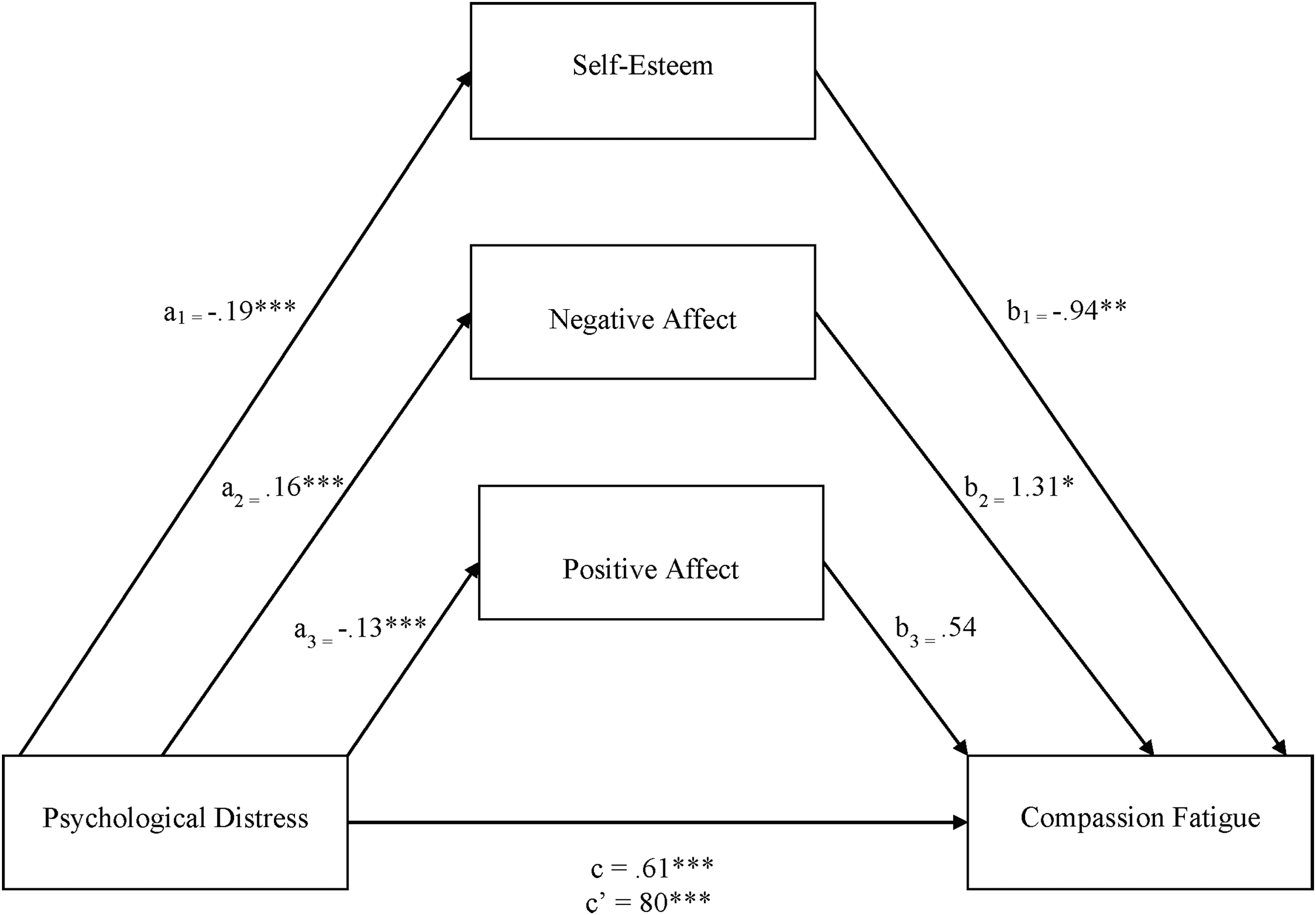
Multiple mediation model (n = 90; *p < 0.05; **p < 0.01; ***p < 0.001).
p < 0.001.
Discussion
The purpose of this study was to investigate self-esteem and affect as mediators between psychological distress and compassion fatigue among hospice nurses. Consistent with previous research, 6 psychological distress was associated with compassion fatigue, supporting H1. We believed that this would be due to psychological distress lowering self-evaluations, depleting positive feelings, and amplifying negative feelings. Psychological distress had an indirect effect on compassion fatigue through lower self-esteem and higher negative affect, meaning that H2 and H4 were supported. This finding is consistent with previous research that has linked negative affect with compassion fatigue. 17 Positive affect did not mediate the relationship, meaning that H3 was not supported. Psychological distress may impact compassion fatigue through the effects of more negative self-evaluations and more negative feelings rather than depleting positive resources.
This study provides insight into the relationship between psychological distress and compassion fatigue among hospice nurses, yet it was limited in a few ways. The study utilized a cross-sectional design, limiting conclusions that can be drawn about causality and directionality of results. Participants were self-identified hospice nurses, and the sample size was small and drawn from a limited geographic area, limiting the generalizability of the results. Future studies could utilize larger samples to overcome these issues as well as explore whether similar mediation effects would be found across other job types.
Finally, we feel that this study has implications for hospice nursing. Psychological distress appears to be a risk factor for compassion fatigue among hospice nurses; thus, engaging in self-care and having access to mental health resources to promote psychological well-being may be effective primary prevention strategies for compassion fatigue. Beyond this, interventions intended to bolster self-esteem and reduce negative affect may be effective tertiary prevention strategies as these may minimize the effects of psychological distress on compassion fatigue.
Footnotes
Author Disclosure Statement
No competing financial interests exist.