




Abstract
Abstract
Background:
Legacy-making (i.e., a way for patients with terminal illness to create or do something for others as a means of remembrance) is rising in popularity in palliative medicine, although only one study has examined its impact in a pediatric population.
Objective:
In response to the gaps in literature, this study (1) examines the impact of legacy artwork on bereaved caregivers' psychological functioning and grief and (2) compares caregivers' perceptions of support provided by the hospital throughout their child's cancer journey between the intervention and control groups.
Methods:
Forty-four caregivers whose children died of cancer completed a demographic questionnaire specifically created for this study, the Brief Symptom Inventory-18, and the Prolonged Grief Disorder-13. They also answered questions regarding supportive services provided to them toward the end of the child's life, at the time of death, and after the child's death. Those caregivers who endorsed participating in legacy artwork were identified as the intervention group, whereas those who did not were classified as the control group.
Results:
There were no significant differences in psychological functioning among caregivers who participated in legacy artwork versus those who did not participate. However, caregivers who created legacy artwork with their child reported significantly less symptoms of prolonged grief and a greater perception of support from health care providers compared with caregivers who did not engage in this activity.
Conclusion:
Although preliminary, these findings suggest that legacy artwork may have the potential to improve grief and overall satisfaction of support from the hospital in bereaved caregivers.
Introduction
After a child dies, parents are likely to experience intense grief. When the death is anticipated, engaging in activities that help create memories and confirm remembrance may be therapeutic for families. One such activity is legacy-making (e.g., memory books and recordings), which is defined as a way for patients with terminal illness to create or do something for others as a means of remembrance. 1 Although some legacy-making occurs intentionally for the purpose of life review, other activities may occur serendipitously and yet are cherished by family after a child's death.1,2
The benefits of legacy-making have been explored more extensively in adult patients.3–5 For example, adults who participated in dignity therapy (e.g., conversations focused on what they would most want remembered) reported an increased will to live, reduced suffering, and a bolstered sense of meaning. 3 Digital storytelling is the only legacy-making activity specifically examined in pediatrics, 6 but other interventions such as therapeutic music videos have indirectly included legacy work by focusing on meaning-making.7,8 And, although most literature has focused on the impact of legacy-making on patients (e.g., improved coping, enhanced quality of life, and deepened spirituality),1,3,6 few studies have examined the potential benefits of these interventions on caregivers.
When compared with other types of grief, parental bereavement has been described as more intense. 9 In fact, bereaved parents are more susceptible to prolonged grief, characterized by intense longing for their child as well as significant emotional distress and functional impairment that persists six months after the death. 10 Numerous negative outcomes are associated with parental grief such as increased anxiety and depression, poor health behaviors, and a lower sense of purpose in life.11–13 Therefore, it is essential to identify interventions that may ameliorate these poor outcomes and facilitate healthy grieving, which includes focusing on their child's death in a controlled manner while also restoring their daily functioning. 14
Chochinov et al. 3 dignity model of palliative care suggests that legacy-making may result in caregiver benefit (e.g., psychologically and spiritually) in addition to patient benefit. Research by Foster Akard and colleagues (2015) support this by showing that bereaved caregivers receive inspiration from their child's digital stories. 6 Other positive caregiver outcomes described in the literature include enhanced family communication and positive emotional experiences.2,3,15 The theory of continuing bonds, which suggests that loved ones adjust to and redefine relationships even after death, may help explain the potential benefits of legacy-making for bereaved caregivers. 16 Legacy-making provides caregivers with a tangible memory and offers means to maintain this comforting connection with their deceased child.17,18
Currently, limited research exists on the impact of legacy-making on caregiver outcomes after the death of a child. Therefore, this study (1) examines the impact of legacy artwork on bereaved caregivers' psychological functioning and grief, and (2) compares caregivers' perceptions of support provided by the hospital throughout their child's cancer journey.
Methods
Participants and recruitment
Eligible participants included caregivers of children, ages 2 months–25 years old, who died from cancer between 2009 and 2014 at Children's Hospital of Alabama, a 340-bed pediatric hospital in southeastern United States. The primary caregiver was identified as the emergency contact in the child's electronic medical record. Participants were at least two years after the death of their child at the time of the study.
Participants were identified from a database of patient deaths maintained by the division of pediatric oncology. A total of 132 eligible caregivers were mailed recruitment letters along with hard copies of the study questionnaires. The recruitment letter included the background of the study, instructions on returning the paper questionnaires versus online collection, study contact information, and a list of community grief resources. No follow-up contact occurred after the mailing of the recruitment letter. Approximately 20 of the mailed surveys were returned to the hospital due to change of address.
Procedure
Data collection occurred between May and September 2016. Forty-four participants completed a demographic questionnaire, the Brief Symptom Inventory-18 (BSI-18), 19 and the Prolonged Grief Disorder-13 20 as part of a larger bereavement survey of oncology and intensive care deaths. They also answered questions regarding supportive services provided toward the end of the child's life, at the time of death, and after the child's death (Table 1). The survey used a 5-point Likert scale ranging from “strongly disagree” to “strongly agree,” with a “nonapplicable” option.
Example Questions About Supportive Services Provided to Families
Families were asked whether they completed legacy artwork with their child at the hospital. These paintings, initiated and facilitated by art therapists near the end of the child's life, were created together by the patient, caregivers, and siblings. To further legacy-making, the child's handprints and footprints as well as their favorite things (e.g., colors and characters) were commonly incorporated into the artwork. Poems, quotes, and metaphors were also included as a way to promote meaning-making in regard to the child's impending death. In addition to building the child's legacy, creating special and lasting memories as a family was central to the legacy artwork experience.
Statistical analysis
Demographics were analyzed through descriptive statistics. Independent sample t-tests were used to examine differences in psychological functioning 19 and grief 20 between the intervention and control groups. The differences in perceived level of overall support provided by hospital staff before the child's death, at the time of death, and after the child's death between the intervention and control groups were analyzed with a repeated measures analysis of variance.
Results
Participants
Of the survey respondents, 25 caregivers reported participation in legacy artwork, leaving 19 participants in the control group (Table 2).
Participant Demographics
SD, standard deviation.
Caregivers' psychological functioning and grief
No significant difference emerged in the Global Severity Index scores on the BSI-18 for those caregivers who participated in legacy artwork (M = 28.72 ± 8.62) versus those in the control group (M = 31.84 ± 8.16); t(42) = −1.22, p = 0.23. Thus, general psychological distress did not differ between the intervention and control groups. Similarly, the BSI-18 subscale scores (i.e., somatization, anxiety, and depression) were not significantly different between the legacy artwork and control groups, although the depression subscale trended toward significance, t(42) = −1.81, p = 0.07 (Table 3). Caregivers who participated in legacy artwork (M = 24.36 ± 5.08) endorsed significantly fewer symptoms of prolonged grief than caregivers in the control group (M = 28.63 ± 5.74); t(42) = −2.61, p < 0.05 (Fig. 1).
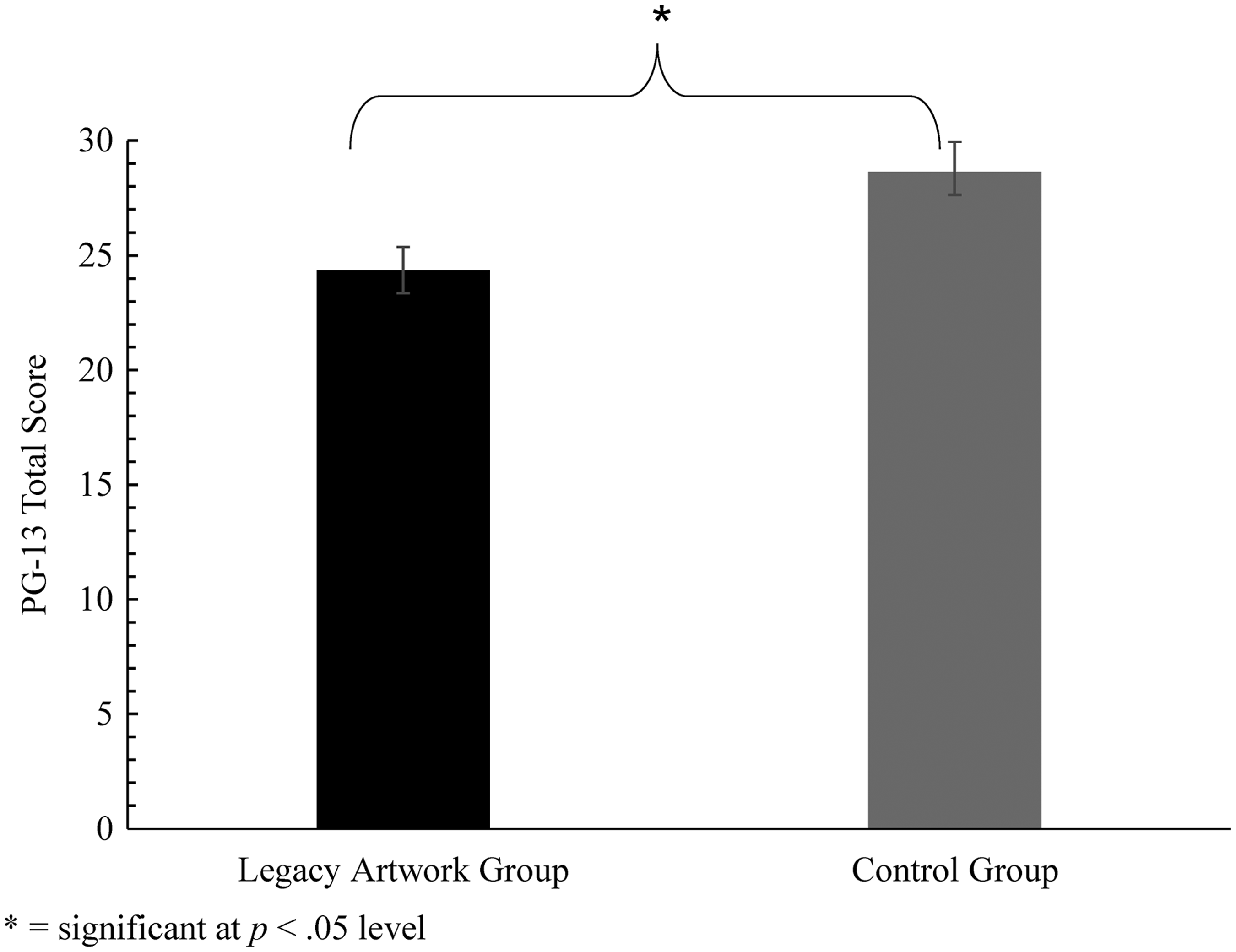
Differences in prolonged grief between caregivers in the legacy artwork group and control group. *Significant at p < 0.05 level. PG-13, Prolonged Grief Disorder-13.
Subscale Analyses on the Brief Symptom Inventory-18 between Legacy Artwork and Control Groups
Caregivers' perception of support
A significant effect of legacy artwork on caregivers' perception of support throughout their child's cancer journey emerged, F(1, 41) = 120.89, p < 0.01. Specifically, families who participated in legacy artwork (M = 3.98 ± 0.04) perceived greater support from the hospital than those in the control group (M = 3.25 ± 0.05); t(42) = 9.90, p < 0.05 (Fig. 2).
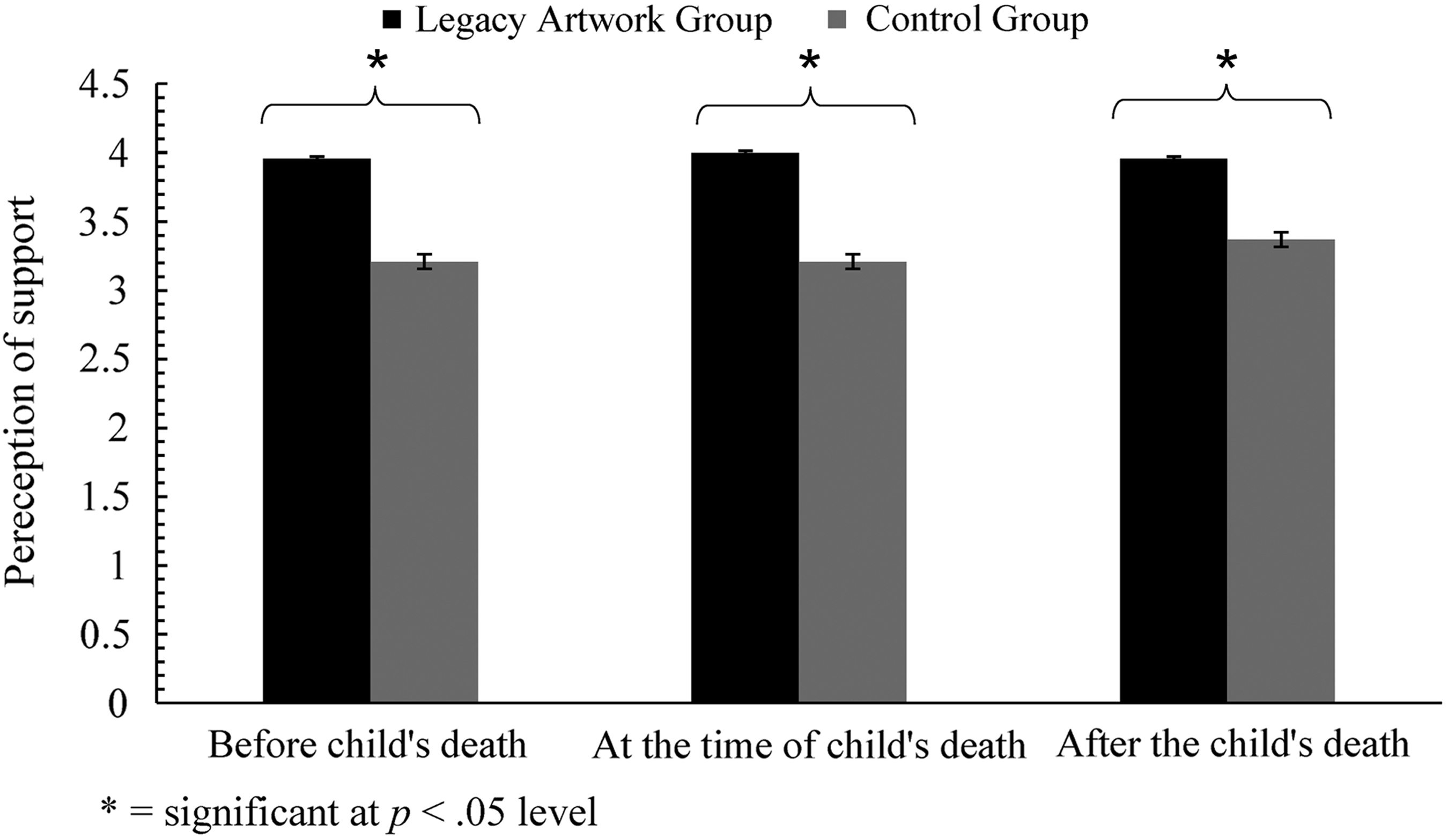
Differences in perception of support from the hospital between caregivers in the legacy artwork group and control group across various time points in their child's illness journey. *Significant at p < 0.05 level.
Discussion
Our findings indicate that participation in legacy artwork has the potential to reduce prolonged grief responses in caregivers two or more years after the death of a child. Owing to the nonsignificant differences in overall psychological functioning between the groups, it appears that legacy-making may be better suited to address caregiver grief rather than general psychological distress.
These findings extend previous literature by highlighting the benefits of legacy-making on caregivers after the death of their child. In addition to helping caregivers create positive memories and prepare for their child's death, 6 our findings suggest that legacy-making positively influences bereavement. Despite previous literature that focuses on the immediate benefits of legacy-making for caregivers during a traumatic time,1,3,6,15 our results highlight the potential longevity of the intervention's impact on grief. Our findings also suggest that participation in legacy-making may lead to increased perceptions of support provided by the hospital. This is significant as previous research has demonstrated that long-term grief outcomes are better in parents who believed that providers were taking initiative to provide extra support during the child's final months of life. 21
There are several limitations to this study. First, our study was conducted at one site. Relatedly, survey respondents mainly identified as Caucasian, which is neither representative of our hospital's patient population or the general population of our region. Second, many recruitment letters were returned to sender, which may result in selection bias of families who maintained stability after their child's death. Finally, the time span between the child's death and data collection introduces concern of memory inaccuracies, as does relying on caregivers' self-report of whether they participated in legacy artwork.
Future research is needed to further understand the impact of legacy-making on bereaved caregiver outcomes. A component analysis of legacy artwork would move this research forward by identifying the specific aspects of this activity that result in benefits for bereaved caregivers. Moreover, studies exploring how legacy-making is presented to families and how the patient's own engagement and view of the project influences caregivers' continued bond and remembrance are needed.
With this preliminary evidence from 44 participants, children's hospitals may consider incorporating legacy-making into the care of seriously ill children, not only for patients but also for their caregivers. Educating health care providers on the benefits of legacy-making may help them address caregivers' needs by encouraging participation in legacy projects. Although some caregivers may be reluctant to participate in legacy-making near the child's end of life, there may be potential to improve their bereavement by providing them with a tangible memory of their child.
Footnotes
Acknowledgments
The project team is grateful to Auburn University's Department of Psychology for awarding the corresponding author with a small grant that made this submission possible. Also, many thanks to the bereaved caregiver participants who generously donated their time and efforts to this study.
Author Disclosure Statement
The authors have no financial disclosures to report.