




Abstract
Abstract
Background:
For children with life-shortening illness, achieving a “good death” can be a tacit goal. There is little understanding of how different stakeholders perceive what a “good death” might be.
Objective:
To review empirical literature to construct an understanding of a “good death” for children with life-shortening conditions.
Design:
An integrative review approach was followed. This involved searching across Embase, Web of Science, Medline, CINAHL, and PsycINFO (no date limits set), as well as identifying eligible studies tracking reference lists. Appraisal of shortlisted articles in full text was performed, followed by data extraction, synthesis, and interpretation.
Results:
Analysis of articles (n = 24) yielded a dynamic and layered narrative about a good death that revolved around three themes. (1) Level of needs: includes both practical support and aspirational goals such as “do everything.” (2) The composite experience: whether positive or negative adds to produce a sense of suffering. (3) Control (preservation and letting go): moving from maintaining status quo to acceptance of the child's death, the experience of which also contributes to suffering. Framed using a health care system perspective, a concept map that interprets a good death in children with life-shortening conditions is represented.
Conclusions:
A single yet holistic understanding of a good death experienced in the “real world” is suggested. Pediatric health and social care providers, and even policy makers, can use this new understanding to conceive alternative approaches to enhance support to dying children and their families.
Background
I
Many pediatric palliative care programs have been established in the last decade.4,5 While laudable, it is critical to ensure that beyond access, the needs of dying children and their families are adequately met. Particularly in the context of pediatric end-of-life care, while “doing everything possible” seeking further life-prolonging treatments, 6 facilitating what is often called a good death can be a parallel goal.7,8
There has been considerable debate on the notion of what may be meant by a good death and the ramifications this has for care.9–16 Most literature discusses this concept in relation to adults, but the attributes of a good death in children have not been well described. The aim of this integrative review is to understand how a good death in children with life-shortening conditions is perceived, from the perspective of multiple stakeholders.
Design
This review follows the integrative review design of Whittemore and Knafl. 17 It is a robust, systematically constructed approach that strives to be inclusive with its “open methodological stance,” 18 enabling data from diverse sources to be synthesized for holistic understanding. 19 Given the review objectives, critical realism 20 was adopted as the philosophical paradigm to underpin synthesis. It posits one social reality that exists at three levels 21 : empirical (where phenomena and meaning making are experienced or cocreated), actual (naturally occurring events, whether perceived or not), and causal (where underlying structural mechanisms exist). Review reporting followed the ENTREQ statement. 22
Literature Search and Selection
Searches were performed across five databases in December 2016 (updated in May 2018): Embase, Web of Science, Medline, Cumulative Index to Nursing and Allied Health Literature (CINAHL), and PsycINFO. Search strings combined variations of “patients,” OR “next of kin,” OR “healthcare providers” (population), AND “death” (exposure) AND “perspectives” (outcomes). The search strategy for Medline database is available in Supplementary Table S1 (Supplementary Data are available online at www.liebertpub.com/jpm).
The inclusion criteria were as follows:
Empirical research on experiences around death and dying in children with life-shortening conditions. Study samples that included patients, family caregivers, and/or health care professionals. Reported perceptions from those who were directly involved in caring for dying children. The children referred to in the study were older than one year (neonatal or infantile deaths not a focus of this review), adolescents, teenagers, or young adults (younger than 19 years).
Articles were excluded if studies were as follows:
Not empirical research published in a peer-reviewed journal. Reported in a language other than English.
No date limits were set. EndNote X7 software was used to manage citations, while NVivo 11 program supported analysis.
Appraisal of Selected Studies
The Australian Palliative Residential Aged Care (APRAC) Guidelines: Evidence Evaluation Tool was used to assess quality and relevance of selected studies. 23 Although not previously used in the pediatric setting, the tool had been customized based on the Cochrane and Campbell Collaboration guidelines.24,25 Quality was addressed using eight questions, each requiring a yes or no answer (scoring one or zero, respectively). The sum total ranges between zero to eight points, with score of eight implying best quality. Relevance was rated by assessing applicability of findings to the review question, with scores that can range from a low of one to a highest of four.
Data Synthesis
For dependability of findings, a protocol for the integrative review was set up in advance.
26
The steps in data synthesis
17
involved the following:
Data reduction—extracting relevant sections from selected articles for an organized handling of data. Data display—grouping excerpts from primary sources around meaningful variables in tables. Data comparison—iteratively studying the displayed data, variables of interest are put into conceptual maps that show patterns, variations, or relationships. Drawing conclusions—moving beyond describing patterns to higher levels of abstractions.
Selected articles were “coded” line by line, similar to how interview transcripts are handled in qualitative research. Emerging insights were recorded in memorandums. Relevant points are shared alongside findings in the Results section. In addition, in the process of coding, second-order findings that are interpretations of primary data by investigators were also coded and extracted. These were obtained from discussion sections of the articles. To achieve what Whittemore and Knafl 17 referred to as an innovative synthesis of evidence, analytic approaches developed for qualitative and mixed-method designs were adopted. One such technique, the constant comparison method,27,28 was applied throughout. It entails categorizing, for example, an action, event, or participant into a general class, either conceptually or theoretically, through iterations during data analysis.
The first author (P.H.C.) performed most of the literature search, study appraisals, and data synthesis. The other authors provided oversight through participation for a sample of articles. A conceptual framework was drafted by P.H.C., before being developed further over virtual meetings between all authors.
Results
The review process is illustrated in Figure 1. Twenty-nine articles met the inclusion criteria initially (seven were added in May 2018).
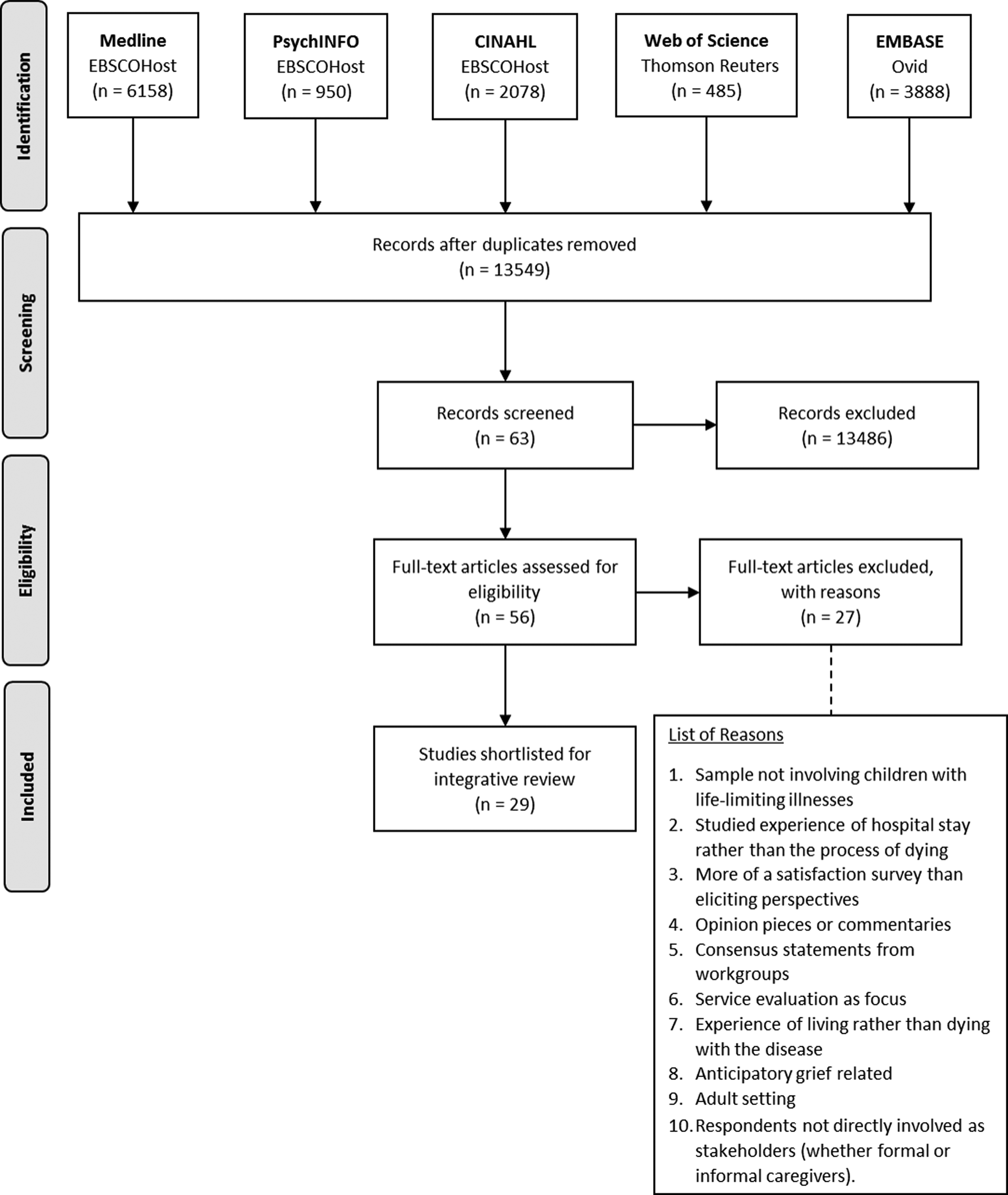
PRISMA flow diagram showing literature search and selection.
Table 1 shows the quality and relevance scores for all 29 articles. Five studies43,47–49,53 (highlighted in italics) below threshold set for quality (above score of four) and relevance (above score of 1) were not included in the final synthesis.
Research Focus and Appraisal Outcomes of 29 Selected Articles
References in italics have not met the threshold set for quality and relevance.
Included studies (n = 24) focused on children with cancer (n = 12), nonmalignant disease (n = 3), or a variety of diagnoses (n = 9). Studies came from North America (n = 7), Europe (n = 14), Australasia (n = 2), and a mix of five countries (n = 1). Studies were conducted in diverse settings, including nationwide and regional centers, institutions and community agencies, single hospital across departments, wards, or individual services. Nineteen studies used qualitative methods, while five used mixed-method research.
Themes
Three broad themes were identified after the process of coding (data reduction) and categorization (data display): “level of needs,” “the composite experience,” and “control.”
Level of needs
Needs were interpreted at two levels, that of day-to-day expectations and aspirational goals (Table 2). On the first level, “wish list or expectations” comprised practical needs that often varied in nature. These can be organized into three aspects: structure related, for example, provision for respite or a quiet location in the ward to grieve; process related, for example, dedicated services for grief support or follow-up after the child's death; stakeholder related, for example, specifically attending to siblings or honoring parents' wishes to provide hands-on care. Conversely, on a higher level, aspirational needs such as “goals at the end of life” embody different types of longing frequently heard in practice, such as doing everything possible, maintaining hope, and minimizing suffering.
Level of Needs (Met or Unmet)
Closer examination of these needs revealed a common thread, that of duality and ambivalence. For instance, most parents wanted to be personally involved in making critical decisions for their child. Yet, this might not extend to decisions involving withdrawal of treatment:
“Some parents clearly expressed the importance of being informed and participating … but they did not want to ultimately decide about withdrawal of life support treatment.”
41
In addition, some wished that they could talk more openly with their own children when it became obvious that they were going to die, yet felt compelled to maintain hope for survival. Nevertheless, some did manage to keep both notions at the same time:
“Maintaining hope for a cure was a prominent theme across all focus groups, even at the end stages of life. Families described the ability to hold on to two dichotomous beliefs: the realism that their child's prognosis was poor and the search for a miracle.”
56
This observation triggered a reflection; the goals to reduce suffering while doing everything possible do seem to conflict. The implication (and question) here is to what extent this factor burdens caregivers.
Respondents in several studies said that their needs were never met. One area cited was that of coordination and continuity of care.
“The lack of a key worker 24/7 left parents to navigate the healthcare system on their own, with no support and anticipatory guidance, especially during the night and weekends.” 42
A mismatch between needs and response from care providers adds to the total burden of care, and this could contribute to perception of suffering.
The composite experience
Beyond needs, stakeholders faced other challenges as they navigated the health care system (Table 3). These included negative experiences among health care providers themselves:
Perception of Suffering in Relation to the Composite Experience
“Unexpected deaths were hardest on the families, and therefore, also hardest on the oncologists.” 36
In this study, the oncologists shared a common humanitarian perspective with many; that the death of any child is against the order of nature. Another point made by the same group surrounded children with cancer dying from medical complications, where frustration related to lack of mastery or control is evident.
Not all experiences in this context were negative though. There were also moments when people felt gratitude in crisis, validated for their selfless devotion, or simply well supported by their providers. Summation of these encounters both good and bad produced the composite experience that colored the perception of suffering for those involved. Most acknowledged that it was a difficult journey for everyone, although there appeared some ways to make the death “better.” For the professionals, their attitude and supportive acts in sharing information consistently or giving bereavement support were mentioned. From the parents' perspective, directly rendering care themselves and being present at the time of death seemed critical. Finally, systemic factors included a family-centered approach to care, access out of hours, and adequate time and space in and around the death of a child.
Suffering (of different degrees) was a given, and both the family and health care professionals perceived it. Death in itself could be recognized as an end to suffering:
“The moment after death was described by parents as the only time in which they could have the child back, free of medical aids and restraints, in a human way that was not possible before.”
41
Control (preservation and letting go)
A third theme identified mainly from second-order findings (described in Design section) was “control.” The imperative for control was pervasive and constant, and affected all stakeholders (patients, parents, and professionals).
Patient's perspective:
“Ed was trying to navigate through adolescence while fighting a serious illness … Like most teens, Ed fought for independence from his parents, but this became difficult as his mobility worsened and he was forced to rely heavily on his family.”
35
Parent's perspective:
“Feelings of loss threaten parental strength and in reaction, parents seek control.”
39
Professional caregiver's perspective:
“The unexpected, acute deaths from complications were described as especially difficult … there was a sense of frustration and irritation over a death caused by a medical complication rather than the disease itself.”
36
Control seemed a precondition for fulfilling fundamental parental tasks. 34 Critically, it mediated the passage from “preservation” to “letting go” as the sick child entered the dying phase. This process was not unidirectional but rather an oscillating one, not unlike the dual-process model of grief. 58 A swing in locus of control between parents and health care professionals was anticipated in the process of transition. Parental perception of suffering was reported to be influenced considerably by the entire experience. 39
Demonstrating interdependence of various stakeholders (and other “conditions” within the system), provision of informational, emotional, and instrumental support by health and social care providers, enhanced the sense of order and personal control for some, and sense of authority over the child's care and life with wider family for others. Overall, this aspect of control was inferred to have kept fear and uncertainty (contributing to a perception of suffering) that marked day-to-day living within limits of tolerability, particularly for parents involved. 50
Synthesis of preliminary findings
Sphere of influence (overall construct of a good death)
Analysis and interpretation of all the findings, expressed as functions of distinct yet interconnected categories brought synthesis to a different level of abstraction. It involved searching for patterns, variations, and relationships among those three themes, within and across different variables (data comparison and drawing conclusions—steps 3 and 4 of data synthesis in an integrative review described earlier). A concept map was created to display and explain the conclusions that were drawn (Fig. 2).
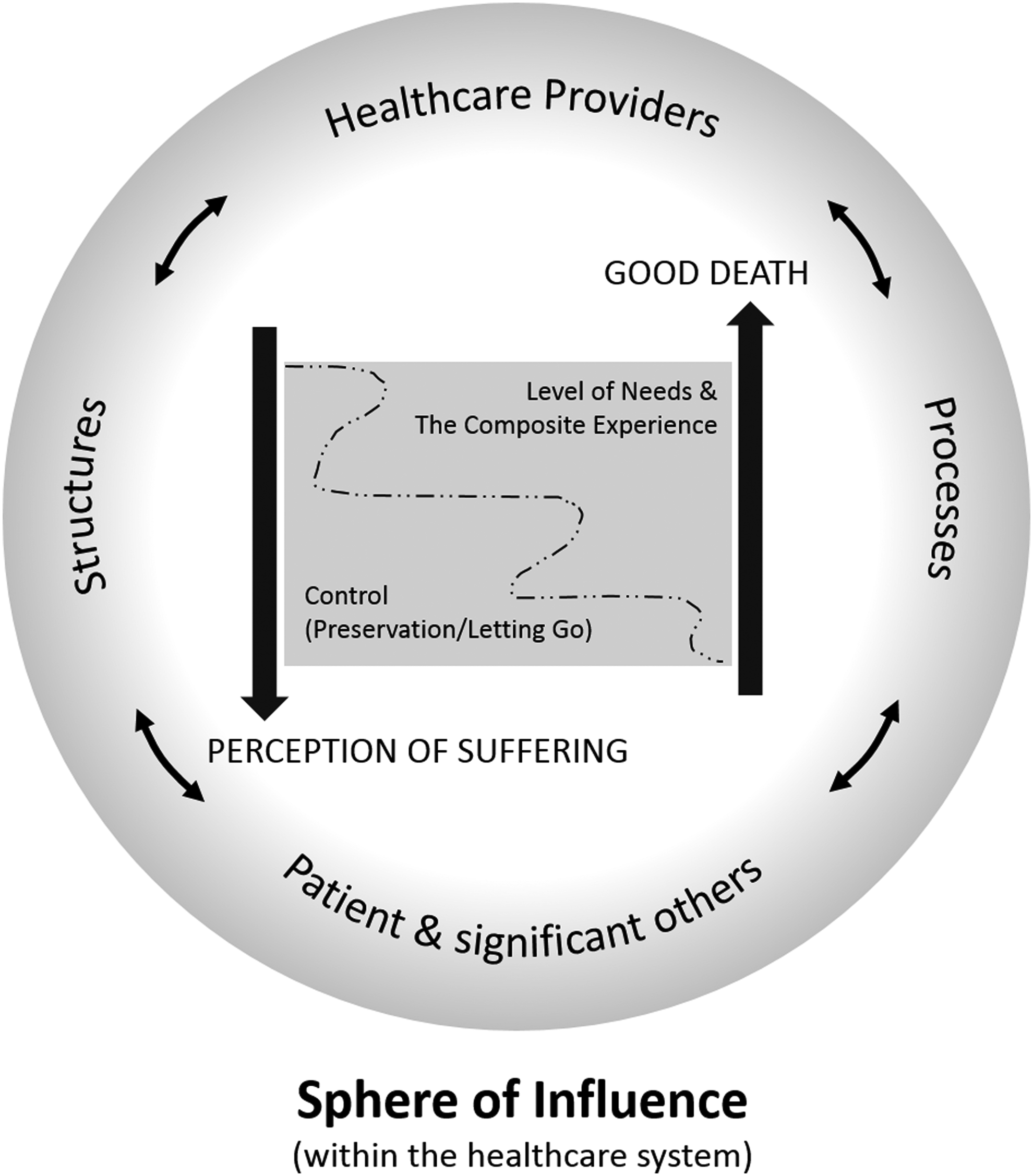
Concept map for a good death in children with life-shortening conditions.
The sphere of influence (a tentative model that requires further testing) refers to the entire health care context (whether in hospital or home) within which stakeholders interact. In line with critical realism, not only does the sphere cover relational experiences and meanings among stakeholders (e.g., unmet needs and perceptions of suffering) it also includes structures and processes (such as 24/7 support or loss of parental roles in the hospital setting) within the health care system that contain and drive these interactions. Whether it is the patient, family, or health care provider, each one could have his or her own intricate balance of needs, experiences, and sense of control. Since needs may be dualistic with ambivalence, and control oscillating between preservation and letting go, the blend between all factors (needs, experiences, and control) determines the extent of suffering at any point in time. It is postulated here that the measure of good death is inversely related to the perception of suffering. Given how its putative attributes are interdependent and fluid, it is posited that the quality of death itself is never constant, at least in and around the dying phase where this review is focused.
Discussion
This review adds to knowledge through synthesizing the scarce evidence related to good death in children with life-shortening illnesses. Previous reviews either drew heavily on adult literature 59 or focused on a specific group such as cancer. 60 Findings revealed a dynamic and multilayered ecosystem that incorporates different elements (control, needs, and experiences) and players (patients, family caregivers, and professionals), within a space bounded by the health care setting. It is dynamic in that the predominance of different elements could change over time, between and within themselves. Yet, they are also intimately layered, influencing how each element is expressed or experienced. In creating this concept map, the work of Corbin and Strauss on the trajectory framework was referenced. 61 The diversity, multiplicity, and complexity of problems in chronic illness described in their trajectory framework appear to be an almost similar journey that evolves over time, involving interactions between various “actors” and different “schemes” (management goals and treatment plans) with associated trade-offs and impact, ultimately ending in death.
These concepts are similar to that of Hendrickson and McCorkle 60 who stated that a good death in a child dying of cancer is “the final social process that involves many perspectives and is the sum of the interactions of multiple dimensions and their influences.” The work of Hendrickson and McCorkle postulated that each stakeholder brings his or her own definition of a good death. In this review, a single unifying construct is displayed, supported by data that showed how different stakeholders and external factors (both situational and ecological) interact and influence each other. This draws from the philosophical perspective of critical hermeneutics, 62 where an integrative approach that emphasized both subjective meanings for individual actors and social structures within a dynamic system is adopted. Not unlike what has been reported in adult literature,63,64 dying children (and their caregivers) similarly face social pressures to fit the norm of a good death, such as open communication or acceptance of dying. That notwithstanding, departure from convention is common. For instance, the duality and ambivalence described earlier frequently define the unique experience. The implication for practice is a need for the professional caregiver to be free of assumptions, and to explore in-depth what may appear to be opposing or shifting positions.
Its methodological design is one strength of this review. The protocol by Whittemore and Knafl 17 facilitated identification of universal concepts from heterogeneous data. Following a stepwise approach that is outlined a priori, rigor is preserved and bias minimized.18,65 The quality of all 24 studies was appraised to be above average, and all were found to be relevant. A good spread of literature across countries, settings, and diagnoses was reviewed. Of the 12 studies (half of total) that sampled patients with noncancer conditions, eight covered diagnoses across all categories (one to four) in Together for Short Lives' typologies of life-limiting conditions. 66 Different stakeholders, including siblings, were also represented.
Nevertheless, there are several limitations. Only one study reflected the child's perspective (single-person case study). Six studies30,31,37,44,45,56 recruited respondents whose children had died more than six years before, with risks of recall bias and perspectives that could have changed over time. The sampling frame had restricted articles to only those published in peer-reviewed journals. Sociocultural attitudes or values did not surface as contingent factors. Finally, the impact from location of care and death, or support from palliative care, was also not evaluated. These present research priorities in future research.
Conclusion
An integrative conceptual framework to the holistic and contextualized understanding of a good death in children with life-shortening illnesses is presented. The “sphere of influence” model should be verified and strengthened in future research. A study design that accommodates the experiences of multiple stakeholders and myriad influences within a dying child's ecosystem would need to be conceived. Nevertheless, preliminary ideas shared here can immediately inform practice and even policy. For example, to appreciate why caregivers suddenly change decisions to start aggressive life-sustaining treatment as their sick child is dying despite a prior do-not-resuscitate order; and at the systems level, shifting the locus of control back to parental caregivers within a family-centered model of care could mitigate the perception of suffering among stakeholders as a seriously ill child dies.
Footnotes
Author Disclosure Statement
The authors do not have potential conflicts of interest, including relevant financial interests, activities, relationships, and affiliations related to this article.
References
Supplementary Material
Please find the following supplemental material available below.
For Open Access articles published under a Creative Commons License, all supplemental material carries the same license as the article it is associated with.
For non-Open Access articles published, all supplemental material carries a non-exclusive license, and permission requests for re-use of supplemental material or any part of supplemental material shall be sent directly to the copyright owner as specified in the copyright notice associated with the article.
