




Abstract
Background:
Educational deficiencies among hospice and palliative medicine (HPM) physicians contribute to suboptimal utilization of palliative radiotherapy (PRT) for patients with advanced cancer.
Objective:
To survey HPM fellowship program directors regarding the need for PRT education in HPM fellowship.
Design:
We conducted a cross-sectional survey of HPM fellowship program directors in June 2018. We used a 5-point Likert-type scale to assess agreement with statements related to PRT education.
Setting/Subjects:
Program directors for all United States Accreditation Council for Graduate Medical Education-accredited HPM fellowship programs with at least one enrolled fellow at the time of survey distribution were included.
Results:
Eighty-one of 120 eligible program directors completed the survey (68% response rate). Nearly all of the respondents agreed that HPM physicians should possess a working knowledge of PRT and that the principles of PRT should be formally taught in HPM fellowship. Thirty percent of HPM fellowship programs, however, lacked a PRT curriculum and only 14% of programs provided more than two hours of PRT education. Limited didactic time, lack of interest among fellows, and lack of collaboration with radiation oncologists were not perceived to be significant barriers to incorporating PRT education into HPM fellowship. More than 75% of program directors indicated that they would consider implementing a PRT curriculum designed specifically for HPM physicians if one were available.
Conclusion:
There is a need for PRT education in HPM fellowship. This need may be best addressed by developing a widely accessible PRT curriculum designed to meet the needs of HPM physicians.
Introduction
Palliative radiotherapy (PRT) can effectively alleviate many of the physical symptoms associated with advanced cancer. In addition to treating tumor-associated pain, bleeding, dysphagia, and dyspnea, PRT can reduce the risk of seizures and paralysis, improve performance status and mobility, and enhance health-related quality of life.1–3
Despite its efficacy, PRT remains largely underutilized.4–6 Insufficient knowledge of the indications for and potential benefits of radiotherapy among hospice and palliative medicine (HPM) physicians has been identified as one of the key barriers to optimal use of PRT.4,7 The extent to which PRT education has been incorporated into HPM fellowship training, however, has not yet been characterized. We conducted a national educational needs assessment of HPM fellowship program directors to evaluate the perceived need for and barriers to implementation of dedicated PRT curricula in HPM fellowship.
Materials and Methods
Study cohort
All Accreditation Council for Graduate Medical Education (ACGME)-accredited HPM fellowship programs in the United States with at least one enrolled fellow as of May 2018 were included in this study. The 2017–2018 ACGME program directory was used to determine which programs met these eligibility criteria; the ACGME was also contacted to confirm the total number of eligible programs at the time of survey distribution. For each eligible program, the program director's name, telephone number, and e-mail address were identified using the ACGME directory and confirmed through manual review of each fellowship program's website when available. If a program director's e-mail address was not available, we made three attempts to contact the program by telephone to obtain this information.
Survey design and distribution
We developed a 17-item electronic survey for distribution to all eligible HPM fellowship program directors (Supplementary Data). Survey questions were designed after a comprehensive literature review and adapted from previously published assessments.8,9 Multiple-choice questions were used to collect program-related information and 5-point Likert-type questions (1 = strongly disagree; 5 = strongly agree) were used to assess level of agreement with various statements related to PRT education.
A unique anonymous link to the survey was e-mailed to the program director on file for each eligible program. Up to three reminder e-mails were sent over a four-week period. Before distribution of the survey, this project was reviewed by the University of California, San Diego Human Research Protections Program. All participants provided informed consent.
Statistical analysis
Categorical variables were compared between groups using chi-squared or Fisher's exact tests as appropriate. Quantitative variables were compared using t-tests or one-way analysis of variances (ANOVAs) depending on the number of groups being compared. A p-value of <0.05 was used to determine statistical significance. We used a correlation matrix to represent the correlation between each pair of quantitative items.
Results
Of the 140 U.S. ACGME-accredited HPM fellowship programs, 20 programs had no enrolled fellows as of May 2018. Therefore, 120 programs met criteria for inclusion in our study. Active e-mail addresses were obtained for 115 of the eligible program directors (Fig. 1). Eighty-one program directors (68% of the 120 eligible program directors and 70% of the 115 contacted program directors) completed the survey.
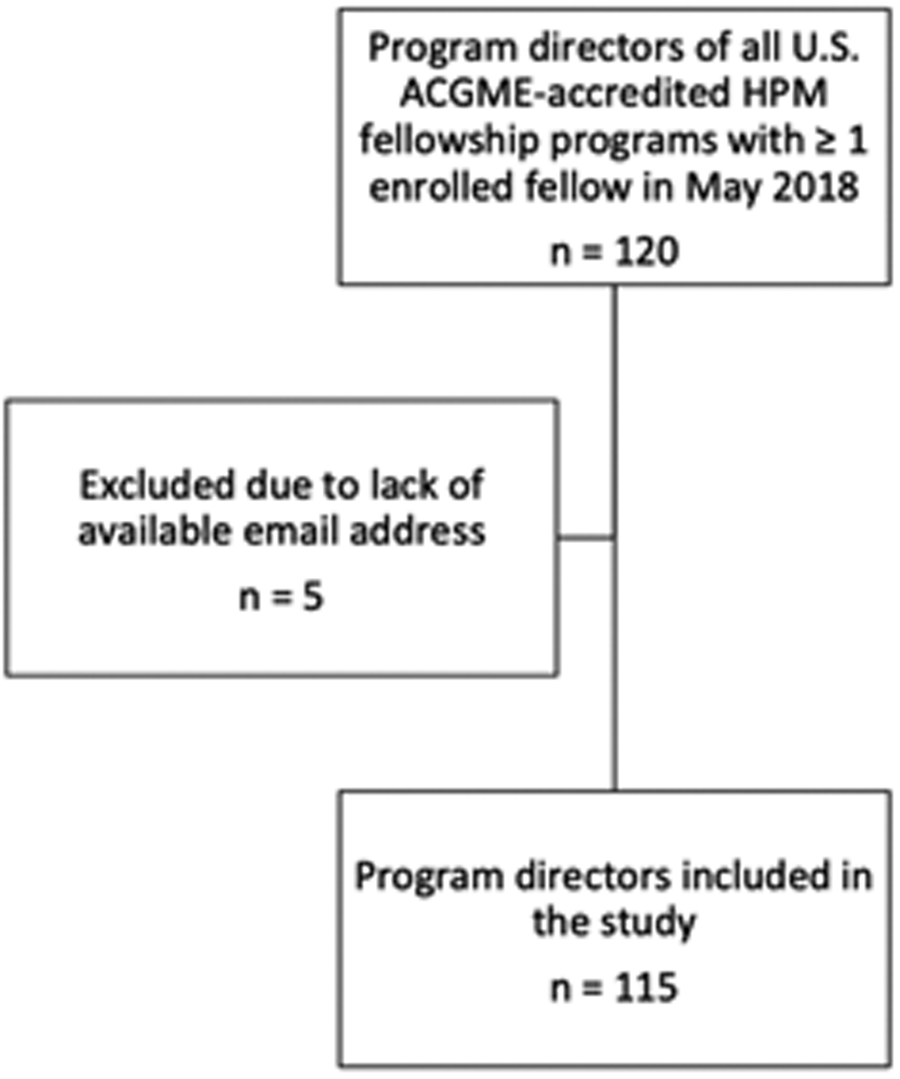
Summary of our study cohort. In May 2018, there were a total of 120 U.S. HPM fellowship programs accredited through the Accreditation Council of Graduate Medical Education (ACGME) with at least one enrolled fellow. Of the 120 program directors, 5 were excluded as we were unable to obtain a valid e-mail address. The survey was distributed electronically to the remaining 115 program directors. HPM, hospice and palliative medicine.
All respondents (100%; n = 81) reported that fellows in their programs worked with cancer patients who had access to radiation oncology. Eighty-six percent (n = 70) of program directors reported that fellows in their programs worked with a primarily adult patient population. The majority of respondents were located in either the Midwest (30%; n = 24) or the Northeast (33%; n = 27) although there was no significant association between geographic location and any other items in our survey.
Nearly all of the surveyed program directors agreed that radiotherapy is an integral component to comprehensive palliative care for many advanced cancer patients (96%, n = 78), that HPM physicians should be familiar with the principles of PRT (98%; n = 79), and that the principles of PRT should be formally taught in HPM fellowship (95%; n = 77) (Fig. 3). Almost one-third of HPM fellowship programs (30%; n = 24), however, lacked any PRT curriculum and only 14% (n = 11) of programs provided fellows with more than two hours of PRT education (Fig. 2).

Eighty-six percent of HPM fellowship programs provided fellows with less than or equal to two hours of PRT education. Fellows in 30% of HPM fellowship programs receive no PRT education, whereas fellows in 56% of programs received only one or two hours in total. PRT, palliative radiotherapy.
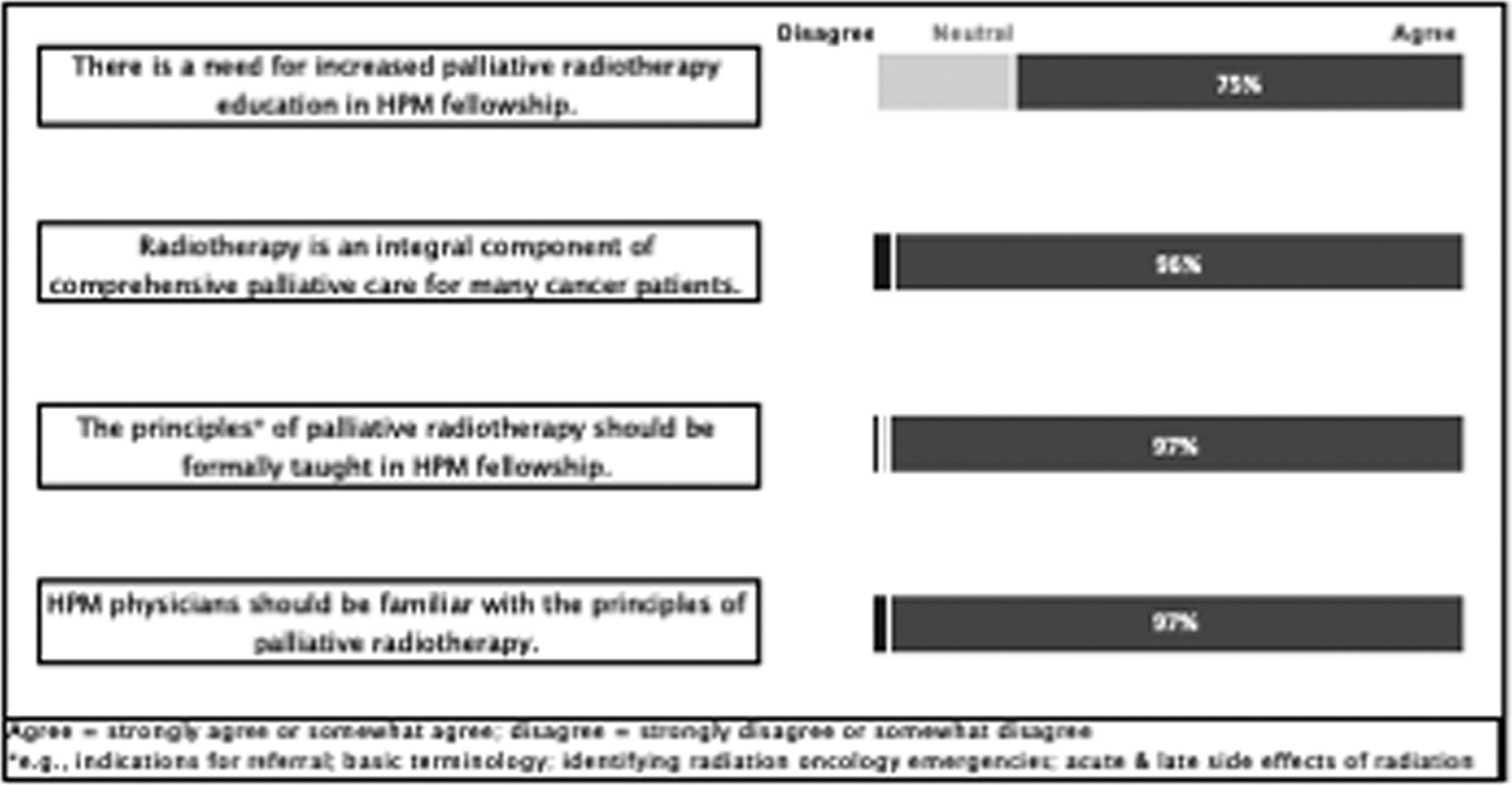
Program directors value PRT education in HPM fellowship. Nearly all respondents agreed that radiotherapy is an integral component of comprehensive palliative care for many cancer patients, that HPM physicians should be equipped with this knowledge, and that this topic should be taught during HPM fellowship. Seventy-five percent of program directors reported a need for increased PRT education in HPM fellowship.
A radiation oncology rotation was required in 16% (n = 13) of programs, whereas fellows in 25% (n = 20) of programs had no option to rotate with radiation oncology. In the remaining 48 programs, fellows had the option to rotate with radiation oncology as an elective. Programs with a primarily adult patient population were significantly more likely to provide fellows with this option compared with those with a primarily pediatric patient population or those with a similar proportion of adult and pediatric patients (p = 0.02).
Program directors for nearly half (n = 23) of the 48 programs that provided fellows with the option to rotate with radiation oncology reported that none of their fellows had elected to do so in the past three years. The programs with fellows who had completed a radiation oncology elective within the past three years were more likely to provide didactic PRT education (p = 0.003). Similarly, we found a positive association between the percentage of programs with fellows electing to participate in a radiation oncology rotation and the program director's agreement with the following statements: HPM physicians should be familiar with the principles of PRT (p = 0.033); PRT should be taught in HPM fellowship (p = 0.006); and there is a need for increased PRT education in HPM fellowship (p = 0.004).
In terms of possible barriers to incorporating PRT education into HPM fellowship training, most program directors did not perceive limited didactic time, lack of interest among fellows, or lack of collaboration with radiation oncologists as significant barriers. Three-fourths of program directors indicated that they would consider implementing a national PRT curriculum into their program if one were available.
Discussion
The role of radiotherapy in effectively alleviating many symptoms of advanced cancer has been well established for more than a century. 10 Despite estimates that 40%–50% of patients referred to radiation oncology are treated with palliative intent, many advanced cancer patients with tumor-associated symptoms are not referred to radiation oncology.6,7,11–14 This underutilization is perhaps the most well established among patients enrolled in hospice: although the majority of patients enrolled in hospice have a diagnosis of incurable malignancy, <1% of hospice patients receive PRT.4,15,16
Several barriers to radiotherapy referral have been identified, including expense, short life expectancy, duration of treatment, and issues with transportation. 4 Notably, insufficient PRT education among HPM physicians has been identified as one of the primary barriers to referral, with only 50% of surveyed HPM professionals reporting sufficient training in identifying which patients might benefit from PRT.4,7,17
We conducted a national survey of HPM fellowship program directors to characterize current efforts to incorporate PRT education into HPM fellowship training and to assess the perceived need for and barriers to such curricular interventions. Our findings compliment those obtained from our concurrent assessment of enrolled HPM fellows, described elsewhere. 18
We received a high survey response rate (68% of all eligible program directors; 70% of all contacted program directors). Given that participation in this survey was voluntary and no incentives were provided, this high response rate suggests that this topic is relevant to the surveyed population. We found that, although 95% of surveyed HPM fellowship program directors agreed that the principles of PRT should be formally taught in HPM fellowship, only 14% of programs dedicated more than two hours to this topic and fellows in 30% of programs received no PRT education throughout their fellowship training.
Based on studies examining radiation oncology curricula in undergraduate and graduate medical training, it is unlikely that fellows in these programs received any training in key radiation oncology topics before HPM fellowship.19–21 The majority of HPM fellows have primary specialty training in internal medicine. A recent nationwide survey of greater than 1000 internal medicine residents, however, showed that 93% of respondents had not received any radiation oncology education during residency. 8 This finding is consistent with the results of our survey of HPM fellows in which only 11% of respondents had received radiation oncology education before fellowship with 36% of these individuals having received this education during residency or fellowship training in an oncology specialty. 18
Our results also show that one-fourth of programs do not provide HPM fellows with the option to complete a radiation oncology rotation and that even in programs with this option, many fellows do not take advantage of it. It is not surprising that program directors who agreed with statements pertaining to the importance of PRT education in HPM fellowship were significantly more likely to ensure that PRT education was incorporated into the didactic curriculum. Interestingly, however, their agreement with these statements was also associated with an increased likelihood that fellows in their programs elected to participate in a radiation oncology rotation. Fellows may be more inclined to explore the clinical applications of radiotherapy if they are encouraged to do so by program leadership or if they develop an interest in this topic through the didactic lectures they receive.
Notably, limited didactic time, lack of interest among fellows, and lack of collaboration with radiation oncologists were not perceived to be major barriers to incorporating PRT curricula into HPM fellowship training. Given that the majority of program directors indicated that they would consider implementing a PRT curriculum if one were available, the development of a nationally available curriculum has the potential to address this educational need. Although the data are limited, this is supported by studies suggesting the effectiveness of brief curricular interventions designed to increase PRT education among referring providers.9,22
Further investigations are needed to define the optimal course content and the most effective methods of teaching the principles of PRT to HPM fellows. Similarly, prospective studies evaluating whether PRT curricular interventions in HPM fellowship impacts patient outcomes or patterns of referral for PRT are needed.

References
Supplementary Material
Please find the following supplemental material available below.
For Open Access articles published under a Creative Commons License, all supplemental material carries the same license as the article it is associated with.
For non-Open Access articles published, all supplemental material carries a non-exclusive license, and permission requests for re-use of supplemental material or any part of supplemental material shall be sent directly to the copyright owner as specified in the copyright notice associated with the article.
