




Abstract
Abstract
Background:
End-of-life (EOL) care is an important aspect of practice in the intensive care unit (ICU), where approximately one of every five patients may die.
Objective:
The objective of this study was to describe clinicians' experiences with the 3 Wishes Project (3WP) and understand the influence of the project on care in the ICU.
Design:
The 3WP is a palliative care intervention in which clinicians elicit and implement final wishes for patients dying in the ICU; it had been implemented for seven months at the time of this study. This mixed-methods study includes quantitative data from clinician surveys and qualitative data from clinician focus groups.
Setting:
A 24-bed medical ICU in a tertiary academic center.
Subjects:
Perspectives of 97 clinicians working in the ICU during the study period were obtained by self-administered surveys. Five focus groups with 25 nurses and 5 physicians were held, digitally recorded, transcribed, and analyzed.
Measurements and Results:
During the 7-month period, 67 decedents and their families participated in the 3WP. The overarching concept identified through analysis of the survey and focus group data is that the 3WP improves EOL care in the ICU, which was supported by three main themes: (1) The 3WP facilitates meaningful EOL care; (2) The 3WP has a positive impact on nurses and physicians; and (3) clinicians observe a positive influence of the 3WP on families.
Conclusions:
This patient-centered and family-partnered intervention facilitates meaningful EOL care, favorably impacting the ICU team and positively influencing family members.
Introduction
Dying in the intensive care unit (ICU) can be associated with suffering for both patients1,2 and families,3,4 and requires attentive management of symptoms5,6 and empathetic interventions to ease distress.7–9 In turn, ICU clinicians caring for dying patients and their grieving family members report compassion fatigue, symptoms of depression, and posttraumatic stress disorder.10–12 Clinician experiences may also reflect vicarious traumatization12,13 or moral distress14,15 about perceived goal-discordant treatment or nonbeneficial interventions at the end of life (EOL).16–18
Palliative care is increasingly recognized as integral to critical care.19–21 The key tenets of palliative care, such as symptom management, emotional support, prompt and sensitive communication, and treatment aligned with patient preferences, 22 are essential to caring for critically ill patients, particularly at the EOL. Palliative care interventions also have the potential to improve ICU clinicians' experiences of providing EOL care. 23
The 3 Wishes Project (3WP) is a palliative care intervention in which a dying patient's wishes are elicited and implemented, which creates a humanized, meaningful experience for patients, families, and clinicians.24,25 As originally described in a Canadian ICU, this patient-centered and family-partnered approach uniquely honors individual lives and celebrates legacies. 24 Our objective was to implement the 3WP in a large American tertiary care center and examine its effect on EOL care from the perspective of ICU clinicians.
Methods
Design
This study was conducted in a 24-bed university-affiliated medical ICU. If a decision to withdraw life support was made or the health care team agreed that the patient's probability of dying soon was >95%, then the patient and/or family was informed about the 3WP and invited to participate. A research team member or the patient's clinical team elicited, implemented, and categorized all wishes honoring the dying patient.
Clinician survey
After the 3WP was underway for one month, we created an anonymous, online self-administered survey using Google Forms to collect clinicians' perceptions of the influence of the 3WP on three domains (personal job satisfaction, professional morale, and workflow). The survey included five-point Likert scale questions to explore clinician perceptions, multiple-choice questions for respondent demographics, years of ICU experience, and open-ended questions inviting comments and implementation suggestions. Through chart review we identified the nurses, residents, fellows, and attending physicians who cared for patients on the day they were enrolled in the 3WP. Approximately one month after each death, we invited these clinicians by e-mail to participate in the survey.
Focus groups
All nurses and physicians who worked in the ICU during the first seven months of the 3WP implementation were invited through e-mail to participate in a 30- to 45-minute focus group. The 3WP physician lead (T.H.N.) facilitated five focus groups (two for physicians and three for nurses), which occurred six to seven months after project initiation. Because of their different roles and responsibilities in EOL care in the ICU, physician and nurse focus groups were held separately. We documented participant age, sex, religious affiliation, and years of ICU experience. A semistructured interview guide was used to facilitate discussion regarding the clinicians' experiences with the project. Participants received a $25 gift card. Focus group discussions were digitally recorded, transcribed verbatim, and anonymized.
Ethics
This study was approved by the hospital Institutional Review Board (IRB 17-001422). Patients and/or families provided verbal consent for participation in the 3WP. Survey completion was considered tacit clinician consent. Focus group participants gave written informed consent.
Analysis
Quantitative survey data were analyzed using descriptive statistics through Google analytics software and STATA 14.
Focus group transcripts were analyzed using conventional content analysis 26 to identify themes. 27 Three research team members (T.H.N., N.A., and M.S.) from different disciplines (critical care medicine, general internal medicine, and clinical epidemiology) independently reviewed the transcripts and conducted line-by-line coding to identify key concepts. 28 Differences were resolved by consensus; changes were tracked in an audit trail. 29 After coding, the research team organized these codes into meaningful categories, which were subsequently grouped into higher level themes. 30 Four members of core research team (T.H.N., N.A., M.S., and D.J.C.) assessed data saturation through a review of all transcripts. 29 The software ATLAS.ti was used to manage the data.
Focus group findings were interpreted in the context of survey findings with similarities or differences examined to triangulate results. 31
Results
Patients and wishes
During the first seven months of the 3WP, 67 dying patients participated. The mean age was 60.7 years (21–98 years, standard deviation [SD] = 19) and 49.3% were women. Of 268 wishes elicited, 264 (98.5%) were implemented (3.9 wishes per patient). The most common wish category was creating keepsakes (n = 75, 28.0%) and humanizing the ICU environment (n = 57, 21.2%) (Table 1).
Categories of Wishes
Surveys
Ninety-seven clinicians (54.8% response rate) completed the survey (Table 2) and shared their experiences (Table 3). All respondents stated that the 3WP should continue (73.2% with no changes, 25.8% with few changes, and 1.0% with significant changes). Primary suggestions included more staff education through in-services and greater visibility to families.
Characteristics of Survey Participants
ICU, intensive care unit.
Survey Results from 97 Clinicians
ICU, intensive care unit.
Focus groups
Attendance at 5 focus groups included 5 intensivists and 25 critical care nurses. The average age was 34.8 years (24–58 years, SD = 7.8) and the mean length of time working in critical care was 7.5 years (1–27 years, SD = 5.5) (Table 4).
Focus Group Participants' Demographics (n = 30)
SD, standard deviation.
Mixed-methods findings
Survey and focus group data show that the 3WP actively engages clinicians in compassionate, patient-centered EOL care, which was reflected in three themes: (1) The 3WP facilitates meaningful EOL care; (2) the 3WP has a positive impact on nurses and physicians; and (3) clinicians observe a positive influence of the 3WP on families (Fig. 1).
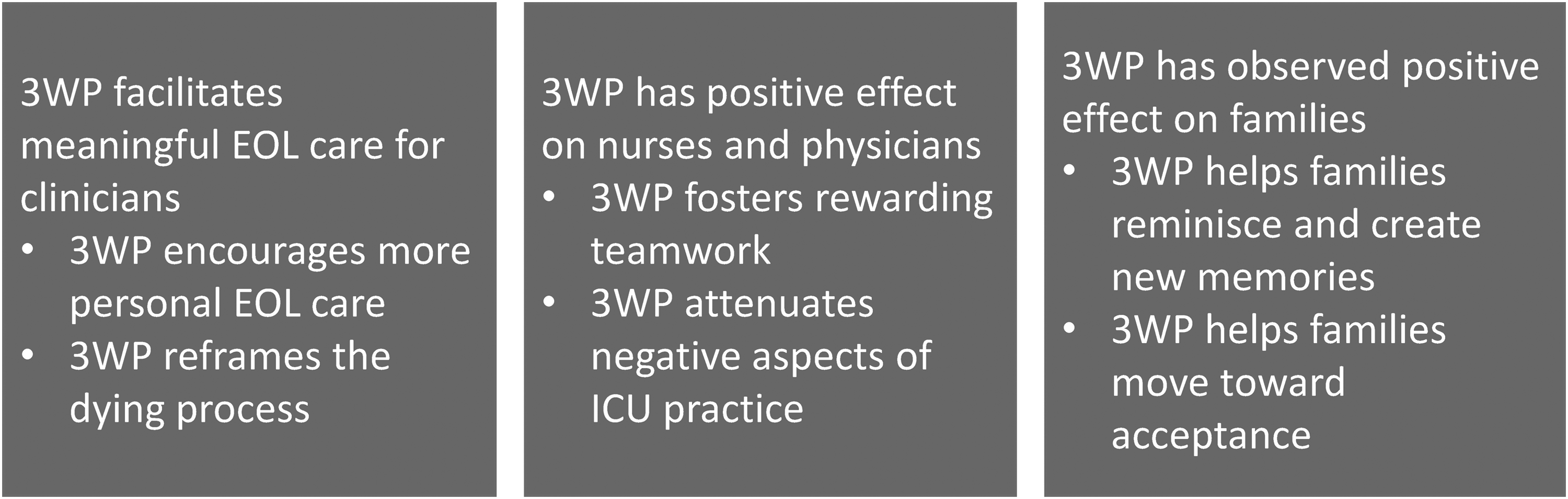
The 3 Wishes Project: changing end-of-life care for clinicians in the ICU. ICU, intensive care unit.
The 3WP facilitates meaningful EOL care
Focus groups indicated that the 3WP (1) encouraged more personal EOL care and (2) reframed the dying process. In the survey, 88.7% of clinicians strongly agreed or agreed (49.5% and 39.2%, respectively) that the intervention helped them to make a meaningful impact on the patient and/or family (Table 3).
In focus groups, clinicians expressed that the 3WP encourages a more individualized approach to EOL care. One nurse commented, “Once they're admitted to the ICU, we kind of take their identity away from them. They're just a medical record number…this program gives them their identity back.” Clinicians reflected on how the 3WP highlights what matters most to patients in goals of care conversations. One physician shared how the intervention helped to elicit the patient's values, ultimately leading to care concordant with the patient's preferences: “I'm not sure that I would've been able to navigate that conversation to get there. [3 Wishes] came up…and all of a sudden, we're talking about what they value.” Clinicians described how the 3WP provides them with a unit-based approach for family support. A nurse shared that introducing the 3WP to a daughter whose mother was dying meant that she could “be [her] right-hand person guiding her through the whole process” and thus tell the worried family, “I can do that with you; I'm here for you.” Another participant discussed how the 3WP validated personhood over technology for someone who loved the outdoors and would not have wanted to die institutionalized: “I think there are a couple of instances where their death has been on their terms, like the [patient] we took out to the patio [to die]. I think that…really aligned with his values and that was actually changing the death process to align with his values.”
In reframing the dying experience, a nurse explained how the 3WP “showed us…what death can look like versus what it often looks like.” A physician described how the project has helped clinicians think differently about EOL care, “[It's] shifting the overall culture in the unit over time. I can see the little sprouts of this popping up, at least, where the staff feel a little bit less helpless in these situations. They don't feel like they're just sitting there and waiting for something to happen…Not only are we able now to give the family something tangible to latch onto at this time, but it also gives us a sense of not being stuck in a situation where there's nothing else to do except to wait.” Clinicians also reflected on how the 3WP helps them transition from initiating and maintaining invasive interventions to a more palliative approach. One nurse explained: “I would say it's hard in ICU because there's two extremes. We go from doing everything, every measure, pulling out all the stops to make sure we can make it work for this patient, and then the moment we switch gears, it can be really sudden…we have to rewire our brains. And so the program really helps me…be like, ‘Okay, well, now I'm not hanging as many drips and I'm not titrating…so let me shift my attention into helping and caring more.’” Recalling a patient's wish for his favorite burger and milkshake, another nurse echoed, “[the 3WP] seems to be reframing the idea of death. Death doesn't have to be painful and sad and tragic every single time…It can be…a positive thing and in some ways, it can be a celebration.”
The 3WP has a positive impact on nurses and physicians
Survey data showed that 84.5% clinicians strongly agreed or agreed (37.1% and 47.4%, respectively) that the intervention increased professional morale and job satisfaction (Table 3). Few (2.1%) stated that it was disruptive of their regular duties. In addition, 88.7% of clinicians reported that the 3WP had a meaningful impact on the ICU team, and 78.3% agreed that the 3WP encouraged a more professional camaraderie.
Focus group participants indicated that the 3WP affected clinicians positively through their descriptions of how the project: (1) fosters rewarding teamwork and (2) attenuates negative aspects of ICU practice.
A nurse shared, “This unit can be a pretty dark place sometimes and I think this is one of the few things that brings light to what we're doing…we have so many patients that are so sick and…might not make it out of here.” Others discussed how the project has become an affirming component of their work when medical therapies have failed. One physician explained, “My personal approach to medicine is wanting to help, wanting to do something, wanting to fix a problem. And you can't fix this problem [imminent death], so if you can take that frustration and energy into doing something positive, it may actually …improve well-being [by giving you] a sense of purpose.” Several nurses commented on how, “It just brings so much of nursing spirit back. Like hey, this is why we do what we do.” Others shared that the 3WP created indelible memories at work: “So rewarding, and something I will never forget.” Physicians commented that there is now more nurse–physician collaboration delivering EOL care, “Overall it's made things a little bit more cohesive…and collegial.” They also observed that many nurses have become united in their mission to individualize EOL care: “They [the nurses] have sort of banded together to focus on this [the 3WP]. It means a lot to them.” Nurses affirmed how implementing final wishes “promoted teamwork.” Hearing how important appearance was to her mother, one nurse enlisted help from his peers to create an “ICU salon” experience for her, commenting, “Obviously I didn't do it alone; I had a lot of help.”
Clinicians also described how the 3WP mitigated some negative aspects of practice including the moral distress of perceived burdensome treatments for dying patients. A nurse explained that if she predicts a poor prognosis before the family's acceptance, the 3WP can help diminish her distress with providing seemingly futile interventions: “I know what the ending is…but we're torturing [the patient] for 4 or 5 months because the family is not ready. So doing this program…to be able to give a nice, more peaceful and personal death…almost takes away a little bit of the guilt of what we've done.” One physician described how nurses streaming a patient's habitual rap music in the room during his final hours created a more familiar atmosphere for the patient's wife: “Even if it seems relatively trivial, it seems nice for everybody involved to have something to focus on…in the middle of all the terribleness.” Physicians shared how offering the 3WP sometimes helped mitigate conflict during difficult EOL discussions. One expressed how eliciting wishes “seems to reduce, overall, the amount of angst in the room a little bit” and another expressed that “it makes the conversation a little bit easier…to have something positive to offer at the end of it.” For one physician, helping families acknowledge a terminal outcome was an important aspect of the 3WP, “We all know that the family meeting conflict is really emotionally exhausting for the entire care team. So on those occasions where it does help move the needle toward doing less potentially inappropriate care…that has definitely improved my emotional well-being about being in the ICU.”
Clinicians observe a positive influence of the 3WP on families
The majority (97.9%) of clinicians surveyed believed that the 3WP intervention was valuable to patients and their families. In focus groups, clinicians posited that the 3WP might positively influence families through (1) reminiscing and creating new memories and (2) helping families move toward acceptance.
Clinicians sensed that family engagement eliciting and implementing wishes can be a welcome distraction, providing a space where loved ones are encouraged to reflect on their loved one's life: “reminiscing helps [families] heal.” Clinicians described how the 3WP helped families to see their relative as a person, giving “us and the family a chance to step back and see the patient for who they are and who they were.” One physician posited, “I think it really does just give a little light to such a dark, dark time in people's lives. It really does help them focus on the positives of that person rather than just the imminent process.” A physician commented how the 3WP may provide solace for loved ones during the final moments, “I feel like we were leaving the family with a more positive memory than they would've otherwise had.” Another clinician believed how showing compassion at the EOL could have an enduring impact, “That relatively small intervention at the very end, they're going to remember that forever.”
Clinicians postulated how the 3WP might help families move toward acceptance of death. One physician shared, “But having a lock of his hair and fingerprints to hold on to, and just the additional support of having a more peaceful environment in the room was enough to get her from ‘I'm not ready, I'm not ready’ to ‘Yeah, we've done everything we can. It's time.’” A nurse observed that families did not linger as long with patients after they die, and a physician described “[the 3WP] gave the families a little bit of closure.”
Discussion
In recent years, there have been numerous calls to improve EOL care, particularly in the ICU.19,21,32–34 Our mixed-methods study demonstrates how the 3WP as a humanizing, relatively simple palliative care intervention 24 can successfully build on the edifice of existing EOL practices in a U.S. center. Clinicians involved reported that the 3WP facilitates more personal EOL care, creating positive impacts on clinicians as well as patients and families.
The 3WP addresses several quality indicators for EOL care, including being patient and family centered, eliciting and attending to the needs of dying persons and their family, and providing organizational support for ICU clinicians. 35 Our study shows that the 3WP encourages critical care clinicians to actively engage in “acts of kindness” during a period that is sometimes inappropriately referred to as the “withdrawal of care.” 36 Rather than a dying process being equated with passivity, the purposeful design of the 3WP reportedly catalyzes a different type of EOL care, amplifying expressions of compassion.
Perceived poor quality of death and family distress have been correlated with emotional distress for critical care professionals.11,37 By encouraging clinicians and families to honor dying patients through eliciting and implementing terminal wishes, participants indicated that the 3WP enhances clinician satisfaction and boosts team morale. Improved teamwork has also been proposed as a mechanism to prevent burnout. 38 Whether invigorating staff engagement in a unit-based palliative care intervention with a common purpose influences a dimension of practitioner burnout could be more formally investigated.
In terms of limitations of this study, patient views were not possible to capture; family experiences were not included given our clinician lens for this evaluation. Further evaluations of families are necessary to determine whether the 3WP affects bereavement. More physicians than nurses participated in the survey because we included residents, but more nurses than physicians participated in the focus groups, reflecting the nurse-to-physician ratio in ICU practice. Although a guide with neutrally worded questions and probes was used for the focus groups, they were led by the physician investigator, potentially introducing moderator bias 39 ; however, the shared experiences may have yielded more detailed expressions of the program's impact. As we sought to introduce this palliative care intervention in the unit, we did not randomize patients to be exposed to the 3WP. It is unknown whether these findings would be reproduced in institutions in which frontline staff did not elect to initiate the 3WP locally.
Study strengths include the mixed-methods design with congruent and complementary findings generated from the qualitative and quantitative methods. In our medical ICU, 67 decedents and their families were cared for, and >200 wishes were fulfilled in the initial 7 months of adopting this intervention. Although half of the survey respondents after a month of implementation reported minimal to no direct involvement in implementation of the 3WP, they had been indirectly involved by observing the effect of the 3WP on patients and families (e.g., clinicians who provided care for the dying patient that day but who did not elicit or implement the wishes). All focus group participants after seven months had been directly involved or witnessed 3WP activities, interpreting positive effects on families, their colleagues, and the ICU, and recommending that the project should be continued.
Conclusions
This study shows how the 3WP, as a patient-centered and family-partnered intervention facilitates meaningful EOL care, favorably impacting the ICU team and positively influencing family members, as perceived by nurses and physicians.
Footnotes
Acknowledgments
The authors thank Neala Hoad, RN and Alyson Takaoka, BSc in Hamilton, Ontario for sharing their 3WP implementation strategies. The 3 Wishes Project at UCLA was funded by a seed grant from the CSU Institute for Palliative Care and philanthropic donations from VITAS Healthcare, Katz Family Foundation, Porath Family Charitable Foundation, and Perlman Family Foundation. The funders played no role in the design and conduct of the study; collection, analysis, and interpretation of the data; or preparation, review, or approval of the article.
Author Disclosure Statement
No competing financial interests exist.