




Abstract

Letters to the Editor
Description of the unique clinical training and competencies of child life specialists in relation to cultural competence, and end-of-life interventions to support the Mexican origin community. (page 884)
Brief Reports
Secondary analysis to investigate whether palliative care interventions differ between cancer and heart failure patients. (page 966)
Fast Facts and Concepts
Management of Refractory Gastroesophageal Reflux Disease #377 (page 998)
Personal Reflection
“My son is still alive because of this treatment. Vomiting and diarrhea are good signs. They mean that bad toxins are leaving his body. If it were for Western medicine he would already be dead.” We tried to explain that our estimates of Jiafu's life expectancy were not meant to be 100% exact, and that the side effects of the “miracle drug” had nothing to do with any antitumor effect. (page 1002)
Case Discussions in Palliative Medicine
This is a case of terminal bleeding in an 87-year-old patient with angiosarcoma. The patient's advanced age and aggressive disease presented challenges in managing the symptoms and precluded many of the conventional interventions to manage bleeding. (page 1009)
Book and Media Reviews
(page 1014)
Recent Literature
(page 1015)
End-of-Life Planning and Marital Status
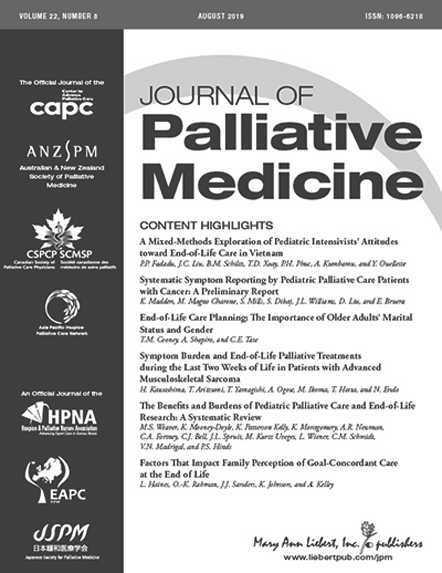
Researchers analyzed data from the U.S. Health and Retirement Study and found that divorced men and married women are at risk for lacking end-of-life planning. (page 902)
Factors Influencing Goal-Concordant Care
The authors used a sample of the U.S. Health and Retirement Study to explore how a family report of goal-concordant care for seriously ill patients was associated with advance care planning, age, race, and multimorbidity. (page 927)
Global Survey of Nurses' Perspectives on Palliative Care
This international needs assessment survey examined >500 home health care nurses' practice, satisfaction, and barriers to home-based palliative care in 29 countries. (page 945)
Promoting the Hospice Chaplain
The authors describe an educational intervention that resulted in greater acceptance of the hospice chaplain by patients and caregivers, allowing them the benefits of spiritual support during end-of-life care. (page 939)
Standardizing Pediatric Symptom Assessment
The authors share a pediatric symptom assessment survey that children and caregivers evaluated as easy to complete. They argue that systematic symptom assessment of children with cancer referred to palliative care should become a true standard of care. (page 894)
Palliative Care for Sarcoma Patients
This retrospective study found that the symptom burden among patients with advanced musculoskeletal sarcoma is profound at the end of life and requires aggressive symptom management, including the option of palliative sedation. (page 908)
Assessing Research in Pediatric Palliative Care
This systemic review reports the benefits and burdens of palliative research participation on children, siblings, parents, clinicians, and researchers. (page 915)
Access to Bereavement Support
A national on-line survey found that access to bereavement support through palliative care services in Australia has improved over a decade, yet remains largely equitable and variable across the continent. (page 933)
Pediatric Palliative Care in Vietnam
In a mixed methods study, researchers explored pediatric intensivists' attitudes and practices surrounding end-of-life care in Vietnam. (page 885)