




Abstract
Background:
Buprenorphine is an opioid medication used for the treatment of moderate to severe pain. In Canada, buprenorphine is not indicated for use in the pediatric population and literature surrounding its use in pediatrics is limited. Our aim was to evaluate the safety of transdermal buprenorphine in a pediatric palliative care setting.
Methods:
Our study was performed at the IWK Health Centre. Medical records of 11 patients were examined for specific clinical characteristics. The study focused primarily on descriptive results; standard data analyses were not performed.
Results:
Buprenorphine was found to be well tolerated in our patient population. There were no adverse effects reported in 8 of 11 patients during their treatment with buprenorphine. The remaining 3 patients described mild adverse effects in the form of skin irritation which resolved with topical steroid treatment. Efficacy was reported as anecdotal quotes from patient records.
Conclusion:
In this study, the use of buprenorphine in this setting was safe in a small group of patients, with the only mild adverse effect noted being a contact dermatitis in 3 patients which resolved quickly. Other studies have also demonstrated buprenorphine to be a safe and an effective opioid for the treatment of severe pain at the end of life in a pediatric population. Given these results, the implementation of buprenorphine in pediatrics may be safe for use in patients who are unable to tolerate traditional opioid analgesic therapies.
Introduction
Buprenorphine is a potent opioid medication used for the treatment of moderate to severe surgical and cancer pain. Buprenorphine elicits an analgesic effect from its action as a partial μ-receptor agonist and κ-receptor antagonist in the spinal cord. 1 Buprenorphine transdermal systems allow for continuous buprenorphine administration, making it valuable in the treatment of severe chronic pain as plasma opioid levels remain consistent. Kapil et al. demonstrated that steady plasma levels of buprenorphine could be reached over a seven-day application cycle in an adult population using a transdermal system. Furthermore, use of a transdermal patch allows patients to discontinue intravenous opioid administration, which can be difficult for patients to manage in an outpatient setting. 2
In Canada, buprenorphine is not indicated for use in the pediatric population. Literature regarding transdermal administration of buprenorphine in pediatrics is minimal and is often limited to case reports. Initial reports have shown promise regarding its efficacy and safety in this population. In a 2014 study, patches applied to 16 patients with cancer pain (ages 2–17) were found to be useful in reducing pain. 3 Furthermore, they demonstrated that 11 pediatric patients (68.75%) responded to the buprenorphine patch after two weeks of treatment. Patient pain measured with the Wong-Baker Scale (WBS) decreased from 6.25/10 at baseline to 1.38/10. 3 Compliance with transdermal buprenorphine systems also increased in comparison to similar treatments.2,3 Ruggiero et al. additionally found that use of buprenorphine patches for pediatric cancer-related pain treatment led to a significant improvement in global quality of life during a 60--day treatment period. 3 Studies investigating the pediatric use of buprenorphine patches are devoid of any major adverse drug reactions among participants, although some mild negative reactions were experienced such as nausea, headache, constipation, and patch site pruritus and erythema. 3 These symptoms quickly resolved after patch removal or topical steroid administration.3–5 Given this information, this study aims to fill some of the current gaps in the literature and to provide potential evidence that buprenorphine can be integrated into evidence-based treatment decisions used in pediatrics. There is a scarcity of data available about the use of transdermal buprenorphine in children, even at the anecdotal level; it is our hope that our study will identify new knowledge about the use of transdermal buprenorphine in this population.
Methods
Our study was a retrospective study performed at the IWK Health Centre in Halifax, Nova Scotia, evaluating the safety of buprenorphine treatment in a pediatric palliative care setting. Efficacy was not assessed, but we reviewed all reports documented in the chart regarding pain relief. All patients involved in the study were administered transdermal buprenorphine during their care at the IWK between June 1, 2010, and June 18, 2018.
Medical records of the 11 identified patients were examined for specific clinical characteristics and were documented using a data collection form developed by the authors. Patients' diseases were classified as neurological, oncological, endocrinological, immunological, musculoskeletal, respiratory, and cardiovascular. The specific conditions were not listed to preserve anonymity. The following patient clinical characteristics were noted (Table 1):
Collected Patient Clinical Characteristics
Data analysis
As the study population is small, the aim of the study was to focus primarily on descriptive results; standard categorical data analyses were not performed. Results for each category are presented separately as percentages.
Results
Population
A total of 11 patient records were reviewed for this study. Of the 11 patients, 6 were male and 5 were female. Mean age of the patients at buprenorphine treatment initiation was 7.8 years, with a median age of 6 years [0.3–16 years]. Of patients entered in the study, six patients suffered from a neurologic disease, four suffered from an oncologic disease, and one suffered from an endocrine disease. Regarding patient type of pain, six patients complained of generalized pain and one patient (9.1%) complained each of bone pain, neuropathic pain, and cramping. For two patients, the pain type was not reported (Table 2).
Patient Demographics and Clinical Characteristics
Buprenorphine dosage
Of the 11 patients, 9 patients' (81.8%) buprenorphine treatment was initiated at a 5 mcg/hour dose, while the remaining 2 (18.2%) were given an initial dose of 10 mcg/hour. Mean weight of patients included in the study was 32.7 kg. Those receiving an initial dose of 5 mcg/hour had a mean weight of 35.4 kg [4.2–113 kg], while those starting at 10 mcg had a mean weight of 20.6 kg [16.9–24.3 kg]. Titration to a maximum dose of 20 mcg/hour occurred in 4 (36.4%) of patients. There were several causes for buprenorphine treatment cessation (Table 3). Ceiling effect occurred when patients' responses to buprenorphine plateaued. At this juncture, four patients were switched to a 12 mcg/hour fentanyl transdermal patch for pain management. Average duration of buprenorphine treatment was 62.8 days [7–160 days].
Reasons for Buprenorphine Treatment Cessation
Adverse effects
Buprenorphine was found to be well tolerated in our patient population. There were no adverse effects reported in 8 (72.7%) of 11 patients during treatment. The remaining three patients (27.3%) described mild adverse effects in the form of skin irritation (Fig. 1), which resolved with topical steroid treatment. The severity of skin irritation only led to treatment cessation in one patient. During our review, we found no mention of additional adverse effects, including constipation, nausea, or vomiting, in any of the patients undergoing treatment with buprenorphine.
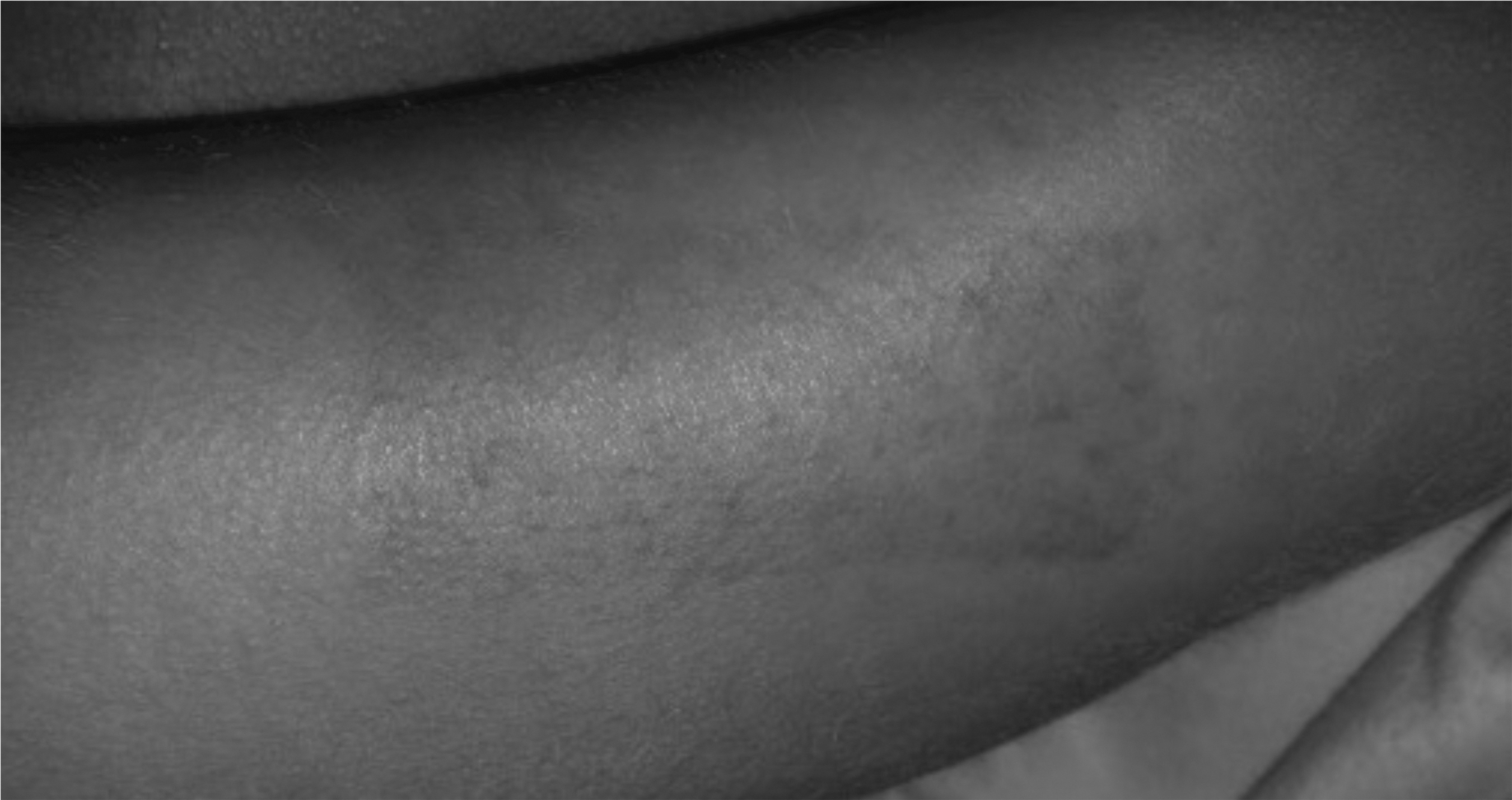
Example of erythematous rash following transdermal buprenorphine patch application.
Discussion
In pediatric palliative care, pain is one of the most prevailing symptoms affecting children and their families. 6 Currently, in medical literature, there are limited data on the safety of buprenorphine in children. 5 It is believed that this is mainly because buprenorphine is unlicensed for use in a pediatric setting.12 The aim of this study was to retrospectively demonstrate safe delivery of transdermal buprenorphine. Of the 11 patients in our study, 3 patients exhibited a contact dermatitis, which quickly resolved upon patch removal. The most common skin reaction found in the literature is erythema and pruritis.13 In fact, a study done by Attina et al. found that 26.6% of their patient population had erythema and 23.2% had pruritis. 4 This is similar to our findings in which 27.3% of patients exhibited skin irritation. No other adverse effects were noted by patients in this study. Side effects in other studies included nausea, vomiting, and constipation, among others.3,5
This study was not without limitations. Due to the minimal reporting of pain severity in the medical records examined, it was difficult to quantify the intensity of patients' pain during their buprenorphine treatment. Pain severity was not reported in 8 (72.7%) records during buprenorphine treatment. Of the remaining three patients, 2 rated their pain as “moderate” and 1 as “severe.” While quantitative information regarding pain severity was rare, anecdotal evidence regarding buprenorphine efficacy was more common (Table 4). Of the 11 patients in the study, anecdotal evidence describing some degree of efficacy of buprenorphine treatment was found in 8 (72.7%) of the patient records. Furthermore, while the results may provide cautious optimism, the sample size of this study limits any conclusion that can be made regarding the safety of buprenorphine use in the pediatric population as these results may not extrapolate to a larger population. Rigorous trials will be required to demonstrate the safety and efficacy of buprenorphine in this population before its implementation as an alternative analgesic therapy.
Anecdotal Evidence of Buprenorphine Efficacy as Reported in Patients' Medical Records
The addition of transdermal buprenorphine in managing pain in pediatric patients has many potential advantages.9,10 Patients often require long-acting opioid treatment to manage their pain, the majority of which come in forms that are not suitable for use in this patient population. Oral formulations are typically found in a large capsule, which cannot be swallowed by some patients due to their condition or by those too young to swallow them. 4 As many opioid medications are designed in such a way that they cannot be crushed, this patient population requires a different route of administration for long-acting opioids. Unfortunately, options outside of transdermal fentanyl can be quite limited. In using the transdermal buprenorphine system, however, patients who would otherwise be unable to tolerate other long-acting opioid treatment are able to benefit from opioid analgesia. Furthermore, the use of transdermal buprenorphine allows for decreased dosing frequency. 11
In our study, the use of buprenorphine in control of pain in a pediatric palliative care population was safe in a small group of patients. Other studies have demonstrated buprenorphine to be a safe and an effective opioid for the treatment of severe pain at the end of life in a pediatric population.3,4
Conclusion
The implementation of buprenorphine in pediatrics may provide a safe alternative for patients who are unable to tolerate traditional opioid therapies. In addition, the transdermal delivery system allows for safer and more manageable opioid analgesia regimen versus intravenous medication. Moving forward, additional research will be required to further demonstrate the safety of buprenorphine in a pediatric population. Trials will also be required to demonstrate the efficacy of buprenorphine in pain management in comparison to the current alternative opioid treatments. Once these research goals are demonstrated sufficiently, seeing buprenorphine added to drug formularies for use in this population would be of great benefit of both providers and patients alike.
Footnotes
Author Disclosure Statement
No competing financial interests exist.