




Abstract
Letters to the Editor
Self-reported data used to describe current practices and perspectives of resident physicians on code reversal before an invasive procedure. (page 1024)
Brief Reports
Administered survey explores current red blood cell transfusion practices among palliative care physicians. (page 1139)
Fast Facts and Concepts
How to Help a Patient Choose a Surrogate Decision Maker #378 (page 1162)
Personal Reflection
Last week, in the middle of January, six children died. I knew them all in one way or another. A child at home with a terrible brain tumor. A baby whose parents felt she had been through too much for her congenital heart disease and it was time to stop. A young man with a hard life that made dying from cancer just another thing to deal with. The list goes on. (page 1164)
Case Discussions in Palliative Medicine
Case of a 61-year old with a ventricular-assist device (VAD): by drawing on educational resources available from VAD patients' acute-care hospital-based VAD teams, interdisciplinary education of hospice staff can be accomplished quickly and effectively. (page 1167)
Book and Media Reviews
(page 1170)
Palliative Care Impact on Population Health Costs and Utilization
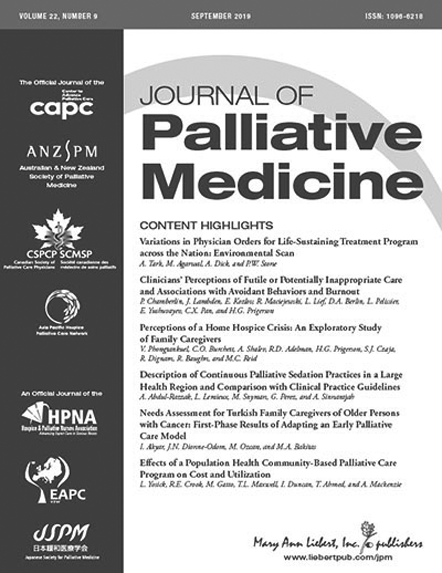
Managed Medicare patients who received community-based palliative care in central Ohio showed a 20% reduction in total medical costs, 38% reduction in ICU admissions, 33% reduction in hospital admissions, and 12% reduction in hospital days. (page 1075)
Perceptions of a Home Hospice Crisis
This exploratory study examined the prevalence and nature of crises in home hospice care as reported by family caregivers. (page 1046)
Before Hospice: Dementia in the Last Year of Life
Researchers examined the type and severity of symptom burden for older community-dwelling adults with and without dementia and how symptoms limited social participation in the last year of life. (page 1106)
Screening for Opioid Misuse
Researchers at the University of Virginia found that cardiologists and oncologists who prescribed opioids were unlikely to screen patients for risk of substance misuse. However, cardiologists were more likely to use a prescription drug monitoring program and/or urine drug screens for monitoring. (page 1115)
Interdisciplinary Communication Skills
The authors describe a new train-the-trainer course for interdisciplinary serious illness communication, which was launched statewide with 26 palliative care teams including nurses, social workers, chaplains, and physicians. (page 1082)
Best Practices in Palliative Sedation
Researchers performed a retrospective chart review of 602 patients in hospitals and hospices in Calgary, Canada, who required palliative sedation at end of life. Overall, they found low adherence to best practice guidelines in palliative sedation. (page 1052)
Clinician Burnout
The authors describe how futile or potentially inappropriate care, when provided or observed by clinicians in two academic hospitals in New York, was associated with avoidance of patients, families, and colleagues. They found these avoidant behaviors were associated with clinician burnout. (page 1039)
Palliative Care after Lung Transplant
This retrospective cohort study of ∼600 lung transplant patients examined the characteristics of post-transplant palliative care encounters, utilization trends, and patient characteristics at a center with established palliative care services. (page 1092)
Regional Variations in Physician Orders for Life-Sustaining Treatment
In this environmental scan, researchers found variation in the inclusion of symptom and infection management in Physician Orders for Life-Sustaining Treatment by state. (page 1032)