




Abstract

Dear Editor:
Offensive wound odors often have a negative psychosocial influence on patients and their families, 1 and may increase a patient's feeling of worthlessness and social isolation. 2 Although studies have reported systemic and gel-based metronidazole to be efficacious, 3 the use of crushed metronidazole tablets has not been systematically examined. Our primary objective was to assess the effect of crush metronidazole in reducing chronic wound malodor. The secondary objective was to assess the impact of crushed metronidazole on wound exudate.
This was a prospective single-center single-arm interventional trial conducted between February 2016 and September 2017 at King Hussein Cancer Center, Jordan. We obtained Institutional Review Board approval and all patients signed informed consent. Patients were eligible if they were ≥18 years, had a diagnosis of cancer, and had a single malodorous wound. Patients with wound ≥225 cm, 2 delirium, anosmia, no caregivers, or allergy to metronidazole were excluded. Crushed 500 mg metronidazole tablets were applied directly to the wound daily. Wound odor and exudate were assessed daily for five consecutive days during metronidazole intervention by two independent research nurses in addition to the patient or their caregiver. Odor was rated on a numeric rating scale from 0–10 (0, no odor; 1–4, mildly offensive odor; 5–8, moderately offensive odor; 9–10, extremely offensive odor) by two nurses and either patient or caregiver independently. 1 Exudate was rated on a numeric rating scale from 0–3 (0, no exudate; 1, scant exudate; 2, moderate exudate; 3, heavy exudate). Patient and caregiver satisfaction and the average cost of treatment were also evaluated.
Descriptive statistics were used for this study. Friedman test was used to examine significant changes for the study period. Inter-rater reliability between three raters was assessed using the interclass correlation coefficient (ICC). Significance criterion was designated as p ≤ 0.05. All analyses were performed using SAS version 9.4.
Fifteen cancer patients were enrolled. Mean odor level rated by research nurses significantly decreased within 24 hours of initial application of metronidazole (7.20 on day 1 vs. 4.60 on day 2; p = 0.0002; Fig. 1). Mean odor level rated by patients/caregivers also significantly decreased within 24 hours (7 on day 1 vs. 4.4 on day 2; p = 0.0001). Moreover, mean wound odor significantly decreased over five days (mean reduction by nurses 5.9; p < 0.001; mean reduction by patients/caregivers 6.1; p < 0.001). Significant decrease (p < 0.001) in wound exudate was also observed for the five day study. Odor assessment ICC was 0.92. Eighty percent of the patients/caregivers rated their satisfaction as >7/10, with a mean rating of 8.06 ± 1.44. The average cost for metronidazole was five to six U.S. dollars for the five-day treatment period.
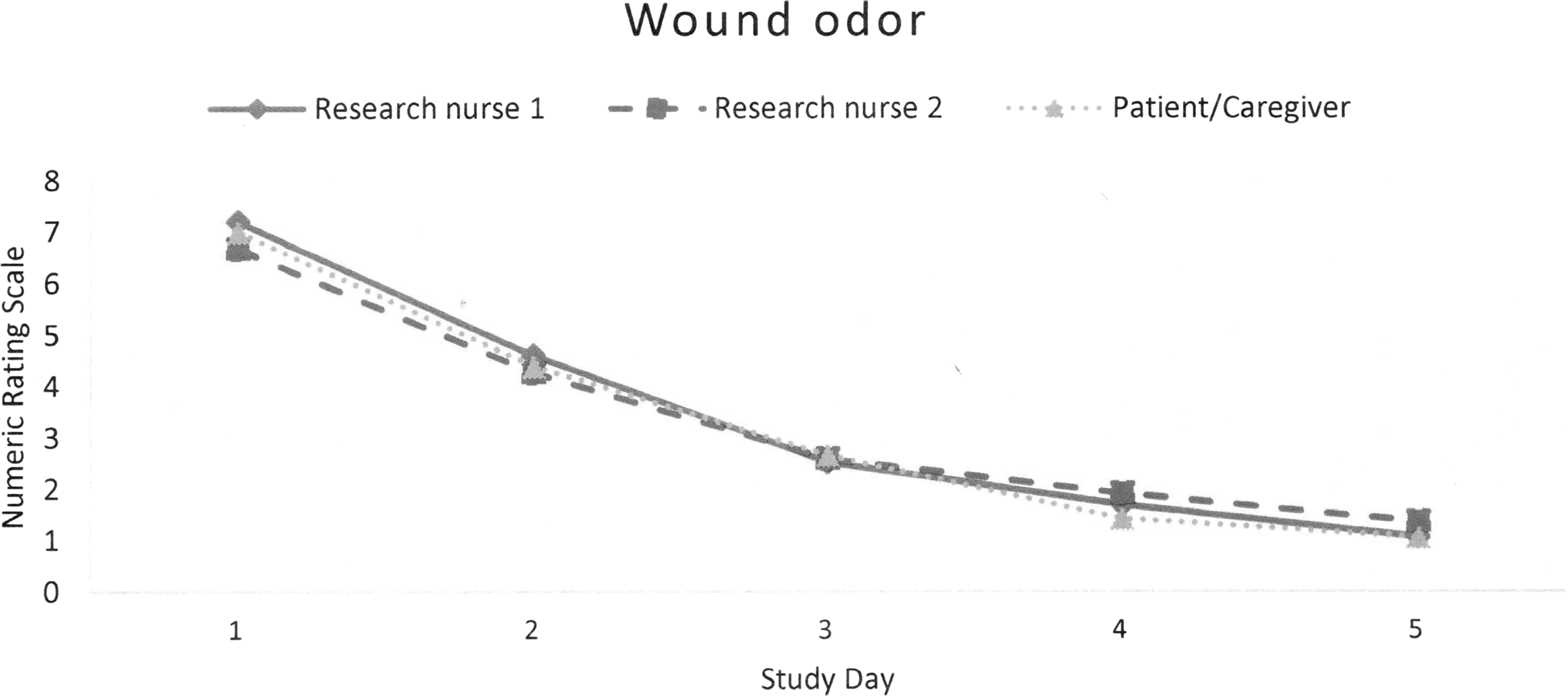
Wound odor scale rating during topical metronidazole intervention. Odor scale rating as determined using a 0–10 numeric rating scale (0, no odor; 1–4, mildly offensive odor; 5–8, moderately offensive odor; 9–10, extremely offensive odor). Wound odor was rated independently by two research nurses as well as the patient/caregiver for each participant daily.
This preliminary study suggests that topical crushed metronidazole may be an effective and inexpensive intervention for controlling offensive odor and distressing exudate in patients with chronic wounds. Key limitations of this study included the small sample size and lack of control group, which may contribute to ascertainment bias. Larger placebo-controlled randomized trials are needed to confirm its benefit.