




Abstract
Background:
Understanding end-of-life (EOL) and palliative care continues to grow. However, little attention has been paid to the experiences, preferences, and needs of older lesbian, gay, bisexual, transgender, and queer (LGBTQ) women. While some universal expectations or preferences at EOL exist, this population may not receive adequate or appropriate attention or reporting of unique EOL issues and experiences.
Objective:
Systematically search for and narratively review existing evidence concerning the expectations, preferences, and needs for palliative and EOL care of LGBTQ older women.
Design:
A comprehensive literature review was conducted in accordance with the Preferred Reporting Items for Systematic Reviews and Meta-Analyses (PRISMA) guidelines. Articles reporting needs, experiences, and perspectives of palliative care and EOL care among LGBTQ older women were evaluated.
Measurements:
Articles published between 1996 and 2019 were retrieved from PsycINFO, MEDLINE, Cochrane Library, Academic Search Complete, AgeLine, CINHAL, PubMed, LGBT Life, SocINDEX, Women's Studies International, Joanna Briggs Institute, and Open Grey.
Results:
A total of 16 articles were included. Articles described several concerns for the overall LGBTQ population; however, additional issues and experiences specific to older LGBTQ women were also identified, including vulnerability associated with isolation and poverty, women's social needs and support networks, and preferences for complementary care.
Conclusion:
There remains a need for further research with older LGBTQ women concerning palliative and EOL care, particularly around preparation for EOL and preferences for support. Inclusion of diverse populations in terms of sexual and gender identification are needed to fully understand how to provide appropriate and preferred support.
Introduction
For the past two decades, studies on lesbian, gay, bisexual, transgender, and queer (LGBTQ) older adults have increased and aging issues have become more prominently acknowledged; however, findings specific to this population continue to be limited and when studies with older adults are conducted, they tend to lack sufficient LGBTQ participation for generalizability or tests of comparison. 1 In addition, much LGBTQ research tends to focus on younger cohorts (<50), gay men, HIV/AIDS, sexual health and care, and broad issues of aging and health.2–8 According to Westwood and Lowe, older LGBTQ women “are under-represented in the literature about both older women…and about LGBT* ageing.”9(p.60) Older adult studies often attend to social networks, mental health, health disparities, quality of life, and long-term care, but rarely include or can speak to implications for LGBTQ populations.7,10–14 In addition, the LGBTQ population is diverse within itself, 15 generating a need for research and interventions developed for distinct aging populations. 16
As the total U.S. proportion of people 65 years and older is predicted to grow to ∼1 in 5 in 2030, the older LGBTQ population is projected to grow rapidly as well. 1 Existing health disparities, disproportionate experiences of chronic illnesses, and limited caregiving networks among LGBTQ midlife and older adults indicate that this population is at heightened need for palliative care and end-of-life (EOL) supports and services. 17 Further, because older women outnumber men, it is possible that a significant proportion of the older LGBTQ population will be women. 18 The few extant studies of LGBTQ aging issues relating to serious illness, EOL, or palliative care largely examine challenges or barriers within health care and social systems, grief and bereavement, and anticipated and experienced discrimination.19–21 Neusifter 22 and Smolinski and Colon 23 have investigated the role of professionals support systems, particularly social worker and therapists, in advocating for better interventions and support during EOL. However, rarely are in-depth experiences of LGBTQ elders living with serious illness, at EOL, or receiving palliative care the sole or primary focus of studies.
Within the limited body of research investigating older LGBTQ individuals' issues at EOL and with palliative care, collapsing all sexual and gender identities into a single group is common. However, both Averett and Jenkins and Westwood and Lowe assert older LGBTQ women are distinct not only from heterosexuals but also from gay men as well; thus increased visibility of LGBTQ older women in research is needed.9,16 While some studies disaggregate by sexual and gender identity, participants are often grouped as either lesbian or gay; few samples have included bisexual older adults,17,24 and few studies focus solely on a particular identity as a selected group.18,22,25–28 Transgender populations also have distinct needs and perspectives compared to those of lesbian, gay, and bisexual-identifying cisgender older adults, which often go unacknowledged.3,29
As LGBTQ women report distinct life events and social experiences from LGBTQ men, it is likely that their experiences at the EOL and with terminal illnesses are also distinctive and deserving of focused attention. 30 This exploration is necessary to develop services and intervention approaches in health and social services that are well-adapted to and informed by such experiences. Of particular interest for this review are the intersectional experiences of age-, sexuality-, and gender-based oppression among older LGBTQ women who, as Kehoe 31 and Trais 32 have described as facing a specific form of triple discrimination. Contextualizing issues specific to a group within the larger community allows researchers to address challenges associated with that population. Thus, it is important to examine the expectations, needs, and preferences of older LGBTQ women to create a distinctive and contextualized framework for understanding those experiences and facilitating care that will lead to a person-centered experience of EOL or palliative care.
Objective
This article seeks to review extant literature on the expectations, needs, and preferences of older LGBTQ women in relationship to palliative and EOL care to assess what is known, summarize key gaps in knowledge, and suggest future areas of study. We limited our review to the experiences of women aged 60 and older as the combined intersectional experience of oppression based on age, gender, and sexual identity may uniquely impact the findings and as the experiences of LGBTQ older adults are particularly neglected in the extant literature. This body of literature is relatively nascent with few studies addressing unique subgroups in detail; thus, we have included all LGBTQ women and attend to subgroup differences in narrative form. While EOL and palliative care are distinct, both are utilized by individuals living with chronic and/or terminal illnesses, and the study of each may produce meaningful insights for practice and research. To highlight the lived experience of EOL and palliative care, we focused our search on literature which spoke to one of three previously identified dimensions of EOL: described experiences, identified needs, and preferences for care and support. 33
Methods
Search procedures and inclusion criteria
The review was conducted in accordance with the Preferred Reporting Items for Systematic Reviews and Meta-Analyses (PRISMA) guidelines. 34 A systematic Boolean phrase search was conducted in PsycINFO, MEDLINE, Academic Search Complete, AgeLine, CINHAL, LGBT Life, SocINDEX, Women's Studies International via EBSCOhost, Cochrane Library, PubMed, and Joanna Briggs Institutes. Search terms included those related to older adults (older adults, elderly, aging, seniors, geriatrics, and age-related), LGBTQ populations (lesbian, lesbianism, LGBT*, sexual minority, gender minority, trans*, and transgender) palliative and EOL care (palliative care, EOL, death, dying, and terminally ill), and terms that addressed lived experience (experience, perception, attitude, and perspective). As few studies were returned, which focused specifically on LGBTQ populations, two authors also manually searched the reference lists of included articles as well as a manual search of the Journal of Gay and Lesbian Social Services and LGBT Health, a peer-reviewed academic journal focused on LGBTQ research and their social environment and which addresses the full scope of LGBTQ populations and subgroups.
Inclusion criteria required that articles (1) be empirical ones published in English in peer-reviewed journals between January, 1996 and September, 2019; (2) include a sample of at least one or more older (60+) LGBTQ women with serious or terminal illness (diagnosed by a physician as having six months or less to live); and (3) address the expectations, preferences, and/or needs of LGBTQ women as distinctive from those of other populations. Common reasons for exclusion included failing to disaggregate the experiences of older LGBTQ women from other LGBTQ populations, from non-LGBTQ women, or from those of younger people in the sample (n = 47); focusing on the experiences of populations younger than the age of 60 years (n = 10); and focusing on health care worker's experiences rather than those of consumers (n = 15). The article search, screening, and selection were completed by two researchers ([blinded for review] and [blinded for review]) and the process is summarized in Figure 1. The search yielded a total of 978 articles, including 393 duplicates, leaving 585, which underwent an abstract review to apply inclusion criteria. Five hundred fifty-nine articles were excluded, leaving a total of 27 articles for full-text examination, after which 15 were excluded. Review of reference lists of included articles garnered four additional articles, leaving 16 for inclusion in the review.

PRISMA 2009 flow diagram. PRISMA, Preferred Reporting Items for Systematic Reviews and Meta-Analyses.
Data Extraction and Analysis
Data extracted from each article included author, publication year, location, study objectives, methods, participants, and outcomes. Data were compiled into an Excel file and reviewed by two researches ([blinded for review]). Researchers individually and collectively assessed each article for contributions as well as assessed patterns across the body of literature to identify characteristics of the studies and their samples, key findings related to LGBTQ older women's experiences of EOL or palliative care, and gaps in the existing literature. Themes were compared between researchers and an agreement upon synthesis was written up by the first author and reviewed by other researchers.
As this area of literature is in preliminary and emergent stages, articles represented wide variation in study design, sample size, and characteristics, limiting our ability to produce meta-analytic or mathematically combined findings. Thus, we narratively describe the findings of this review, as narrative reviews are useful for assessing bodies of literature across varied approaches and areas of foci. 35 First, we describe the body of literature itself and characteristics of studied samples. Next, we report emergent themes within study findings, mainly focusing on issues described as distinctively experienced by LGBTQ women. Throughout, we also attend to notable gaps in the literature, which have implications for the current state of knowledge and possible future directions for empirical study.
Results
Table 1 provides detailed information about the 16 articles reviewed. Eight studies were from the United States,21,25,27–29,36–38 two from the United Kingdom,3,19 two from Australia,4,39 and four from Canada.40–43 Nine studies used only qualitative methods,3,19,21,27,28,40–43 five included only quantitative methods,25,36–39 and two used a mixed methods approach.4,29 Sample sizes ranged from 2 to 1962 with an average of 242. Six articles included findings from lesbian, gay, and bisexual men and women, but not transgender participants.19,21,25,27,28,37 One study reported findings from heterosexual service providers as well as gay, lesbian, bisexual, and transgender service recipients of all ages. 4 Two studies included all female participants, but included both heterosexual women and lesbians or women paired with women.36,37 Only 3 of the 16 articles focused solely on older LGBTQ women, most of whom self-identified as lesbians.25,27,28 One clear issue that arose during this review was not only the lack of transgender- and bisexual-specific articles but also the minimal number of transgender or bisexual participants in studies which sought to include their experiences. Only two articles focused on transgender individuals exclusively29,43 and three included a sample of transgender older adults within the larger sample40–42 ; however, none focused solely on bisexual experiences. 29 While three articles4,28,37 aimed to include transgender participants and named the unique clinical concerns transgender individuals might experience related to EOL and palliative care, no transgender participants were eventually recruited or participated.
Articles Included in the Review
LGB, lesbian, gay, bisexual; LGBT, lesbian, gay, bisexual, transgender; GLBT, gay, lesbian, bisexual, transgender; TW, transgender women.
Summary of Findings
Overarching themes for the full LGBTQ population were identified in 16 articles and included the following: (1) fears about discrimination, stigma, or mistreatment3,4,21,25,27–29,37,38,40–43; (2) loss of control or decision-making ability3,4,21,25,27–29,37,38,40–43; (3) fear of lack of recognition and support from health care or service providers, including for spouses/partners3,4,19,21,25,27–29,36–38,40–42; (4) poverty and isolation, including from caregiving3,4,19,28,29,36,40–43; and (5) fears about not being able to be “out” or being silenced in old age and at EOL, especially if institutional care was required.3,25,28,40,42,43 A few studies also addressed issues specific to transgender populations, including (1) importance of being buried as their chosen gender29,41,43; (2) insensitivity and lack of recognition around acknowledgement of gender29,41; (3) provision of intimate care 43 ; (4) fear of abuse 29 ; and (5) dependency on others, especially in long-term care.29,41 Key issues among transgender individuals, including transgender women, seem to focus on issues of isolation, barriers to care, trust, and honesty, and representation and vulnerability, particularly in long-term care.
Among those studies that addressed the experiences of LGBTQ women more specifically, samples tended to be limited mainly to lesbian- and gay-identified women, and key themes included (1) social isolation and poverty3,29,29,41–43; (2) support for and from women,22,23,28,43 (3) hospice, palliative care, and complementary and alternative medicine,3,28,37,38 and (4) the role of former partners and chosen families at EOL,19,28,36,40,41 each of which we explore in more detail.
Distinctive issues among older LGBTQ women
Social isolation and poverty
While certainly not exclusive to older LGBTQ women and spanning experiences from serious illness to caregiving to EOL and long-term care, poverty and isolation were discussed as a key issue of interest in 6 of the 16 articles. Lesbian and transgender participants in a number of studies were concerned about how sexual identity may cause isolation40,42,43 and financial difficulties were found for both transgender and lesbian or bisexual women participants.29,41 Isolation related to caregiving was a prominent stressor for lesbians, including many lesbian seniors who “return in a cyclical manner to fears of dependence and isolation.”28(p.246) Feminine-identifying transgender women also noted a fear of being “assigned to ‘the boy's room’ meaning an exile from femininity.” 29 Studies also found older unpartnered LGBTQ women may feel isolated as a result of caregiving, lifelong financial challenges, and having to give up home environments when spouses or partners died. 41
Support for and from women
While the need for social support is not specific to LGBTQ women, 44 participants in studies by Averett et al., 25 Putney et al., 28 de Vries et al., 43 and Hughes and Cartwright 39 identified both issues concerning women receiving fewer resources than gay men and the need for support from women who share their experiences. Findings also show a marked division between cohorts, including participants finding more and better resources for gay men, more gay men staffing help lines, and more exposure for gay men than for lesbians and bisexual women. 41 Other lesbian and bisexual women participants noted a desire to be separate from other gay, bisexual, transgender, or queer (GBTQ) groups as they age, noting in one study that they did not “want to retire with a whole pile of drag queens.”41(p.368) This remark emphasizes a clear division within the community and indicates how exclusive this type of sentiment can be. Findings also show that, as a consequence of being gay, lesbian, or bisexual, women had more support within their own networks among other LGB women.” 36 Being able to live in a lesbian-only residence was important, 25 and participants often spoke of sharing living space in facilities geared toward lesbians and with those with similar backgrounds.
Hospice, palliative care, and complementary and alternative medicine
Three articles mentioned participants' desire for hospice at EOL.28,37,38 A desire to die at home with hospice was found to be preferential 28 as well as an emphasis on pain management rather than overextending lives. 38 Participants preferred environments other than a nursing home, assisted living facility, hospital, or other institutional setting for their death, as well as options for interventions that either complement traditional medicine or include hospice and/or palliative care, specifically. June et al., found “lesbian women reported more positive beliefs about the role of alternative medicines in health care compared to heterosexual women”37(p.459) a finding also established in a second article. 45
Role of former partners and chosen families
Woven throughout the study findings was the idea of creating a community of family and/or close friends or sharing experiences with partners/spouses or a larger community of women. Participants relied heavily on former partners and similar relationships, creating a bond among chosen family.19,41 The same sentiment is found in Pang et al., 43 through a transgender women who stated, “When you have somebody as part of your life, as part of your support system, whether we like to recognize it or not, it is”(p.47) although this sentiment was less prevalent in the trans community and was described as a potential EOL issue for many who lack a close person who could serve as a source of support.
Discussion
The objectives of this review were to identify the expectations, needs, and preferences of LGBTQ older women with serious illness or at EOL found in the body of literature currently available, and identify areas for future research. As indicated by the findings, there continues to be limited research dedicated to palliative and EOL experiences among older LGBTQ women despite the potential growing needs for such services as the older adult population grows. Particularly there is a dearth of findings specific to or which include bisexual and transgender women. The limited findings do show an overlap in themes for LGBTQ populations, illuminating that research with LGBTQ women is both inclusive of and different from research with LGBTQ persons in general. Figure 2 shows the breakdown of studies, including older lesbian, gay, bisexual, and queer women and older transgender women. Findings also indicate that transgender older women have specific expectations, needs, and preferences for palliative and EOL care, including concerns related to support networks, loss of control over how their bodies are identified and treated following death, acknowledgement of gender by physicians and other service professionals, and fear of abuse in long-term care. While these findings are preliminary, the distinctive needs of this population indicate that this is an area in need of added study in addition to addressing the unique needs of bisexual women whose experiences were largely absent from this literature.
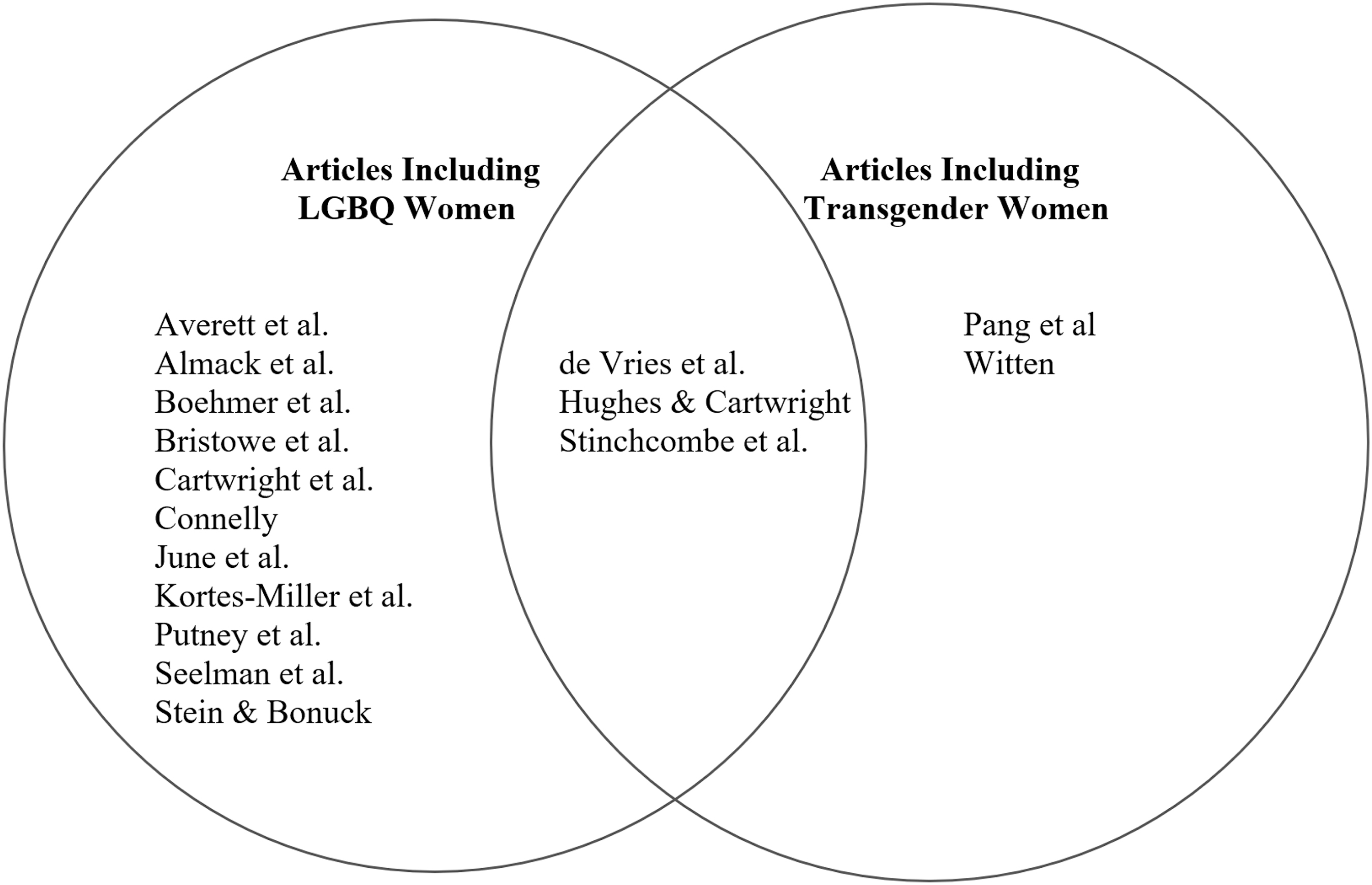
Articles including LGBQ and/or transgender women.
While some studies identified EOL issues for the full LGBTQ population or looked at wider issues, including bereavement or legal and financial challenges, only six studies focused exclusively on LGBTQ women in relationship to palliative care or EOL care. However, findings suggest that older LGBTQ women have concerns, needs, and preferences relating to social support, isolation, vulnerability in relationship to cultural insensitivity, and potential loss of control, and preferred support at EOL. While these issues are not unknown to the full LGBTQ population, findings show distinct reasons for concern for older LGBTQ women, particularly around the desire for women-specific spaces and support and the creation of dense families of choice, inclusive of ex-partners. Although these themes were identified in literature specific to palliative and EOL care, they are consistent with prior studies which have summarized differences in social networks and supports among LGBTQ older women more broadly, indicating that these social patterns across the life span will come to inform EOL needs and desires. 17
In response to such findings, health care and support professionals should be better prepared to acknowledge and understand the EOL expectations, needs, and preferences of this population to close the gap between theory and praxis and develop supports specific to the needs of unique populations. Just as clinical trials for interventions should include diverse populations to determine the proper treatment for each specific patient, so should studies focus on specific populations to gain depth of insight into the personal and dynamic EOL and palliative care environments, which will ultimately produce the best interactions and outcomes possible. To do this, it is important to determine not only how the broader LGBTQ population views their EOL experiences, but also how LGBTQ older women in particular view their EOL experiences, as the needs and preferences of this population (and, certainly, individuals within this population) are different in some respects from those of broader older adult populations. Researchers and practitioners might also find ways to capitalize on the strengths of older LGBTQ women, drawing on their desire and potential for strong social networks to supplement and anchor EOL and palliative care services.
Limitations of Existing Knowledge
A number of limitations were identified within the reviewed literature, which to some extent in turn limited our ability to synthesize across studies. We acknowledge these issues as limitations of our review while also calling for added attention to reliable methods in the field, which will foster the accumulation of knowledge across studies. First, there is a lack of research found dedicated specifically to older LGBTQ women in EOL and palliative care, thus requiring the authors to include broader studies that only minimally included the perspectives of older LGBTQ women. Another issue was the lack of information from bisexual women or transgender older adults. While two quantitative studies focused on transgender people specifically, it was difficult to distinguish those who were feminine-identifying and older in one of the studies. 29 Next, the issue of heterogeneity must be identified as the studies were not all methodologically the same. In terms of sampling, studies with larger sample sizes often relied on snowball or convenience sampling, rather than more generalizable sampling methods. Finally, sexual identity was not always clearly described, and populations were at times identified broadly as “LGB” or “LGBT people” or “LGB older adults.” Thus, in future research, we call for added attention to subgroup analyses and representation, particularly among transgender and bisexual older women, consistency and clarity in distinguishing such subgroups, and added methodological rigor in terms of producing generalizable findings.
Conclusion and Future Directions
While studies with older LGBTQ women and about EOL as a topic of study are on the rise, it is difficult to find research focusing on the triply underrepresented population of older LGBTQ women, and even more challenging to find research on this population in relationship to EOL. The limited amount of research does show a need for further study to not only understand the needs of these populations but also apply the information to changing health care and support services. Future research should adequately attend to subgroup distinctions, experiences of transgender and bisexual older women, and methodological advancements to facilitate the accumulation of knowledge in this nascent area of study. Reporting individual sexual and gender identities will help to address challenges in correctly identifying the population, which can lead to inaccurate analysis or representation. In addition, addressing topics such as isolation, trust, social support, partnership in later life, vulnerability in long-term care, and aligning principles with practice is necessary to lessen discrimination and other challenges during EOL and palliative care.
Footnotes
Funding Information
This research received no specific grant from any funding agency in the public, commercial, or not-for-profit sectors.
Author Disclosure Statement
No competing financial interests exist.