




Abstract

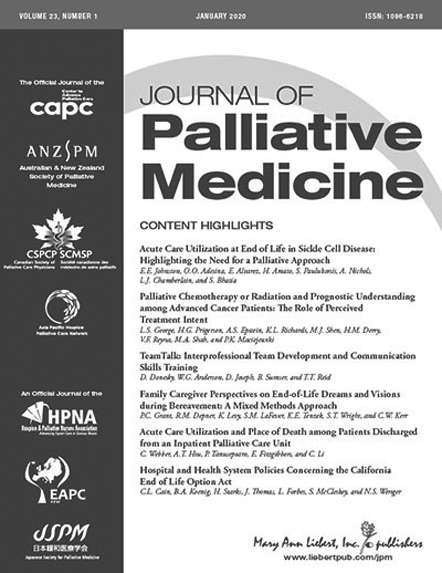
Letters to the Editor
Retrospective review to determine if patients engaged in advance care planning discussions with their outpatient providers prior to their terminal ICU hospitalization. (page 5)
Brief Reports
Project to increase the number of serious illness conversations occurring in an accountable care organization using a script delivered telephonically by nurse care managers. (page 112)
Fast Facts and Concepts
The Role of Ketamine in Depression #384 (page 136)
Fertility Planning for Patients with Advanced Cancer #385 (page 139)
Personal Reflection
I realized that not only was it the smell, but the entire house reminded me of my grandfather's makeshift garage workshop. There were narrow walkways with old electronics strewn about, uneven carpets, a fine layer of dust covering everything, and enough fall risks that even me and Brook had a few close calls during our short visit. While it brought back fond memories for me, it was a geriatrician's worst nightmare. (page 144)
Case Discussions in Palliative Medicine
Virtual reality is quickly becoming a useful tool in many areas of medicine, including: surgical planning, simulation training, rehabilitation, and pain prevention and treatment. We present a case report of use in the pediatric palliative care population. (page 147)
Book and Media Reviews
(page 150)
Recent Literature
(page 151)
Health System Policies on Physician-Assisted Death
The authors surveyed hospitals in California on their policies and challenges in implementing the End of Life Option Act (EOLOA), finding considerable heterogeneity in their approaches. They found access to the EOLOA depends on where a patient receives medical care, and recommend health systems define and share best practices. (page 60)
Palliative Care in End-Stage Liver Disease
Researchers analyzed more than 67,000 hospitalizations among patients with end-stage liver disease in the U.S. and found few but growing numbers of patients who received an inpatient palliative care consult. Palliative care was associated with a decline in readmission rates resulting in a lower burden on healthcare resource utilization and improvement in cost savings during subsequent readmissions. (page 97)
Treatment Intent and Prognostic Understanding
In this multi-site, observational study, researchers interviewed advanced cancer patients about their perception of their treatment as curative or non-curative, and how it associated with their understanding of prognosis. (page 33)
Training Inter-Professional Learners in Serious Illness Communication
The authors report on an inter-professional communication skills curriculum called TeamTalk, adapted from Vital Talk pedagogy. They found TeamTalk improved attitudes and self-confidence among 61 inter-professional learners to collaborate on serious illness conversations. (page 40)
End-of-Life Dreams and Grieving
This cross-sectional study aimed to explore differences in self-reported grief for people whose loved ones shared end-of-life dreams and visions (ELDVs) versus those that did not, and to describe the role of ELDVs in the grieving process. (page 48)
Discharge Outcomes from an Inpatient Palliative Care Unit
In this single-institution, retrospective study, patients discharged from an inpatient palliative care unit who were younger or did not have a cancer diagnosis were at high risker of post-discharge hospitalizations, emergency department visits and in-hospital deaths, despite having community supports in place. (page 54)
Impact of Home-Based Palliative Care
In this retrospective study in Sweden, a home-based palliative care program reduced emergency room visits and and hospital admissions by 51 percent and 41 percent, respectively. There was a significant increase in admissions to inpatient palliative care units, which was the most common place of death for patients enrolled in the program. (page 67)
Benefits of Early Inpatient Palliative Care
This retrospective, case-control study demonstrates a significant association between reduced length of stay and hospital charges when consults for palliative care were initiated within twenty-four hours of hospital admission. (page 107)
Understanding Hospital-Hospice Referrals
The authors describe the variability in hospice use rates among elderly Medicare decedents by hospital referral regions and county in North and South Carolina, as well as implications for patient care, research, health systems and policy. (page 90)
Prognosis in Prolonged Mechanical Ventilation and Dialysis
The authors utilized a national database in Taiwan to determine life expectancy and major prognostic factors among patients receiving both prolonged mechanical ventilation and maintenance dialysis. They found more than 85 percent died within one year and argue for earlier, targeted palliative care for these patients. (page 74)