




Abstract
Objective:
Characterize hospice staff practices and perspectives on discussing end-of-life care preferences with patients/families, including those desiring intensive treatment and/or full code.
Background:
Patients in the United States can elect hospice while remaining full code or seeking intensive interventions, for example, blood transfusions, or chemotherapy. These preferences conflict with professional norms, hospice philosophy, and Medicare hospice payment policies. Little is known about how hospice staff manage patient/family preferences for full-code status and intensive treatments.
Methods:
We recruited employees of four nonprofit US hospices with varying clinical and hospice experience for semi-structured, in-depth interviews. Open-ended questions explored participants' practices and perceptions of discussing end-of-life care preferences in hospice, with specific probes about intensive treatment or remaining full code. Interdisciplinary researchers coded and analyzed data using the constant comparative method.
Results:
Participants included 25% executive leaders, 14% quality improvement administrative staff, 61% clinicians (23 nurses, 21 social workers, 7 physicians, and 2 chaplains). Participants reported challenges in engaging patients/families about end-of-life care preferences. Preferences for intensive treatment or full-code status presented an ethical dilemma for some participants. Participants described strategies to navigate such preferences, including educating about treatment options, and expressed diverse reactions, including accepting or attempting to shift enrollee preferences.
Discussion:
This study illuminates a rarely studied aspect of hospice care: how hospice staff engage with enrollees choosing full code and/or intensive treatments. Such patient preferences can produce ethical dilemmas for hospice staff. Enhanced communication training and guidelines, updated organizational and federal policies, and ethics consult services may mitigate these dilemmas.
Introduction
In hospices across the United States, a substantial proportion of enrollees elect full code or intensive medical interventions (e.g., blood transfusions, chemotherapy, total parenteral nutrition [TPN]). Estimates of the prevalence of non-do not resuscitate (DNR) status among recipients of the Medicare Hospice Benefit (MHB) range from 13% to 20%.1–3 One study estimated that 20% of patients discharged live from hospice do so specifically to resume disease-directed treatment. 4 While speculative, this suggests up to 200,000 of the ∼1.5 million Medicare beneficiaries receiving hospice annually may have full code or intensive treatment preferences. 5
The provision of intensive treatment in hospice arises from professional and federal efforts to serve diverse enrollee preferences and disease types6–9 and accords with an essential hospice tenet (preference-aligned care). Nevertheless, many consider CPR and intensive treatment as deviations from hospice's historic focus on comfort care. 10 Hospice organizations and clinicians have adjusted their practices with little policy guidance amidst increasing payment restrictions.1,11–14 Permitting full code and intensive treatments may therefore have resulted in clinical, organizational, financial, and ethical challenges 15 for hospice employees.
Little research explores how hospice clinicians and staff discuss end-of-life preferences or care for patients/families who remain full code or seek intensive interventions. This article reports findings from a qualitative study of hospice employees regarding their practices of engaging patients/families in these discussions.
Materials and Methods
Design
We conducted a qualitative, descriptive, multisite study 16 of how clinicians elicit patient/family goals and values for hospice care and changes in these practices over time. Methods, summarized below in accordance wiht SRQR guidelines, have been described in detail elsewhere. 17 Feedback from a community advisory group of nonparticipating hospice stakeholders and methodologic experts within the Palliative Care Research Cooperative (PCRC) 18 informed study design and interview guides. The University of California San Francisco IRB reviewed this study and determined it exempt.
Participants
Sites
Nonprofit community-based PCRC-affiliated hospices were eligible. Sites were selected using a criterion sampling strategy20,21 based on geographic diversity and nonprofit status. The first four recruited sites agreed to participate; each received $500 after data collection. Individuals: Seventy-one individuals were recommended for recruitment based on criterion sampling.19,20 Eligible hospice staff were clinicians, leaders, and quality improvement experts. Data collection concluded at a site when at least 12 individuals had been interviewed and the sample reflected a range of clinical experience, hospice experience, and positions. Fifty-one employees (72%), evenly split across sites, participated (4 declined and 16 did not respond): 61% were clinicians, 25% executive leaders, and 14% administrative staff. Participants with clinical backgrounds included 23 nurses (RN), 21 social workers (SW), 7 physicians (MD), and 2 chaplains; two had multiple degrees/disciplines. Eighty-six percent were non-Latinx white and 80% were female.
Data collection
Data collection occurred in 2016. The interviewer (K.L.H.) had doctoral-level training in qualitative research and familiarity with hospice from prior employment in nonprofit hospice leadership. K.L.H. visited each site and conducted semistructured in-depth interviews. 19 All participants consented verbally. Interview domains emanated from the Theory of Domains Framework21–23 to understand stakeholder behavior. Questions addressed: (1) capability, opportunity, and motivation to facilitate end-of-life care conversations; and (2) professional opinions about end-of-life care conversations and changes in practice over time. Based on early themes, later interviews probed about intensive treatment and full-code status (e.g., whether approaches to discussions have changed to accommodate patients' “diverse preferences, like being full code”). Interviews were recorded, redacted, and notes/transcripts returned to participants for clarification; participants made no changes. Mean interview length was 49 minutes.
Data analysis
The team employed the constant comparative method, 24 an approach based on iterative comparisons within and between analytic cases that is well-suited to investigate and develop theories about complex phenomena. Members of the interdisciplinary research team independently reviewed the data and identified elements relevant to end-of-life care conversations. They next created preliminary codes, evaluated code adequacy in 25% of the data, and further refined the code set. One investigator then coded the full dataset in ATLAS.ti version 8. 25 Data relevant to code status or intensive treatment were coded separately unless both terms were mentioned explicitly by participants, in which case those data were double coded. Ambiguous cases were resolved through discussion. The team iteratively reviewed and discussed the coded data to identify key concepts and patterns; they evaluated and refined findings through discussion, analytic memoing, 26 and comparisons across and within respondent type. 20 The team documented an audit trail of methodologic and analytic decisions. Interview data citations below refer to “s,” data collection site number; “p,” participant number; and participant role and/or discipline, for example, leader.
Results
Across all four sites, participating hospice staff described their organizational context and practices for discussing end-of-life care preferences with patients/families. All sites were founded in the 1970’s, had free-standing inpatient units, employed formal processes to document preferences on admission, trained staff in advanced care planning conversations, and accepted full-code patients. Three themes emerged regarding staff practices and attitudes. First, participants encounter challenges when engaging in these conversations, including supporting patients who are full code or prefer intensive treatment. Second, participants use specific strategies to engage patients/families with these preferences. Third, participants describe varying reactions to preferences for intensive treatment or remaining full code. Although these themes often overlapped in practice, we describe them as conceptually distinct phenomena here.
Challenges encountered during end-of-life care conversations in hospice and resulting ethical dilemmas
Participants frequently referenced challenges inherent to discussions about end-of-life preferences (Table 1). Many participants emphasized concern about upsetting patients/families by initiating discussion of end-of-life care preferences too quickly, too often, or at the wrong time, and thereby unintentionally “squelch[ing] somebody's hope” (site 2, participant 33, role as QI administrator with RN training). Similar hesitation stemmed from participants' own discomfort discussing death and fear of affirming the misconception that hospice is “the death squad” (s3-p9-clinician-SW). Participants also acknowledged that patients/families were often unprepared for these conversations despite being on hospice, and were reticent to discuss death and dying: “As a new nurse and with my ideas of hospice, I was really looking forward to talking about death… By and large, my experience has been that most patients and certainly some family members are not interested… It's too intimate, too close, too hot” (s4-p43-clinician-RN).
Challenges Inherent to Discussing End-of-Life Care Preferences in Hospice and Resulting Ethical Dilemmas
Patient/family preferences for full-code status or intensive treatment presented a significant challenge. One nurse reflected, “I think the DNR and full code is the hardest thing for me… a lot of patients feel like if they sign that they're giving up” (s3-p11-clinician-RN). Intensive treatments discussed by participants included: TPN, blood transfusions, intravenous fluids and antibiotics, chemotherapy, radiation, and left ventricular assist devices. One participant said that clinicians have to consider whether these treatments “are enhancing [patients'] quality of life or just prolonging basically the inevitable” (s3-p12-clinician-SW). Another emphasized the difficulty of making such a determination: “There's people where radiation for pain makes sense to improve their quality of life, and it's not extending their life… So we do cover those things. But again, it's case by case, and it's a struggle” (s2-p27-leader-MD). Participants described that patients and families sometimes disagreed about which intensive treatments were appropriate. Among patients/families who remained full code, a subset did not want CPR but would not consent to a DNR. One clinician noted that, “they [patients/families] just can't seem to bring themselves to sign that paper” (s3-p14-clinician-SW).
Some participants were challenged with ethical dilemmas when engaging with enrollee preferences for intensive treatment or being full code. Participants noted tension between three goals: respecting patient/family choices, avoiding harm, and alleviating suffering. A social worker explained, “I think hospice will always, it seems, have a vested interest in wanting to see DNRs in homes… Our goal is to never sway someone, but I think that we would always hope, knowing that this person is going to take a last breath with us, that they would not want CPR performed. But again, if it is their wish to do so, we will honor that” (s1-p15-QI-SW). To some participants, upholding one ethical obligation (e.g., respecting patient/family wishes for intensive treatment) would violate another (e.g., avoiding harm). This caused some clinicians distress: “Our clinicians struggle the most when families and patients make decisions that [providers] can see are physically hurting them: doing tube feedings or PEGs [percutaneous endoscopic gastrostomy tubes] or IVs or TPN—things that the burden is more than the benefit” (S3-p2-leader-APN). Others anticipated distress: “It's never happened to me, and I would never want it to, but I would hate to get called out to a house and end up having to perform CPR on a patient that's dying and frail… I mean, that would be traumatic” (s2-p35-clinician-RN).
Strategies to discuss end-of-life preferences, including intensive treatment or remaining full code
Across all sites, participants reported “meeting patients where they are” as their general approach to discussing end-of-life preferences: “We try to meet them where they're at, compromise a little bit, find a middle ground, you know, in terms of interventions that wouldn't be harmful and may be beneficial” (s3-p1-leader-MD). Additional general strategies included receiving training in advance care planning and communication, building rapport and trust, assessing patient understanding, communicating honestly, and relying on interdisciplinary teamwork (Table 2).
General Strategies to Discuss End-of-Life Care Preferences in Hospice
Participants also described specific strategies to engage patients/families who prefer intensive treatment or full-code status (Table 3). The first such strategy involved educating about treatment options, including clarifying misconceptions about DNR orders: “If you get a UTI, we're going to treat you. If you get pneumonia, if you elect it, we will treat you… People confuse do not resuscitate with do not treat” (s1-p20-clinician-SW). Some participants sought to inform patients/families about the likely outcomes of intensive treatment and CPR: “You have to educate the family that you really don't do just a few compressions, and you just don't put them on a ventilator for two hours… [You] discuss the disease progression and the outcome of emergency measures” (s3-p13-clinician-RN). Often such education was without agenda; other times, clinicians aimed to convince patients/families to adopt DNR status.
Specific Strategies to Engage Patients/Families Who Prefer Intensive Treatment or Remaining Full Code
This was evidenced in a second strategy employed by a subset of participants: using graphic language to describe CPR and intensive treatments. One clinician explained, “Discussions get very, very blunt with folks because they don't always understand that word resuscitation. And we use terms such as, ‘someone will pound on your chest when your heart stops'” (s2-p34-leader-RN). Other participants disagreed about the efficacy of this approach.
Additionally, participants reported leveraging physicians' perceived authority if conversations about being full code stalled: “we'll have our doctor help… They seem to have a little bit more influence” (s1-p23-clinician-sw). Another strategy involved revisiting end-of-life care conversations “quite frequently” with full code patients/families, but not with those who had signed a DNR (s3-p13-clinician-RN). A nurse explained, “We have an obligation to give them the information… and help them see why it doesn't make any sense [to continue treatment]. The ultimate choice is theirs, but… we should be revisiting that, and the frequency depends on what the treatment choice is” (s3-p5-QI-NP).
Finally, where available, hospice staff relied on organizational structures to navigate patient/family preferences for intensive treatment or remaining full code. These structures included interdisciplinary team meetings, ethics committees, and organizational policies (e.g., prohibiting hospice clinicians from calling 911 or requiring DNR orders for admission to an inpatient hospice unit). One participant described, “It's in our brochure, our entrance guide to the [inpatient unit]… ‘You have the right at any time to change your mind and want to be resuscitated and have 911, and you can come in without a DNR, but we will not provide that service on-site’” (s3-p2-leader-APN). However, such organizational policies and structures varied across sites.
Reactions to patient/family preferences for intensive treatment or remaining full code
Preferences for receiving intensive treatment or being full code while on hospice elicited three reactions from participants: (1) accepting preferences; (2) attempting to shift preferences; and (3) hoping that preferences would change (Fig. 1).
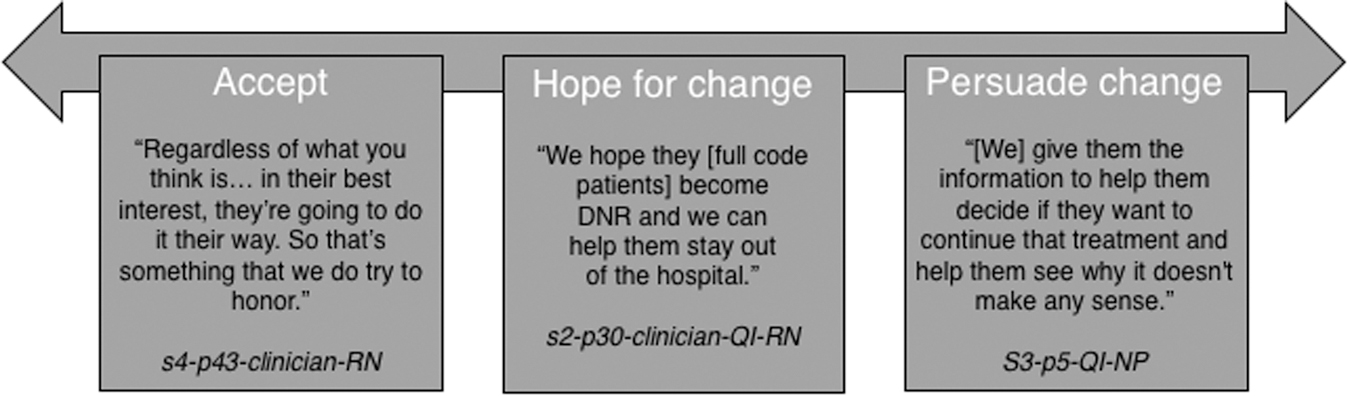
Reactions to patient/family preferences for intensive treatment or remaining full code.
First, many participants described accepting patient/family preferences: “If somebody wants everything, you have to uphold that… that's not for us to determine” (s2-p36-clinician-RN). Some participants accepted these preferences to allow [patients/families] “the humility of their own process, whatever that might look like” (s1-p15-QI-SW). Others spoke to the importance of delivering preference-aligned care to avoid “severing” the patient/clinician relationship (s3-p9-clinician-SW).
Second, some participants explicitly desired to shift patient/family preferences away from intensive treatment or full-code status. One participant framed this effort as preventing anticipated harms: “a lot of times, it's convincing families that… high flow rate IV fluids… are not conducive to comfortable dying” (s3-p1-leader-MD). Another suggested that intensive treatments and CPR are inappropriate in hospice: “If you're on hospice, the understanding is that this is a time when you don't want aggressive treatment… Sometimes we have to help the family make that transition to realize that really what we want is comfort, that medicine is done” (s2-p28-clinician-SW). One participant characterized shifting preferences as a professional duty: “Our staff do back off a little too easily from having conversations… You do have an obligation as a professional… to help people move along even if they don't want to when it's very clear what's going to happen” (s3-p5-QI-NP).
A third reaction involved hoping that patients/families would change their preferences. This more subtle position represented neither complete acceptance nor active efforts to change patients'/families' minds. One participant explained, “We really hope when people come on as a full code, that we are able to at some point help them see the light” (s4-p40-clinician-RN). Others described tension between hoping to keep patients out of the hospital and honoring patient/family preferences for intensive treatment or full-code status.
Discussion
In this study, participants reported challenges in discussing end-of-life care preferences in hospice, including patient/family preferences for intensive treatment and remaining full code. Participants sought to balance respecting patient/family wishes, avoiding harm, and alleviating suffering. Yet, their accounts—which raised similar concerns across sites—revealed tension between these goals, ethical dilemmas, and sometimes moral distress. Our data demonstrate conflict between three components of the hospice philosophy: (1) honoring patient/family wishes for CPR and/or intensive treatments (respect for persons), (2) promoting comfort-focused care in line with the hospice philosophy (beneficence), and (3) avoiding harm and relieving suffering by mitigating negative consequences of CPR or intensive treatments (nonmaleficence).
Our data suggest that this clinical ethical dilemma may stem from changes in US hospice policy and culture over time. 11 While the MHB requires enrollees to forgo “curative” treatment to elect hospice care,7,27 the shifting evidence regarding what can be palliative (e.g., radiation and dialysis, formerly primarily perceived as curative but now recognized to alleviate distressing symptoms) blurs what may be hospice appropriate. Evolving economic incentives (i.e., capitated rates that must cover all costs associated with terminal prognosis 28 ) further impact how organizations advise clinicians to consider expensive treatment preferences. Although the Patient-Self Determination Act 12 prohibits discrimination based on directives, 1 many participants described DNR as the unspoken preference of hospice clinicians. Yet, patients and families may associate DNR status with abandonment and death, versus aligning CPR with treatment and life, creating a fundamentally false choice. 29 This is complicated by the way that contemporary US medical culture positions intensive treatment as the “default” at the end of life, 30 and that hospital culture and policies influence physician trainees' recommendations about DNR orders.31,32 Our results suggest that such cultural trends may be infiltrating hospice, despite its philosophical origin as a counter-culture backlash against intensive end-of-life care. 7
Our findings have clinical implications for hospice clinicians and referring providers. Lack of policy guidance about whether hospices must or may accept potential enrollees preferring full code and intensive treatments may contribute to confusion and cause eligibility 33 and care inconsistencies across organizations.34,35 Electing full code while on hospice could suggest poor communication concerning the scope of hospice care and the likely inefficacy of CPR once hospice eligible. 1 Improved communication before, during, and after hospice referral could help inform patients', families', and hospice providers' expectations for care.
Hospice stakeholders need additional information and training about supporting patients, families, and clinicians in discussions of preferences. First, we need to understand how preferences for full code or intensive treatments impact hospice patients/families. Limited studies suggest that younger patients, those without advance directives, and patients of color—particularly African Americans 36 —are more likely to revoke their hospice benefit to pursue life-prolonging treatment 4 or to be discharged alive after enrolling in hospice as full code. 1 Research is needed to inform models of care that equitably support high-quality end-of-life care for all people. Additionally, we need a comprehensive evaluation of how intensive treatment and CPR in hospice may impact moral distress or burnout among clinicians 37 and how economic forces—including the entry of for-profit hospices into the US market 38 —may shape these issues.
Strengths and limitations
This study has several strengths. Experienced researchers employed a method appropriate to explore and characterize an underresearched phenomenon. Study design and data analysis were crafted by individuals with substantial knowledge of hospice and palliative care, hospice policy, preference-aligned end-of-life care, and bioethics. Numerous approaches enhanced rigor and trustworthiness (community advisory group, member checking, audit trail, double-coding). This study presents one of the first descriptions of how hospice stakeholders approach and react to preferences for full code or intensive treatments.
The study also has limitations. Our findings may differ from for-profit, rural, or international hospices. Additionally, intensive treatment and remaining full code were one of multiple topics addressed. The research team did not uniformly probe whether participants' use of aggressive treatments included CPR when participants did not specify. Future studies may discover additional nuance, particularly around differences between full code as compared with intensive treatment preferences.
Conclusion
This study offers insight about challenges of discussing end-of-life preferences, including intensive treatment or full-code status, in hospice. Participants depicted ethical dilemmas between respecting patient/family wishes, avoiding harm, and alleviating suffering, which enhanced the difficulty of providing preference-aligned care. Hospice clinicians currently engage with this dilemma on an individual, ad hoc basis. Additional ethics training and organizational structures may be helpful, but they cannot resolve systemic conflicts between hospice philosophy and current payment and policy structures. Our findings help clarify contemporary hospice practice, inform future scholarship, and identify opportunities to better support hospice clinicians and organizations.
Footnotes
Acknowledgments
The authors appreciate the time invested by participants and administrators at the four hospice organizations as well as members of our community advisory group. They would like to thank the Palliative Care Research Cooperative (PCRC) leaders and members of our community advisory group for their formative feedback on study design.
Authors' Contributions
G.D.: contributed to analysis and interpretation of the data, drafting of the article, and critical revision of the article for important intellectual content. S.B.G.: contributed to analysis and interpretation of the data, drafting of the article and critical revision of the article for important intellectual content; and study supervision. L.J.H.: contributed to interpretation of the data and critical revision of the article for important intellectual content. N.T.: contributed to analysis of the data and critical revision of the article for important intellectual content. K.M.: contributed to analysis of the data and critical revision of the article for important intellectual content. R.L.S.: contributed to study concept and design; interpretation of the data; and critical revision of the article for important intellectual content. C.S.R.: contributed to study concept and design; interpretation of the data; and critical revision of the article for important intellectual content. K.L.H.: secured funding; led study concept and design; collected data; and contributed to analysis and interpretation of the data, drafting of the article and critical revision of the article for important intellectual content, and study supervision.
Research Ethics and Patient Consent
The University of California San Francisco IRB reviewed this study and determined it exempt. All study participants verbally affirmed informed consent.
Data Management and Sharing
Study data will be made available on the Qualitative Data Registry (QDR;  ). The sponsor of this study (PCRC) is currently developing guidance on preparing data for deposit. Interested parties who wish to inquire about data access before it is available from QDR may contact the corresponding author directly.
Disclaimer
The contents of this article are solely the responsibility of the authors and do not necessarily represent the official views of the NIH. The funders had no role in development of the study, data acquisition, data interpretation, writing, or editing of article.
Funding Information
The author(s) disclose receipt of the following financial support for the research, authorship, and/or publication of this article: This work was supported by funding awarded to Dr. Harrison from a pilot award from the Palliative Care Research Cooperative (PCRC) Group funded by the National Institute of Nursing Research (U24NR014637); pilot award from the UCSF Claude D. Pepper Older Americans Independence Center funded by the National Institute on Aging (P30 AG044281); and the National Institute of Aging Loan Repayment Award and Mentored Research Scientist Development Award (K01AG059831). Ms. Dressler was supported by the Medical Student Training in Aging Research (MSTAR) Program funded by the National Institute on Aging (T35AG026736), the John A. Hartford Foundation, and the Lillian R. Gleitsman Foundation. Dr. Sudore was funded in part by the National Institute on Aging (K24AG054415). Experts from the Palliative Care Research Cooperative (PCRC) Group, funded by the National Institute of Nursing Research (U24NR014637), provided consultations about the design and methods. Sponsors were not directly involved in the design, methods, subject recruitment, data collection, analysis, or preparation of the article.
Author Disclosure Statement
No competing financial interests exist.
References
Supplementary Material
Please find the following supplemental material available below.
For Open Access articles published under a Creative Commons License, all supplemental material carries the same license as the article it is associated with.
For non-Open Access articles published, all supplemental material carries a non-exclusive license, and permission requests for re-use of supplemental material or any part of supplemental material shall be sent directly to the copyright owner as specified in the copyright notice associated with the article.
