




Abstract
Background:
Women with breast and gynecological cancers often experience adverse symptoms such as anxiety, depression, pain, and fatigue.
Objective:
The purpose of this meta-analysis was to clarify the role of arts therapy (based on music, painting, and dance) in quality of life and reported symptoms among women with breast and gynecological cancers.
Methods:
Articles on arts therapy were retrieved from relevant electronic databases through to May 2020. The outcomes (quality of life and symptoms such as anxiety, depression, pain, and fatigue) were estimated according to standard or validated scales that assessed psychological status and activities of daily living. The effect sizes for arts therapy were combined to show the standardized mean difference (SMD) and corresponding confidence interval (CI), and a random-effects model was used for computation.
Results:
In total, 19 randomized controlled studies were included in this meta-analysis. The pooled SMDs for arts therapy were statistically significant for quality of life (0.58; 95% CI: 0.02–1.13; p = 0.04), anxiety (−1.10; 95% CI: −1.88 to −0.32), depression (−0.71; 95% CI: −1.19 to −0.23), pain (−1.01; 95% CI; −1.97 to −0.08), and fatigue (−0.59; 95% CI: −1.18 to −0.00). However, the summary SMDs for arts therapy was not significant for sleep disturbance, anger, vigor, tension, confusion, and stress.
Conclusion:
This meta-analysis shows that arts therapy has favorable effects on improving quality of life and depression among patients with breast and gynecological cancers. Arts therapy also has positive effects on improving anxiety, pain, and fatigue symptoms among patients with breast cancer. Further studies are required to confirm the effect of arts therapy on anxiety, pain, and fatigue in patients with gynecological cancer.
Background
Patients with breast and gynecological cancers commonly experience various symptoms (e.g., depressed mood, pain, and fatigue) that adversely affect their quality of life 1 and potentially decrease their survival rate. 2 Conventional pharmaceutical therapies used to alleviate such symptoms in patients with cancer are commonly accompanied by treatment toxicities (e.g., constipation, somnolence, nausea).3,4
The potential utility of non-pharmaceutical approaches such as arts therapy is increasingly being recognized. Arts therapy includes various forms such as music, painting/drawing, and dance, and they may be selected based on the interest of the patients. Accumulated evidence5,6 has shown that arts therapy has a positive effect on alleviating symptoms such as fatigue and depression among patients with cancer. However, previous trials7–25 reported inconsistent results regarding the relationship between arts therapy and quality of life and symptoms (e.g., anxiety, depression, pain, and fatigue) in patients with breast and gynecological cancers. This means there is a lack of quantitative evidence showing the relationship between arts therapy and quality of life and related adverse symptoms among patients with breast and gynecological cancers.
Therefore, it is necessary to perform a meta-analysis to clarify the role of arts therapy in improving quality of life and related adverse symptoms in women with breast and gynecological cancers.
Methods
Literature search
The present meta-analysis was guided by the Preferred Reporting Items for Systematic Reviews and Meta-Analyses (PRISMA) statement. 26 We searched for relevant studies in Embase, PubMed/Medline, Scopus, Elsevier, the Cochrane Library, Web of Knowledge, and ClinicalTrials.gov. The search terms were: (“mamma” OR “breast” OR “gynecological” OR “ovarian” OR “cervical” OR “endometrial” OR “endometrium” OR “uterus”) AND (“tumor,” “carcinoma,” OR “cancer,”) AND (“art,” “writing,” “painting,” “music” “dance,” OR “movement,”) AND (“symptom,” OR “pain,” OR “fatigue,” “anxiety” OR “depression” OR “insomnia” OR “sleep” OR “anger” OR “tension” OR “vigor” OR “stress” OR “constipation” OR “diarrhea” OR “confusion” OR “appetite” OR “sex” OR “upset” OR “nausea” OR “dyspnea” OR “quality of life”). The reference lists of reviews focused on arts therapy and symptoms related to cancers were also screened for relevant studies.
Selection criteria
Studies were included if they were randomized controlled trials (RCTs) and evaluated arts therapy interventions for patients with breast or gynecological cancers. The outcomes of arts therapy on quality of life and all reported symptoms (e.g., anxiety, depression, pain, fatigue, sleep disturbance, anger, vigor, tension, confusion, stress) were estimated according to standard or validated scales used to assess psychological status and activities of daily living. Reviews, experimental animal studies, conference abstracts, comments, and studies without data for the corresponding outcomes (e.g., mean, standard error, number of cases with each symptom type) were excluded.
Evaluation of study quality
The quality of the included studies was assessed according to the Jadad scale. 27 Trials that were awarded a score ≥3 were classified as having high quality, and those that were scored <3 were classified as low quality. Any disagreement was resolved by discussion among the research team.
Statistic analysis
Data were analyzed by using an inverse variance method. Trials were combined based on the effect sizes for arts therapy. Standardized mean differences (SMDs) with 95% confidence intervals (CIs) were used to combine the effect sizes for arts therapy, based on the effect sizes at the end of treatment for each study.
Study heterogeneity was estimated by using I2 and Q statistics. An I2 value more than 50% or a significance test of p < 0.10 was regarded as high heterogeneity. 28 All effect sizes for arts therapy were used to calculate summary SMDs, based on a random-effects model. All data analyses were performed by using Review Manager 5.3 and Stata 12.0.
Estimation of publication bias
Funnel plots were used to assess potential publication bias based on visual detection of symmetry. When the meta-analysis included more than five studies, both funnel plots and Egger's test were used. A significant p-value was used to determine publication bias, with a meaningful p-value being <0.05 in the Egger's test.
Results
Evaluation of identified trials
In total, 5385 relevant articles were included for screening. First, 96 duplicated articles were excluded, and then 5056 articles were removed based on title and abstract screening. Next, 236 articles were selected for full text evaluation, 217 of which were excluded according to the predefined exclusion criteria. Finally, 19 trials7–25 were identified that met the predefined inclusion criteria for this meta-analysis (Fig. 1). The focus areas of these 19 trials were quality of life (n = 8),8,10–13,16,20,22 anxiety (n = 8),7,10,11,13,14,18,23,24 depression (n = 10),10,11,13,14,16,19,21,23–25 pain (n = 4),7,11,13,17 fatigue (n = 4),9,11,13,19 sleep disturbance (n = 3),11,13,15 stress (n = 2),11,16 and anger, vigor, tension, and confusion (n = 2).9,19 All included trials were awarded scores ≥3, indicating high quality (Table 1).

Flow chart of included studies.
Summary of Included Studies
BDI, Beck’ s Depression Inventory; BFI, brief fatigue inventory; BPI, brief pain inventory; C, control; CA, cancer; CCT, clinical controlled trial; CES-D, The Center for Epidemiologic Studies—Depression Scale; DMT, dance movement therapy; EORTC QLQ, European organization for research and treatment of cancer quality of life questionnaire; POMS, profile of mood scale; FACT-B, functional assessment of cancer therapy—breast questionnaire; FAC-G, functional assessment of cancer therapy—general; HADS, Hospital Anxiety and Depression Scale; NA, not available; NRCT, nonrandomized controlled trial; PAI, Personality assessment inventory; POMS, Profile of Mood States; PSQI, Pittsburgh Sleep Quality Index; QED, quasi-experimental design; QoL, quality of life; RCT, randomized controlled trial; RCOT, randomized crossover trial; SCL-90, Symptom Check List-90; SAI, Spielberger State Anxiety Scale; SF-MPQ, short-form of McGill pain questionnaire; T, Trial; VAS, visual analog scale; VRSQ, virtual reality symptom questionnaire; WHOQOL-BREF, World Health Organization quality of life-abbreviated version; ZSDS, General Questionnaire and Chinese version of Zung Self-rating Depression Scale.
Characteristics of trials
Table 1 showed the baseline data for the 19 included trials. The articles were published between 2000 and 2020, and participants' mean age ranged from 45 to 67 years. Seven trials7–10,19–21 were conducted in the United States, five11,17,18,24,25 in China, two13,16 in Korea, two22,23 in Sweden, two14,15 in Turkey, and one 12 in Iran. The duration of arts therapy in the included trials varied from 1 to 12 weeks.
Results of meta-analysis for studies
In the summary analysis, the pooled SMD of arts therapy were 0.58 (95% CI: 0.02–1.13) for quality of life (Fig. 2), −1.10 (95% CI: −1.88 to −0.32) for anxiety (Fig. 3a), −0.71 (95% CI: −1.19 to −0.23) for depression (Fig. 3b), −1.01 (95% CI: −1.97 to −0.08) for pain (Fig. 3c), and −0.59 (95% CI: −1.18 to −0.00) for fatigue (Fig. 3d). However, the summary SMD for art therapies showed no significant value for sleep disturbance (−3.14, 95% CI: −6.69 to 0.41) (Fig. 4a), anger (−0.19, 95% CI: −0.83 to 0.45) (Fig. 4b), vigor (0.27, 95% CI: −0.29 to 0.82) (Fig. 4c), tension (−0.38, 95% CI: −0.85 to 0.10) (Fig. 4d), confusion (−0.25, 95% CI: −0.80 to 0.31) (Fig. 4e), and stress (−0.30, 95% CI: −0.61 to 0.00) (Fig. 4f). All of the results just cited are shown in Table 2.
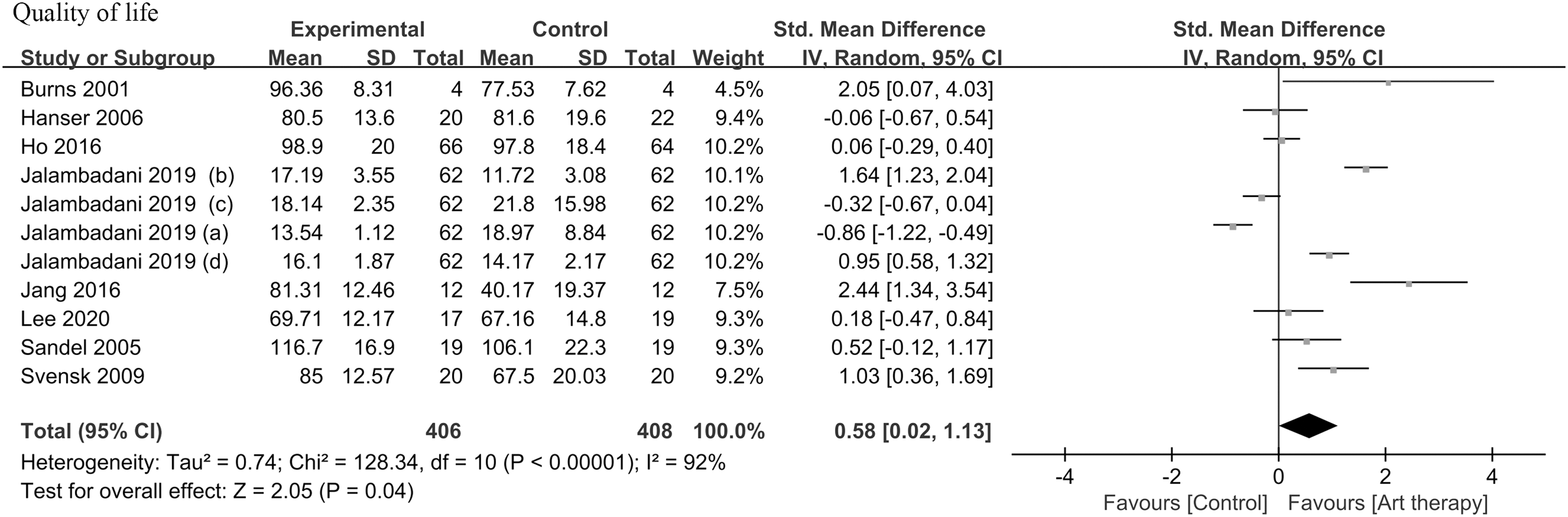
Forest plot of arts therapies on quality of life. The SMDs of art therapy on pain was statistically significant. (a) Social relationships-related quality of life; (b) physical health-related quality of life; (c) psychologic-related quality of life; (d), environment-related quality of life. CI, confidence interval; SMD, standardized mean difference.
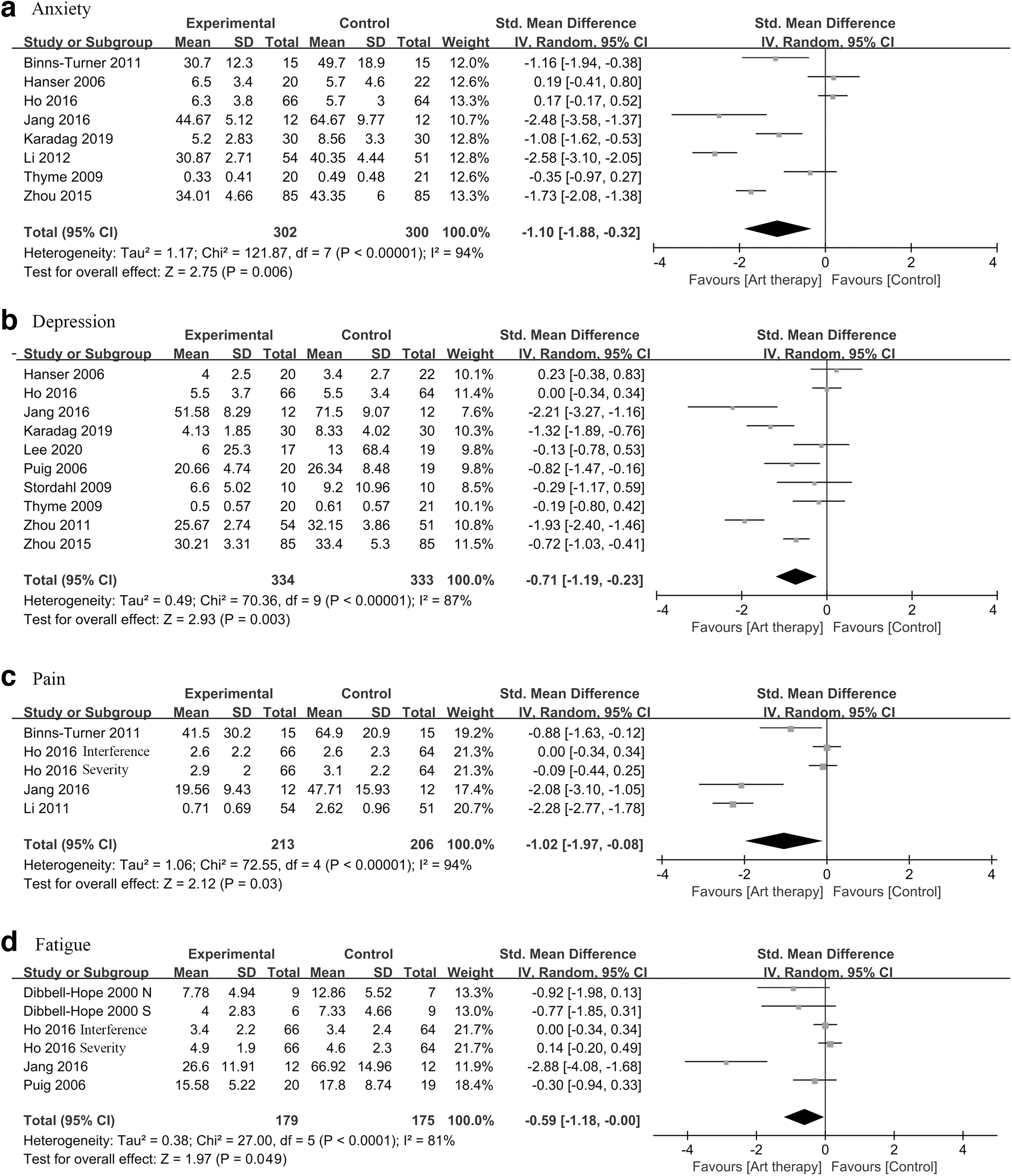
Forest plot of arts therapies on anxiety, depression, pain, and fatigue.

Forest plot of arts therapies on sleep disturbance, anger, vigor, tension, confusion, and stress.
Meta-Analyses of Art Therapy for Quality of Life and Adverse Symptoms
p < 0.05, statistical difference.
SMD, standardized mean difference; CI, confidential interval.
Publication bias
The funnel plots showed no asymmetry for trials focused on quality of life, anxiety, or depression (Fig. 5). The Egger's test detected no risk of publication bias for trials of quality of life (p Egger's = 0.247), anxiety (p Egger's = 0.619), and depression (p Egger's = 0.650).
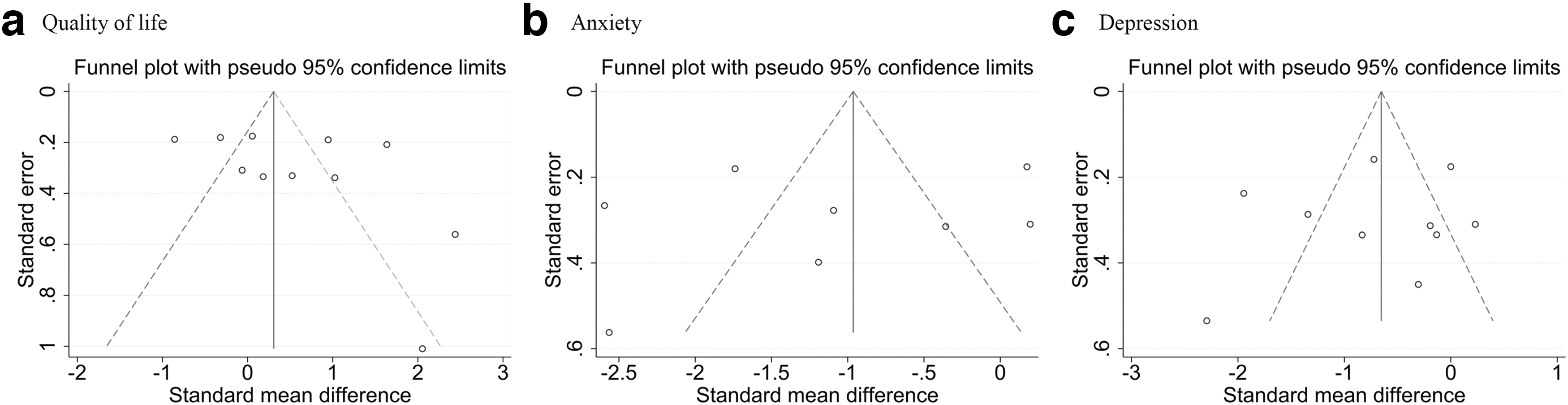
Funnel plots of arts therapy on quality of life, anxiety, and depression.
Discussion
This meta-analysis provided evidence that arts therapy plays a positive role in improving quality of life and symptoms of anxiety, depression, pain, and fatigue among patients with breast and gynecological cancers. However, arts therapy had no effect on sleep disturbance, anger, vigor, tension, confusion, and stress in this population. To our knowledge, this is the first meta-analysis to investigate the effect of arts therapy on quality of life and all reported adverse symptoms among patients with breast and gynecological cancers. The potential mechanisms by which arts therapy alleviates symptoms of anxiety, depression, pain, and fatigue and promotes quality of life are complicated.
The effects of music have been widely studied. Music has been found to modulate brain activity associated with emotion in areas such as the amygdala, hypothalamus, nucleus accumbens, cingulate cortex, orbitofrontal cortex, hippocampus, and caudate. 29 It has been reported that elevated brain-derived neurotrophic factor (BDNF) level is associated with the improvement of depression. 30 BDNF is associated with neuroplastic processes, and music exposure may enhance the BDNF level in the brain.31,32 Like music, dance and painting/drawing are universal forms of human expression. Both dance and painting/drawing are associated with structural brain plasticity,33–35 which underlies a fundamental mechanism of neural adaptation. Neural adaptation is disrupted in affective disorders. 36 Accumulated evidence has shown that pain and fatigue symptoms can be mediated by altered neuroplasticity.37,38 Therefore, neuroplasticity appears to be a common mechanism by which music, dance, and painting/drawing to improve anxiety, depression, pain, and fatigue. Further, there is evidence 39 suggesting that in the treatment of depression and anxiety, music may induce alpha and theta changes in temporo-parietal and fronto-temporal areas. Moreover, evidence also indicates that music can induce dopamine release and regulate opioid signaling in the brain,40,41 thereby producing analgesic effects by modulating the descending analgesia pathway. This mechanism means music could alleviate perceived pain intensity.
Eight trials8,10–13,16,20,22 were included in this meta-analysis that focused on quality of life; six10–13,20,22 of these trials investigated breast cancer, and two8,16 investigated gynecological and mixed breast and ovarian cancers. One trial 20 showed a positive effect of dance-based arts therapy on promotion of quality of life, as shown by changes in outcomes between baseline and after the intervention. Another trial 12 showed that music-based therapy had favorable effects in improving the psychological well-being and social relationship domains of quality of life, and two trials13,22 demonstrated that painting-based therapy had favorable effects on promoting quality of life. A music-based study 16 showed improvement in the functional and emotional well-being domains of health-related quality of life, and another music-based study 8 demonstrated improved quality of life scores. In contrast, the two remaining trials10,11 reported no effect of arts therapy on quality of life.
As a psychotherapeutic approach, arts therapy has been used to manage a range of symptoms in patients with cancer, with anxiety and depression being the most widely studied among these symptoms.42–44 A previous meta-analysis 45 demonstrated that arts therapy (based on music, painting, and dance; it is defined the same as our study) was beneficial for women patients with breast cancer who had symptoms of anxiety (four RCTs) and depression (two RCTs). Our meta-analysis pooled the results of arts therapy for anxiety (eight RCTs7,10,11,13,14,18,23,24 on breast cancers) and depression (10 RCTs; nine10,11,13,14,19,21,23–25 on breast cancer, one 8 on mixed breast and ovarian cancers) in patients with breast and gynecological cancers.
All four trials7,11,13,17 included in this meta-analysis that investigated pain focused on breast cancer. Two trials7,17 used music-based arts therapy and one 13 used painting-based arts therapy, and they showed that arts therapy had positive effects on alleviating pain in patients with breast cancer. The remaining trial 11 was dance-based and reported arts therapy had no effect on pain symptoms. We included four trials9,11,13,19 that investigated fatigue among patients with breast cancer. One trial 13 reported that painting-based arts therapy had a positive effect on fatigue. Another trial 11 reported that dance-based arts therapy had a nonsignificant effect on fatigue. The third trial 9 demonstrated that dance-based arts therapy had a positive effect on reducing scores of fatigue, but the fourth trial 19 showed that painting-based arts therapy had no effect on fatigue. Anxiety, depression, pain, and fatigue are considered the most prevalent symptoms in patients with cancer, and patients with coexistence of these symptoms were more likely to report a poor quality of life. 46
This study had some limitations. First, art and music therapy were often completely separated in the included trials because they are different modalities and tend to affect different aspects of symptom management and quality of life. In addition, the included trials used a variety of rating scales to evaluate different modalities of arts therapy. The SMD was selected as the summary statistic for this meta-analysis, because it is considered superior to weighted mean difference when rating scales differ across studies. 47 Therefore, SMD was used to eliminate the measurement bias generated by the various modalities of arts therapy investigated. Second, there was high heterogeneity between clinical trials. A random-effects model was used in the statistical analysis to yield more conservative results. Third, symptoms of nausea, pain, dyspnea, appetite loss, constipation, and diarrhea were only reported in one trial 13 and sexual functioning was reported in one trial. 22 Therefore, the summary SMDs for these symptoms could not be estimated. Fourth, only two included trials8,16 reported results of arts therapy in the context of gynecological cancer (one 8 reported mixed results for breast and ovarian cancers, and one 16 focused on gynecological cancer); therefore, a comparison of arts therapy between breast cancer and gynecological cancer could not be conducted.
In summary, this meta-analysis provides evidence that arts therapy plays a role in improving quality of life and depression among patients with breast and gynecological cancers, and it has positive effects on improving symptoms of anxiety, pain, and fatigue in patients with breast cancer. Further studies are required to confirm the role of arts therapy in anxiety, pain, and fatigue among patients with gynecological cancer.
Footnotes
Acknowledgments

Funding Information
This work was supported by research grants from the National Natural Science Foundation of China (Grant No. 81871034), the Philosophy and Social Science Research Planning Project of Heilongjiang Province (Grant no. 20YSE292), the Natural Science Program of Health Committee of Heilongjiang Province (Grant no. 2016-280), and the Natural Science Program of Jiamusi University (Grant no. JMSURCGG2016-004).
Author Disclosure Statement
No competing financial interests exist.