




Abstract
Background:
In February 2020, the German Federal Constitutional Court revoked a law that had made assisted suicide (AS) a potentially punishable offense. As a result, appropriate legal regulations for AS, including physician-assisted suicide (PAS), must be made. The medical curriculum should be adapted correspondingly.
Objective:
To explore medical students' knowledge of the legal situation, attitudes toward PAS and wishes regarding PAS education.
Design:
A cross-sectional survey was conducted.
Setting:
A questionnaire was distributed to all fourth-year students (n = 331) at a German medical school.
Results:
Students had a predominantly favorable attitude toward PAS. A majority considered AS to be a task that should be assigned to doctors (71%) and were willing to perform PAS (68%). Education on PAS was explicitly desired. Most participants had only limited knowledge of the legal situation.
Conclusions:
Medical students are largely in favor of PAS. A structured and interdisciplinary approach to PAS education is needed.
Introduction
In Germany, the legal situation regarding physician-assisted suicide (PAS) is currently undergoing fundamental changes: Since 2015, a law had been in force that made assisted suicide (AS) punishable “by imprisonment for a term not exceeding three years or a fine” (Criminal Code §217) for those persons who act repeatedly. This legal norm was declared null and void by the German Federal Constitutional Court ruling of February 26, 2020. 1 The court stated that this provision violated “the general right of personality (…) in its manifestation as a right to a self-determined death of persons who decide to end their own life.” In contrast to PAS, killing on demand remains a punishable offence in Germany. The legislator is now faced with the task of finding a legal regulation for access to PAS, which conforms with the judgment. Generally, the ruling of the Federal Constitutional Court is in line with the opinion of the German general public, which is increasingly in favor of PAS.2,3 In contrast, several medical associations such as the World Medical Association (WMA), the German Medical Association and the German Association for Palliative Medicine reiterate their firm opposition to PAS4–6 —an attitude that many palliative care specialists do not share. 7 Other medical associations have adopted a position of “studied neutrality.” 8 This situation poses a particular challenge for medical students: They will have to develop their own reflected personal attitude toward PAS within an often emotional discussion, as they will be confronted with wishes for PAS and little-established procedures for its provision right from the beginning of their professional careers.
With the aim of shaping educational approaches that may enable students to deal with the difficult clinical and ethical decisions they may face in the near future, we asked medical students about their knowledge of the current legal situation, their personal attitude toward PAS, and their wishes for the integration of this topic into medical teaching.
Materials and Methods
Study design and participants
We conducted a cross-sectional study in July 2020. After a written examination, we invited all fourth-year medical students at the Technical University of Munich to complete a standardized paper-and-pencil questionnaire. Participation was voluntary, data were gathered anonymously, and participants gave their informed consent. The Institutional Review Board of the Medical Faculty of the Technical University approved this study (no. 310/20 S-EB).
Questionnaire/material
We developed a self-administered questionnaire to assess medical students' attitudes toward PAS, their knowledge regarding current legislation on AS in Germany, and their preferences regarding PAS education. Items were constructed based on findings from previous studies on views of physicians and medical students regarding medically assisted dying.2,9–12 Items were adapted to reflect the situation of medical students and the recent legislative changes regarding PAS in Germany. There was also space for free text comments. In addition, we collected data on sociodemographic variables.
We generated 10 items to measure different facets of students' attitudes toward PAS. Answers were captured on a 6-point Likert scale (from “completely disagree” to “completely agree”).
To elicit students' understanding of the recent Federal Constitutional Court's decision on AS, we presented four statements on central aspects of the court's ruling and asked participants to indicate if those were true or false.
To assess preferences regarding PAS education we asked students to rate the importance of different aspects of PAS education on a 10-point Likert scale (from “not at all important” to “extremely important”).
Statistical analysis
Descriptive and statistical analyses were performed using IBM SPSS Version 22.0. To assess group differences we calculated Student's t tests (two-tailed significance level of 0.05). This being an exploratory study, p-values were not adjusted for multiple testing.
Results
A total of 271 students completed the questionnaire, representing 82% of all (n = 331) fourth-year medical students. This group of students had not yet received any specific teaching on euthanasia or AS as part of the mandatory palliative care course. Sixty-two percent of respondents were female, the mean age was 24.5 years (SD ±3.5). Fourteen percent of respondents stated that they were “fairly” or “deeply religious,” whereas 38% reported that they were “only slightly religious” and 48% were “not religious at all.”
Medical students' knowledge regarding current legislation on AS
The current legal situation and, in particular, the core statements of the Federal Constitutional Court ruling on §217 German Criminal Code were not familiar to the majority of students (Table 1).
Fourth-Year Medical Students’ (n = 271) Knowledge Regarding Current Legislation on Assisted Suicide in Germany and Attitudes toward Physician-Assisted Suicide
Multiple choice questions with three possible answers (“true,” “false,” and “don't know”); correct answers for each question are given in parentheses.
Missing n = 6.
Attitudes were assessed on a 6-point Likert scale from “(1) completely disagree” to “(6) completely agree”; absolute and relative frequencies were calculated based on dichotomization of attitude ratings (favorable attitude subsumes response options “somewhat agree,” “agree,” and “completely agree”).
PAS, physician-assisted suicide.
Medical students' attitudes toward PAS
The majority of respondents had a favorable attitude toward PAS (Table 1 and Fig. 1). This included their willingness to perform PAS as future physicians (Table 1). Students' attitudes toward access to PAS varied considerably depending on the patients' medical conditions (Fig. 1).

Attitudes of fourth-year medical students toward access to PAS for different patient groups. Percentages subsume relative frequencies of favorable response options (striped columns: “somewhat agree,” “agree,” and “completely agree”) and indicate students' agreement rate. PAS, physician-assisted suicide.
Curriculum and medical students' preferences for PAS education
Medical students considered the inclusion of PAS in the medical curriculum to be very important (M = 8.9/SD = 1.5). Both students with a favorable attitude toward PAS and students with an unfavorable attitude indicated a wish for education on relevant aspects of PAS (Fig. 2). Statistically significant differences between the two groups were only found in the rating of individual aspects of PAS education.
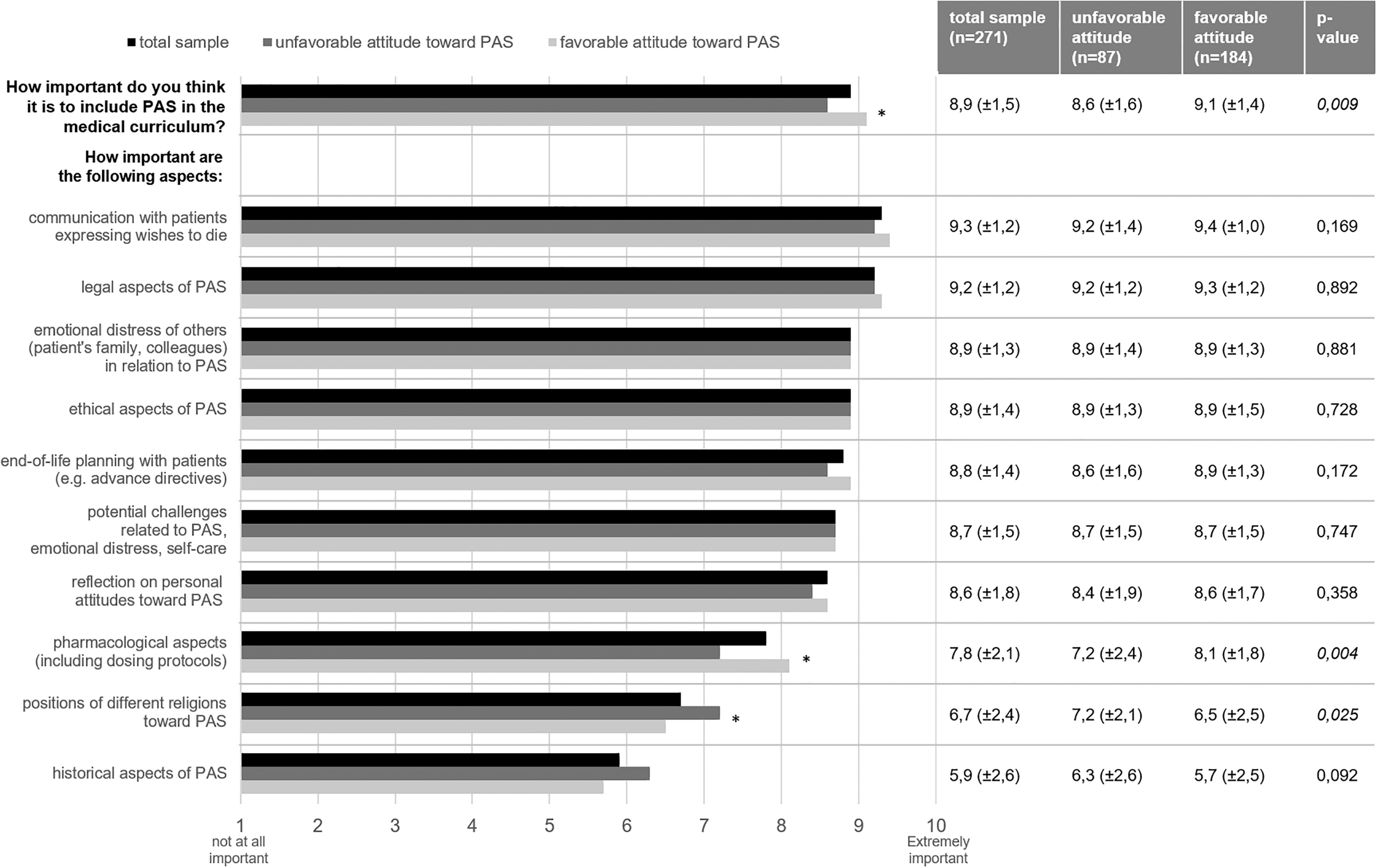
Preferences of fourth-year medical students for PAS education in medical school (10-point Likert scale from “[1] not at all important” to “[10] extremely important”); Student's t test were used to assess differences in importance ratings between medical students with a favorable attitude toward PAS (agreeing responses to the question on willingness to provide PAS) and medical students with an unfavorable attitude toward PAS.
Discussion
In this study, the percentage of medical students who felt that seriously ill people should be granted access to PAS was exceptionally high and exceeded the proportions found in previous studies at German universities.9,13,14 Students' agreement was dependent on the illness situation described: Most students did not limit their consent to situations of incurable disease with limited life expectancy but were predominantly of the opinion that—after exclusion of a mental illness—PAS should also be accessible to very old multimorbid persons and to severely disabled people with a normal life expectancy. This is in line with the recent judgment of the Federal Constitutional Court that declared that “the right to determine one's own life (…) is in particular not limited to serious or incurable illness, nor does it apply only in certain stages of life or illness.” 1 However, only a minority of students believed that PAS should be provided (after exclusion of mental illness) to all people regardless of their motives. A recent survey among Canadian family medicine residents 15 showed that increased exposure to death and dying was correlated with greater odds of agreeing to prescribe patients a lethal drug. Since most medical students in their fourth year have already had experience in caring for terminally ill or dying people, 16 their attitude toward PAS may well reflect personal experiences with death and dying.
Although the rate of students' acceptance of PAS varies between countries,10,12,17–20 previous studies revealed that medical students' approval of PAS and euthanasia is growing.18,21 In our cohort the decriminalization of PAS as a result of the Federal Constitutional Court's recent ruling has probably further strengthened this trend. Consequently, the discrepancy between students' increasingly favorable attitudes toward PAS, on the one hand, and the opposing statements of many medical and palliative care associations such as the WMA or the European Association for Palliative Care (EAPC),4,22 on the other hand, may be increasing.
In general, students tended to consider AS as a task to be assigned to doctors and the majority could imagine writing a lethal prescription (Table 1). Consequently, they attached great importance to PAS as a topic in the medical curriculum. The subtopics “communication with patients expressing wishes to die” and “legal aspects” ranked highest (Fig. 2). These results were similar to a survey with Canadian medical students about medical assistance in dying. 10 The strong focus on communication may reflect the wider problem that students often feel little prepared for communications with patients and carers pertaining to death and dying.23,24 The desire for legal training may mirror the fact that most students were found to have only limited knowledge of the current legal situation. To a lesser, but still high degree the “pharmacological basis of PAS” was a subtopic considered as an important aspect that should be included in the curriculum. Understandably, students having a more favorable attitude toward PAS attached significantly greater importance to this subtopic compared with students with less favorable attitudes.
The fact that both students who support PAS and those who do not express great interest in this subject demonstrates the students' willingness to enter into a well-founded and critical discussion about PAS. Our findings should be understood as a call to medical educators to implement relevant aspects of PAS in the curriculum. This is underlined by the large number of free-text comments in which students argued in favor of a rapid implementation of teaching on PAS.
It is a matter of controversy in which subjects teaching on PAS should be integrated. The multifaceted topic may require an interdisciplinary approach, ideally taught in coherent and comprehensive course units and with the participation of (among others), psychiatrists, ethicists, and palliative care specialists. Although most palliative care associations firmly oppose PAS (e.g., German Association for Palliative Care, 6 Radbruch et al., 22 Association for Palliative Medicine of Great Britain and Ireland 25 ), different degrees of interrelatedness between palliative care and assisted dying exist in countries where PAS is legal, 26 indicating that there may be reasonable and feasible forms of cooperation. Because of their role within medical hierarchies, nurses seem to be particularly prone to “moral distress” in end-of-life care. 27 Effective preventive measures include good mentoring programs, but also interprofessional team discussions with physicians. Mixed teaching groups comprising medical and nursing students could be envisaged to establish a culture of conversation around PAS.
Limitations
The most important limitation of this study is that the survey was conducted at only one medical school. Therefore, it is possible that students' local characteristics and previous teaching may have influenced the results. The questionnaire was kept short and more detailed demographic data were not recorded to assure anonymity on this sensitive issue.
Conclusion
Medical students generally supported PAS and a majority would be willing to perform/participate in PAS. Students desire comprehensive teaching that covers all relevant aspects of PAS.
Footnotes
Authorship Confirmation Statement
Both authors equally contributed to the design and implementation of the study, to the analysis of the results, and to the writing of the article.
Acknowledgments
We greatly appreciate the contributions from the medical students who participated in our survey. Prof. Dr. Gian Domenico Borasio provided detailed helpful feedback on our article and we gratefully acknowledge his input. We also thank Dr. Anna Brown for proofreading and language editing.
Funding Information
No funding was received for conducting this study.
Author Disclosure Statement
No competing financial interests exist.