




Abstract

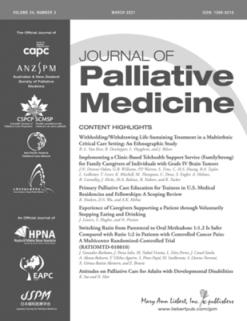
Letters to the Editor
Use of Scrambler therapy for 80-year-old patient with several years of severe diabetic neuropathy. (page 320)
Brief Reports
Leveraging case managers to introduce advance care planning for frail older adults receiving in-home care may increase engagement. (page 428)
Fast Facts and Concepts
Financial Toxicity and Cancer Care #409 (page 453)
Preparing for a Destination Therapy Ventricular Assist Device: The Palliative Care Planning Conversation #410 (page 455)
Personal Reflection
Bearing witness to the grief and love and respect and selflessness that Mitchell's parents displayed during the last week of their son's life shook me to the core. They welcomed our palliative care team into his room and into their lives quickly and wholeheartedly… (page 457)
Case Discussions in Palliative Medicine
Report describes death experiences of four COVID-19 patients receiving very different degrees of medical interventions. (page 468)
Book and Media Reviews
(page 472)
Recent Literature
(page 474)
Switching from Oral to Parenteral Methadone
Routine use of methadone for analgesia is increasing. The most commonly used conversion ratio from parenteral to oral methadone is 1:2. Would a ratio of 1:1.2 be better? In this multicenter double-blind randomized clinical trial, 39 of 44 inpatients were evaluable. Median age 65 years. Pain was well controlled without differences between both ratios. Drowsiness at day +1 (p < 0.017) and myoclonus at day +3 (p < 0.019) were more prevalent in group 1:2. (page 382)
Routine Measurement of Symptoms and Function
Research tools are too burdensome to use in routine clinical practice. The EORTC QLQ-C15-PAL is a shortened version of the widely used EORTC QLQ-C30. This prospective study of 225 patients (mean age 65 years) from Austria, Italy, the Netherlands, Poland, Spain, and the United Kingdom shows high sensitivity and mostly high specificity in identifying clinically important symptoms and functional health impairments. (page 397)
Thinking versus Feeling
In this prospective study of 309 family members, there was poor correlation between what family members thought about impending death of a patient versus how they felt. The actionable items that health care professionals can impact are to cultivate the family members' emotional preparedness for death by enhancing patient–family contact/communication and easing their caregiving burden as distinct from giving them more “education.” (page 405)
Voluntary Stopping Eating and Drinking
In many countries throughout the world, a patient may ethically and legally stop eating and drinking as a way to hasten death. This prospective qualitative study of 24 people caring for 20 U.S. patients produced four themes: (1) caregivers believe that voluntary stopping eating and drinking (VSED) is the best death available to the patient. (2) Caregivers act as advocates and worry that the patient's goals will be challenged by health care professionals, the community, or legal authorities; obtaining support from hospice is an important way to legitimize VSED. (3) Through the VSED process itself, caregivers carry the responsibility for the patient's success as the patient becomes weaker and loses focus. (4) Because there is no social script to guide the VSED process, caregivers choose what roles to play during VSED, such as focusing on physical care or being emotionally present as the patient's spouse or child. The implication for health care professionals is clear—we need to confirm our support to improve caregiver confidence and reduce worry. (page 376)
Withdrawing/Withholding Treatment in Critical Care
Withholding and withdrawing treatment in terminal illness are ethical and legal in many countries. However, in face of increasing cultural diversity of patients and family members, such decision making often involves patients from ethnic minority groups. In this prospective study in Belgium among 18 patients in an urban hospital, the physicians and family members played the most important roles. In the face of challenges, the physicians tended to stress their control that seemed to be a reaction to their inability to align families' wishes with their own. Decision making without explicitly informing relatives was a consequence. The implications for practice are to better involve patients and relatives in communication and include interprofessional health care workers/other services. (page 338)