




Abstract

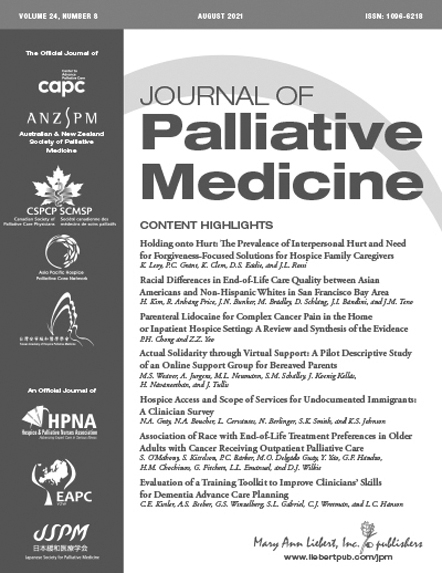
Letters to the Editor
The COVID-19 pandemic presents novel challenges in administering nonpharmaceutical pain and symptom management techniques while ensuring social distancing and avoiding unnecessary contacts in hemodialysis units.
(page 1124)
Brief Reports
The Canadian Toronto-based palliative education and care for the homeless (PEACH) program was launched to better support those experiencing homelessness with life-limiting illness.
(page 1232)
Fast Facts and Concepts
Caregiver Burden #419
(page 1246)
Neuroablative Interventions for Refractory Pain #420
(page 1248)
Personal Reflection
Amid this darkness you are becoming palliative care doctors. Fittingly, you are learning about the depths of patients' suffering in their darkest moments… We are asking you to not only step out of your comfort zone, but also to jump out with both feet. We even dare to ask you to embrace your discomfort. We know it is hard, maybe the hardest thing you have ever done. And we know it is dark.
(page 1253)
Case Discussions in Palliative Medicine
Case describes a rapid buprenorphine induction using a microdosing regimen in a pregnant patient and highlights the potential of buprenorphine for cancer-related pain in this population.
(page 1257)
Book and Media Reviews
(page 1263)
Cost Effectiveness of Indwelling Pleural Catheter
Malignant pleural effusions are associated with severe dyspnea and discomfort. Intermittent draining versus placement of a permanent drain are treatment options. In this systematic review, it appears that placement of a permanent catheter for ongoing draining of malignant pleural effusion is cost-effective. The challenges of the calculations with small number of patients point to the need for a prospective study.
(page 1206)
Race Associated with Preferences of Life-Sustaining Treatment
It has been widely observed that African Americans are less likely to enroll in hospice care than whites in the United States. In a secondary analysis of a randomized trial, black race emerged as a strong predictor of preferences for cardiopulmonary resuscitation and mechanical ventilation in the setting of advanced cancer. Income was not associated with prediction, while religion was.
(page 1174)
Infusional Lidocaine for Pain Relief
The development of infusional approaches to the management of severe pain when standard opioids or NSAIDs are ineffective remains an important therapeutic. Many standard approaches use only oral medications that take days to weeks to reach therapeutic levels before their efficacy can be judged. In this systematic review, lidocaine administered intravenously or subcutaneously was quickly effective for treating a variety of refractory pain syndromes. Clearly, there is enough evidence for a prospective trial.
(page 1154)
Forgiveness Solutions during Bereavement
It has long been known that a sense of unforgiveness is a barrier to appropriate bereavement. In this survey, 42% of bereaved people reported a sense of hurt or injury that impaired the bereavement experience. A similar percentage reported a forgiveness intervention to help them in bereavement—not a standard approach in standard bereavement programs. This is a much larger number than many would estimate from standard practice experiences.
(page 1139)
Transition to Comfort Care after Acute Stroke
Stroke is an acute event with profound implications for treatment planning. In this prospective cohort study, those who had either formal or informal advance care planning before the stroke transitioned to comfort-only measures sooner. Interestingly, there was no difference between formal or informal advance care planning in the timing.
(page 1191)