




Abstract

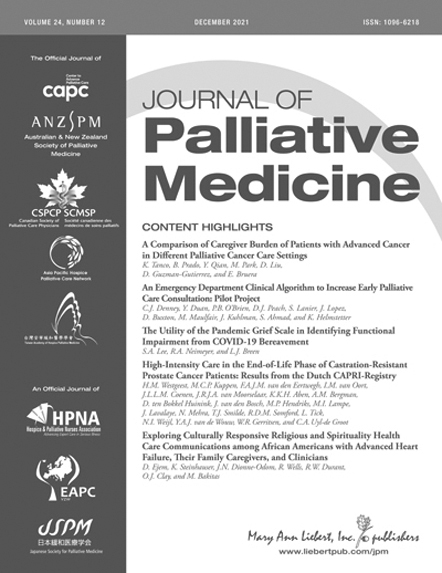
Letters to the Editor
Pilot study using artificial intelligence to scan electronic health records (EHRs) to identify incorrect documents uploaded to the Advance Directives section of patient EHR.
(page 1754)
Brief Reports
Nominal group technique (NGT) is a well-established structured cross-sectional mixed-methods approach. Owing to the Covid-19 pandemic research methods need to be adapted to engage with participants online.
(page 1867)
Fast Facts and Concepts
COPD: Emerging Therapies That Can Also Palliative Symptoms #427
(page 1895)
Electroconvulsive Therapy (ECT) for Patients with Serious Medical Illness #428
(page 1897)
Personal Reflection
“Her actions preparing for death originated from an intellectual understanding of what was to come but were very much distinct from emotional acceptance. I had pushed an emotion-laden button for which she was not ready…”
(page 1904)
Case Discussions in Palliative Medicine
Owing to the unprecedented nature of this pandemic, the health care community has been prioritizing infection control, and although no one can dispute its importance, it has come with a great cost in terms of the emotional and possibly long-term psychological consequences for dying cancer patients and their family members.
(page 1905)
Book and Media Reviews
(page 1909)
Caregiver Burden: Inpatient versus Outpatient
Informal family caregivers bear the brunt of caregiving for patients with cancer. Caregiver stress burden was measured in inpatient and outpatient palliative care settings in this specialty cancer hospital in the United States. Surprisingly, the burden was higher in the inpatient setting. This contrasts with that of health care professionals, who generally prefer providing care in inpatient settings.
(page 1766)
Identifying Patients Early in the Emergency Department
Patients with end-of-life conditions frequently present to the emergency department (ED). Emergency medicine physicians identified 663 patients with advanced cancer (41%), dementia (23%), and chronic obstructive pulmonary disease (16%) being the most common EOL conditions. The majority of presentations involved specialist consultations (77%), hospitalization (65%), and numerous clinical investigations (97%), including blood work (97%) and imaging (92%) while in the ED. The majority of patients had a history of ED visits (68%). Using a modified screening tool, 78% of presentations involved patients with unmet palliative care needs, but only 1% of presentations involved a palliative consultation or admission to a palliative care unit.
The evidence for effectiveness of specialist palliative care in hospitals is clear—the earlier the better. The challenge is how it identify them in the ED. In this pilot study, using an algorithm, 12% of cases had a palliative care consultation ordered in the ED. As compared with other patients, those seen in the ED had a lower average length of stay (6.7 vs. 13.1 days; p < 0.001), lower in-hospital mortality (12.5% vs. 19.1%; p = 0.11), less surgery (11% vs. 37%; p < 0.01), fewer radiological tests/patient (4.01 vs. 10.57; p < 0.001), and lower cost ($7,193 vs. $22,354).
(page 1776)
Palliative Care Knowledge among the Public
In this national study, people living outside of metropolitan areas knew less about palliative care than those living in metropolitan urban areas (79% vs. 70%, p < 0.05). Yet, in the bigger picture, ignorance is still prevalent.
(page 1833)
Palliative Care and Interstitial Lung Disease
Integration of palliative care with standard management of diseases other than cancer are a leading edge area of development in our field. In this study of 31 patients co-managed with palliative care and the rate of advance care planning notes increased from 3% to 100% (p < 0.001). Half (52%) were prescribed short-acting opiates for dyspnea.
(page 1823)