




Abstract

Letters to the Editor
A letter to determine what interventions were effective for clinically significant depressive symptoms in people with advanced life-limiting illnesses and extremely short prognoses. (page 341)
Fast Facts and Concepts
Communication Strategies when Patients Utilize Spiritual Language to Hope for a Miracle #433 (page 506)
Eastern Cooperative Oncology Group Performance Status #434 (page 508)
Personal Reflection
I've been incredibly lucky a few times in my life and this was one. Instead of the devastating regimen of chemotherapy, intended to control my cancer, I got proton radiation designed to eliminate it. I was irradiated twice a day for six weeks, the dosage cut to half to reduce the risk of burning a hole in my esophagus. Instead of chemotherapy I received immunotherapy, which I tolerated without significant side effects. (page 511)
Case Discussions in Palliative Medicine
We hypothesized that the application of topical lidocaine to mimic a digital nerve block would be beneficial in addition to traditional supportive care interventions and subsequently report its immediate and continued efficacy for targeted therapy-induced onycholysis. (page 516)
Book and Media Reviews
Palliative Care in Nursing Homes
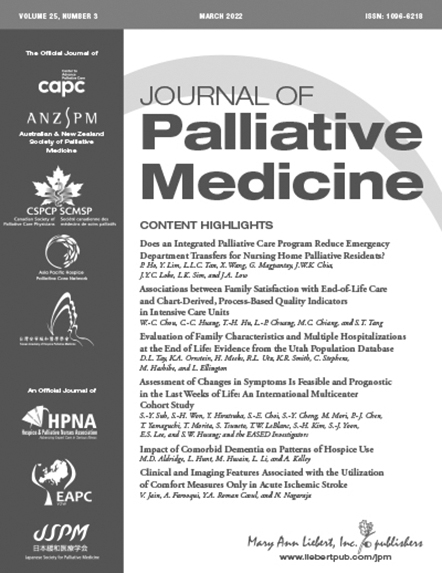
It makes sense that an integrated program of palliative care could prevent unneeded or wanted transfers from nursing homes to the hospital emergency department (ED). In this study from Singapore, a total of 217 telemedicine consults were conducted for 187 unique nursing home residents across 5 nursing homes over a 27-month period. Eighty-two percent of the urgent telemedicine consultations prevented transfers to the hospital ED. Gender and completion of advance care planning were statistically significant between ED transfer group and non-ED transfer group. (page 361)
Correlation of Family Satisfaction with Process Measures
It is challenging to routinely collect and analyze reports of family satisfaction. Process measures are easier in standard health care. In this exploratory prospective longitudinal observational study, 278 family members were consecutively recruited from medical intensive care units (ICUs) at two medical centers in Taiwan. Documentation of process-based indicators of high-quality end-of-life care was generally associated with higher scores for both the care and the decision making that occurred. Higher family satisfaction with ICU care was significantly associated with physician–family prognostic communication, a do-not-resuscitate (DNR) order in place at death, and death without cardiopulmonary resuscitation. Family members' satisfaction with decision making was positively associated with documentation of social worker involvement, a DNR order issued, and withdrawal of life-sustaining treatments before death. (page 368)
Families and Multiple Hospitalizations
The role of families is integral to the care of patients with serious illness. Yet, there is scant research evaluating the correlations. In this retrospective analysis of the Utah Population Database, 216,913 patients who died of natural causes were identified over an 18-year period. Interestingly, those who were unmarried and those with children were less likely to have multiple admissions near the end of life. (page 376)
Symptom Severity and Prognosis
Improving our ability to prognosticate is a compelling research priority. In this secondary analysis of an international cohort study in Japan, Korea, and Taiwan, 2074 patients with advanced cancer were admitted to 37 palliative care units over a nine-month period. Those patients whose symptoms worsened had the shortest survival compared with those with improved symptoms. (page 388)
Dementia and Hospice Use in the United States
In this pooled cross-sectional analysis of the nationally representative Health and Retirement Study of Medicare claims data, 15% (465/3123) had a primary diagnosis of dementia making them eligible for hospice care. Dementia as a comorbidity was listed in an additional 30% (943/3123). As a whole, this group was associated with long periods of hospice enrollment and hospice disenrollment after six months of care. (page 396)
Clinical and Imaging Features of Comfort Measures Only in Acute Stroke
Up to 10% of patients with acute stroke die in the first 90 days. In addition to age, this study attempts to identify other features that would improve prognostication. Hemorrhagic transformation, severe stroke, infarction of the insular cortex, and presence of cerebral edema with herniation were all correlated with a shift to comfort measures only. (page 405)