




Abstract
Background:
Although palliative care programs are beneficial to patients and families, most of the public is unfamiliar with and underutilizes palliative services. TikTok, a fast-growing social media platform worldwide, allows users to share short live-recorded videos and could be used to educate the public about palliative care.
Objective:
This study characterized palliative care TikTok videos and determined characteristics associated with higher user engagement metrics (views, likes, comments, and shares).
Methods:
The investigators analyzed the content and engagement metrics of palliative care TikTok videos. Each video was coded for author type (health care professional, patient, caregiver, or other) and demographics, features, and themes. Negative binomial regression analyses identified whether author type and themes were associated with engagement statistics.
Results:
After screening 510 videos, 146 met criteria for analysis. The most prominent author types were health care professionals (55.5%), followed by patients (32.9%) and caregivers (7.5%). Authors were often female (71.2%) and played music (59.5%) while talking (45.9%). Themes were describing personal experiences (47.3%), educating (39.7%), addressing misconceptions (16.4%), responding to questions and comments (14.4%), and raising awareness (11.0%). Caregivers' videos were most likely to be viewed (p = 0.003) and liked (p < 0.001), whereas health care professionals' videos were most frequently shared (p = 0.01). Engagement was highest among videos describing personal experiences (views: p < 0.001, likes: p = 0.002, shares: p = 0.003) and educating (views: p = 0.005, likes: p = 0.002, comments: p = 0.02, shares: p < 0.001).
Conclusion:
TikTok provides an interactive platform for patients, professionals, and caregivers to share information and experiences about palliative care, making it potentially valuable for explaining palliative care to the public.
Introduction
Palliative care is on the rise in the United States; however, there are millions of Americans with serious illnesses who are not receiving palliative care but could benefit from it.1,2 Although many Americans could benefit from the service, the majority of adults have never heard of palliative care and fear it due to a conflation with hospice care and death. 3 Educating patient populations and the general public has been shown to work, with some exceptions. Researchers have found that online mediums such as webpages, multimedia, and video-based interventions have mixed efficacy in improving palliative care knowledge and attitudes among seriously ill patients.4–7 Therefore, examining the dissemination of palliative care information is a necessary step toward ensuring that patients with serious illnesses receive the beneficial services.
Social media could provide an opportunity to impart useful information about palliative care. Platforms such as Facebook, Twitter, and YouTube have been used globally by palliative care health care professionals, researchers, and advocacy organizations to educate the public, 8 but a new platform called TikTok is on the rise. Founded in 2016, TikTok is a fast-growing social media platform with over 1 billion active users in more than 150 countries and 130 million active users in the United States.9,10 Users can create and upload short videos (less than or equal to three minutes) with music, special effects, captions, and hashtags (e.g., #palliative). They can view and interact with videos on TikTok's “For You” page, on which TikTok's algorithm populates videos based on levels of user engagement, or they can visit the “Discover page,” where users search for videos using keywords, audio file names, or hashtags. 11 Thus far, TikTok has served as a source for health care professionals, patients, and caregivers to consume and disseminate health information on many topics, including dermatology, diabetes, and COVID-19.12–14
Palliative care social media studies have focused on retrospective analyses of Twitter, YouTube, and Facebook. Organizations have posted educational palliative care videos on YouTube, while Twitter and Facebook mainly allow clinicians, scientists, and organizations to network with one another.15–18 However, to date, there have not been any studies investigating palliative care videos on TikTok. Given TikTok's growing popularity, widespread reach, and easily accessible videos, it is essential to explore its potential as a novel platform for the dissemination and consumption of palliative care education and support resources among its users.
The present study aimed to characterize palliative care TikTok videos. The secondary aim was to determine whether certain video characteristics were associated with higher levels of user engagement.
Methods
Data collection
From January 1, 2021 to January 4, 2021, the investigators screened TikTok videos that used the term “palliative.” Videos that did not refer to “palliative care” in the caption or verbally by the video author were determined to be unrelated to palliative care and were subsequently excluded. Videos were additionally excluded if they (1) solely focused on hospice care, end-of-life care, or palliative care for non-human animals; (2) were not in English; or (3) were deleted by the author before they could be coded.
Data collected for each video included social media engagement statistics such as the number of likes, comments, shares, and views, in addition to general video information such as the author's name, the date the video was posted, hashtags listed by the author, and the type of video. Other characteristics noted and recorded for each video included music, presentation of statistics, and number of individuals appearing on screen. Data were then collected on author characteristics, including gender, author type (health care professional, patient, caregiver, or other), type of health care professional (if applicable), and the actions performed by the author. Themes were identified before coding and each video was subsequently classified under one or more of those themes.
Statistical analyses
Analyses were performed in SPSS 28.0. Descriptive statistics were examined for all video features. As the variance was greater than the mean and overdispersion was present, negative binomial regression analyses were conducted to determine whether engagement metrics were predicted by (1) author type and (2) video themes. After conducting a goodness of fit test and omnibus test to confirm that the model fit the data well and was statistically significant, we examined each categorical predictor in the models simultaneously. Statistical significance was determined using an alpha level of 0.05.
Results
Descriptive characteristics
A total of 510 videos were screened, and 146 videos met eligibility criteria (Table 1). All eligible videos were found to have been posted between January 2020 and March 2021, with 72 videos being posted in the first quarter of 2021 and 74 videos being posted in all of 2020 (Fig. 1). Most videos were live recordings (95.2%), with one individual appearing on the screen (87.7%), usually talking (45.9%). The most common hashtag appearing in videos was #palliativecare.
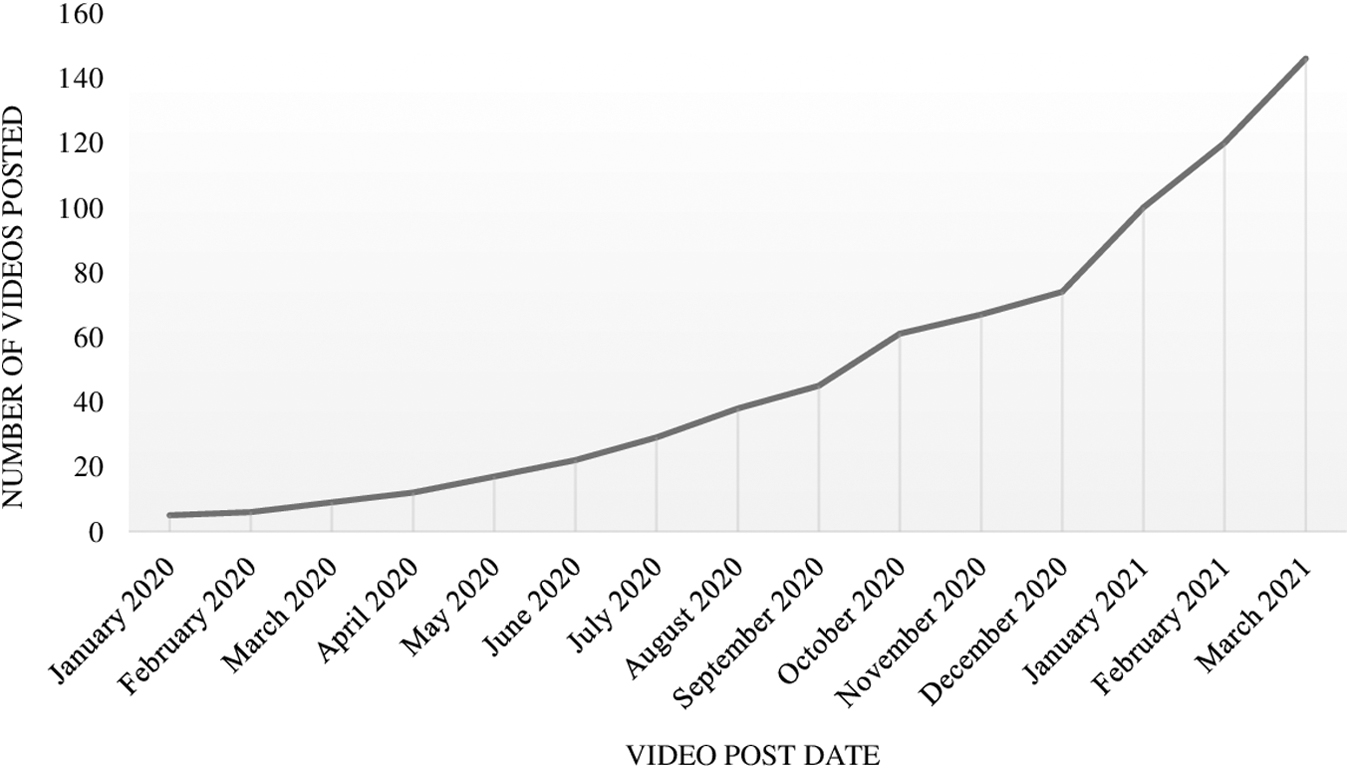
Palliative care TikTok is an active and growing community.
Descriptive Statistics for Palliative Care TikTok Videos
As shown in Table 1, most videos were uploaded by women. Health care professionals appeared most often in videos (55.5%), followed by patients (32.9%), and caregivers (7.5%). Among health care professionals, physicians (40.4%) and nurses (8.9%) posted most. Among caregivers, the vast majority (90.9%) were mothers.
The videos covered at least one of six broad themes: raising awareness, educating, addressing misconceptions, describing personal experiences, responding to questions and comments, and other (Table 2). The greatest number of videos included the “describing experiences” theme and “educating” theme.
Themes Featured in Palliative Care TikTok Videos
Note. Categories were not mutually exclusive. Additionally, 8.9% (13/146) of the videos had other themes beyond those listed.
In social media research, it is important to avoid quoting directly as this may negate community norms for privacy. All quotes have been disguised by paraphrasing and replacing non-essential information.
PC, palliative care; WHO, World Health Organization.
Negative binomial regression models
The results of the negative binomial regression models for both author type and themes associated with number of views, likes, comments, and shares are shown in Tables 3 and 4. Caregivers' videos were most likely to be viewed (p = 0.003) and liked (p < 0.001), whereas health care professionals' videos were most frequently shared (p = 0.01). Engagement was highest among videos focused on describing personal experiences (views: p < 0.001, likes: p = 0.002, shares: p = 0.003) and educating (views: p = 0.005, likes: p = 0.002, comments: p = 0.02, shares: p < 0.001).
Negative Binomial Regression Using Palliative Care Video Author Type to Predict TikTok Social Media Engagement Metrics
The bold values have p < .05.
Note. ORs indicate the odds relative to the reference category of other authors.
CI, confidence interval; OR, odds ratio.
Negative Binomial Regression Using Palliative Care Video Theme to Predict TikTok Social Media Engagement Metrics
The bold values have p < .05.
Discussion
This investigation has implications for improving public awareness and understanding of palliative care via social media. Health care professionals, patients, and caregivers use palliative care TikTok (Table 1), and use of TikTok for palliative care health communication is on the rise (Fig. 1). We identified common themes in these videos (Table 2). Users engaged actively in viewing these videos. Caregiver videos were more likely to be viewed and liked, perhaps owing to personal connections between video authors and viewers, whereas videos by health care professionals were most likely to be shared, reflecting their authority and expertise. Several of the video themes had high levels of engagement, with those emphasizing discussing personal experiences or educating as most promising. Palliative care articles on Twitter, videos on YouTube, and activity on Facebook have had themes similar to “educating,” but none similar to “describing experiences”; additionally, users on these platforms have largely been comprised of only palliative care professionals and organizations to date.16–18 These findings can assist palliative care clinicians, scientists, and patients in expanding their communication, health education, and patient advocacy to create and disseminate engaging video content using a novel, fast-growing social media platform.
Findings showed that users engaged actively with palliative care videos and indicate several strategies for increasing the likelihood that videos would be successfully disseminated. Analyses also described what typical palliative care TikTok videos are like, which may help guide health care professionals, patients, and caregivers to the idea of using this platform. Importantly, the identification of video qualities associated with increased user engagement can assist health care professionals, patients, and caregivers in creating TikTok videos that will reach a larger audience of those seeking information about palliative care using this platform.
Our results indicate that video authors should consider focusing on themes of educating and describing one's personal experience to increase user engagement. Based on normative trends, (1) record a live selfie-style video, rather than a formal slideshow, (2) find ways to incorporate music, (3) use captioning, (4) talk without worrying much about incorporating more complex elements such as dance, (5) present alone, and (6) help users to find the videos by using the hashtag #palliativecare. These basics will allow palliative care experts to share their knowledge with the public successfully, and seasoned TikTokkers can experiment with more novel techniques.
Limitations
This study has its limitations. Since we only included English-language videos in our analysis and some eligible videos were deleted by the authors before they were coded, our analysis was restricted to a particular cultural and historic context. Additionally, our analysis of user engagement likely reflects the activity of mostly younger users since TikTok primarily consists of users between the ages of 16 and 34. 10 Finally, the present investigation was designed to summarize the landscape of palliative care TikTok, not evaluate the extent to which various videos improve knowledge. Future investigations could compare TikTok videos with more traditional academic videos in improving understanding of palliative care. Despite these limitations, to our knowledge, this was the first study that examined palliative care on TikTok and serves as the first step in exploring TikTok's potential as a platform for discussing palliative care among health care professionals, patients, caregivers, and the public.
Conclusion
Results of this study show an active and growing community on palliative care TikTok. Caregivers and health care professionals were able to engage users in learning about palliative care while videos that focused on describing personal experiences or educating fostered more social media engagement. TikTok is a novel and promising setting for disseminating information about palliative care to the general public.
Footnotes
Acknowledgments
All authors made substantial contributions to the design, analysis, and interpretation of the data. All authors were involved in drafting, revising, and final approval of the article and meet the specified authorship criteria.
Funding Information
This research was supported by the American Cancer Society (134579-RSG-20-058-01-PCSM).
Author Disclosure Statement
No competing financial interests exist.